To make mayonnaise by hand, whisk 1 room-temperature egg yolk with 1 teaspoon Dijon mustard and 1 teaspoon lemon juice until pale and slightly thickened, then pour in 1 cup of neutral oil a drop at a time before building to a slow, steady stream, whisking constantly until the sauce turns thick and glossy. Five minutes of work, one bowl, one wire whisk, nothing to plug in.
Most batches fail for one reason, and it usually is not the recipe. It is pouring the oil too fast. The yolk and mustard have to be ready to coat every drop of fat before that drop arrives, and if you flood them, the mixture separates into a greasy soup instead of a sauce.
The other half of the technique is temperature. Eggs straight from the fridge and oil straight from the cupboard make a stubborn emulsion. Thirty minutes on the counter fixes almost every “my mayonnaise broke” complaint I have seen.
Table of Contents
- What You Need to Make Mayonnaise by Hand
- Step-by-Step: How to Make Mayonnaise by Hand
- 1. Make the Egg Yolk Base
- 2. Add Oil Slowly in Small Streams
- 3. Thin and Season the Mayonnaise
- 4. Check the Texture and Store It
- Common Mistakes and How to Fix Them
- Frequently Asked Questions
- Is homemade mayonnaise safe with raw eggs?
- Can I fix mayonnaise that has split?
- Why is my homemade mayonnaise thin and watery?
- How long does homemade mayonnaise last in the refrigerator?
- Is it worth making mayonnaise at home?
- Conclusion
What You Need to Make Mayonnaise by Hand
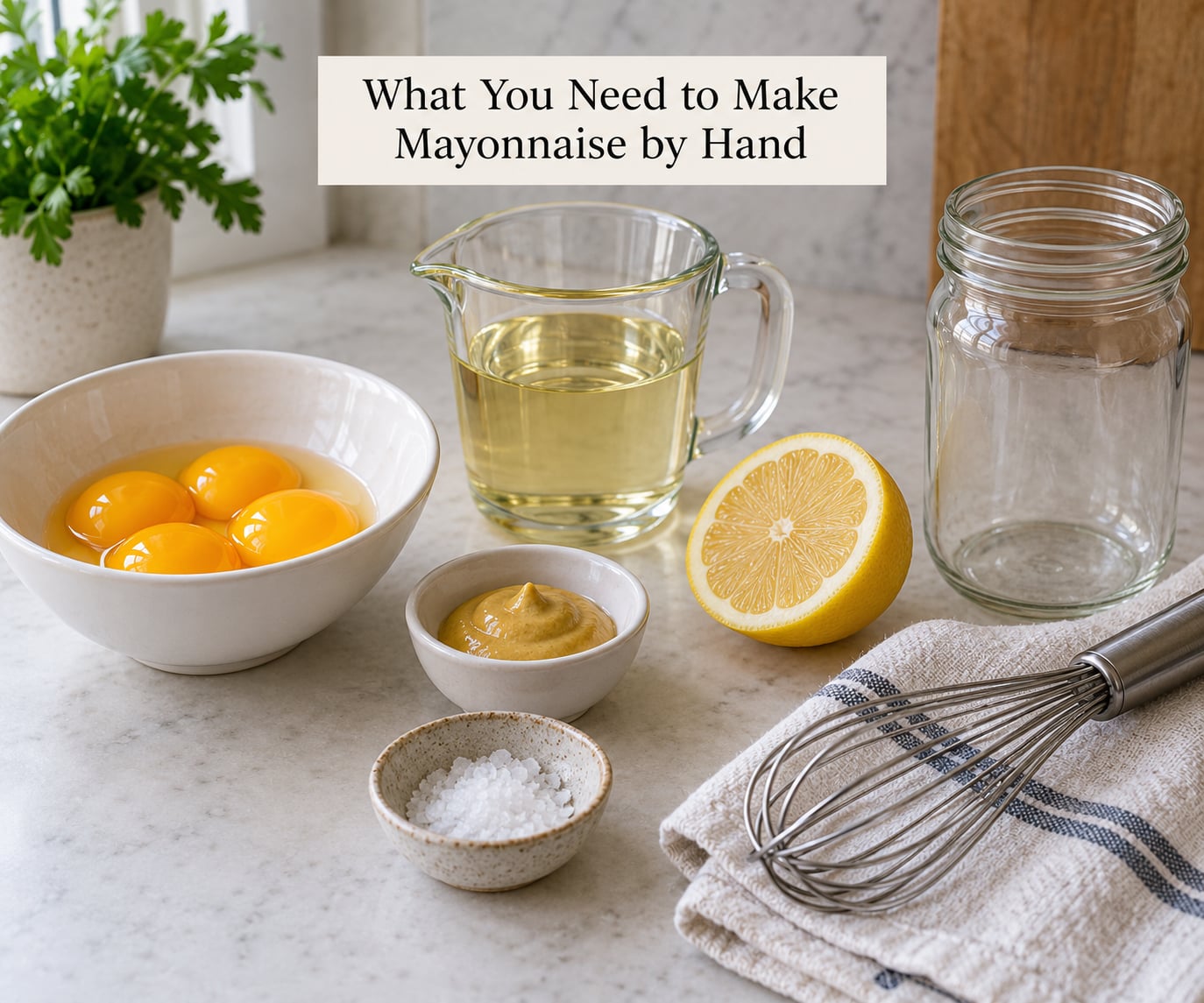
Here is the short version for the at-a-glance crowd:
- Base ratio: 1 egg yolk to roughly 1 cup (240 ml) of oil
- Hands-on time: 5 to 7 minutes
- Equipment: one small bowl and a wire whisk, no electricity
- Yield: about 1 cup of mayonnaise
- Fridge life: 3 to 5 days refrigerated, made with raw egg
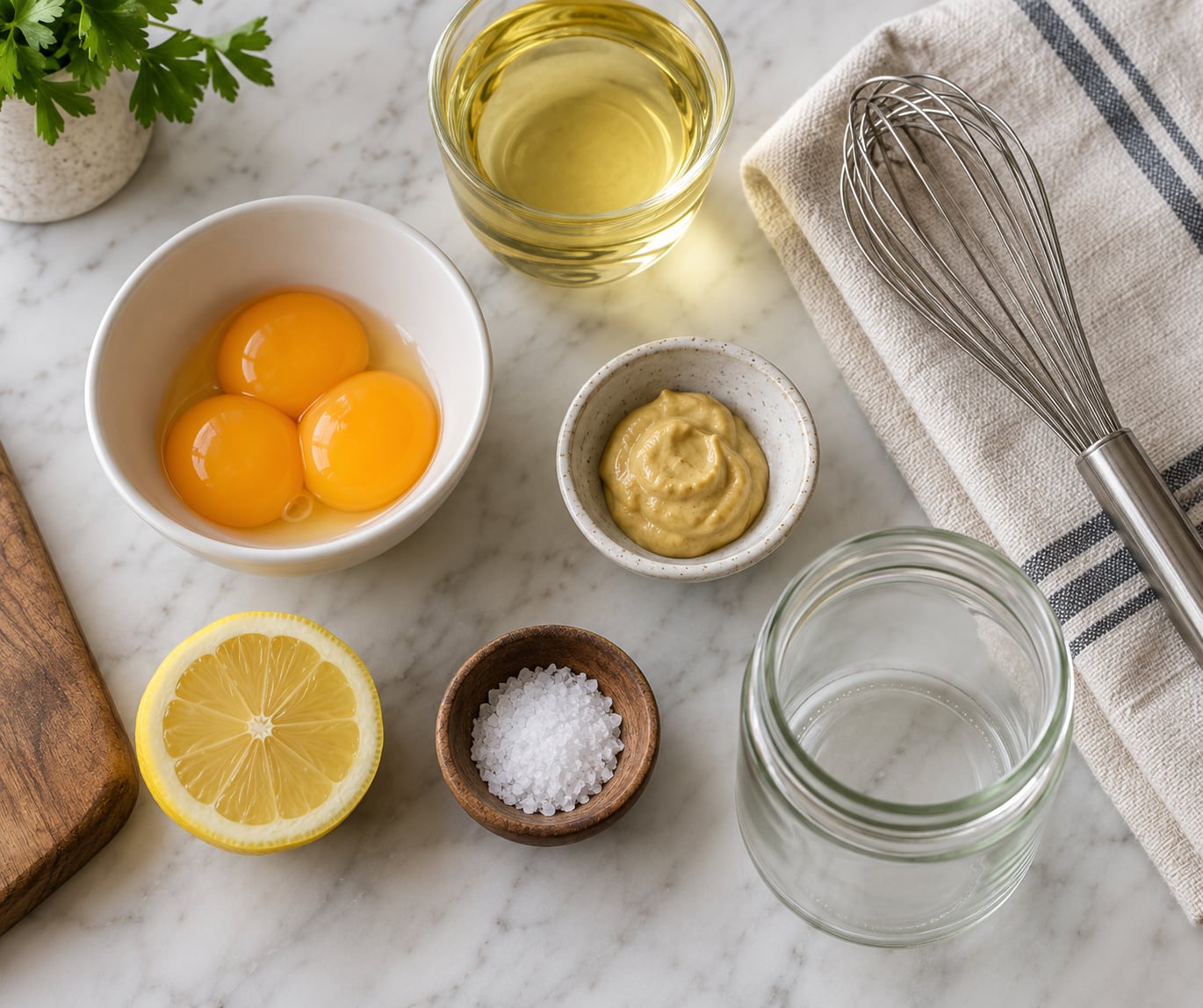
Then the actual list. Egg yolks are the emulsifier: the lecithin in the yolk is a molecule with a water-loving end and a fat-loving end, and that two-headed shape is the whole trick. One yolk emulsifies roughly a cup of oil. Two yolks will carry closer to a cup and a half, which is why many cooks like a richer, more stable batch with two.
Dijon mustard is the second emulsifier. Its mucilage gives you extra structure and a gentle heat that cuts the richness of the oil. Use Dijon rather than yellow mustard, which is often sweetened and thinned.
Acid does three jobs: it seasons, it brightens, and it slows the growth of bacteria in a raw-egg sauce. Lemon juice is the classic, but cider vinegar, white wine vinegar or champagne vinegar all work. A tablespoon of vinegar gives a tangier, more European aioli.
Neutral oil is where most people go wrong at the shelf, not in the bowl. Grapeseed, canola, sunflower, avocado and refined olive oil all emulsify smoothly and let the other flavours speak. Extra virgin olive oil is heavier and peppery; a tablespoon of it stirred in at the end is a lovely finish, but do not build the whole batch on it.
Salt is not optional. Season in layers rather than at the end, because the mayo tastes flatter than it is until you add a proper pinch.
Two optional additions: a teaspoon of garlic paste or finely grated garlic for aioli-style garlic mayonnaise, and a teaspoon of honey if you want a touch of sweetness. Neither is traditional, and both are easy to leave out.
On equipment, a small bowl with high sides is more useful than a big wide one, because the whisk works a smaller volume and the sauce stays in the path of the wires. Fold a damp kitchen towel under the bowl before you start. You will be pushing sideways for five minutes, and a sliding bowl is the most common reason hand-whisking feels harder than it should. A fork works in a pinch. A jar with a tight lid is a decent emergency substitute, though the texture comes out looser.
Step-by-Step: How to Make Mayonnaise by Hand
1. Make the Egg Yolk Base
Bring the eggs out 30 minutes before you start. Separate the yolks from the whites, or skip that and use one whole egg if you would rather not separate, since the extra white adds a little body and stability.
Put the yolk in the bowl with the mustard, the acid and a good pinch of salt. Whisk briskly until the mixture pales from yellow to a soft butter colour, thickens enough to leave a trail, and looks slightly foamy. If you still see a glossy pool of raw yolk at the bottom, keep going. That base has to be emulsified on its own before any oil touches it.
2. Add Oil Slowly in Small Streams
Now the part that decides the outcome. Work in three stages, and let each stage set before you start the next.
First, drop by drop. Hold the bottle or spoon a few centimetres above the bowl and let single drops fall in while you whisk. This might take a minute and it feels silly, but the yolk is being saturated with fat here, and it cannot absorb anything faster.
Second, teaspoon by teaspoon. After about twenty drops, the mixture will look loose and slightly split, almost like a thin dressing. That is normal and it is the point. Add a teaspoon of oil, whisk until it disappears into the sauce, then add the next. Keep going until roughly one eighth of the oil is in, about 2 tablespoons.
Third, a slow stream. Hold the bottle higher and pour a thin, steady trickle while whisking constantly. Once the sauce starts to thicken and cling to the whisk, you can speed up a little. If it breaks at any stage, stop, wait a minute, and drop back to the stage you were at.
Watch for the cue at the end: the colour goes from a dull yellow to a bright creamy white, the surface turns glossy, and a ribbon of sauce falls slowly off the whisk and holds its shape on the bowl. That is finished mayonnaise.
3. Thin and Season the Mayonnaise
Hand-whisked mayo often finishes a shade looser than the jar stuff, and that is fine, not broken. Loosen it with a teaspoon of water, lemon juice or vinegar at a time and whisk it back in. For a dressing, thin it a little further with the same measure of water; for a dip, leave it thick.
Taste, then add salt. Season again after a minute, because the palate adjusts and mayo almost always needs more than you think. Fold in any flavourings now with a spatula rather than the whisk, so you shear as little of the structure as possible.
4. Check the Texture and Store It
Run the ribbon test: tilt the bowl and let a ribbon fall off the whisk. It should land slowly, mound slightly, and hold for a second before slumping. If it runs flat like milk, it is thin rather than broken, and more whisking or a splash of acid will fix it.
Spoon the mayo into a clean jar, press a little cling film onto the surface so it does not dry out, and refrigerate at or below 4C (40F). Use it within 3 to 5 days. Do not leave it on the counter, and do not rely on the oil layer as protection; it is not a sealed environment.
On safety, a homemade mayonnaise made with raw egg carries a small but real risk of Salmonella. Pasteurised eggs are the sensible choice if you are making it for anyone pregnant, elderly, very young or immunocompromised. Otherwise, buy the freshest eggs you can and do not skip the acid. When in doubt, use pasteurised eggs.
Common Mistakes and How to Fix Them
The mayo broke and there is oil floating on top. The emulsion overloaded, usually from pouring too fast or from cold ingredients. Do not throw it away. Make a fresh yolk base with a teaspoon of mustard and a splash of water, then whisk the broken mixture back into it, a spoonful at a time. It will come back together, sometimes lighter in colour than the original.
It is thin but not separated. This is the most common outcome and the most misunderstood. Thin mayonnaise is under-emulsified, not broken. Whisk another 30 to 60 seconds, add a little more acid or salt, and if you want it thicker, whisk in another egg yolk.
It is too thick to spread. You went in with too little acid or used a full cup of oil against a single yolk and no adjustment. Loosen with water or lemon juice, a teaspoon at a time, until it ribbons.
It tastes greasy or dull. That is a sign of an incomplete emulsion, not of the oil. Passing it through a fine sieve or giving it another minute of whisking will push any unmixed droplets into suspension.
It is lumpy. Mustard was added straight from the jar instead of loosened, or you added dry mustard into the oil stage. Whisk the lumps down before they meet any oil, and use smooth Dijon.
It is too strong after sitting overnight. The acid and salt keep working in the fridge. Loosen with water, then season right before serving instead of at the start of the week.
It keeps separating every time you open the jar. That is a sign it was under-seasoned and under-acidified. A proper pinch of salt and a tablespoon of vinegar or lemon juice give the emulsion more to hold onto.
Frequently Asked Questions
Is homemade mayonnaise safe with raw eggs?
A homemade mayonnaise made with raw egg carries a small but real risk of Salmonella, which is why it only keeps for 3 to 5 days refrigerated instead of the months a jar mayonnaise lasts. Use pasteurised eggs if you are making it for anyone pregnant, elderly, very young or immunocompromised. Keep it cold, use the acid, and discard it if it smells off or when five days have passed.
Can I fix mayonnaise that has split?
Yes, almost every time. Whisk a fresh egg yolk with a teaspoon of Dijon mustard and a teaspoon of water in a clean bowl until thick, then add the broken mayonnaise a spoonful at a time while whisking. The fresh yolk gives you new emulsifying capacity to absorb the loose oil. If it re-separates immediately, the original batch was badly broken and is better binned.
Why is my homemade mayonnaise thin and watery?
Thin mayonnaise is under-emulsified, not broken, and it is easy to fix. Whisk another 30 to 60 seconds, then loosen or set the texture with a teaspoon of water, lemon juice or vinegar at a time. Other causes are cold eggs, oil poured too fast in the early stage, or a single yolk carrying more than a cup of oil. Add an extra yolk for body.
How long does homemade mayonnaise last in the refrigerator?
Three to 5 days, stored in a sealed jar at or below 4C (40F), with cling film pressed onto the surface so it does not dry out. Store-bought mayonnaise lasts much longer because it is pasteurised, acidified and contains preservatives. Do not leave homemade mayonnaise on the counter, and do not leave it out of the fridge for more than about two hours.
Is it worth making mayonnaise at home?
For flavour and control, yes. You decide the salt, the acid and the oil, with no preservatives, sugar or additives, and it takes about five minutes. You also get dressings you cannot buy, like a garlic aioli or an herb mayonnaise. The trade-off is a five-day fridge life, a raw-egg safety consideration, and a little more patience than unscrewing a lid.
Conclusion
Three things decide how to make mayonnaise by hand: room-temperature eggs and oil, a yolk-and-acid base whisked pale before anything else goes in, and an oil stream that starts dropwise and only widens once the sauce starts to cling. Season in layers, adjust the texture with a teaspoon of water or acid at the end, and refrigerate it within three to five days.
Start with the base. Everything after that is patience.