A sauce that tastes too acidic usually needs one of five corrections: dilute it with unsalted cooking liquid, add a little sweetness, round it out with fat or dairy, simmer it down, or balance the sourness with another strong flavor. Start with the mildest option, add it in small amounts, and taste between every addition.
That last part is where most guides go wrong. They hand you “a pinch” and leave you guessing, and thirty seconds later you are trying to figure out why your sauce tastes soapy or cloying. Exact small amounts are what rescue a pot, not big ones.
The fix also depends entirely on what the sauce is made of. Baking soda works on a tomato sauce but will wreck a delicate wine reduction, and sugar suits a barbecue glaze where it would flatten a French vinaigrette. Identify the base first, then pick your correction.
Table of Contents
- What You Need
- Step-by-Step: How to Fix a Sauce That Is Too Acidic
- 1. Dilute the Sauce
- 2. Add a Small Amount of Sugar or Sweetener
- 3. Enrich the Sauce With Fat or Dairy
- 4. Reduce the Sauce to Concentrate Its Flavor
- 5. Balance the Acidity With Another Flavor
- Common Mistakes
- Frequently Asked Questions
- What is the best way to dilute an overly acidic sauce?
- Can I fix a too-acidic sauce by adding sugar?
- Will adding butter or cream make my sauce less acidic?
- How much liquid should I add to a sauce that tastes too sour?
- Does simmering a sauce remove its acidity?
- How do I fix a thick sauce without making it bland?
- Conclusion
What You Need
Before you add anything, work out what is actually making the sauce acidic. It takes ten seconds and saves you from correcting the wrong problem.
Name the base. Tomato, vinegar, citrus, wine, dairy, tamarind or chocolate all behave differently. Then identify the likely acid: lemon juice, red wine vinegar, rice vinegar, white wine reduced too little, canned tomatoes with added citric acid, or an unripe tomato cooked down hard. Jarred sauce is acidic partly by design, since citric acid is what keeps it stable on a shelf.
Next, decide how much room you have to change the sauce. A thin soup has plenty of dilution headroom. A glaze that has to coat a spoon does not, and diluting it just gives you a sad, watery version of the same problem.
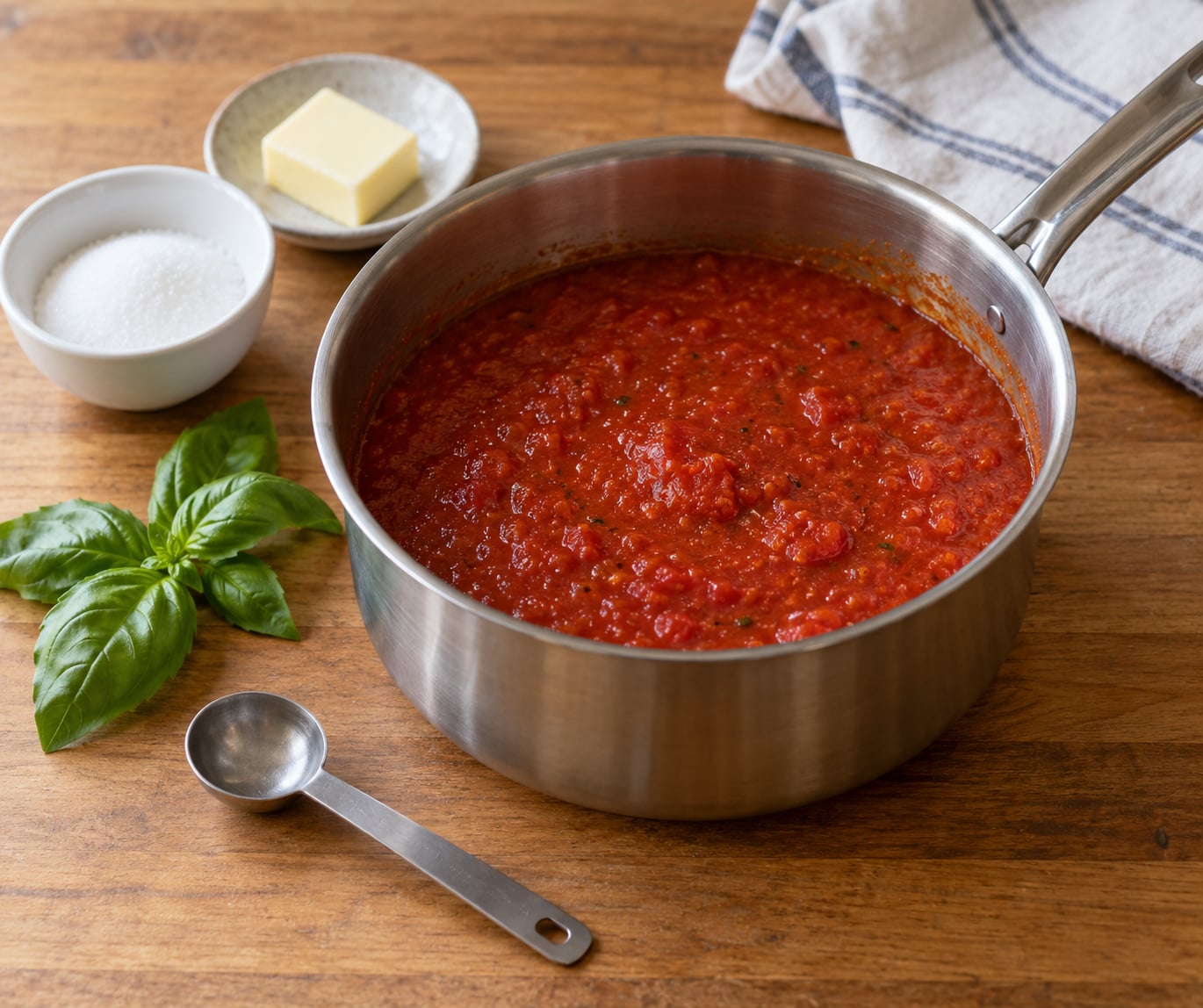
Keep one or more of these on hand, though you will rarely need more than one:
- Unsalted stock, water, or the liquid the sauce was built from
- Caster or granulated sugar, honey, or maple syrup
- Unsalted butter
- Heavy cream, whole milk, or plain yogurt
- A neutral oil such as grapeseed or sunflower
- Tomato paste for tomato-based sauces
- Grated carrot, grated onion, or a finely diced sweet potato
Use one corrective ingredient at a time. Sugar after butter, or soda after stock, makes it impossible to tell what fixed the sauce and what overshot it.
You also need a clean spoon. Taste, swallow, then taste again with a fresh bite. Acid is easier to judge on the second taste than the first, and a spoon carrying the last sample will make a mild sauce taste worse than it is.
Step-by-Step: How to Fix a Sauce That Is Too Acidic
Turn the heat down and put the pan back on it. Corrections are about flavor, not boiling, and a hard boil makes it harder to taste anything accurately.
Taste the sauce on a clean spoon and decide honestly how far off it is. Slightly sharp is a teaspoon job. Grimacing is a quarter-teaspoon job. If it is only a little sharp, you can often fix the whole thing with one careful addition, and if it is aggressively sour, you should expect to need two of the methods below rather than one.
1. Dilute the Sauce
Dilution is the least invasive fix and the one most people skip. Add unsalted stock, water, or the same liquid the sauce started with, one to two teaspoons per cup.
Unsalted matters. Broth and canned stock bring salt, and you will trade an acidic sauce for a salty one, which is not an upgrade. If your sauce came from a can, a splash of the can’s own liquid or water is closer to the right choice than anything from the cupboard.
Add a little at a time. Stir it through, let the sauce come back up to a gentle simmer, then taste again. You want the acid to sit behind the other flavors, not to disappear completely, because a sauce with no acid reads as flat and heavy.
If dilution has left the sauce tasting thin or watery rather than merely less sour, simmer it gently for a few minutes to put some concentration back. That combination, dilute then reduce lightly, fixes a lot of thin jarred sauces without adding anything new to the flavor profile.
2. Add a Small Amount of Sugar or Sweetener
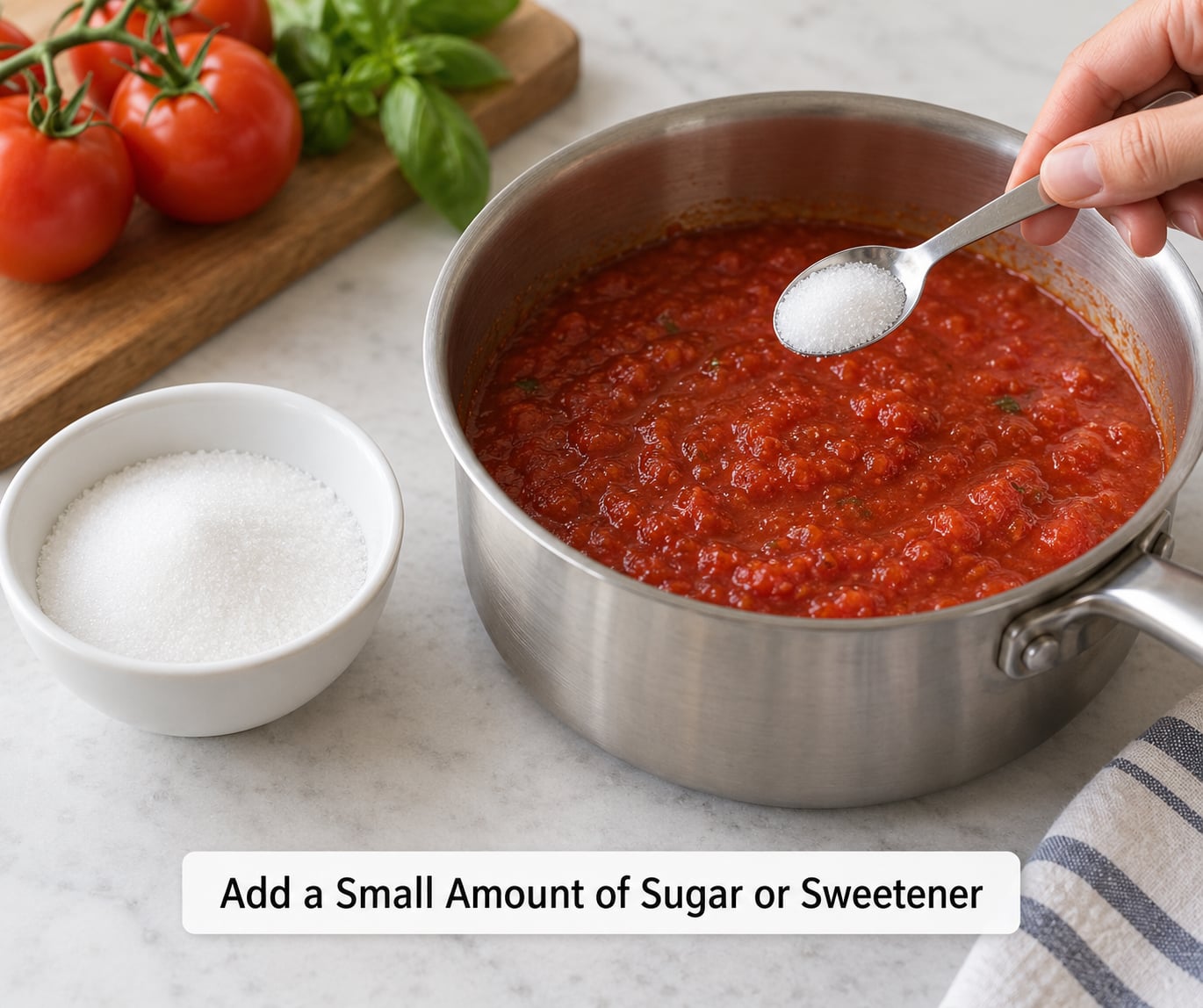
Sugar is the most common answer and the most commonly overdone. It does not change the pH at all; it simply competes with the acid for the sweet receptors on your tongue, so the sourness becomes less noticeable while remaining chemically present.
Start at about a quarter teaspoon of caster sugar per cup. Dissolve it fully by stirring over low heat, then taste. Add in quarter-teaspoon increments from there. Honey works too and carries its own flavor, so use roughly half again as much as you would sugar.
Sugar suits tomato and barbecue sauces, glazes, fruit-based sauces and some vinaigrettes. It does not suit a red wine pan sauce, a mustard vinaigrette, or anything where sweetness reads as a fault rather than a balance.
For a gentler route in a tomato sauce, grate a carrot or a small sweet potato directly into the pot and simmer it until the sauce is done. The sauce sweetens as the root vegetable breaks down, and you get body at the same time.
The warning: if you have now made the sauce sweet instead of sour, you cannot take sweetness back out. Add the next correction in smaller amounts than feels reasonable, and taste more often than feels necessary.
3. Enrich the Sauce With Fat or Dairy
Fat and dairy do not touch the acid. They coat the palate and interrupt the sharp bite, which is why a spoonful of butter makes a biting sauce taste instantly rounder.
Unsalted butter works on almost anything savory, and cold butter stirred in off the heat melts into a sauce without splitting it. Start at one tablespoon per cup and stir until it disappears completely. Cream is heavier and sweeter, so a tablespoon goes a long way in a curry or a cream-based sauce. A neutral oil is the fallback when butter would change the dish, in a vinaigrette or a glaze.
Temperature is the whole game with dairy. Never pour cold cream into a sauce at a rolling boil. Take the pan off the heat, wait a few seconds, and add the dairy in a thin stream while stirring; the residual heat cooks it gently instead of shocking it. A little yogurt or crème fraîche goes in the same way, off the heat, so it does not split.
And keep it proportionate. Half a cup of cream in a cup of tomato sauce is not a correction, it is a different dish with tomatoes in it.
4. Reduce the Sauce to Concentrate Its Flavor
Simmering is the method people reach for first, and it is the one that most often disappoints. Evaporation removes water and concentrates everything else, including the acid. A thin acidic sauce will taste sharper after twenty minutes, not milder.
That said, reduction is worth doing in two situations. The first is a wine pan sauce deglazed with red or white wine that never got reduced, where the raw alcohol and tannic edge read as sourness; simmer it until the liquid is nearly gone, au sec, before adding anything else. The second is after you have already corrected with dilution and the sauce now needs its concentration back.
Simmer uncovered at a lazy bubble, stirring occasionally so it catches nothing, and taste every five minutes. If the sauce is already reduced and thick, skip this step. There is nothing left to evaporate, and more heat will only concentrate the problem.
5. Balance the Acidity With Another Flavor
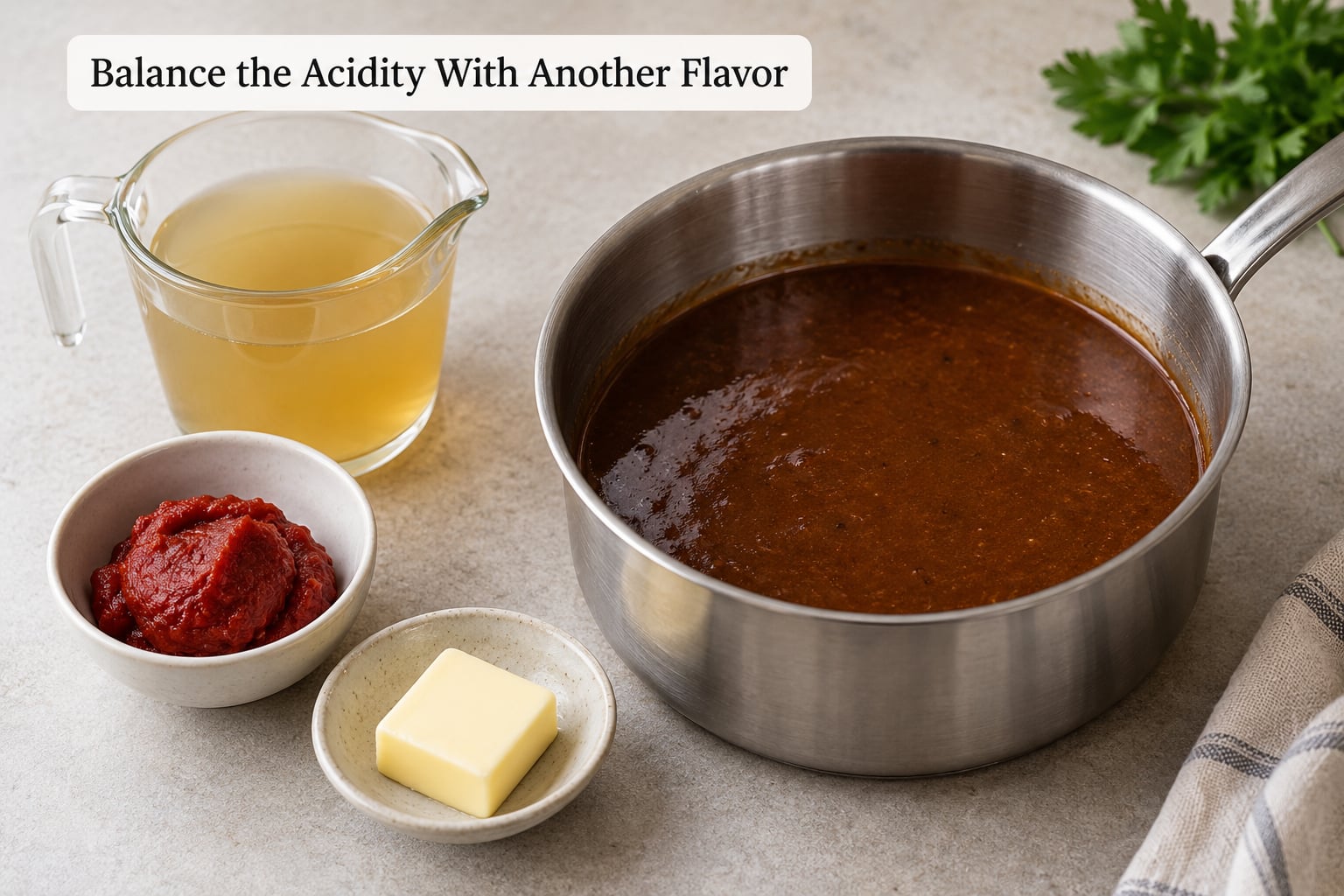
The last method is the most powerful and the one that needs the most judgment. You are not subtracting acid, you are giving the tongue something else strong enough to stand next to it.
Tomato paste is the classic move for a thin, sharp tomato sauce. One tablespoon stirred in and simmered for five minutes adds sweetness, body and depth at the same time. It deepens a sauce more than it sweetens it.
For a vinaigrette that is too sharp, the answer is almost never sugar. Add the oil a spoonful at a time until the ratio is right, or add a spoonful of the mildest vinegar you have to replace the sharp one. Mustard emulsifies and rounds a dressing, and a teaspoon of honey is the standard sweetener where one is wanted.
For a curry or chili sauce that is too sour, you are usually looking at tamarind or vinegar, not the tomato. Sugar, coconut milk, or a spoonful of peanut butter will pull the balance without touching the acidity itself. For a barbecue glaze built on vinegar or ketchup, dark brown sugar or molasses in half-teaspoon amounts does the job.
There is also a move worth knowing, and it is the one that confuses people. Once you have added sugar or dairy and the sauce has gone flat, add a small splash of the original acid back. A few drops of lemon juice or vinegar into a sauce you just sweetened will make it taste more vivid, not more sour, because now both flavors are present. Home cooks on r/Cooking have been recommending this rebalance for years, and it works in the same way for a punchy vinaigrette.
The rule for this method: match the addition to the sauce. Do not throw something unrelated into a dish just because it is strong enough to cover the sourness. You will end up with a plate you do not want to eat.
Common Mistakes
Adding too much at once. A whole teaspoon of soda, or a quarter cup of sugar, is not a correction, it is a new recipe. Add the smallest amount, wait, taste, repeat. It takes three rounds instead of one and the sauce still works.
Using salted butter. You will fix the sharpness and create a salt problem, which is harder to undo than sourness. Buy unsalted, or use a neutral oil if that is all you have.
Adding dairy to a boiling sauce. This is the deal breaker most people never hear about. Cold cream into a rolling boil will scramble into grainy curds that no amount of stirring recovers. Off the heat, thin stream, constant stirring.
Diluting a sauce that has to stay thick. A glaze that should coat a spoon cannot absorb a lot of liquid. Use one of the other four methods and keep the reduction at the end.
Reducing a sauce that is already concentrated. Simmering concentrates acid along with everything else. Reduce first for wine and thin sauces, never as a last resort for a thick, sharp one.
Expecting more heat to remove acid. Boiling does not take acidity out. It cooks off alcohol, concentrates flavor, and softens raw aromatics, and that is worth doing, but the sourness is still there when the liquid is gone.
Forgetting what the recipe wanted. Some dishes are meant to be sharp. A puttanesca, a ceviche, a piccalilli and a good tomato salad all depend on a bright, aggressive acid. Before correcting, check whether the recipe called for acid you should have left out, or called for less than you added.
One habit worth picking up: spoon a small sample into a plain cup before you start adjusting. Taste the sample cold, then taste the sauce hot, and you will find the fix much faster, because flavor shifts as a sauce cools and you can compare the two directly.
Frequently Asked Questions
What is the best way to dilute an overly acidic sauce?
Add unsalted cooking liquid, water, or the liquid the sauce was built from, starting at one to two teaspoons per cup. Stir it in, let the sauce return to a gentle simmer, and taste before adding more. Dilution is the gentlest correction because it adds nothing new to the flavor, so it works first on thin sauces and vinaigrettes. If the sauce ends up thin afterward, simmer it briefly to restore concentration.
Can I fix a too-acidic sauce by adding sugar?
Yes, but understand that sugar masks sourness rather than removing it. It does not change the pH, it simply competes with the acid for the sweet receptors on your tongue. Start at roughly a quarter teaspoon of caster sugar per cup, dissolve it over low heat, and add in quarter-teaspoon increments while tasting. Sugar suits tomato sauces, barbecue glazes, fruit sauces and some dressings, but flattens a wine reduction or mustard vinaigrette.
Will adding butter or cream make my sauce less acidic?
No, fat does not neutralize anything. Butter, cream and olive oil coat the palate and interrupt the sharp bite of acid, which is why the sauce tastes rounder immediately. A tablespoon of unsalted butter per cup is a good starting point, added off the heat in small pieces and stirred until melted. Never add cold dairy to a boiling sauce, or it will split into grainy curds that cannot be stirred back together.
How much liquid should I add to a sauce that tastes too sour?
Begin with one to two teaspoons of unsalted liquid per cup and taste before going further. Sauce strength varies enormously, so a fixed quantity for all recipes is not possible. Add in small increments, stirring each time and letting the sauce come back to a gentle simmer, because dilution needs heat to redistribute the acid. If the sauce turns thin and watery once the sourness is under control, simmer it for a few minutes to concentrate it again.
Does simmering a sauce remove its acidity?
No. Simmering removes water, which concentrates the acid along with every other flavor, so a thin acidic sauce will taste sharper after a long reduce rather than milder. Simmering is still worth doing in two situations: to cook off raw alcohol in a wine sauce before adding liquid, and to restore body after you have corrected a sauce with dilution. Simmer uncovered at a lazy bubble and taste every five minutes.
How do I fix a thick sauce without making it bland?
Skip dilution, since a sauce that needs to coat a spoon cannot spare much liquid. Use fat or dairy instead: a tablespoon of unsalted butter or a slow stream of heavy cream stirred in off the heat will soften the sharpness and add body at the same time. For a tomato-based sauce, tomato paste is the better choice, stirred in and simmered for five minutes. Save the reduction for last, and keep it short.
Conclusion
Start simple. Taste the sauce on a clean spoon, name the base and the main acid, and dilute it with a compatible unsalted liquid in small amounts until the sourness sits behind the flavor instead of in front of it. If that is not enough, move to richness with unsalted butter or cream off the heat, or to a little sugar in quarter-teaspoon increments.
That order is what makes knowing how to fix a sauce that is too acidic a skill rather than a guess. Dilute first, adjust second, and keep tasting with a clean spoon between every addition. The sauce will come back, and it will still taste like the dish you meant to make.