Smash the peeled cloves flat with the side of a sharp knife, then rock the blade back and forth over them until the pieces are even. That is how to mince garlic fast without a press, and a whole bulb takes about two minutes once your knife is sharp.
A press crushes garlic into a wet paste. A knife gives you control over the size, and size is flavor: a coarse chop for a long simmer, a fine mince for a raw sauce or a stir-fry. Here is what you need, the fastest route through the process, and the mistakes that slow most people down.
Table of Contents
- What You Need
- Step-by-Step
- Step 1: Choose the Easiest Method
- Step 2: Prepare the Garlic
- Step 3: Mince with a Rocking Knife Motion
- Step 4: Check the Texture
- Common Mistakes
- Tips for Mincing Garlic Fast Without a Press
- Frequently Asked Questions
- What is the fastest way to mince garlic without a press?
- Should I crush garlic before mincing it?
- How do I mince garlic evenly with a knife?
- Can I use a garlic press alternative with a fork?
- How finely should garlic be minced for cooking?
- How long can minced garlic stay in the refrigerator?
- Conclusion
What You Need

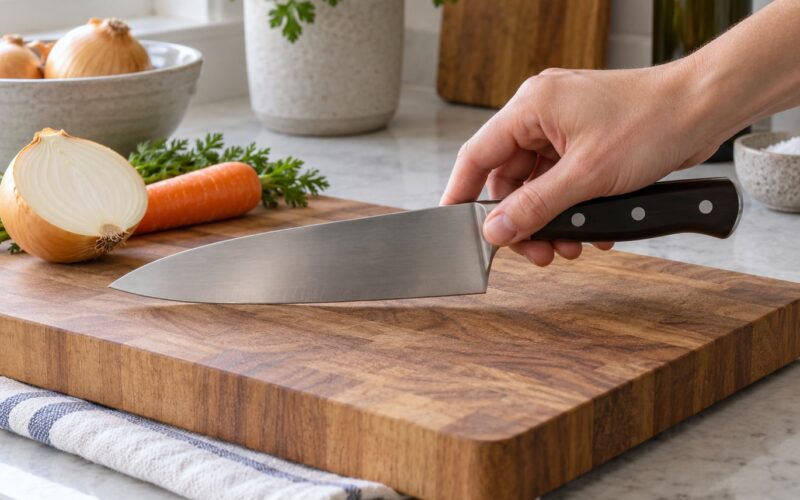
A sharp 8-inch chef’s knife is the only tool that really matters here. A dull blade crushes instead of cuts, so the garlic smears and a surprising amount of flavor stays behind on the board.
A solid cutting board comes next, and a damp towel folded underneath stops it from sliding while you chop. A wide chef’s knife or a nakiri both work; the nakiri’s straight edge makes the rocking motion easier if you are new to it.
A small pinch of coarse salt is optional but genuinely useful. It acts as an abrasive on the blade, breaks the pile back into separate pieces instead of one sticky clump, and pulls the juices out of the garlic.
If you have no press and no interest in sharpening knives, a microplane, an immersion blender or a meat tenderizer will get the job done. Just expect a wetter, coarser result.
Step-by-Step

Step 1: Choose the Easiest Method
There are two reliable knife methods. Smash-and-rock is the fastest and the one most people want when dinner is already started. You flatten a clove, cut it into rough strips, then chop across those strips until the mince is fine. It takes about two minutes for a bulb and leaves a fine, slightly irregular texture that suits stir-fries, sautés and sauces.
The slice-and-dice method is slower, closer to four minutes for a bulb, and produces perfectly even cubes. Pick it when appearance matters, like a raw sauce or aioli where you are serving the garlic rather than cooking it out.
My default is smash-and-rock. It releases more juice, so the finished garlic tastes noticeably stronger for the same number of cloves.
Step 2: Prepare the Garlic
Break the head apart by holding it root-side down on the board and hitting it firmly once with the heel of your hand. The whole head separates into cloves in one hit, and you can skip peeling any that you decide to crush anyway.
Trim the root end from each clove, then lay the flat of the knife over it and press down until it splays. The papery skin lifts off in one piece. About six to eight cloves fit under the blade at a time, which is the amount you want per batch.
Do this on a thicker board, and do it with a cleaver or the spine of your knife rather than pressing down on a thin, single-bevel edge. Crushing with the flat side puts real stress on the edge, and a thin gyuto is the easiest one to chip or roll.
Step 3: Mince with a Rocking Knife Motion
Slice the flattened cloves lengthwise into strips a few millimeters thick. Gather them into a loose pile with the spine of the knife, then keep your guiding hand in a claw grip with curled fingertips tucked behind the knuckles.
Rock the blade from the tip, not the heel. The tip does the cutting while the heel stays in contact with the board, which makes the motion fast and keeps your knuckles away from the edge. A dull knife forces you to press straight down instead of rock, and that downward force is what turns garlic into paste.
Every few passes, scrape the pile back into a mound with the side of the blade. Garlic releases juice as it breaks down, and that wet pile is the reason mincing slows down halfway through and why pieces stick to the steel.
The fixes are simple. Add a pinch of coarse salt, scrape with the spine rather than pressing, and let the pile fall apart instead of letting the blade push through it.
Step 4: Check the Texture
Finished mince looks like coarse wet crumbs, roughly the size of coarse sea salt, with a few irregular bits mixed in. Uniformity is not the point; even flavor distribution is.
If you are sautéing, stop there. The pieces soften within a minute of hitting hot oil. For a raw sauce or a stir-fry, keep going until almost every piece is under a millimeter.
Stop before you reach paste. Over-chopping drives the garlic past the point where it tastes sharp and clean and starts tasting acrid, especially if the garlic has been sitting cut for more than ten minutes before hitting heat.
Common Mistakes
Uneven pieces. You cut the strips at different widths. Re-stack the strips after slicing so they line up, then cross-cut once. One pass fixes most of the variation.
Cloves rolling on the board. The damp towel trick solves it, and a light sprinkle of salt adds grip. Do not use a board that flexes, because a soft board absorbs the impact of the rocking motion and slows you down.
Cutting too close to the board. This is the classic garlic-finger injury. Your guide hand holds the food, the blade does the descending, and the tip stays on the wood the whole time. Slow down for the first few strokes until the motion feels automatic.
Over-smashing. Repeated heavy crushing on the flat of the knife is for removing skin, not for mincing. Crush once, then move the knife to the chopping position.
A dull knife. You cannot fix this with technique alone. Garlic is hard and brittle, and a dull edge turns it into pulp rather than dice. If your board ends up covered in garlic juice and there is little visible mince, the blade is the problem.
Tips for Mincing Garlic Fast Without a Press
Crush while you peel. Every clove you are going to flatten anyway can skip the careful skin removal, so you break a head apart, smash six cloves in one press, and go straight to slicing. That alone cuts most of the prep time from a bulb.
Work in batches of six to eight cloves rather than one at a time. Small batches mean more passes over the pile and more scraping, which is where most of the time actually goes.
Keep the blade from getting sticky. Wipe the flat of the blade and the board once with a paper towel between batches and the mince stops clinging to the steel.
Save the skins. Garlic skins carry real flavor and go straight into a stock pot, a simmering sauce, or a brine. They cost you nothing once you stop treating them as waste.
For storage, keep minced garlic in an airtight container in the refrigerator for up to five days, and label the date. Freeze it in a small portion for about three months, or cover it with oil in a spotless jar for roughly two months refrigerated.
For a meal-prep batch, mince four or five heads at once, then pulse the garlic with a little salt and lemon juice in a food processor until it is a loose paste. Kept cold and sealed, that keeps about two months, and it saves roughly twenty minutes of chopping on a Sunday.
Frequently Asked Questions
What is the fastest way to mince garlic without a press?
Smash the cloves with the flat of a sharp chef’s knife to pop off the skin, slice them lengthwise into thin strips, stack the strips, and rock the blade across them until the mince is fine. A whole bulb takes about two minutes. Add a pinch of coarse salt between passes so the pile stays loose instead of sticking to the steel.
Should I crush garlic before mincing it?
Crush once, not repeatedly. A single press with the flat of the knife pops the papery skin off and flattens the clove so it slices more evenly, and that is genuinely faster. Continuing to pound it crushes the cells completely and turns the garlic into a bitter paste. Crush to peel, then switch to the rocking motion to mince.
How do I mince garlic evenly with a knife?
Slice the flattened cloves lengthwise into strips of the same thickness, then push the strips into a neat pile with the side of the blade before cross-cutting. One pass across the stacked strips gives you even dice, where chopping loose cloves one at a time gives you big chunks mixed with smears. Resting your guide hand in a claw grip keeps the pile from scattering.
Can I use a garlic press alternative with a fork?
Yes, and it needs no press at all. Put a peeled clove in a bowl and pinch it with a fork, then rock the fork quickly over the bowl to scrape the garlic off the tines. Repeat until you have the consistency you want. It is slower than a knife and works best for a couple of cloves, but it saves your hands from the rocking motion entirely.
How finely should garlic be minced for cooking?
Aim for pieces the size of coarse sea salt, which is roughly one to two millimeters. That is fine enough to season a stir-fry or sauce evenly and coarse enough to keep some texture in a saute. Go much finer and the garlic will go past savory into acrid, especially if it sits cut for more than ten minutes before it hits the pan.
How long can minced garlic stay in the refrigerator?
Store it in a sealed airtight container for up to five days at or below 40 degrees Fahrenheit, and always label the date. For longer storage, freeze it in small portions for about three months, or pack it under a layer of oil in a very clean jar for roughly two months refrigerated. Discard it if the jar has been opened and left at room temperature.
Conclusion
Start by flattening six to eight cloves with the flat of the knife to strip the skins, slice them into even strips, stack them, and rock the tip of the blade through the pile. A pinch of coarse salt and a scrape with the spine between passes keep everything loose, and you are looking at a bulb in about two minutes.