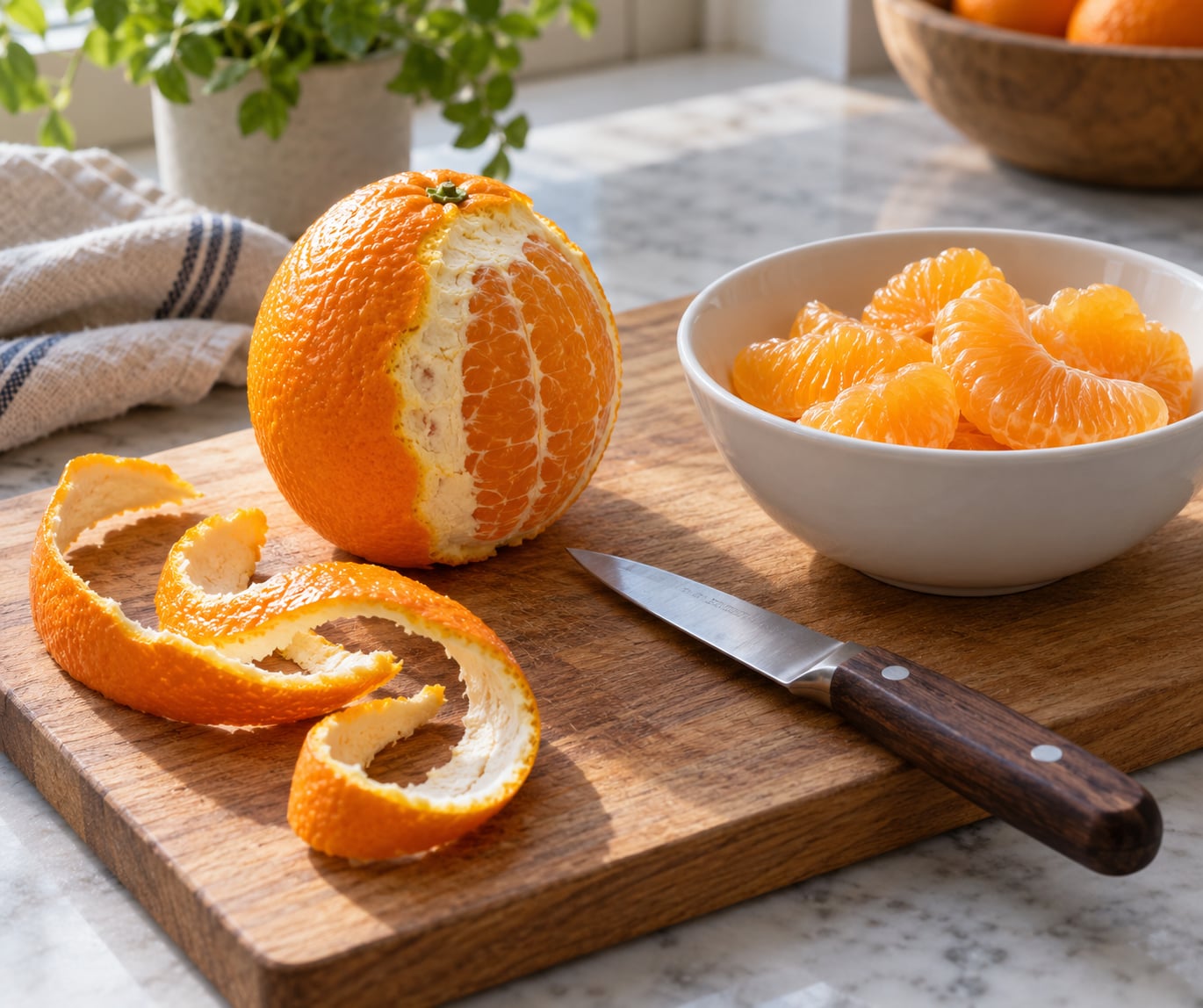
Supreming a citrus fruit means cutting away the peel and bitter white pith, then freeing each juicy segment from the thin membrane walls around it, so you are left with clean, pith-free pieces. It is a French culinary technique, pronounced soo-PREM, and once your knife is sharp it takes about two minutes per orange.
The part people get wrong is not the peeling. It is the last cut, the one where the blade follows the membrane instead of cutting through the flesh. Get that motion right and the segment lifts out whole, with none of the chewy white skin you would otherwise chew.
Table of Contents
- What You Need
- How to Supreme a Citrus Fruit by Difficulty Tier
- How to Supreme a Citrus Fruit Step by Step
- Trim the Ends
- Stand the Fruit Upright and Remove the Peel
- Cut Away the Pith
- Release the Citrus Segments
- Repeat and Finish
- Common Mistakes
- Frequently Asked Questions
- What does it mean to supreme a fruit?
- Which citrus fruits are easiest to supreme?
- Why are my citrus segments bitter and tearing?
- Do I need a paring knife or will a chef’s knife do?
- How do I keep cut citrus segments from drying out?
- What should I do with the peel, pith and core?
- Conclusion
What You Need
A short tool list is enough. You do not need any specialist equipment, and you do not need a mandoline or a channel knife, whatever a recipe might imply.
- A small sharp paring or utility knife. This is the blade that matters most, because it is what follows the membrane.
- A chef’s knife, only if you prefer it for the peel and end cuts. Its size makes it awkward inside the fruit.
- A sturdy cutting board, plus a clean tea towel laid underneath if your board slides.
- A shallow bowl set on the board or held right under the fruit, so the juice and any drips land somewhere useful.
Chill the fruit first if you have time. Citrus straight from the fridge is firmer, and a firmer segment holds its shape while the blade moves through it instead of squashing under pressure.
How to Supreme a Citrus Fruit by Difficulty Tier
Not every citrus behaves the same, and starting with the wrong one is a good way to decide the technique is not for you.
- Easiest: navel oranges and Cara Cara oranges. Round, even segments, thick membranes, and a core that leaves behind easily.
- Comfortable but bigger: ruby red grapefruit and blood oranges. Fewer but heavier segments, so go slowly and use a longer knife for the peel.
- Hardest: limes, Meyer lemons and pomelos. Small fruit or irregular, fused segments mean the membrane will not follow a straight line, so expect to trim rather than release.
If your first attempt has gone sideways, an orange is the fruit to practise on, not a lime.
How to Supreme a Citrus Fruit Step by Step
Trim the Ends
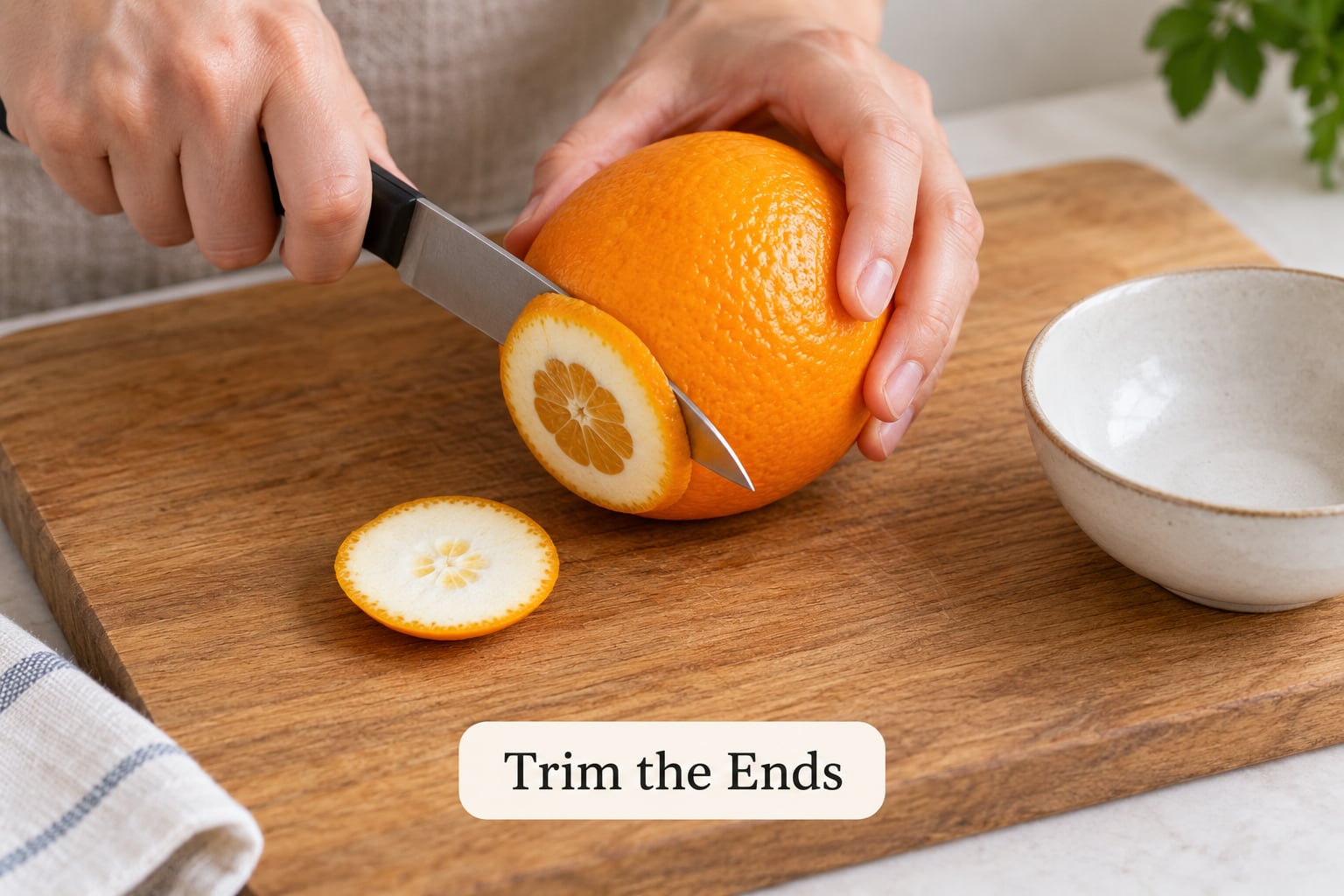
Scrub the fruit under cold running water first, then cut about half an inch off the stem end and the blossom end. Those two flat faces give you a stable base and a flat top, which is the whole reason this step exists.
Stand the fruit on the cut base. It should not rock. If it wobbles, take a little more off the bottom rather than forcing it later.
Stand the Fruit Upright and Remove the Peel
With the fruit upright, slice down in strips following its curve, taking the peel off in one piece like a spiral rather than rotating the fruit against a stationary blade. Rotating is faster and it is also how you end up with a thick, ragged layer of pith underneath.
Leave a sliver of pith behind the knife. You are shaping the fruit at this point, not skinning it to the last fibre. Most of the white layer comes off in the next step.
Cut Away the Pith
Turn the fruit as you work and shave the remaining white pith off the sides and the base, rotating the fruit against the blade. Follow the curve all the way around until the flesh looks clean and faintly shiny.
You want to remove the pith but not cut into the segments underneath. Thin, careful strokes with the tip of the paring knife do better here than long cuts with the whole blade.
This is the step people skip, and it is the step that leaves a bitter aftertaste. A thin strip of white pith that you miss will follow the segment onto the plate and you will taste it.
Release the Citrus Segments
Hold the peeled fruit over your bowl with the cut top facing down. Slide the paring knife down alongside a membrane wall and cut inward toward the core, then turn the blade and cut along the next wall, so the segment comes free in a shallow V.
Cut along the membrane, not through it. Every millimetre of membrane you leave behind is a strip of white skin on the finished segment, and every millimetre you cut past it is fruit you lose.
There is a faster version once you get going. On r/seriouseats, a user named u/albino-rhino described keeping the blade at full depth after the first cut, twisting it away from the adjacent membrane, then lifting the segment straight out without pulling the knife away. Because you only cut one side, you lose flesh on a single membrane instead of two. They also noted it is awkward on the very first segment, so start with the plain V cut and switch over once your hand knows the angle.
Repeat and Finish
Work around the fruit one segment at a time until only the core is left in your hand. The small segments at the ends are perfectly usable, just skinnier than the rest, and they are often the sweetest ones.
Squeeze the spent core over the bowl before you throw it away. There is usually a decent mouthful of juice in there, and it goes straight into the salad dressing or the glass of prosecco you were about to pour.
Serve the segments right away, or hold them in the bowl you caught them in. Once exposed, cut citrus starts losing moisture and browning at the edges, so it does not sit well for hours.
Common Mistakes
- Peeling with the fruit spinning. Rotate the fruit against a still blade. The other way drags the knife through the pith and leaves a thick, uneven white coat behind.
- Cutting all the pith away. Leave a little support when you peel. Take the rest off in the next step, once the fruit has a flat base to stand on.
- Forcing segments apart. If a segment will not lift, you are cutting the wrong wall or using a blade that is too dull. Widen the cut rather than pulling harder.
- A dull knife. This is the failure behind most torn, weeping segments. A blunt edge drags and bruises the flesh, squeezes the juice vesicles, and leaves the segment looking bruised and dry.
- Leaving a wet board. Peeled fruit rolls. Lay a damp tea towel under the board and keep the fruit’s cut side down until you are ready to segment it.
- Working slowly enough to attract ants. This is a real complaint from home cooks, and it is an annoying one. Peel two or three fruits at once, or segment the fruit straight over a bowl.
The first time I tried this I left a thick coat of pith on and only worked out what I had missed on the second orange. Worth knowing now so you do not have to learn it that way.
None of this makes the technique fussy. People who try it for the first time often expect it to be difficult, and r/Cooking consensus is roughly the opposite: it looks intimidating on a plate and is genuinely easy with a sharp knife.
Frequently Asked Questions
What does it mean to supreme a fruit?
Supreming means separating the flesh of a fruit from the pith and the membrane walls surrounding it, using a knife. For citrus, you cut off the peel and all the white pith, then slice along both sides of each membrane wall to lift out whole segments. It is a French culinary technique, pronounced soo-PREM.
Which citrus fruits are easiest to supreme?
Navel and Cara Cara oranges are the easiest, because their segments are round, even and separated by thick membranes. Grapefruit and blood oranges come next, with fewer but larger segments. Limes, Meyer lemons and pomelos are hardest, since the segments are small or fused together, so you trim more than you lift.
Why are my citrus segments bitter and tearing?
Bitter flavour comes from pith and membrane oils released when the blade drags, when the fruit is bruised, or when a thin strip of white pith is left behind. Tearing usually means the knife is not sharp enough, so it crushes rather than cuts. Fix both by sharpening the knife, following the membrane closely, and doing a final shave of the sides and base.
Do I need a paring knife or will a chef’s knife do?
A small sharp paring or utility knife is the better tool, because its short blade is easy to control against the curved membrane. A chef’s knife is fine for trimming the ends and removing the peel, and some cooks use it for everything. What matters is that whichever blade you use is genuinely sharp, since a dull edge is what causes torn segments.
How do I keep cut citrus segments from drying out?
Supremed segments are best used within a day. Keep them in a bowl in the refrigerator rather than on a tray, press a piece of plastic wrap lightly over the top, and leave a little of the juice from the core in the bowl to keep them moist. Squeezing a little juice over them helps too. Cut fruit browns at the exposed edges, so keep it covered and out of the fridge door.
What should I do with the peel, pith and core?
Save the peel for marmalade, candied zest or a simple syrup, and the spent core can be squeezed for juice or dropped into a vinaigrette for extra acidity. Pith is also fine to eat in small amounts, and it is a normal part of the fruit, so a stray sliver is nothing to worry about. Nothing from the fruit has to go in the bin.
Conclusion
Start by cutting both ends off and standing the fruit upright. Once you have peeled in downward strips and shaved off the remaining pith, the fruit sits there as a clean sphere of segments, and the only hard part left is the curved cut along the membrane.
Practise that motion on a soft orange. Once your hand learns how the knife follows the white wall, you will reach for it every time a salad or a dessert needs looking finished.