Most home cooks undersalt their food, and it usually has nothing to do with taste buds. It’s about timing and measurement: salt added at the wrong moment dissolves unevenly, sits on the surface instead of seasoning the interior, and leaves a dish that tastes flat no matter how long it cooked. Learning how to salt food properly while cooking comes down to three things — pick the right grain size, measure by weight, and season in layers while you taste.
The whole method takes about a week to make automatic. You already have everything you need in the cupboard.
Here are the three methods of salting, and which one each food actually wants:
- Seasoning in layers — a pinch at each stage of cooking, tasted and adjusted as you go.
- Dry brining — salt rubbed onto meat, then rested uncovered in the fridge before heat.
- Wet brining — meat submerged in salted water for hours before cooking.
Everything below builds on those three.
Table of Contents
- What You Need
- Step-by-Step: How to Salt Food Properly While Cooking
- 1. Choose the Right Salt for the Job
- 2. Taste Before and During Cooking
- 3. Salt at the Moment That Builds Flavor
- 4. Apply Salt Evenly
- 5. Adjust and Finish the Dish
- Common Mistakes and How to Fix Them
- Salting by volume and switching salt types
- Treating flaky salt as a measuring salt
- Salting only at the end
- Chronic under-salting out of fear
- Panicking at the pan when you forgot to salt
- Ignoring salt that is already in the dish
- Seasoning only the top layer
- Frequently Asked Questions
- Should I salt food before cooking?
- How much salt should I use when cooking?
- Can I use kosher salt instead of table salt?
- When should I salt meat and vegetables?
- How do I fix a dish that is too salty?
- Conclusion
What You Need
You need a salt you can measure accurately and a way to taste as you go. That’s the short version.
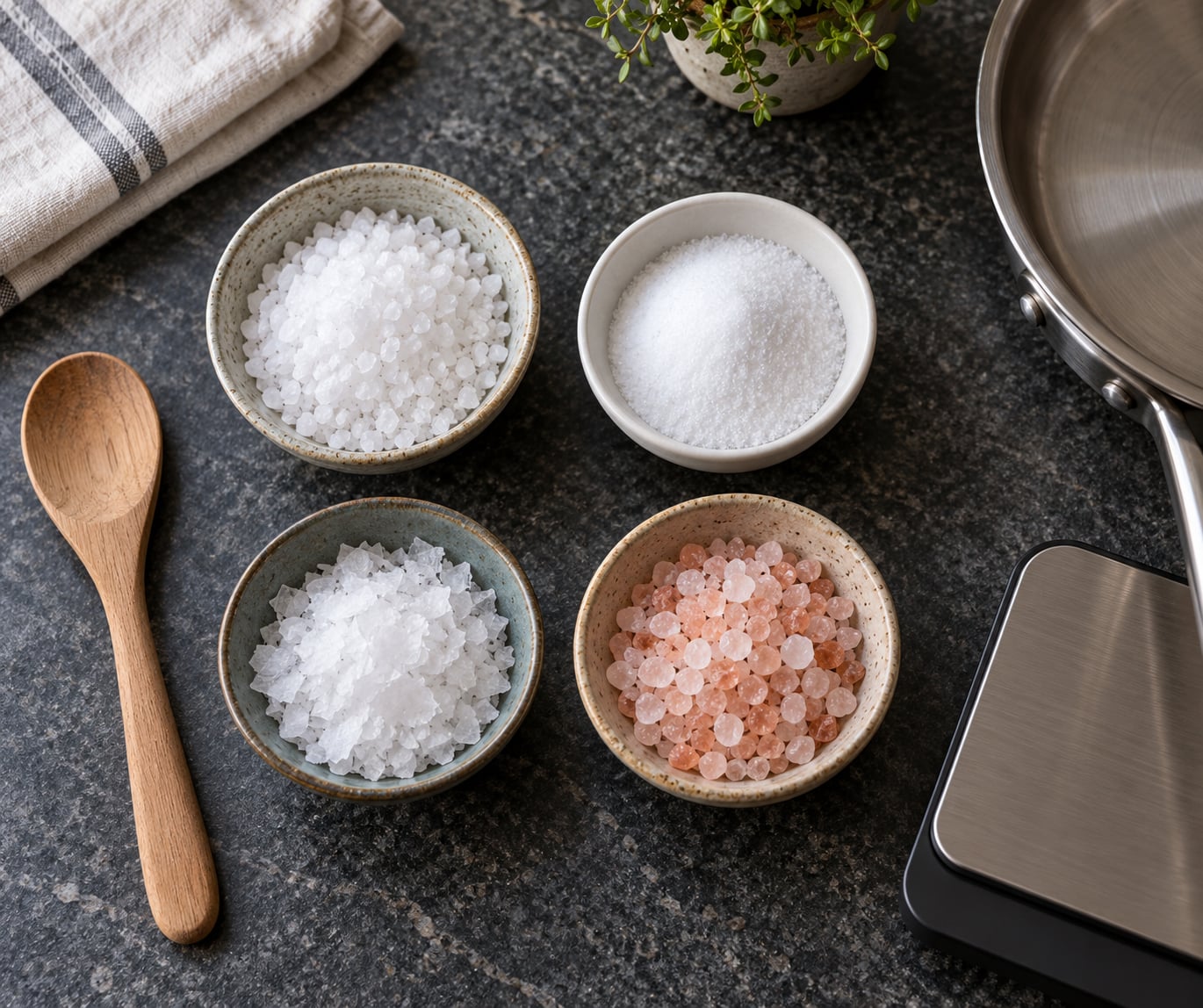
- A cooking salt with a coarse grain. Diamond Crystal or Morton kosher salt are the two most common in American kitchens. The flakier, wider crystals pour more predictably than fine table salt and sit on the surface of meat long enough to season deeper than the first millimetre. Fine sea salt works too, though it dissolves faster and is harder to pinch.
- A small scale, ideally one that reads in grams. This is the single biggest upgrade to your cooking. Volume measuring fails because kosher salt crystals are far less dense than table salt — the same teaspoon of each holds a noticeably different amount by weight, and that mismatch is why recipes swapped between salt types come out wrong.
- A finishing salt. Something flaky for the last second before serving. Maldon or any large-flake sea salt gives a crunch and a bright hit of salinity that dissolved cooking salt can’t.
- Table salt in the shaker. Iodized table salt still has a job: it is fortified with iodine, and cook on r/Cooking keep it around for exactly that reason — “if you might be iodine deficient, use table salt.” Nothing else in the pantry carries a reliable iodine dose.
- A tasting spoon and a small bowl of water. The bowl matters more than it sounds. A spoonful of sauce stirred into a little water gives you a diluted sample you can actually judge, where a hot spoonful of sauce burns your tongue and skews everything after it.
A paper towel matters too, and for one reason: a wet surface will not hold salt. Dry brine only works on dry meat.
Step-by-Step: How to Salt Food Properly While Cooking
1. Choose the Right Salt for the Job
Kosher salt is the default for cooking because you can see it, pinch it accurately, and it dissolves at a rate that seasons more than the surface. Table salt is finer, dissolves almost instantly, and is measured differently by volume.
The myth that kosher salt is “less salty” is the single most common source of over-salting. It is not less salty — it is less dense per volume. One teaspoon of Morton kosher holds roughly twice the salt by weight of one teaspoon of table salt. Cooks on r/Cooking describe it as “a lot less salty,” which is exactly the perception that makes them add more. The fix is to stop measuring by volume and start weighing, or to use the table below.
| Salt type | Grams per teaspoon | Substitute for 1 tsp table salt | Best used for |
|---|---|---|---|
| Table salt (fine) | about 6 g | Use as the base measure | Baking, brines, dissolving into liquids |
| Morton kosher (medium grain) | about 8.5 g | Use roughly 3/4 tsp, or weigh it | General cooking, seasoning in layers |
| Diamond Crystal kosher (fine grain) | about 2.8 g | Use roughly 1.5 tsp, or weigh it | General cooking, lighter seasoning |
| Fine sea salt | about 5 g | Use roughly 1.2 tsp | Finishing, dissolving into sauces |
| Flake salt (Maldon) | about 3.5 g | Not meant for volume measuring | Finishing only, after cooking |
Himalayan pink salt is a coarse rock salt, not a stronger salt. Its color comes from trace minerals in small amounts too tiny to taste as anything but salt. Treat it as a finishing or grilling salt and stop paying more for it than kosher. The one place I do not skimp is the flaky finishing salt, since that is the version you eat directly.
One safety note. Curing salt contains sodium nitrite and is not table salt in any sense. It is used in tiny measured quantities by people following tested recipes, and using it as a general seasoning can make food unsafe. A beginner on r/cookingforbeginners described buying “fancy pink curing salt” to season a steak, which is the exact use it should never get. Keep it off your everyday shelf unless you are following a proper recipe from a source you trust.
2. Taste Before and During Cooking
Under-seasoned food tastes flat and dull with nothing sharp to it. Properly seasoned food tastes brighter and more complete, with the ingredients themselves louder. Over-seasoned food is simply salty, and once you cross that line, salt does not bring other flavors back.
Taste at four points, not one: the raw ingredient before it goes in the pan, the cooking liquid or pan juices halfway through, the sauce just before it finishes reducing, and the plated dish. Each of those four samples tells you something different. The sauce tastes different after twenty minutes than it did at the start because water evaporates and everything left behind — including the salt — concentrates.
This is the reason that a recipe which was right when you tasted it can be wrong by the time it reaches the table. Salt added to a soup at the start ends up more concentrated after twenty minutes of simmer. Taste the pot again right before you turn off the heat.
3. Salt at the Moment That Builds Flavor
Both: season in layers while the food cooks, then make a final adjustment at the end. Salting early seasons the interior, not just the surface, and the final taste is the only one that tells you what the plate will actually need.
| Food | Salt by raw weight | For 1 lb (450 g) raw |
|---|---|---|
| Steak, chops, roasts (dry seasoning) | 0.75% to 1% | 3.5 to 4.5 g |
| Chicken, pork, ground meat | 1% to 1.25% | 4.5 to 5.5 g |
| Fish fillets | 0.75% | 3.5 g |
| Sausage, bacon (cured) | 1.5% to 2% | 7 to 9 g |
| Wet brine, poultry or pork | 1 cup kosher salt per gallon of water | Submerge fully |
| Pasta water | 1.5 to 2 tbsp per gallon | Taste before draining |
| Roasted or sautéed vegetables | about 1% of raw weight | 4 to 5 g |
| Home bread dough (about 2 cups flour) | 1 tsp table salt | not kosher at this volume |
The percentage framework comes straight from home cooks scaling up. The advice that circulates on r/cookingforbeginners for big batches is beautifully simple: “Weigh out the meat in grams. Divide by 100. That’s how many grams of salt you need as a comfortable amount.” People curing meat push it higher — 1.5% for sausage and 2% for bacon are common numbers on smoking and barbecue forums, and those cooks will tell you plainly that even those sit at the low end.
Timing works differently for each category:
- Before cooking, for proteins. Salt steak, chops and roasts at least 30 to 60 minutes ahead, ideally 4 to 24 hours. Fish takes less — 10 to 20 minutes is plenty, and overnight will cure the surface and firm the texture past what most people want.
- During, for the cooking medium. Salt pasta water before the pasta goes in, salt butter before it browns in a pan sauce, salt stock and soups as they simmer.
- During, in layers. For a braise or a stew, season at three points rather than one: when the aromatics hit the pan, when the liquid goes in, and after it has reduced.
- At the end, for finishing. A pinch of flake salt on a plated dish is a different ingredient from dissolved cooking salt. It adds texture and a clean, bright hit right where the tongue registers saltiness most.
- Not at all, sometimes. Salted baking, milk and butter-based sauces like béchamel, and caramel are cases where the salt level needs to be set deliberately by the recipe, not by your fingers. Salt in caramel also competes with the sugar flavors as it reduces.
4. Apply Salt Evenly
Salting properly means every bite gets the same amount, which is mostly a distribution problem rather than a chemistry problem.
Sprinkle from about a foot above the food. Grains falling from height spread across a wider area than grains pinched close to the surface, which land in a pile and then dissolve into a salt pocket that over-saltens one bite while the rest of the dish stays bland. For a large roast or sheet pan of vegetables, work in sections rather than dumping from one spot.
Pat the surface dry before salting meat. Salt on a wet surface dissolves immediately, runs off, and leaves an uneven patch. A damp surface also sears badly, which matters if you are building a crust.
Dissolve salt into liquids rather than dropping it in. Put the salt in the cold liquid and give it a minute before heating starts, and it disappears completely. Dropped straight into a hot reduction, it sits on the bottom in a gritty pile.
Use a fine pinch for delicate things. A pinch of fine sea salt lands on a spoonful of soup as seasoning. The same pinch of coarse kosher, on a plate of tomatoes, lands almost nowhere and leaves three crystals of crunch on one wedge.
5. Adjust and Finish the Dish
The last taste is the only one that counts, and it happens after the sauce has reduced and the food has rested.
Salting earlier than you taste is the single biggest reason home cooking tastes flat. Too little salt cannot be corrected at the table, and too much cannot be removed — so start at the low end of the ranges above, taste, and add again. You can always add salt to a dish. You can never take it out.
If the plate needs more, use the finishing salt rather than the cooking salt. Flake salt gives a stronger sensory hit per gram, so a small pinch reads as more seasoning than the same pinch of fine salt would.
Resting matters for the same reason. Meat salted four hours ago and rested in the fridge has had time to season through the outer centimetre or so. Taste a slice from the edge and a slice from the middle; if the edge is seasoned and the middle is not, the salt has not had time yet.
Common Mistakes and How to Fix Them
These are the errors that show up over and over in the source threads, along with what to do instead.
Salting by volume and switching salt types
The single most damaging mistake. If a recipe calls for kosher salt and you use table salt by volume, you have under-salted. The reverse oversalts. Weigh the salt, or commit to one type in your cooking and stay there. As one r/cookingforbeginners put it: “don’t think you can use it like salt 1:1 with table salt.”
Treating flaky salt as a measuring salt
Maldon flakes were designed for finishing. A pinch is light and unpredictable, and the flakes dissolve so slowly that half of them sit on the food as texture rather than seasoning. Keep it for the last moment, and use a measured salt for everything before that.
Salting only at the end
Salt sprinkled on cooked food mostly sits on top. It tastes like a coating rather than seasoning. Salt earlier, taste during, adjust at the end. That is the whole loop.
Chronic under-salting out of fear
A cook on r/cookingforbeginners wrote that he “never put salt on my food until very recently,” which is a common starting point and explains a lot of dull home cooking. Under-salting cannot be repaired at the table. Start at 1% of raw weight and work up from there — you will find you land around 1.25% and wonder why you were ever afraid.
Panicking at the pan when you forgot to salt
You missed the step. Do not dump a large pinch into the finished dish. Put the salt in early in a dish that still has time to cook, or dissolve it in the sauce so it disperses instead of sitting in one place. If the dish is truly finished, add a small amount dissolved in a spoonful of warm liquid and let it stand for a minute.
Ignoring salt that is already in the dish
Stock, canned tomatoes, broth, soy sauce, Worcestershire and most commercially made dressings all arrive salted. If you season on top of that without tasting first, you will oversalt, not under-salt. A homemade stock with no added salt behaves differently from a jar of stock, so a recipe written by one author will not transfer to the other.
Seasoning only the top layer
Layered dishes — casseroles, lasagna, vegetable gratins — get seasoned once at the top layer and none in the middle. Season each layer as you build it. The filling needs salt as much as the surface does, and you will not taste the middle once it is covered.
Frequently Asked Questions
Should I salt food before cooking?
Usually yes, and earlier than most people expect. Salt proteins like steak, chops and roasts at least 30 to 60 minutes before heat, and four to 24 hours is better. Fish needs less, usually 10 to 20 minutes. Salt in layers during cooking and make a final adjustment at the end, because that last taste is the only one that matches what lands on the plate.
How much salt should I use when cooking?
Start at about 1% of the raw ingredient’s weight by mass, then taste and adjust upward. That is 4.5 grams for a pound of chicken or ground meat, and 3.5 grams for a pound of steak. Cured meats like bacon and sausage run higher, around 1.5% to 2%. Weighing beats measuring by volume, because kosher salt is far less dense than table salt.
Can I use kosher salt instead of table salt?
Yes, and most professional kitchens do. It is coarser, pours more predictably, and seasons deeper than fine table salt. The only adjustment is volume: one teaspoon of Morton kosher holds roughly twice the salt by weight of one teaspoon of table salt, so use about 3/4 teaspoon in its place, or switch to weighing. Keep iodized table salt in the shaker, since it is the pantry salt that carries iodine.
When should I salt meat and vegetables?
Salt meat before cooking and let it rest; salt vegetables during or just before. Dry brine proteins for 30 to 60 minutes minimum, longer for thick cuts, and leave them uncovered in the fridge so the surface dries for browning. Vegetables have no resting step and no interior to season, so salt them in the pan or the oven and taste again at the end of cooking.
How do I fix a dish that is too salty?
Dilute it with more of the unseasoned base ingredient: broth for a soup, cream or milk for a sauce, water for a stew, an extra ladle of pasta water. Add unsalted fat such as butter or olive oil, which softens the perception of saltiness. If you can, serve it alongside something unsalted like rice, bread or plain potatoes. In baked goods, mix in more unseasoned dough.
Conclusion
Salting well is less about a secret technique than about restraint and timing. Start at about 1% of the raw ingredient’s weight, season in layers at the stages where flavor actually builds, and taste at each one. Add the final pinch of flake salt at the table, after the sauce has reduced and the dish is on the plate. That loop takes ten seconds and fixes more flat cooking than any single ingredient ever will.