How to make an iced tea that is not bitter comes down to three levers: water temperature, steep time, and how much leaf you use. Bitterness in homemade iced tea is almost never a bad-tea problem, and pulling any one of those levers back drops the harshness away, even with the same bag of tea you bought last week.
This matters most in summer, when most of us brew a pitcher instead of a single cup. A pot on the stove that steeps for twenty minutes while you finish another task will turn out harsh no matter which brand you picked. The fix takes about fifteen minutes of active work and the rest is patience.
Table of Contents
- What You Need
- Step-by-Step
- How to Make Iced Tea That Is Not Bitter: Start with the Right Water
- How to Make Iced Tea That Is Not Bitter: Control the Steep
- Cool It Quickly, Then Sweeten It
- Common Mistakes
- Frequently Asked Questions
- Why should you never squeeze a teabag?
- Why does my iced tea taste bitter all of a sudden?
- Why does my cold brew tea taste bitter?
- How do you fix tea that is already bitter?
- What type of tea is the least bitter?
- How do I drink green tea if I hate the taste?
- Conclusion
What You Need
Gather this before you turn on the stove. The list is short, and every item on it removes one specific way bitterness creeps in.
- A kettle, ideally temperature-controlled. If you only have a stovetop pot, boil the water and let it sit uncovered for a few minutes before pouring. You are aiming for a number, not a guess.
- A large heatproof pitcher, at least a half gallon (2 liters) if you are brewing for more than two people.
- A kitchen thermometer for the first few batches. After that you will recognize your water by feel.
- A sturdy mesh strainer or a reusable infuser, ideally one with more surface area than a teabag so the leaf can be pulled out fast.
- Loose leaf tea, or a decent bag if that is all you have. Large whole-leaf bagged teas bruise less and release bitterness slower.
- A large bowl and plenty of ice for the cooling bath, plus a second bowl or a flat strainer lid if you want to lift the leaf out in one move.
- A timer. This is the single most important tool on the list.
- Optional extras: sugar or simple syrup, honey, a lemon or orange, fresh mint, peaches or berries, and a splash of milk if you drink tea that way.
Step-by-Step
The process has three stages: brew it gently, chill it fast, then sweeten and flavor it. Do them in that order and the drink finishes smooth. Most home brewers get the order wrong by sweetening hot tea and leaving the pitcher to cool on the counter for an hour, which wrecks the flavor in two separate ways.
How to Make Iced Tea That Is Not Bitter: Start with the Right Water
Fresh, filtered water tastes cleaner because the minerals and chlorine in tap water mute the aromatics you are trying to extract. If your kettle has been sitting full for a week, dump it and start fresh. Water you boiled earlier and reheated also tastes flatter, because dissolved oxygen has boiled off.
Then match the temperature to the leaf. Hot water pulls bitter tannins out fast, and iced tea has a double disadvantage: the tannins keep extracting as the tea sits cool and cold in the pitcher.
| Tea type | Water temperature | Steep time | Bitterness risk |
|---|---|---|---|
| Black (Assam, English Breakfast, Luzianne) | 195-205°F (90-96°C) | 3-5 minutes | Low, if timed |
| Green (Sencha, matcha) | 175-180°F (79-82°C) | 30-90 seconds | High, very narrow window |
| Oolong (Tieguanyin) | 190-195°F (88-90°C) | 2-4 minutes | Medium |
| White (Silver Needle) | 185-195°F (85-90°C) | 3-5 minutes | Medium |
| Herbal / rooibos | 200°F (93°C) | 5-7 minutes | Very low, no tannins to speak of |
| Cold brew, any type | Fridge cold | 6-8 hours | Very low |
No thermometer? Pour about a fifth of the water into a cool glass first, then top it up with boiling water. That drops the temperature roughly 20°F and lands you near a good range for black tea.
Herbal and rooibos are the practical answer if bitterness is a recurring problem for you. They have essentially no tannins, so there is nothing to over-extract. That is also why a chamomile or hibiscus pitcher can sit on your desk all afternoon without turning harsh.
How to Make Iced Tea That Is Not Bitter: Control the Steep

Set the timer when the leaf goes in, not after. Every extra minute past the window in the table above pulls more tannin and less aroma. For a large pitcher of black tea I use about 8 loose-leaf tablespoons, or eight family-size bags, per half gallon of water.
Watch for the removal signal. Black tea is ready when the color goes from pale tan to a deep russet. Green tea passes through its window so fast that color barely changes, so pull it while the leaves are still bright green and floating rather than sitting dark at the bottom.
Never squeeze, poke, or stir the bag or infuser. Squeezing forces the tannins out of the leaf by force, which is exactly what waiting was supposed to avoid. It is a habit from stirring in coffee, and it is the top cause of bitter iced tea in homes where one person is cooking and minding three other things.
Here is the counter-intuitive part that surprises people: if your iced tea tastes weak and slightly bitter at the same time, the answer is more leaf, not a longer steep. Weak plus bitter is a dilution problem, and diluting tea over ice weakens the flavor without weakening the bitterness equally. Brewing stronger and pouring less of it into the glass solves both halves of the problem at once.
Cold brew works because cold water extracts the aromatic and sugary compounds while leaving most tannins behind in the leaf. Put 8 to 10 bags or 10 tablespoons of leaf into a jar, cover with a half gallon of cold filtered water, and leave it in the fridge six to eight hours. Overnight is fine. Do not use hot water to speed it up; you just get a weaker version of the quick steep.
Cool It Quickly, Then Sweeten It
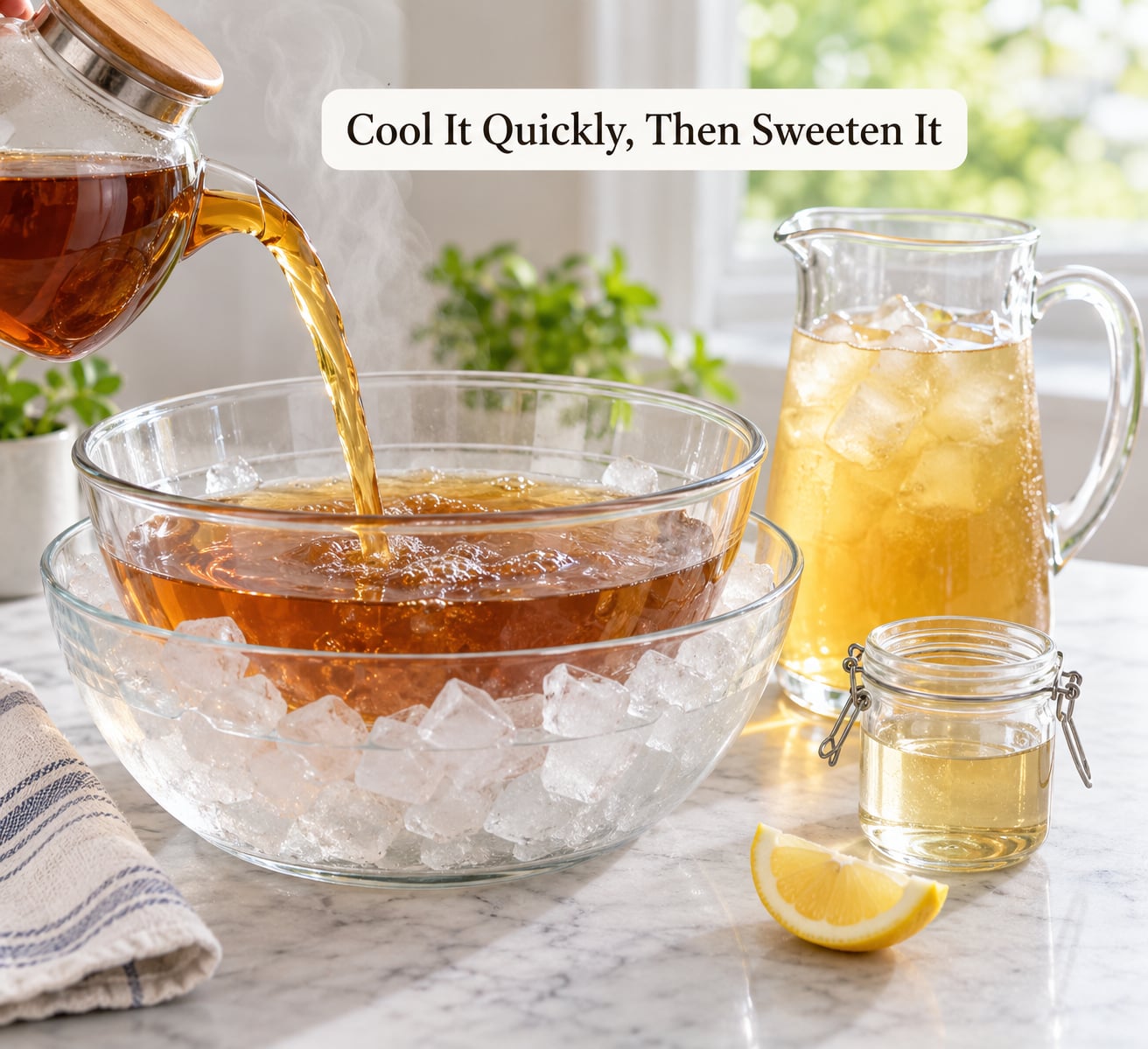
Set the hot concentrate inside a bowl filled with ice and water, then stir for two minutes. The outside of the pitcher goes from scalding to cool to the touch in that time, and the tea inside drops fast enough that extraction effectively stops. Pouring straight from the hot pitcher into a glass of ice warms the tea instead of chilling it, which is how you end up with a lukewarm drink that tastes thin.
Let the tea reach room temperature before it goes in the fridge. Warm tea sealed in a cold pitcher sweats, and the condensation dilutes the top of the pitcher while the taste stays heavy at the bottom.
Add your sweetener only after cooling. Sugar stirred into hot tea needs extra time to dissolve, so people tend to over-add it; the same amount stirred into cold tea dissolves immediately and tastes cleaner. A simple syrup made by heating equal weights of sugar and water for three minutes, then cooling, gives you control in small pours.
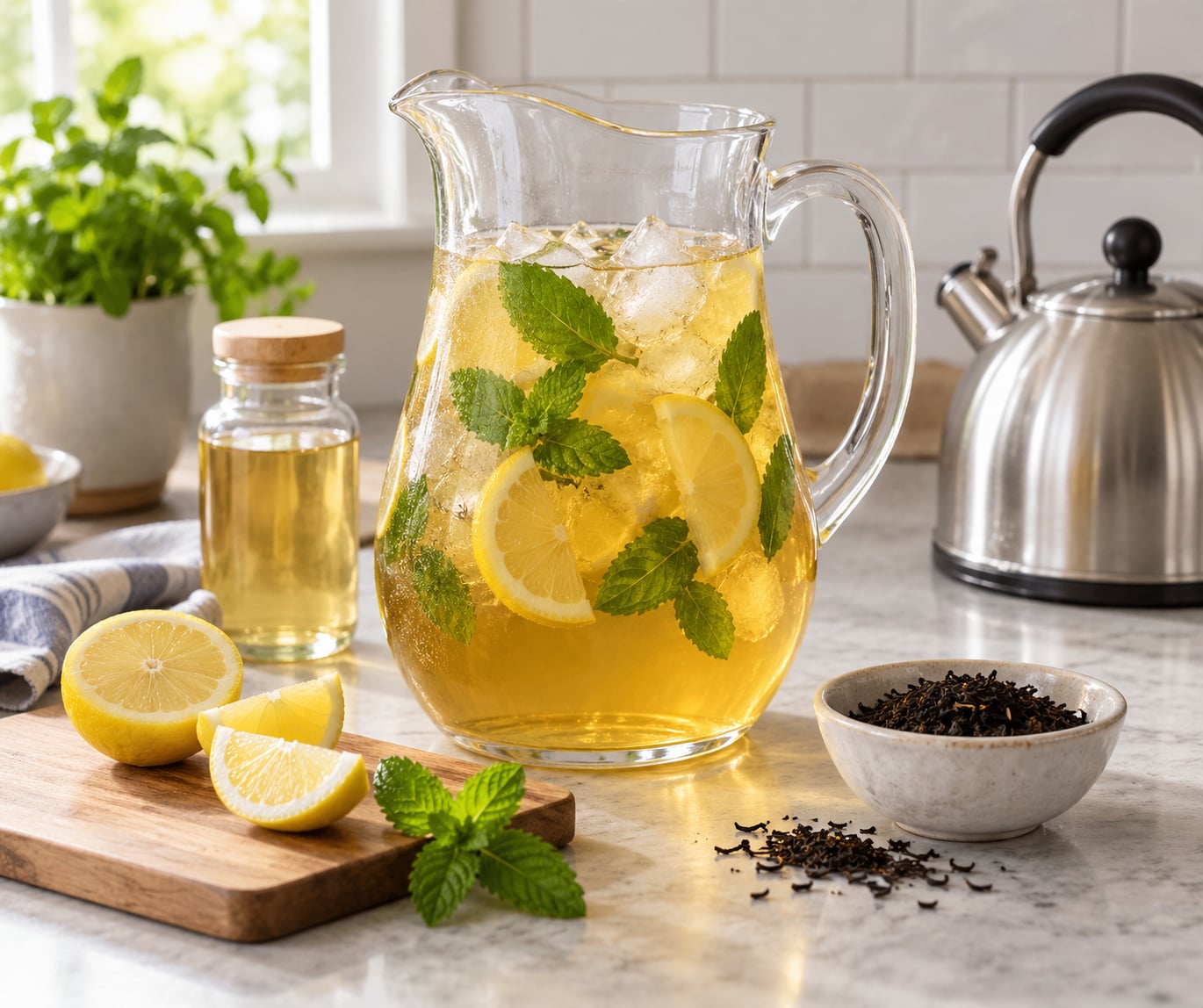
A squeeze of lemon does more than flavor. Citrus brightens the finish and softens the perception of bitterness, which is why restaurant sweet tea always has lemon in it. Mint crushed gently at the last second, a few peach slices, or a splash of milk each push the drink in a different direction without adding more bitterness.
Freeze leftover tea into ice cubes for the next pitcher. Regular ice dilutes as it melts, and that is the single most common reason a well-brewed pitcher tastes weak by the second glass. Make the cubes a day ahead and the problem disappears.
Common Mistakes
These are the failures I see most often, in rough order of how often they happen.
- Steeping bagged tea for ten to twenty minutes. Bagged black tea is usually a small cut leaf with a large surface area, so it gives up its tannins quickly. Three to five minutes is the range.
- A full rolling boil for everything. Green and white tea need water well below boiling. A hard boil on delicate tea is the fastest route to a cup you cannot finish.
- Squeezing or poking the teabag. It pushes tannins out on demand. Lift and walk away.
- Too much leaf for the water. This is rare but real, especially with large-leaf whole tea in a small pot. Halve the leaf and extend the time a little instead.
- Batch brewing in a slow cooker or Instant Pot on a long setting. Slow cookers hold heat for eight hours, which is a slow cooker’s entire point and a disaster for tea. Use the fast manual setting, treat it as a quick steep, or switch to cold brew.
- Letting the pitcher sit warm for hours. Extraction continues as long as leaf and liquid touch. Cool fast, refrigerate, and drink within three days. If a pitcher tastes fine on day one and bitter by day three, over-extraction during storage is why.
- Pouring hot tea over ice. The tea never gets cold enough to stop extracting, and it dilutes as it chills.
One honest note on the cold brew debate: you will hear that cold brewing wastes good leaves and hot water is better for quality tea. That is partly true for oolong and green, where you are chasing aroma and cold water cannot pull much of it. For everyday iced tea, sweetness and a low astringency matter more than aromatics, and cold water wins on both. Use the method that matches what you are drinking it for.
Frequently Asked Questions
Why should you never squeeze a teabag?
Squeezing pushes water out of the saturated bag by force, and that water carries tannin out of the leaf with it. A bag left floating releases its tannins slowly on a schedule you control; the same bag squeezed hard delivers a concentrated dose in seconds. This is the most common cause of bitter iced tea in a busy kitchen, and it takes ten seconds to avoid: lift the bag, set the timer, and leave it alone.
Why does my iced tea taste bitter all of a sudden?
Two causes account for almost every case. Either the steep ran long, or the pitcher sat warm and kept extracting after brewing. If it tastes fine on day one and turns harsh by day three, the leaf kept working in the fridge. Chill the concentrate fast in an ice bath, refrigerate only once it is at room temperature, and use the pitcher within three days.
Why does my cold brew tea taste bitter?
Cold water is gentle, so bitterness usually points at a ratio problem rather than extraction. Too little leaf in too much water gives you a thin brew that reads as harsh once it hits ice. Fix it by adding more leaf, not steeping longer. If you used plenty of leaf, the likely culprit is a dusty or low-grade bag, which releases tannin even in the fridge.
How do you fix tea that is already bitter?
Start by diluting with cold water or ice, which is the least invasive fix. A very small pinch of table salt softens the perception of bitterness by dulling it. Half a teaspoon of simple syrup also rounds off the edge. A pinch of baking soda neutralizes tannins more directly, but add it last and expect fizzing in anything carbonated. You cannot extract tannins back out once they are dissolved.
What type of tea is the least bitter?
Herbal tisanes and rooibos, hands down. They carry no tannins to over-extract, so a long steep makes them stronger, never harsh. Among true teas, white tea and lightly oxidized oolong sit at the gentle end, while cheap supermarket black blends are usually the most bitter per cup. A larger leaf size also slows tannin release in any type.
How do I drink green tea if I hate the taste?
Respect the window. Green tea brewed at 175-180u0026deg;F for 30 to 90 seconds tastes sweet and grassy; give it three minutes and it turns medicinal. Cold steeping the same leaf overnight in the fridge removes the bitterness almost entirely. A squeeze of lemon and a light syrup also smooth out the finish without hiding what the tea actually tastes like.
Conclusion
Start tonight with the one change most likely to fix your pitcher: use cooler water and cut the steep in half. Set a timer, pull the leaf the moment the color deepens, and drop the pitcher into an ice bath until it feels cool to your hand.
Then use the same formula every time: about 8 bags or loose-leaf tablespoons per half gallon, steeped at the temperature in the table for the time in the table, shocked in ice, sweetened after cooling, and served over ice cubes you froze from yesterday’s tea. Fifteen minutes of work, and how to make an iced tea that is not bitter stops being a question you have to ask.