To pair wine with cheese, match the wine’s intensity and body to the strength of the cheese, and let a bright, acidic wine cut through the fat. High-tannin reds need hard or aged cheese, not soft ones. Take the cheese out of the fridge 30 minutes before serving, taste both separately, then together.
That is genuinely the whole method. Most of the advice online dresses this up in ceremony, and beginners come away convinced they need a vocabulary of tasting notes they do not have. You do not. You need to know how strong the cheese is and how heavy the wine feels, then adjust from what your own tongue tells you.
The rest of this guide breaks that into steps: how to sort a cheese counter into manageable groups, what to look for on a wine label, a six-step tasting routine, and a pairing list you can work from without memorising anything.
Table of Contents
- How to pair wine with cheese: the basic matching rules
- Start with the cheese, not the wine
- Why soft, aged and washed-rind cheeses need different wines
- Choose the wine’s sweetness, acidity, and body
- How to pair wine with cheese without overthinking it
- Reliable pairings for common cheeses
- Fresh cheeses: goat, ricotta, burrata, mozzarella, feta
- Soft-ripened cheeses: brie and camembert
- Washed-rind cheeses
- Semi-hard and hard cheeses: cheddar, gruyere, gouda, parmesan
- Aged cheddar and other long-aged cheeses
- Blue cheese
- Wine and cheese pairings by serving situation
- Common pairing mistakes and easy fixes
- Frequently Asked Questions
- What is the 20 minute wine rule?
- Which cheese goes best with wine?
- What to bring to wine and cheese night?
- What is a good wine and cheese pairing?
- What not to pair red wine with?
- Should cheese be served at room temperature?
- Conclusion: make one confident pairing and taste from there
How to pair wine with cheese: the basic matching rules
Learning how to pair wine with cheese comes down to a handful of variables. Each one changes the match in a predictable direction, which is what makes the whole thing learnable rather than guesswork.
| Pairing variable | How to judge it | What it changes |
|---|---|---|
| Cheese intensity | Mild, medium or pungent; how long the smell lingers | Sets the weight the wine has to carry. A pungent cheese beside a thin wine tastes flat and one-dimensional. |
| Acidity | The tart snap you feel at the sides of your tongue, especially in the finish | Cuts fat and resets the palate between bites. This is the single most useful pairing lever. |
| Sweetness | Dry through to dessert-sweet | Sweet wine makes anything mild taste sour. Sweetness only works against salty, mouldy or very aged cheese. |
| Texture and fat | Creamy, semi-hard, hard, or crumbly | Creamy cheeses need acid to stay lively. Hard cheeses can take tannin without complaint. |
| Saltiness | How much you reach for water after a bite | Salt and sweetness balance each other. Salt plus dry, thin wine just leaves you thirsty. |
| Tannin | The drying, gripping feeling in your cheeks, mostly in red wine | Tastes bitter and chalky beside soft, delicate cheese. It sits fine next to firm aged cheese. |
| Oak | A vanilla, toast or spice note baked into the wine | Over-oaked whites smother fresh goat cheese and fresh curds. It crowds anything mild. |
| Finish | What is left in your mouth ten seconds after the bite | The most honest test. If the finish is long and clean rather than short and dull, the pairing works. |
Two ideas sit underneath the table. The first is that fat dulls your sense of flavour, and acid is the fastest way to switch it back on. The second is that intensity is a two-way street: bring together things of similar strength, or the louder one wins and the quieter one disappears.
Start with the cheese, not the wine
Standing in front of a cheese counter with forty wheels on offer, people freeze. Sort the cheese first and the choice gets much smaller. Ask the counter to cut a small taste piece, and use freshness, richness, hardness, saltiness and strength as your five sort keys.
Freshness separates the milky, uncooked-curd cheeses from everything aged. Ricotta, mozzarella, burrata, chèvre and feta are all fresh, and they are delicate, wet and low in strength. Anything with a bloomy white rind, like brie or camembert, is soft-ripened, where the mould does the work and the flavour is much stronger. Washed-rind cheeses are the loud ones in the room, and they are meant to smell like a locker.
Richness matters more than most people expect. A triple-cream brie has more fat than a goat cheese, so it tolerates more acidity and less tannin than its price suggests. Hardness predicts tannin tolerance better than anything else. Parmesan can stand next to a tannic red because it has the texture to hold its own, while the same wine next to brie will taste sour.
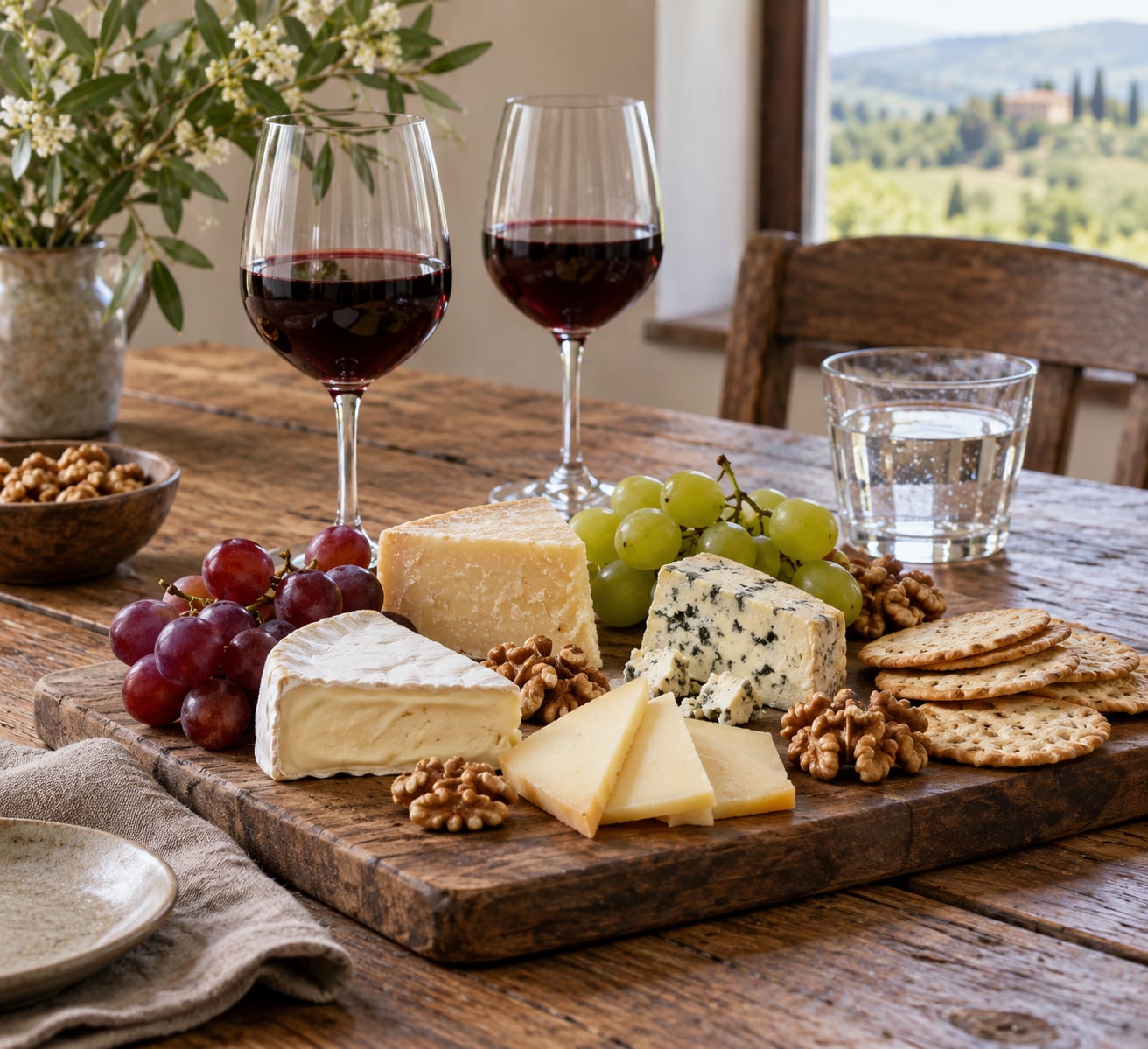
For a mixed board, a workable formula is one soft-ripened, one hard, and one blue or washed-rind. Add a fresh cheese if you have room. That gives four textures and four different intensity levels, and one bottle of wine will not have to please all of them equally well. For a beginner, a fresh goat cheese log, a wedge of aged cheddar and a piece of Stilton is a board that already covers the range.
Why soft, aged and washed-rind cheeses need different wines
Soft-ripened cheeses are mostly fat and salt with a delicate, mushroomy middle, so they want acid rather than weight. Aged and hard cheeses are dense, nutty and crumbly, and they can handle tannin and oak. Washed-rind cheeses are salty, funky and high in both fat and intensity, which means they work with anything from a fizzy dry white to a sticky dessert wine. Knowing which of the three you are holding removes most of the guesswork before you even look at a bottle.
Choose the wine’s sweetness, acidity, and body
On the wine side, three decisions matter most: how sweet it is, how much acidity it has, and how heavy it is. Everything else, including grape variety and region, is a shortcut for those three.
Start with sweetness. A dry wine will not sweeten a plain mild cheese; it will just taste thin beside it, and can make the cheese seem sour by comparison. Sweet wine belongs with salty, mouldy or very old cheese, where the sugar and the salt meet in the middle. Blue cheese with Sauternes or tawny port is the classic, and it works because both are aggressive enough to stand up to each other.
Acidity is the lever you will feel most. Sauvignon Blanc, Sancerre, Muscadet, dry Riesling, unoaked Chardonnay and Champagne all have a bright, snapping finish. That snap is what makes a creamy cheese taste lively instead of heavy. If a white wine tastes flat and soft with no tartness at the end, it will not do much for a triple-cream.
Body is simply how much weight the wine carries. Light reds like Pinot Noir and Gamay feel like they disappear; full-bodied reds like Cabernet Sauvignon, Malbec or Syrah feel broad and firm. Beer drinkers judge this well: a lager is a light body, a stout is heavy. A light wine with a pungent blue cheese leaves you hunting for flavour that is not there, while a heavy, hot, oaked red with fresh chèvre will bully it.
Sparkling wines deserve their own mention because they solve more problems than any other style. Carbonation plus high acidity cuts fat and lifts salt, and the bubbles scrub the palate between bites. Dry sparkling is a safe choice with a mixed board, which is why it appears so often in hosting advice.
How to pair wine with cheese without overthinking it
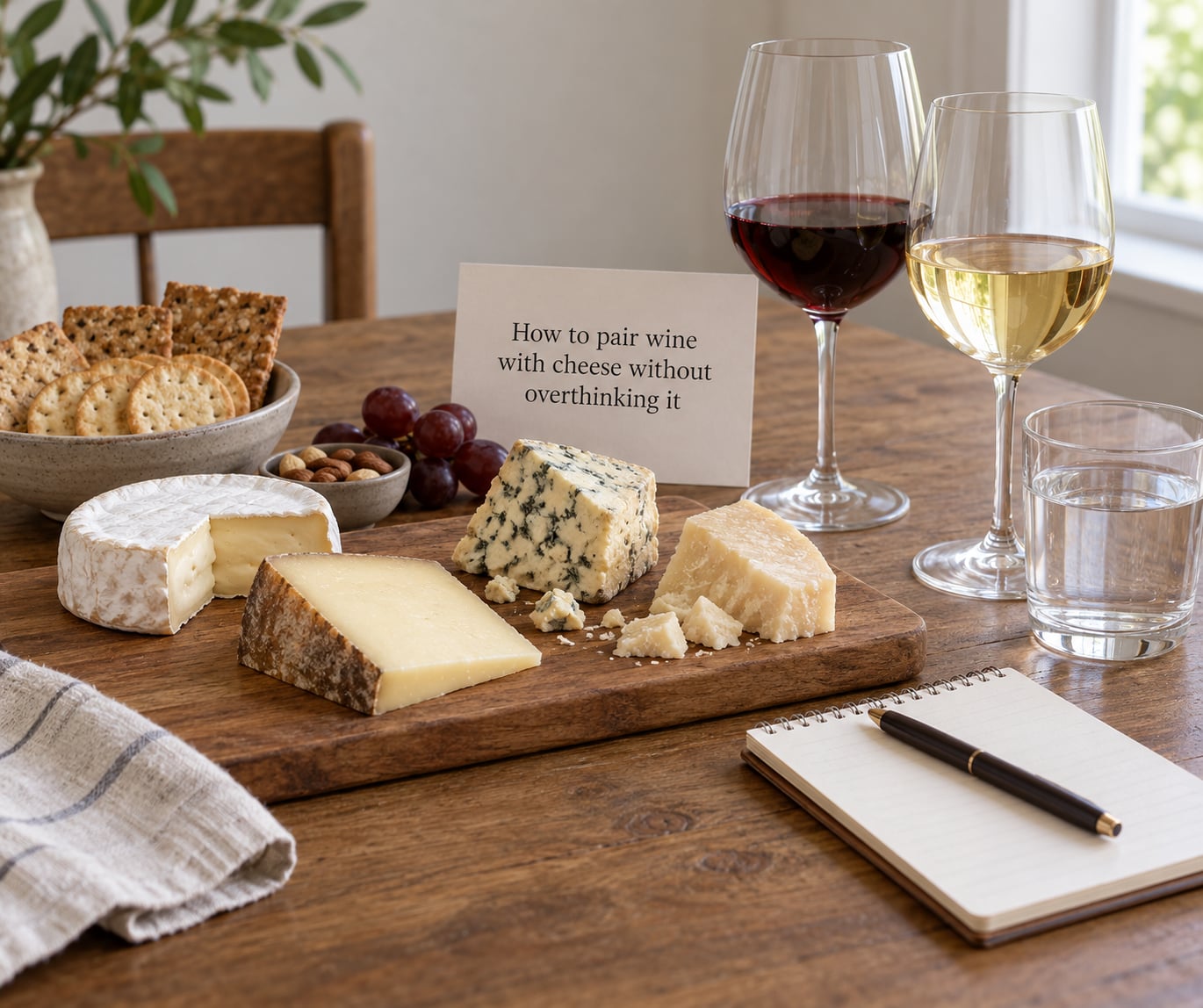
This is the routine I would hand anyone hosting for the first time. It takes about ten minutes and it turns a hunch into a decision you can defend.
Taste the cheese on its own. Notice the aroma, the salt, the texture and how strong it is. Say the answer out loud in one word: mild, tangy, nutty, pungent.
Taste the wine on its own. Before it touches food, notice the acidity and the weight. Then smell it again with the cheese scent still in your nose, which is a quick way to spot whether the two belong to the same family.
Take both together. Take a bite of cheese, then a sip, and let them sit. Resist the urge to chew and sip at the same time, because the point is to taste what each does to the other rather than a blended mouthful.
Write the first impression. Within a few seconds, one word will come to you, and it is usually accurate: bright, flat, bitter, creamy, long, short. Keep a pen and paper by the board. It sounds fussy and it is the fastest way to learn.
Test acidity and texture separately. If the pair feels heavy, add acid before you add anything else. If it tastes thin, move to a more structured cheese. The correction is almost always on the food side, since you have already opened the bottle.
Adjust the order for the next round. Serve light and mild first, then more intense, then salty and blue at the end. Save the strongest cheese for last, because it is the one that will reappear if you serve it early.
On timing: take the cheese out of the fridge 30 to 45 minutes before serving. Cold suppresses aroma, and a cold cheese is the single most common reason a good wine and a good cheese seem like an odd match. White and sparkling wines belong in the fridge; reds and most fortified wines do not. If a red has been sitting in a warm room, chill it briefly and then take it out again, since cold tannin and warm tannin are both unpleasant.
Reliable pairings for common cheeses
Each pairing below gives a reason and a backup, so you can adjust when the bottle you have does not match. Start from the left-hand column as a safe default rather than a rule.
Fresh cheeses: goat, ricotta, burrata, mozzarella, feta
Fresh goat cheese with a Sauvignon Blanc or Sancerre is the reliable starting point for a beginner. The wine’s acidity handles the tang and the grassy edge of the goat without picking a fight. As a backup, a dry sparkling wine works just as well, and a plain Muscadet is the budget version of the same idea.
Ricotta is mild and slightly sweet, so it suits a light, slightly fruity white. Feta is briny and aggressive, which means it can handle more body than you would expect, including a light red such as Pinot Noir. Burrata and mozzarella are about texture rather than flavour, so a very dry, high-acid white is best for cutting the cream, and an oaked Chardonnay will flatten both.
Soft-ripened cheeses: brie and camembert
Brie and camembert want a white with enough acid to cut the cream and enough weight not to vanish against it. An unoaked Chardonnay or a Champagne brut is the classic answer, and Pinot Noir works too, since its soft tannin is gentle on a soft cheese. The backup is a dry sparkling, which handles the same job with bubbles.
Washed-rind cheeses
Washed-rind cheeses are the ones that smell like a boot locker, and they are the most misunderstood. Their salt and funk pair naturally with fizz, so a dry sparkling or a light, acidic red like Gamay both work. Dry Riesling is the best-value choice if you want something with a bit of grip to hold up to the funk.
Semi-hard and hard cheeses: cheddar, gruyere, gouda, parmesan
Young cheddar is mild and nutty, so it takes a light red such as Pinot Noir or a medium Chianti without any problem. Gruyere is nuttier and more structured, and it is one of the few cheeses where a full-bodied red genuinely improves rather than overwhelms. Gouda, especially aged or smoked, is mild enough for a light red and strong enough for a bold one, which makes it the safest cheese on any board.
Parmesan and pecorino are hard, salty and aged. A tannic red such as Cabernet Sauvignon or Barolo is the traditional match, and a good sparkling wine is a surprisingly good backup. This is the case where the usual advice to avoid tannin with cheese does not apply, because the cheese is hard enough to handle it.
Aged cheddar and other long-aged cheeses
Aged cheddar develops crystalline crunch, sharpness and a deep savoury note. A full-bodied red with ripe tannin, such as a Bordeaux blend, Malbec or Syrah, is the right weight. The backup is a fortified wine such as tawny port, which is sweet enough for the salt and strong enough for the age.
Blue cheese
Blue cheese is the easiest pairing on the board and the most reliably impressive. Its salt and sweetness-generated mould funk line up with a sweet wine, so Sauternes, sweet Riesling, tawny port and Oloroso sherry all work. Dry styles also succeed, especially a port-style dry red, and a very cold dry sparkling with Stilton is the most useful party answer because guests already know it.
Wine and cheese pairings by serving situation
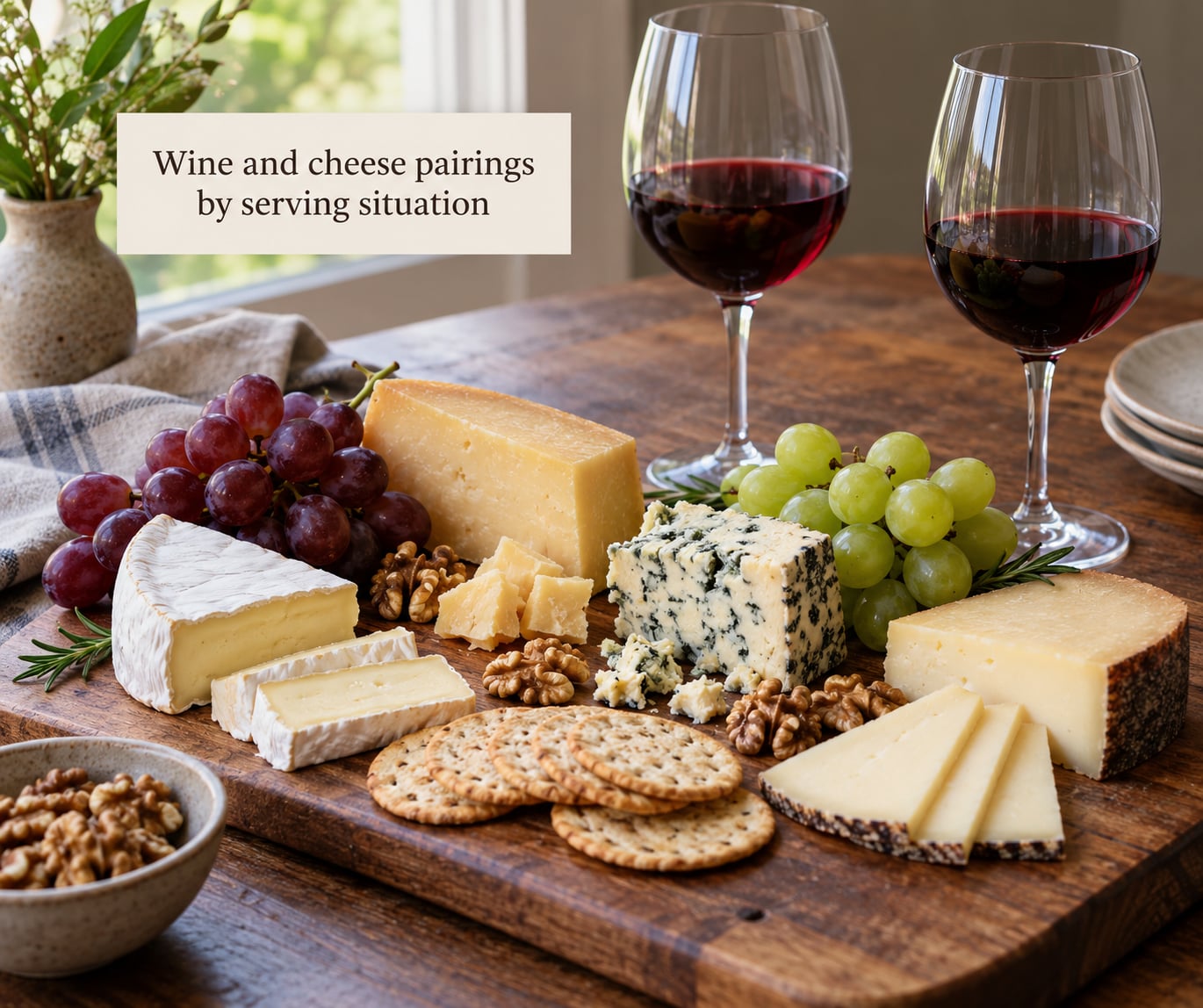
The same cheese behaves differently depending on what you are doing with it. These are the combinations I would actually plan rather than improvise.
Casual cheese board. Pick one white and one red that cover the board rather than matching each cheese. A dry sparkling or Sauvignon Blanc for the fresh and soft-ripened cheeses, plus something with body like Pinot Noir or Chianti for the harder ones, will carry a varied board with two bottles and no stress.
Dinner-party cheese course. Serve one cheese at a time, matched properly, and pour a slightly more serious bottle. This is where a single confident pairing beats variety, and where a well-chosen aged white such as an off-dry Riesling or a Chablis-style dry white with a hard cheese earns you easy credit.
Outdoor gathering. Choose wines that tolerate warm weather and a table of hungry guests: a chilled dry sparkling, a light red served cool, and one sweet or fortified pour at the end. Keep the cheese count low, because heat and sun make everything on the board taste flatter than it did in your kitchen.
Gift basket. Match the basket to the recipient’s known preferences and go with aged, hard and blue cheeses, which keep longer and travel better than fresh ones. Pair them with a dry fortified wine or an off-dry Riesling, since both pair with more than one cheese style and neither needs a precise vintage.
Non-alcoholic options. This comes up more often than the coverage suggests. A dry sparkling apple or pear juice behaves much like a light sparkling wine, an off-dry non-alcoholic Riesling has enough acidity and a little residual sweetness to handle goat cheese, and a sparkling grape spritz with a squeeze of lemon works on a mixed board. The key is acidity, because without it the drinks taste flat against anything creamy.
Common pairing mistakes and easy fixes
Almost every bad pairing comes from one of five mistakes. Each one has a specific correction.
A sweet wine with a mild cheese. Sugar makes anything gentle taste sour and hollow. The fix is to move the wine to a salty, mouldy or very aged cheese, or move the cheese to something stronger.
An overpowering aged cheese beside a delicate wine. A thin, low-acid white next to a pungent washed rind simply disappears, and guests assume the wine was bad. The fix is to go heavier and more aromatic, or drop to a sparkling that can stand up to it.
A tannic red with a very soft cheese. The tannin has nothing to grip and turns bitter and chalky. The fix is to keep big reds for hard, aged and blue cheeses, and use a lighter red or a white for anything soft-ripened.
Serving the strongest cheese first. After a pungent blue, everything mild tastes of nothing. The fix is a fixed order: fresh and mild, then semi-hard, then soft-ripened, then blue or washed-rind last. Put the crackers and palate-cleansing water within reach at the start, not the end.
Assuming there is one universal rule. Advice that only says red or only says white is too narrow to use. The fix is to keep the mechanism in your head instead of the slogan: acid for fat, matching weight for intensity, tannin only for hard cheese, sweetness only for salt.
One more worth naming, because it is the most common: cheese straight from the fridge. Cold mutes the aroma, so the cheese gives the wine nothing to work with and the pairing seems flat even when the combination is sound.
Frequently Asked Questions
What is the 20 minute wine rule?
It is a sommelier shortcut for letting an opened bottle settle before you judge it. Decant or open it, stand the bottle upright for about 20 minutes, then taste. The aroma comes together, the sharpness from the initial oxidation settles, and you taste the wine rather than the shock of air hitting it. It matters most for young, tannic or aromatic reds.
Which cheese goes best with wine?
Fresh goat cheese, brie and camembert are the easiest matches because they are widely available and forgiving. Cheddar and Gouda are close behind, since mild versions pair with almost anything. If you only remember one pairing from the table above, remember goat cheese with a dry, acidic white such as Sauvignon Blanc or Sancerre, then work outward from there.
What to bring to wine and cheese night?
Plan on three to four cheeses per six guests: one fresh, one soft-ripened, one hard and one blue or washed-rind. Around 75 to 100 grams per person per cheese is generous, so err on the lower side. Add plain water crackers, unsalted nuts and fresh fruit, and one bottle per two guests so nobody is watching the last glass run out.
What is a good wine and cheese pairing?
A good pairing matches intensity and lets acidity do the work. A dry sparkling with brie, an off-dry Riesling with a washed-rind cheese, or a medium red with young cheddar are all reliable examples. A good pairing also means the wine stays drinkable on its own, which is the quickest way to check whether you have gone too sweet or too heavy.
What not to pair red wine with?
Avoid a big-tannin red with soft, delicate cheeses such as brie, camembert, burrata and fresh chèvre, because the tannin has nothing to grip and tastes bitter. A very sweet red is also awkward with mild cheeses, and an over-oaked white will smother anything fresh. Keep those reds for hard aged cheeses, blue cheese and anything salty.
Should cheese be served at room temperature?
Close to it, but not straight from the fridge. Take it out 30 to 45 minutes before serving so the aroma opens up, and take a hard aged cheese out a little longer than a soft-ripened one, which can become too soft at room temperature. Keep the blues cool and serve them last, since they are the most intense thing on most boards.
Conclusion: make one confident pairing and taste from there
Pick one cheese you already know the taste of, choose a wine by matching its weight to the strength of the cheese and looking for acidity, then taste the two separately before you taste them together. Adjust once, from what your own tongue says. That first correction teaches you more than any list, because you found it yourself.
None of this needs memorising. Keep the mechanism rather than the slogans, use the pairing list as a starting point, and let your own palate correct the rest. That is how to pair wine and cheese without buying a single book about it.