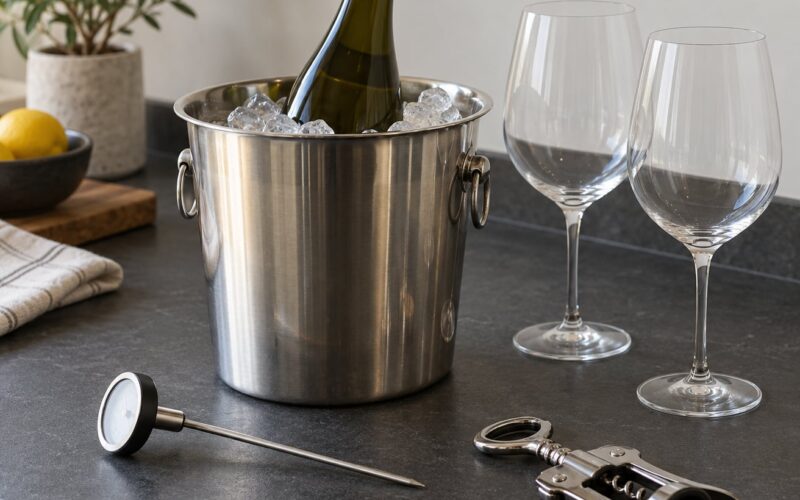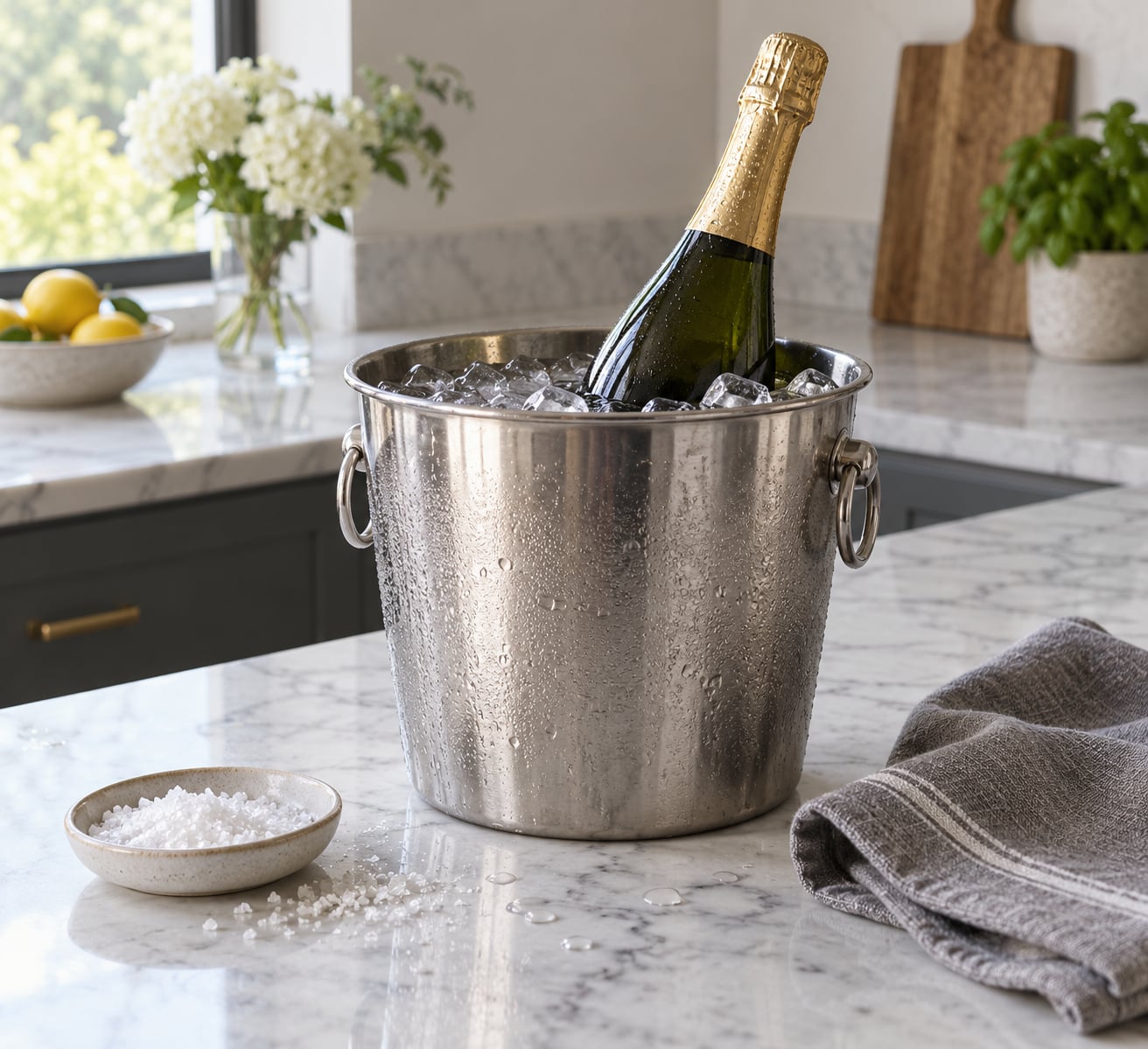
A bottle of champagne at room temperature is the fastest way to derail a party. The quickest way to chill champagne fast is an ice and water bath with salt: submerge the bottle in ice, cold water and 4 to 6 tablespoons of coarse salt, and it reaches serving temperature in roughly 20 to 30 minutes. No bucket? The freezer works too, but only with a timer you actually set.
Below is how each method behaves, how long it honestly takes, and the temperature to aim for before the cork comes out.
Table of Contents
- What You Need
- Step-by-Step: How to Chill Champagne Fast
- Chill It in Ice, Water, and Salt
- Chill It in Ice and Water
- Chill It in the Freezer
- Common Mistakes
- Frequently Asked Questions
- How fast can you chill a bottle of champagne?
- Do you actually need salt to chill champagne fast?
- Can you put a champagne bottle directly in ice without water?
- How cold should champagne be when served?
- Can you chill sparkling wine in the freezer?
- Conclusion
What You Need
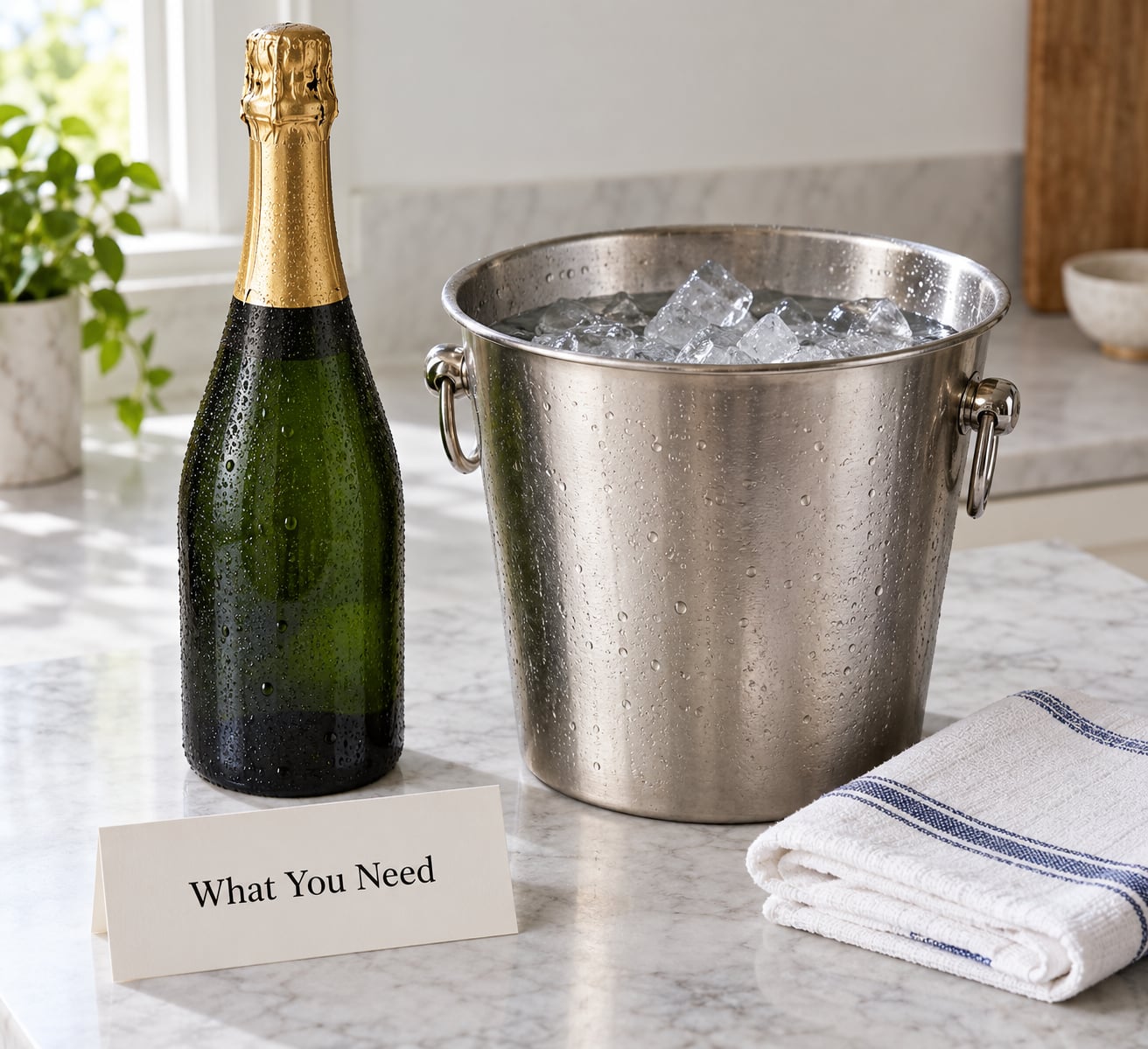
None of this is specialist gear, which is the good news. Most of it is already in a kitchen cupboard.
- Ice: roughly 4 to 6 cups, about half a bag, plus extra in case it melts fast in a warm room.
- Water: enough from the tap or the kettle to cover the bottle up to its shoulder.
- Coarse salt: 4 to 6 tablespoons per bottle, or about 1 cup per gallon of water. Table salt works, though coarse or flaky salt dissolves faster and chills harder.
- A deep container: an ice bucket, a large bowl, a clean sink or a plastic tub that fits the bottle at an angle.
- A tea towel or paper towel to dry the bottle before it reaches your guests.
- A refrigerator or freezer for the plan-ahead methods.
- A timer that you can hear from another room. This is the one item people skip and then regret.
An instant-read thermometer is helpful if you serve often or own good vintage bottles, but it is optional. You can judge progress by touch and by the bottle itself.
Step-by-Step: How to Chill Champagne Fast
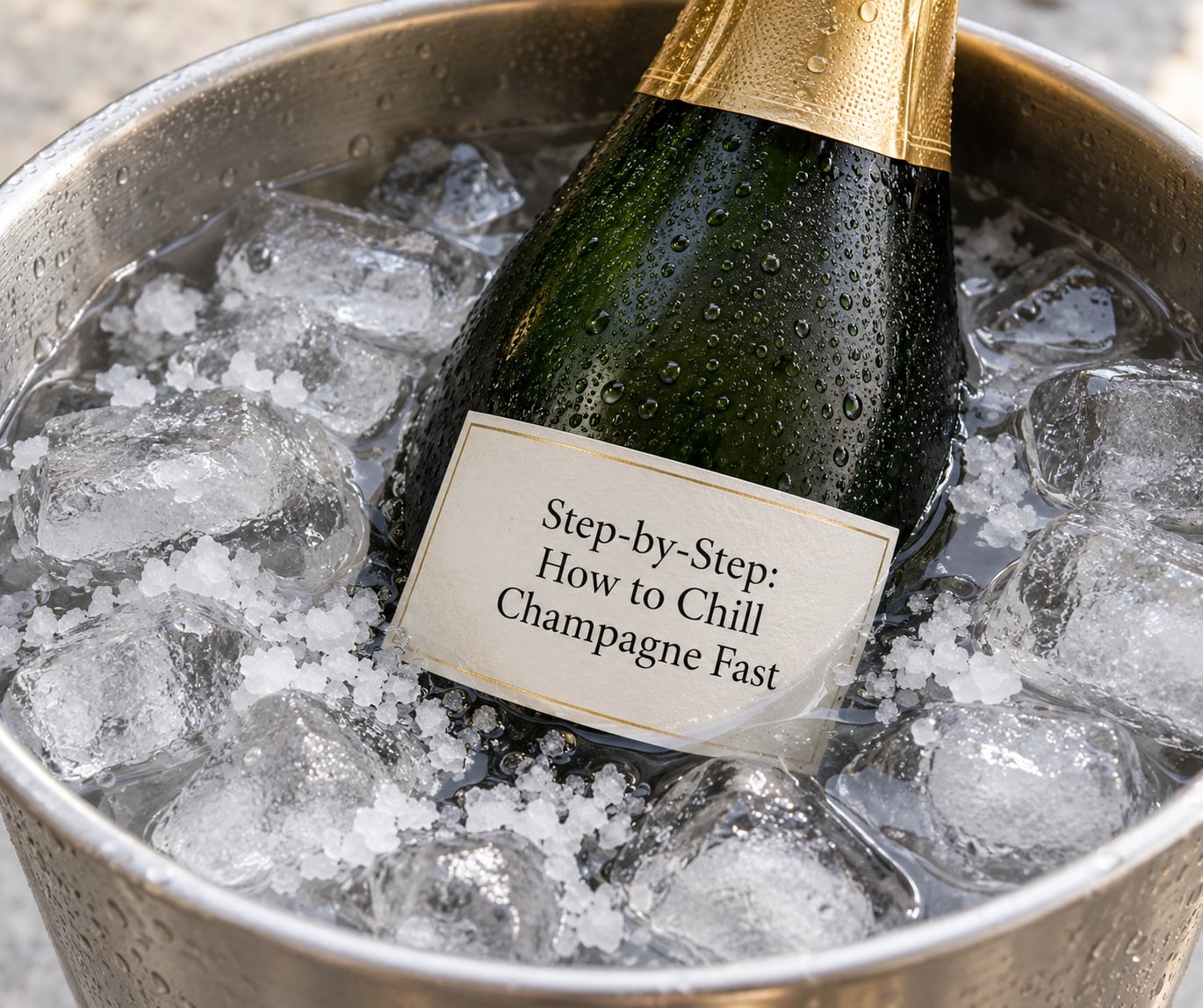
Here is how the methods compare. Note how much of the difference comes down to whether water is involved, not how cold the water is.
| Method | Chill time from room temperature | What you need | Risk |
|---|---|---|---|
| Ice, water and salt | 20 to 30 minutes | Bucket, ice, salt | Low |
| Ice and water | 30 to 40 minutes | Bucket, ice | Low |
| Freezer | 20 to 30 minutes, hard limit | Freezer, timer | Medium |
| Damp towel, then freezer | 15 to 20 minutes | Towel, freezer | Medium |
| Refrigerator | 2 to 3 hours | Fridge | None |
| Wine chiller sleeve | 30 to 45 minutes | Sleeve, freezer, planning | Low |
| Cold tap water only | 5 to 10 minutes, not enough alone | Sink | Will not hold |
Chill It in Ice, Water, and Salt
This is the fastest and most even method, and the one to win for guests arriving in under half an hour.
- Fill the bucket halfway with ice, then add cold water until the bottle will sit submerged to its shoulder.
- Stir in 4 to 6 tablespoons of coarse salt. The mix should turn slushy, not watery.
- Lower the bottle in, cork well under, and angle the label away from floating ice if you care about reading it later.
- Turn the bottle a quarter rotation every few minutes so every side touches the brine.
- Wait 20 to 30 minutes, then test the bottle all the way around, not just at the base.
- Pull it out, dry it thoroughly with the towel, and let it stand upright for a minute before opening.
You will see the paper label darken with condensation within the first few minutes, and a light frost form on the glass. Both mean heat is moving out of the bottle.
If the bottle came straight out of the fridge, 10 to 15 minutes is usually enough, which is where most of the quick social media timings come from. A bottle sitting on a warm counter needs the full 20 to 30. Salt is what buys you the extra ten minutes: it drops the freezing point of the bath, so the ice and water sit several degrees below freezing and keep pulling heat instead of levelling off at 32°F.
Once it is out, aim for the range that suits the style you are pouring. A bath left for half an hour will not overshoot these numbers.
| Style | Serve at | Notes |
|---|---|---|
| Brut non-vintage | 43 to 46°F (6 to 8°C) | The everyday standard |
| Rosé and blanc de blancs | 46 to 50°F (8 to 10°C) | A touch warmer shows off the fruit |
| Vintage and demi-sec | 45 to 50°F (7 to 10°C) | Warmer keeps the sweetness readable |
| Millésimé and other prestige cuvées | 50 to 54°F (10 to 12°C) | Too cold flattens the aroma |
Chill It in Ice and Water
When there is no salt, you are trading speed for simplicity, and the water is still doing most of the work.
Pack a bucket or bowl with equal parts ice and water, then submerge the bottle to about three-quarters of its height. Turn it periodically, the same as before, and give it 30 to 40 minutes from room temperature.
The common mistake is assuming ice alone does the work. Ice is mostly trapped air, so a bucket packed with dry ice chunks cools a bottle far more slowly than the same ice floating in water. Water is a liquid, and liquid pulls heat out of glass far faster than air ever will.
If your tap runs cold and you are out of ice, a sink or bathtub filled with cold water still beats a dry bucket. It will not get a room-temperature bottle all the way down, but it will take the chill off the worst of it in about ten minutes and buy you time to find ice.
Chill It in the Freezer
This is the hands-off option for casual planning, and the one with a real downside.
Put the bottle in the freezer cork end up and set a timer for 20 minutes. At 30 minutes you are in the danger zone, and by 40 the liquid inside may have started to freeze. Champagne freezes around 15 to 20°F while the pressure inside the bottle sits near 90 psi, so expanding ice has somewhere dangerous to go: a cracked shoulder, a cork pushed out of the neck, or a bottle that is no longer drinkable. Freezers have not become gentler in 2026, so treat 20 minutes as a ceiling rather than a target.
The damp towel trick does circulate online. Wrapping the bottle in a wet tea towel before it goes in gives a small extra surface where water evaporates and pulls heat, and plenty of hosts say it works. It is worth doing, but it does not replace the timer, and plain ice and water still chills more evenly.
If you have already gone past the timer and the bottle is solid, do not open it. Move it to the refrigerator and let it thaw slowly for several hours, cork end up, before you touch the wire cage.
Common Mistakes
Most disappointing bottles are not a technique problem, they are one of these.
- Ice with no water. This is the big one. Dry ice in a bucket looks right and chills slowly, because air is a poor conductor. Add water until the ice floats.
- Leaving the bottle upright and still. A rotating bottle chills every side evenly. A stationary one leaves a warm band that shows up as warm wine in the first glass.
- Forgetting the freezer bottle. Set the timer, put the phone where you have to stand up to see it, and if you are the forgetful type, tie a ribbon to the freezer handle. Wine communities agree this is the number one reported disaster.
- Opening too early. A warm bottle gives you a foamy pour, no fine bubbles, and more wine on the floor than in the glass. Wait until the bottle feels cold all the way around the shoulder.
- Chilling far past the serving range. Ice and water cannot over-chill a bottle in 20 to 30 minutes, but a bottle left in a cold car or a fridge for hours will taste flat, with the aroma muted and the finish shortened.
- Putting ice cubes in the glass. They melt and water the wine down. Drop in a few frozen grapes or wine stones instead, or serve from a bucket with ice and water so each glass stays cold on its own.
- Pouring to the very top. Leave about a third of the glass empty. The foam needs somewhere to go, and a full glass overflows.
For a party, do the maths early. Plan on one bucket or tub per two bottles, roughly 8 to 10 cups of ice and 8 to 12 tablespoons of salt per bottle, and start the bath about 30 minutes before your guests arrive. If you are chilling a bigger run, get the buckets into the bath first and drop bottles in as they come out of the fridge.
The same timings hold for prosecco, cava, pet-nat, sparkling cider and canned sparkling wine. Cans go in the bath as happily as glass bottles, and a narrower can shape takes the cold faster.
Frequently Asked Questions
How fast can you chill a bottle of champagne?
An ice, water and salt bath gets a room-temperature bottle to serving temperature in about 20 to 30 minutes, and 10 to 15 minutes if the bottle already spent time in the fridge. The freezer is comparable but riskier. A refrigerator needs 2 to 3 hours. So if guests are landing in fifteen minutes, the salt bath is the only method with real margin.
Do you actually need salt to chill champagne fast?
No, but you will wait longer without it. Water alone pulls heat out of the glass far faster than air, which is why ice and water beats a dry ice bucket every time. Salt lowers the freezing point of the bath so it keeps cooling below 32u0026deg;F instead of levelling off, and that is worth roughly ten minutes. Add it if you have it, skip it if you do not.
Can you put a champagne bottle directly in ice without water?
You can, but it chills slowly and unevenly, so it is not the answer to how to chill champagne fast. A bucket packed with dry ice is mostly air between the cubes, and air transfers heat far more slowly than water. If all you have is ice, add water until the ice is floating, and the same bucket will chill a bottle in half the time.
How cold should champagne be when served?
Most non-vintage brut is at its best around 43 to 46u0026deg;F, or 6 to 8u0026deg;C. Rosu0026eacute;, blanc de blancs and vintage styles sit slightly warmer, around 46 to 50u0026deg;F, so the fruit reads properly. Prestige cuvu0026eacute;es and millu0026eacute;simu0026eacute; want 50 to 54u0026deg;F. Well below that, the aromatics flatten out and the wine tastes less lively than it should.
Can you chill sparkling wine in the freezer?
Yes, with a hard limit of 20 minutes and a timer you set. Sparkling wine freezes around 15 to 20u0026deg;F while the bottle holds close to 90 psi internally, and expanding ice in that state can crack the glass or push the cork out. Set a phone alarm, remember the bottle, and if you have missed the window, move it to the fridge and thaw it slowly.
Conclusion
Start with ice, water and salt when the bottle has to be open within 20 to 30 minutes. Drop in 4 to 6 tablespoons of salt, submerge the bottle to its shoulder, and give it a turn every few minutes.
Use plain ice and water when you have no salt or need to stretch the last bottle, budgeting 30 to 40 minutes. Use the freezer for a room-temperature bottle you forgot about earlier, with a 20-minute timer you set out loud. And a chilled bottle loses heat slowly, so finish the batch in the bucket with fresh ice and water rather than leaving opened bottles on the counter.