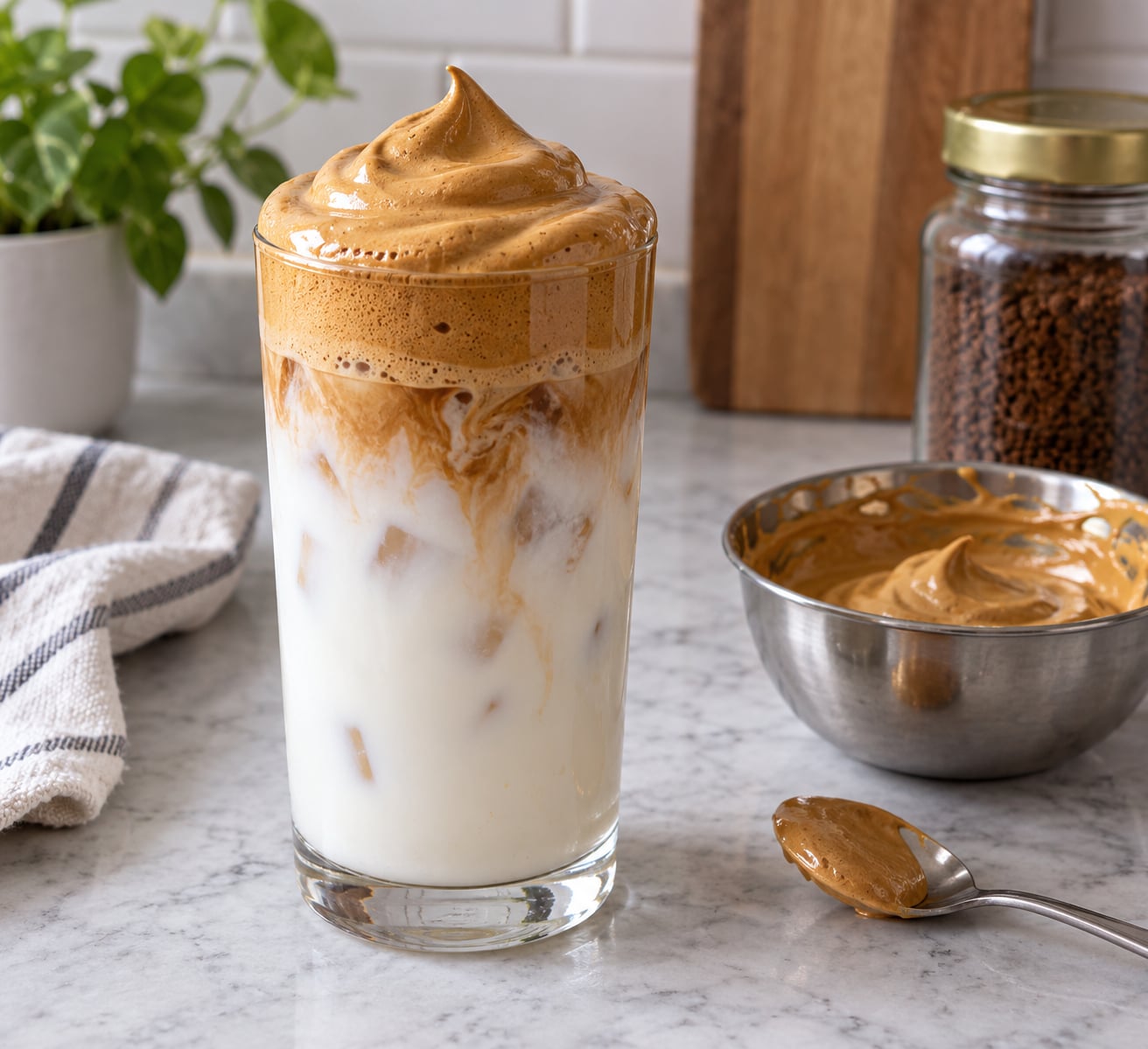
Dalgona whipped coffee is equal parts instant coffee, sugar and hot water, whipped until the mixture roughly triples in volume and holds stiff peaks, then spooned over cold milk and ice. The whole thing takes about five minutes, most of it spent holding a mixer. This guide covers how to make dalgona whipped coffee the way café bars do, including the visual cues that tell you the foam is ready.
The part that trips people up is not the recipe, it is the water. Lukewarm water gives you a thin, watery foam that never stiffens, and that single mistake explains most disappointing bowls. Everything else is patience and watching the colour change.
Table of Contents
- What You Need
- Step-by-Step: How to Make Dalgona Whipped Coffee
- 1. Mix the Coffee, Sugar, and Hot Water
- 2. Whip Until Thick and Fluffy
- 3. Layer the Dalgona Coffee Over Iced Milk
- Common Mistakes and Helpful Tips
- Frequently Asked Questions
- Can I make dalgona whipped coffee without a hand mixer?
- Why is my whipped coffee not getting fluffy?
- Can I use regular coffee instead of instant coffee?
- Can I make dalgona coffee ahead of time?
- Can I use milk alternatives for dalgona whipped coffee?
- Conclusion
What You Need
The base is three ingredients in a 1:1:1 ratio by volume, which for one drink means two tablespoons of each. Measure them properly rather than eyeballing, because the ratio is what makes the foam hold. Everything that follows in how to make dalgona whipped coffee depends on those three numbers being right.
- 2 tablespoons instant coffee (about 10 g). Freeze-dried granules work best. Avoid espresso powder, and see below for why ground coffee will not work at all.
- 2 tablespoons granulated sugar (about 25 g). Regular white sugar is the reliable choice.
- 2 tablespoons hot water (about 30 ml), heated to roughly 70 to 80°C. Boiling water is fine; lukewarm or cold water is not.
- Cold milk and ice for serving. About 200 ml per serving.
Sugar is not a garnish here, it is part of the structure. It dissolves into the coffee granules and helps the aerated mixture hold together, which is why cutting it back changes the texture and not just the sweetness. If the drink feels too sweet once it is sitting over sweet milk, use one and a half tablespoons of sugar next time instead of dropping it to nothing.
Sweetener swaps work unevenly. Swerve, erythritol and monk fruit blends whip reasonably well in the same 2:2:2 proportion. Stevia does not, because the granules are too fine and the mix stays thin and loose no matter how long you beat it. Brown sugar dissolves less cleanly, so expect faint graininess, and powdered sugar dissolves fast but adds almost no body.
For equipment, the difference between tools is mostly how long your arms last.
| Method | Time to stiff peaks | Result |
|---|---|---|
| Hand mixer | 2 to 3 minutes | Best balance of speed and control, easiest to start and stop |
| Stand mixer | 3 to 4 minutes | Same texture, no wrist fatigue, ideal for double batches |
| Immersion blender | 1 to 2 minutes | Fast and very aerated; keep the head submerged or you will spray foam everywhere |
| Food processor | 3 to 5 minutes | Good texture, but the blade throws mixture up the sides |
| Wire whisk | 8 to 20 minutes | Works, genuinely, but slow and hard on the wrist |
To scale up, keep the ratio even and whip each batch separately. Four equal measures of each ingredient needs two bowls and a mixer that can hold steady for six minutes, not one giant batch.
Step-by-Step: How to Make Dalgona Whipped Coffee
1. Mix the Coffee, Sugar, and Hot Water
Put two tablespoons of instant coffee and two tablespoons of sugar in a small bowl or the bowl of your mixer, then pour over two tablespoons of hot water. Stir it first with a spoon, taking about thirty seconds, until every dry granule has disappeared.
You are looking for a dark, glossy, syrup-like paste that leaves a clean streak behind the spoon. If it looks grainy or thin, keep stirring and let the residual heat finish dissolving the sugar. This step is also where instant coffee earns its place: freeze-dried granules carry soy-derived emulsifiers that coat the mixture and let air bubbles survive the whipping. Brewed coffee and ground coffee do not have those granules in suspension, so they foam badly no matter how long you beat them.
One r/Coffee thread summed up the consensus neatly: most people treat dalgona as a genuinely good way to drink instant coffee rather than a replacement for a brewed cup. That is what it is best at.
2. Whip Until Thick and Fluffy
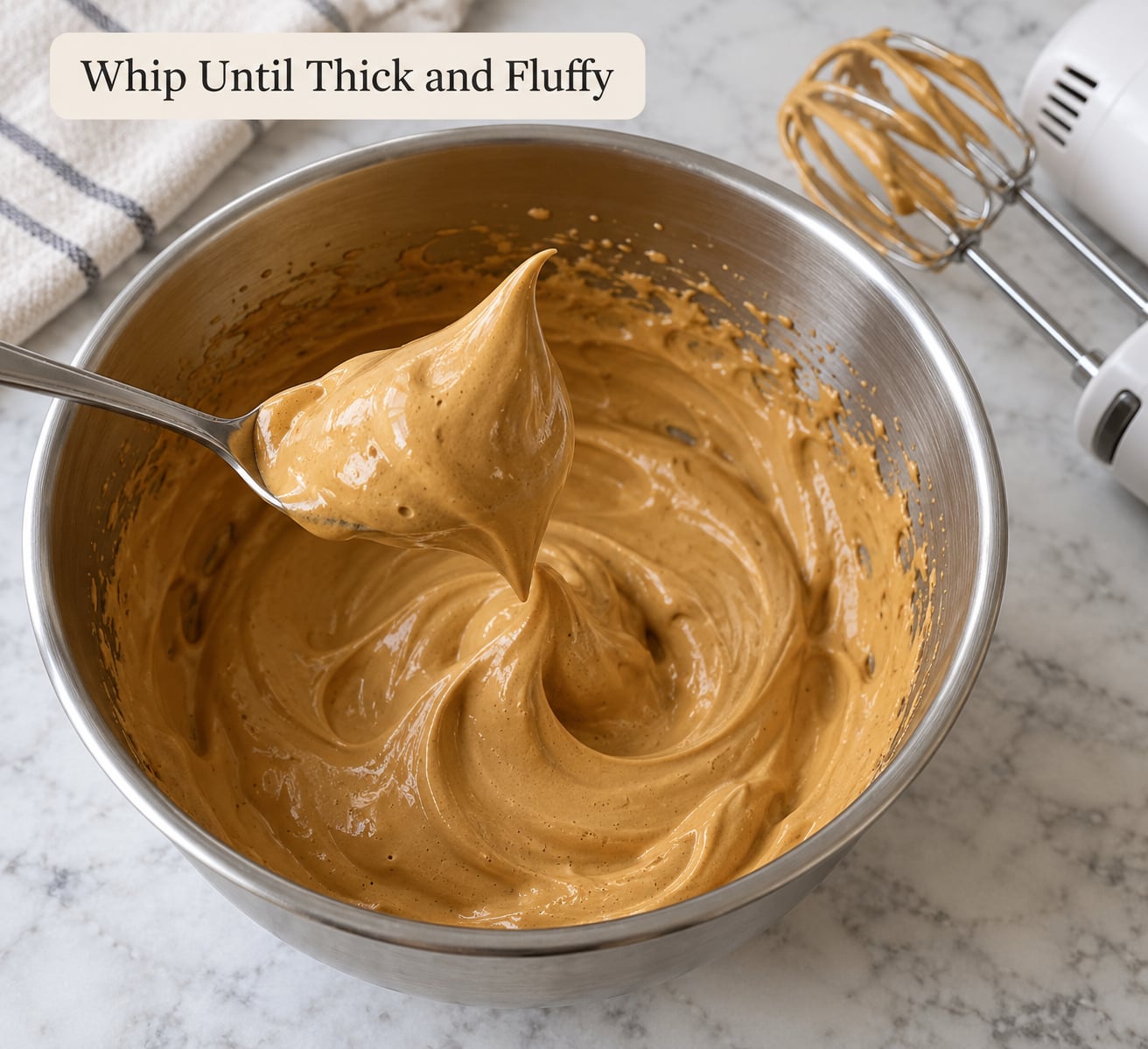
Start the mixer on medium speed. High speed early on throws loose bubbles around instead of building body, so let it settle into a rhythm once the mixture starts moving. Keep the beaters submerged and move the bowl in a slow circle, scraping the sides every half minute or so.
There are three checkpoints, and each one tells you something.
- Thin and dark, around 30 seconds. It will look like ordinary strong coffee. That is normal and not a sign of failure.
- Loose bubbles, around 90 seconds. The volume starts climbing and the surface turns to froth. Large bubbles here are expected, they are the scaffolding the rest gets built on.
- Stiff peaks, 2 to 3 minutes total. The colour shifts from dark brown to a light caramel, the volume roughly triples, and the foam holds its shape when you lift the beaters.
Stop at stiff peaks, not past them. Whipping well beyond that point breaks the foam down into something grainy and slightly watery, and it leaks straight to the bottom of the glass. If you want to check, tap the bowl gently and look for a wobble that settles slowly rather than a liquid surface that sloshes.
3. Layer the Dalgona Coffee Over Iced Milk
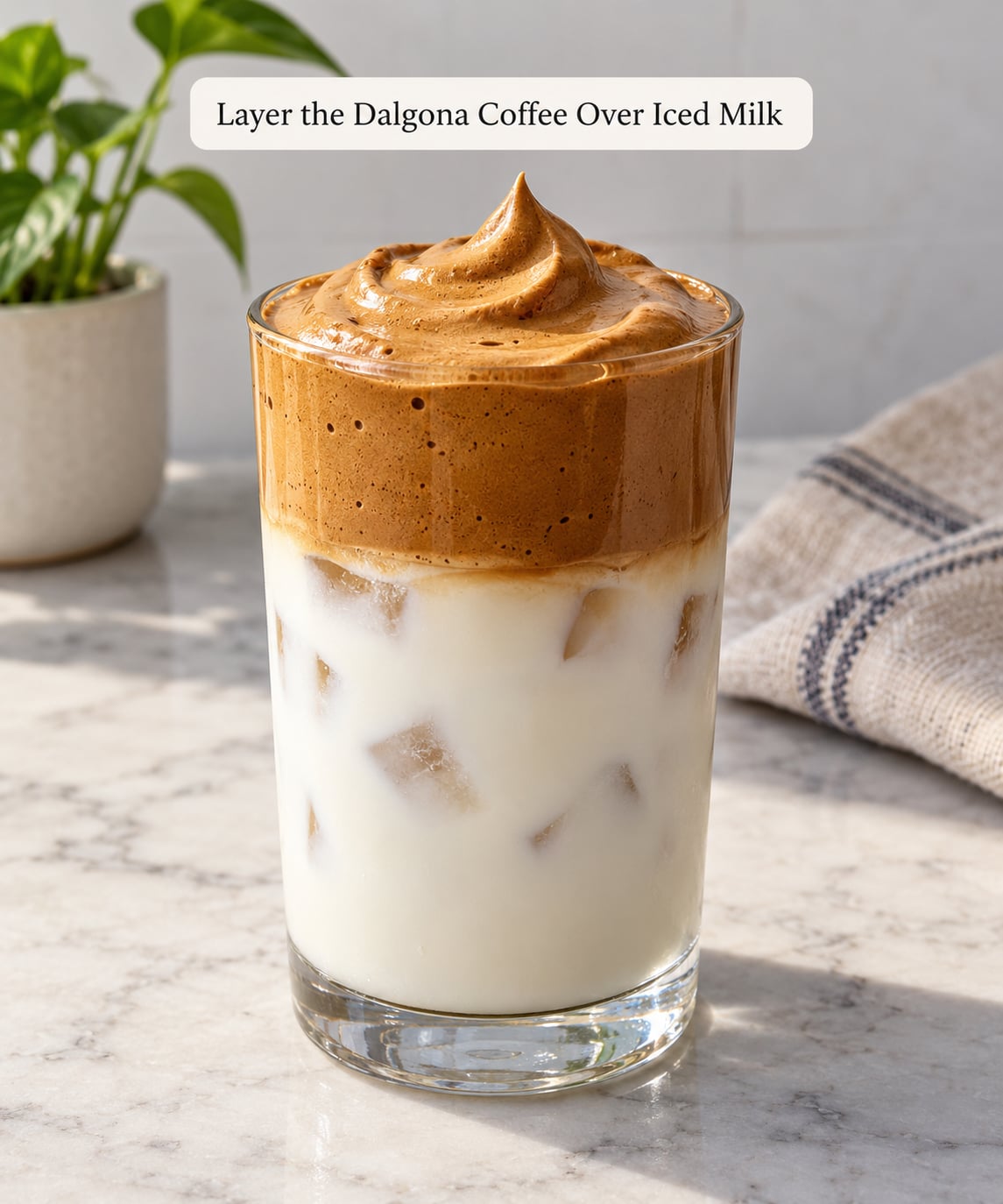
Chill your glass in the freezer for ten minutes while you whip, and fill it about two-thirds with cold milk over ice. Cold milk and cold glass keep the foam from collapsing on contact, which is the difference between distinct layers and a brown drink.
Spoon the foam on top rather than pouring it. A spoon keeps the two-tone boundary clean and stops the foam from sinking halfway through the milk. Use about half the whipped mixture per serving, so a two-serving batch of foam fills two tall glasses.
Drink it layered or stir it in, depending on how much you want the dessert-style sweetness. Swirl in a little extra milk for a lighter, iced-coffee version.
Common Mistakes and Helpful Tips
Nearly every failed bowl comes down to a handful of familiar things. Work through these before you change anything else in the recipe.
The foam stays thin and watery. The water was too cool, or the sugar never fully dissolved before whipping. Make a fresh base with water just off a simmer, stir until glossy, and whip again. Using less water also helps, and a popular large-batch community version uses noticeably less water than the classic 2:2:2 for a stiffer foam.
Nothing happens at all. You probably used brewed coffee, espresso, or ground coffee instead of instant granules. Those have no emulsifying granules in suspension, so air escapes as fast as you beat it in. One Reddit user reported trying espresso with extra cream and extra sugar and still getting no froth, which is consistent with the emulsifier explanation rather than a ratio problem.
The foam looks grainy instead of silky. The sugar did not dissolve. Push the base through a fine sieve, stir in another spoonful of hot sugar syrup, or start over with liquidised or very fine sugar. Sugar crystals that stay whole will feel sandy in the mouth.
The peaks are stiff and the foam leaks. You whipped too long. Over-aerated foam starts breaking down after about four or five minutes of continuous beating, so stop the first time it holds a peak shape and do not chase volume beyond that.
It tastes too sweet. You are almost certainly serving it over sweetened milk, which doubles the sugar. Use plain milk, and drop the base to one and a half tablespoons of sugar. Do not drop it to zero, because the foam will not hold.
The milk is hot. Warm milk thins and dulls the foam almost instantly. Iced dalgona is the classic serve, and cold is what makes the layers work. If you want it hot, spoon the foam over warm milk and drink it right away rather than expecting it to hold.
On make-ahead timing, whipped foam is at its best within an hour and starts to deflate after a couple of hours in the fridge. Store it in a sealed container, not an open bowl, and give it a quick re-whip before serving. Keep the milk separate and pour it cold at the last moment.
Frequently Asked Questions
Can I make dalgona whipped coffee without a hand mixer?
Yes. A wire whisk takes 8 to 20 minutes for the same 2:2:2 batch and produces an almost identical foam, just with a lot more effort. A food processor works in 3 to 5 minutes, though the blade throws mixture up the sides. An immersion blender is the fastest hand option at 1 to 2 minutes, but keep the head fully submerged or the foam will spray everywhere. All four methods hit the same target: volume roughly tripled, colour shifted to light caramel, stiff peaks.
Why is my whipped coffee not getting fluffy?
Three causes account for almost every flat batch. Cold or lukewarm water is the most common, because the sugar never fully dissolves and the foam stays thin. The second is using brewed or ground coffee, which lacks the emulsifying granules that hold air. The third is whipping too long, which breaks foam down after four or five minutes. Fix all three by starting fresh with hot water, instant granules, and a timer you stop at the first stiff peak.
Can I use regular coffee instead of instant coffee?
Not for this recipe. Instant coffee granules dissolve into the mixture and carry soy-derived emulsifiers that let air bubbles survive whipping. Brewed coffee and ground coffee do not, so the foam collapses as fast as you build it, even with extra sugar or cream. If you want a lower-caffeine version, use decaf instant granules instead, which whip exactly like the caffeinated ones. Strong brewed coffee belongs under the foam as a separate layer, not in it.
Can I make dalgona coffee ahead of time?
Yes, with a caveat about timing. Whipped foam is best within an hour and slowly deflates over a couple of hours, so store it in a sealed container in the fridge rather than an open bowl. Give it a short re-whip with a spoon or mixer before serving to bring the volume back. Keep the milk separate and pour it over ice at the last moment, since warm or still milk knocks the foam down fast.
Can I use milk alternatives for dalgona whipped coffee?
Yes, and the choice changes the flavour more than the foam. Whole milk is richest and classic, oat milk is creamy with a cereal note, almond is lighter and thinner, and coconut gives the strongest tropical flavour. Sweetened varieties make the whole drink sweeter, so pair them with a base made slightly under two tablespoons of sugar. Avoid anything already very warm, and skip very thin rice milk if you want the layers to stay clean.
Conclusion
If you keep one line from how to make dalgona whipped coffee, make it this: hot water, equal parts of everything, and stirring until the base is glossy with no dry sugar left in the bowl. From there, whip on medium speed for two to three minutes and stop the moment it holds stiff peaks and has roughly tripled in volume. Spoon it over a chilled glass of iced milk, keep the layers intact, and drink it before the foam settles.