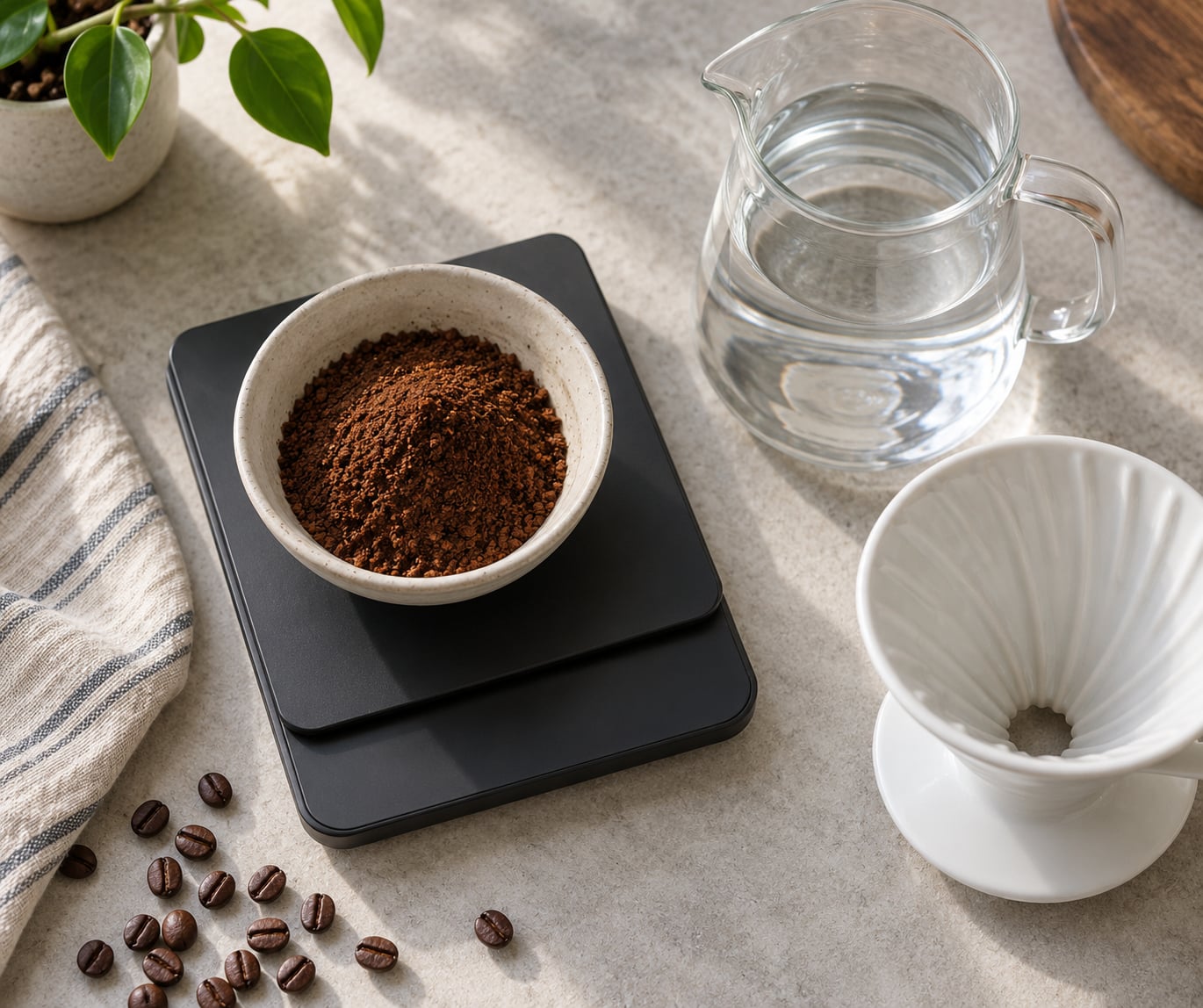
Measure coffee by weight, not by scoop: weigh your ground coffee in grams on a scale, then multiply that number by your ratio to get your water in grams, since 1 gram of water is 1 milliliter. Start at a 1:16 ratio, which is roughly 60 grams of coffee per liter of water. The whole method takes about 30 seconds once the scale is out, and it is the difference between a cup you can repeat tomorrow and one you never get back.
The reason it matters is that tablespoons are not a repeatable unit. Depending on how the beans were roasted and how tightly they were ground, one tablespoon of coffee can land anywhere between 4 and 7 grams. That is a 75% swing before you even start pouring.
Below is the setup, the math, the starting ratios for each brewing method, and the adjustments that turn a weak or bitter pot into one you actually want to drink.
Table of Contents
- What You Need
- Step-by-Step: How to Measure a Coffee to Water Ratio
- How to Calculate the Coffee to Water Ratio
- Choose a Starting Ratio for Your Brewer
- Measure the Ratio by Weight
- Taste and Adjust the Result
- How to Measure Coffee Without a Scale
- Common Mistakes
- Frequently Asked Questions
- What is the ideal coffee to water ratio in grams?
- How many scoops of coffee to water ratio?
- How to measure coffee weight without a scale?
- If I have 30 grams of coffee, how much water should I use?
- Why is my coffee bitter even though the ratio is right?
- What is the 15-15-15 coffee rule?
- Conclusion
What You Need
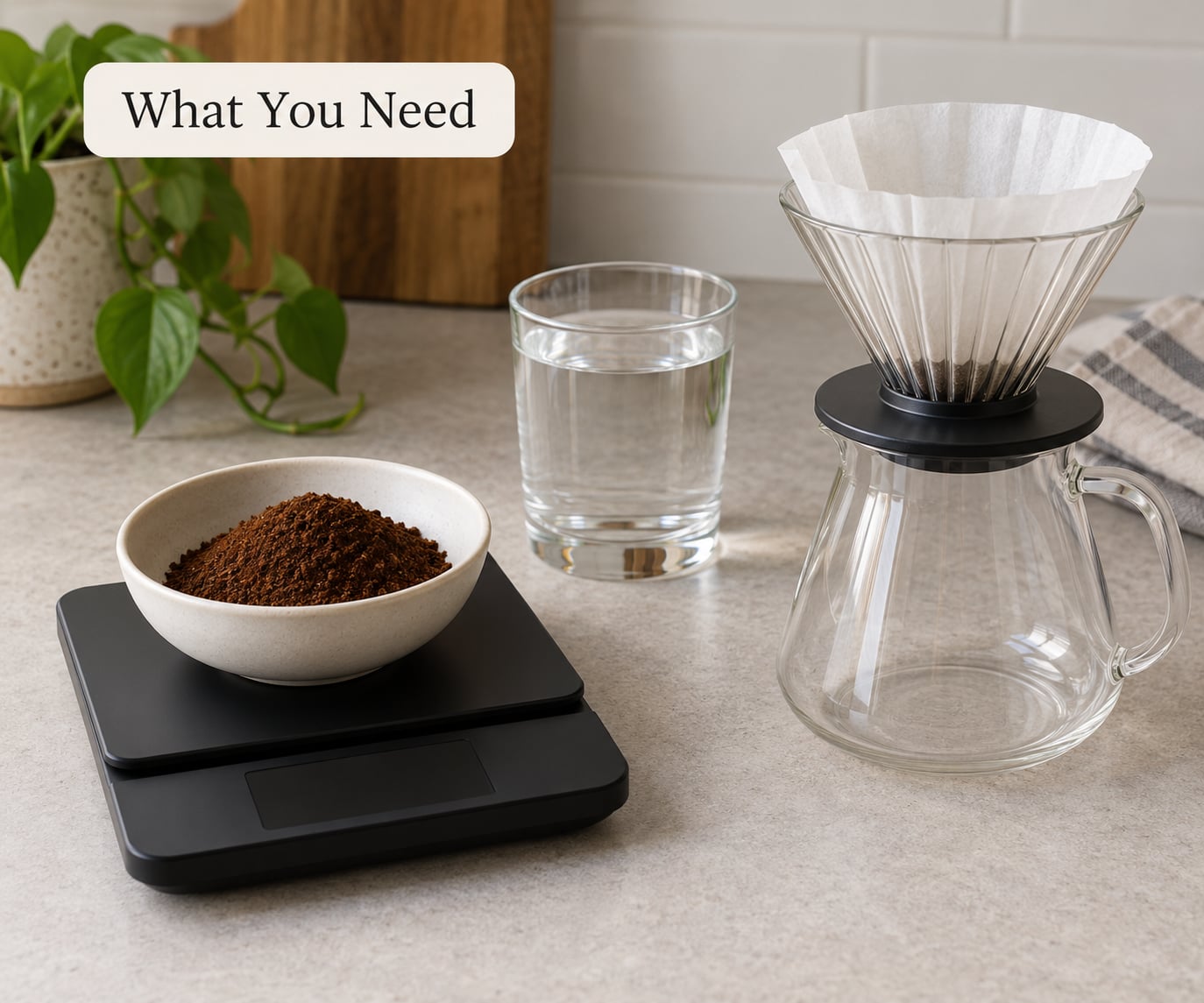
A scale with 0.1 gram resolution is the one tool worth buying. The cheap pocket scales that read to 0.1 g do everything you need, and the brewing world treats that resolution as the practical floor rather than a luxury.
Alongside it you want:
- Fresh coffee, ground to suit your brewer
- Filtered or bottled water, heated to somewhere between 195 and 205 F (90 to 96 C) for most methods
- A brewer: drip machine, pour-over cone, French press, AeroPress, moka pot, or a jar for cold brew
- A kettle with a gooseneck spout if you brew by hand, since pouring control matters as much as the dose
- A spoon or small container to hold the grounds between weighing and brewing
Water is the easy half of the measurement, because 1 gram of water equals 1 milliliter. So when a recipe calls for 480 grams of water, you can pour any measuring cup that holds 480 ml, including 2 US cups, and you have measured it correctly by weight.
Coffee is the awkward half, because density varies by bean. The same scoop of a dark, oily roast weighs more than a scoop of a light, dusty Ethiopian roast. Weighing removes that variable entirely, which is why home baristas treat ratio as the constant they hold and grind as the variable they tune.
Step-by-Step: How to Measure a Coffee to Water Ratio
Here is the process in full. It works the same whether you are making 250 ml in a cone or 1.8 liters in a machine.
- Decide your water amount first. Water is what you actually want to drink, and it is easier to measure than coffee. Fill your vessel, or decide how much is left in the kettle.
- Look up or choose your ratio. For most drip and pour-over brewing, start at 1:16. French press usually lands between 1:15 and 1:16. Cold brew concentrate runs much stronger, around 1:8.
- Do the division. Divide your water in grams by the ratio number. That gives you the coffee dose in grams.
- Put the brewer on the scale and tare it. Press the tare or zero button with the empty vessel sitting there. Now the display reads zero and only the coffee counts.
- Add coffee until you hit the number. Pour grounds in gradually and watch the display. Grind, then weigh, not the other way around.
- Pour the measured water. If you are brewing by hand, weigh the water in your kettle or carafe first, then pour to that target in stages.
- Brew, taste, and write it down. Record the dose, the water, and what the cup tasted like. Change one variable next time.
How to Calculate the Coffee to Water Ratio
A coffee to water ratio is written as 1:X, and X tells you how many parts of water go with one part coffee. So 1:16 means one gram of coffee for every sixteen grams of water. Anything larger than 16, like 1:17 or 1:18, is a weaker cup. Anything smaller, like 1:15 or 1:14, is stronger.
The formula for finding the coffee dose is simple:
Coffee in grams = water in grams ÷ ratio number
And the reverse, for scaling water from a dose you already know:
Water in grams = coffee in grams × ratio number
Worked example: 15 grams of coffee with a 1:16.7 ratio needs 250 grams of water, which is 250 ml. That single cup is the reference most pour-over recipes are built on, and it is why a 1:16 ratio keeps landing near 16 grams of coffee per 250 ml of water.
Here is the same math for a full pot. Everything below uses 8-ounce cups, which is 240 ml each.
| Cups of water | Water (ml) | Coffee at 1:16 (g) | Coffee at 1:18 (g) |
|---|---|---|---|
| 1 | 240 | 15 | 13 |
| 2 | 480 | 30 | 27 |
| 3 | 720 | 45 | 40 |
| 4 | 960 | 60 | 53 |
| 5 | 1200 | 75 | 67 |
| 6 | 1440 | 90 | 80 |
| 7 | 1680 | 105 | 93 |
| 8 | 1920 | 120 | 107 |
| 9 | 2160 | 135 | 120 |
| 10 | 2400 | 150 | 133 |
| 11 | 2640 | 165 | 147 |
| 12 | 2880 | 180 | 160 |
The third column is your everyday dial-in point. The fourth is for anyone who finds 1:16 too heavy, and it lands close to 60 grams of coffee per liter, the modern specialty standard.
Here is the unit cheat sheet, because most ratio confusion is really unit confusion:
| Measure | What it equals |
|---|---|
| 1 gram of water | 1 ml |
| 1 US fluid ounce | about 29.6 ml |
| 1 cup | 240 ml, or 240 grams of water |
| 1 standard coffee scoop | 2 tablespoons, roughly 10 grams |
| 1 tablespoon of whole beans | roughly 4 to 7 grams, depending on roast |
That last row is the one that causes trouble. If a recipe says two tablespoons per cup and your beans happen to be on the heavy end, you are dosing 14 grams where the recipe expected 8. Spoons describe volume, and volume is not a repeatable proxy for weight.
Choose a Starting Ratio for Your Brewer
Two different things get confused when people talk about strength. Brew strength is how much coffee ends up in your cup, and it is mostly the ratio. Extraction is how much of that coffee got pulled into the water, and it is mostly grind, time, and temperature. Ratio alone will not make a bitter cup bitter if your grind and time are right.
That is why the same bag tastes different at 1:15 and 1:18. The ratio changed the strength, and the extra water gave the grounds more time and more surface contact, so the extraction moved too.
| Method | Starting ratio | Typical dose | Grind |
|---|---|---|---|
| Drip machine | 1:16 to 1:18 | 15 g per 240 ml | Medium |
| Pour over (V60, Chemex, Kalita) | 1:16 to 1:17 | 15 to 18 g per 250 ml | Medium-fine |
| French press | 1:15 to 1:16 | 30 g for 500 ml | Coarse |
| AeroPress | 1:13 to 1:15 | 15 g for 220 ml | Medium-fine |
| Moka pot | 1:10 to 1:12 | Fill the basket level, do not pack | Fine |
| Cold brew concentrate | 1:8, then dilute 1:1 with water or milk | 100 g per 800 ml, steep 12 to 18 hours | Extra coarse |
| Espresso | 1:2 dose to yield | 18 g in, 36 g out | Fine |
| Iced coffee | 1:8 to 1:10, then cut with ice and milk | Same as concentrate | Medium |
Espresso is the odd one out. Its 1:2 is a dose-to-yield figure, not coffee-to-water, because most of the water never leaves the puck. A double shot of about 36 grams of liquid coming from an 18 gram dose is right in line.
For strength on a normal brew, the shorthand is 1:18 or higher for a light cup, 1:16 for a balanced middle, and 1:15 or less for a strong one. If your coffee is light-roasted, lean toward the weaker end, because lighter roasts are less dense and give up their flavors faster.
Measure the Ratio by Weight
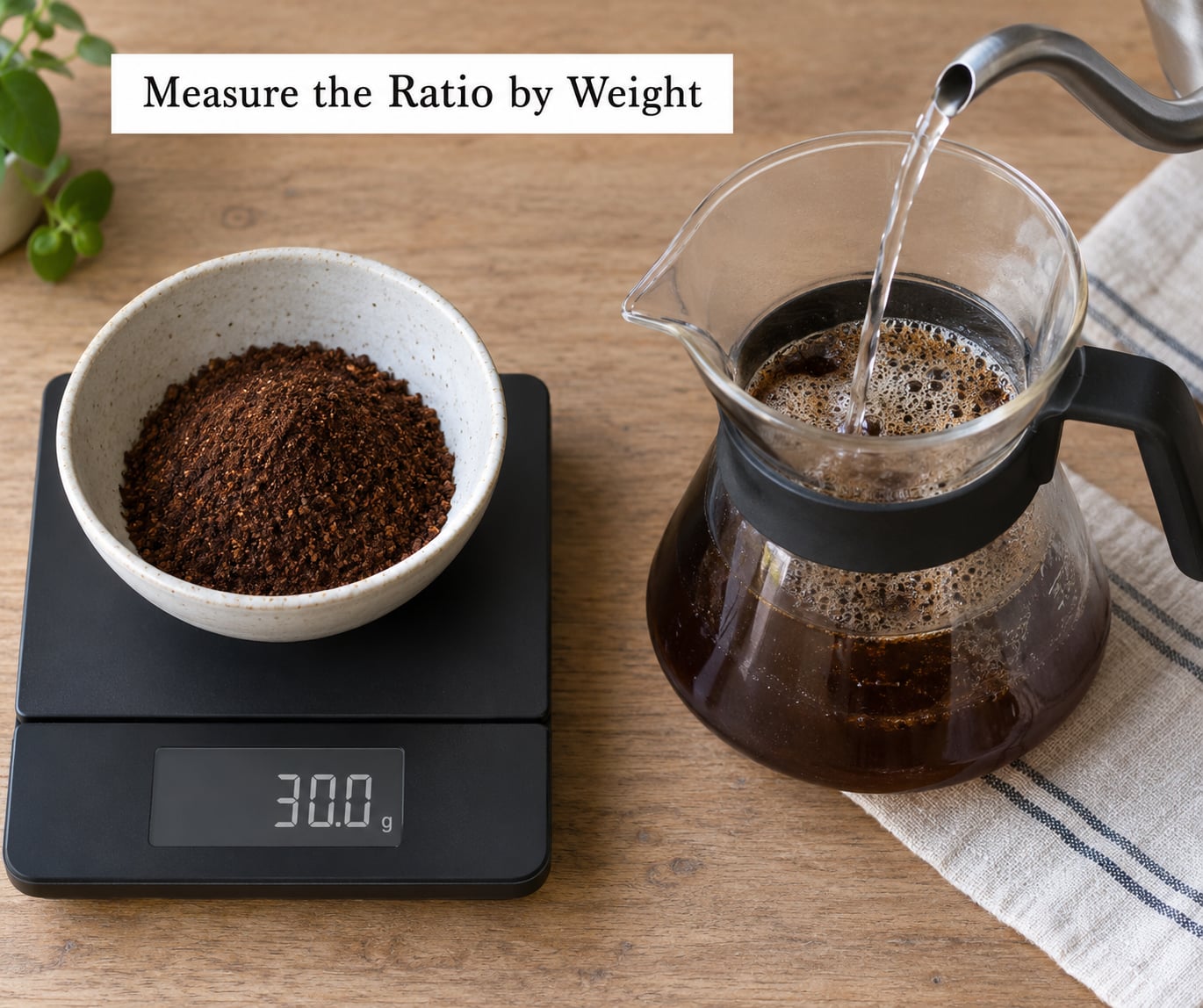
When people ask how to measure a coffee to water ratio, they are usually asking which unit to trust: the scale or the scoop. It is the scale, every time. The sequence takes five steps and it is the same every single time:
1. Put your brewer, mug, or carafe on the scale and press tare.
2. Add ground coffee in small amounts until the display reads your target dose.
3. Lift the vessel off the scale and move the coffee to your brewer, or brew directly on the scale if your brewer allows it.
4. Weigh your water. Because 1 g equals 1 ml, a target of 480 grams and a target of 480 ml are the same measurement.
5. Brew, then repeat the identical numbers next time so you can isolate what changed.
Example: you want a French press for two people. Two 8-ounce cups is 480 ml of water. At 1:15, divide 480 by 15 to get 32 grams of coffee. Tare your press, add 32 grams of coarse grounds, and pour 480 ml of water at about 200 F.
Why bother with all that when a scoop is quicker? Because the scoop makes your coffee unrepeatable, and repeatability is the whole point. Once you have a number that works, you never have to guess again, and you can change one variable at a time to actually learn what each one does.
Taste and Adjust the Result
Taste before you change anything, and describe what you notice rather than labeling the cup good or bad.
- Sour, thin, and short of sweetness usually means under-extraction. Move the grind finer, lengthen the contact time, or use slightly hotter water.
- Bitter, dry, and hollow means over-extraction. Go coarser, shorter, or cooler.
- Weak but clean-tasting means you have a solid ratio with too little coffee in it. Add coffee, not water. Going from 1:17 to 1:16 adds strength without changing how the grounds extract.
- Strong and slightly sour at once means you have plenty of coffee but your grind is too coarse for the amount of water. Change the grind before you add more coffee.
Make small moves. Changing the ratio by one step, from 1:16 to 1:15 or 1:17, is a meaningful adjustment. Going from 1:16 to 1:10 in one session is a new recipe, and you will not learn which change fixed the problem.
Fix problems in a set order. Start with the ratio, since it sets strength and is easy to hold constant. Then move the grind, which changes extraction. Then adjust water temperature within 195 to 205 F, and only then change brew time. Users on home brewing forums follow roughly the same order, and it is why their recipes improve quickly: each brew isolates one variable.
Write down what worked. A note that reads 18 grams of coffee, 300 ml of water, 200 F, three minutes, ground like coarse sand is worth more than any table in a book, because it is tuned to your beans, your water, and your taste.
Filtered water matters more than people expect. Water that tastes flat or faintly metallic will flatten an otherwise good ratio, and no adjustment to the dose will fix it.
How to Measure Coffee Without a Scale
If you have no scale, three methods work, and none of them are as good as owning one.
A kitchen or bathroom scale. Any scale that reads to the gram will do for batch brewing. Zero it with your bowl on top, add coffee until the number reads right, and subtract the bowl’s weight if it was not zeroed. This works up to about 90 grams of coffee, which covers most full pots.
Tablespoon math. A standard coffee scoop equals two tablespoons and lands near 10 grams for most medium roasts. For a 15 gram dose, that is one scoop plus one tablespoon. Expect drift of a couple of grams in either direction, which on a 15 gram dose is a noticeable difference, so treat scoop recipes as a starting point and refine once you own a scale.
Divide the bag. If you brew every day from the same bag, count the doses you get through and split the bag into equal parts. A 340 gram bag is roughly 34 ten-gram doses. Mark the bag with a pen after each brew and you have a repeatable system with no equipment at all.
A note on one unit worth abandoning entirely: the machine’s printed cup count. A 12-cup drip machine does not produce twelve 8-ounce cups. The carafe in most of them holds roughly 60 fluid ounces, which is closer to six and a half real cups, and the reason coffee from those machines so often tastes over-extracted is that people dose for twelve. Volume the water into a jug instead, weigh it, and dose from the number.
Common Mistakes
Measuring coffee by volume. Tablespoons and scoops measure space, not mass, and bean density swings enough that one tablespoon can be 4 or 7 grams. Weigh it, or at least use the same scoop every time rather than filling it by eye.
Reading the ratio backwards. In 1:16, the 1 is always coffee and the 16 is always water. Getting this backwards means brewing four times more coffee than intended.
Treating the cup count on the machine as real cups. That printed number is an advertising convention, not a volume. Measure the water you actually pour.
Using inconsistent scoops. A heaped scoop and a level scoop can differ by several grams. Level it off, every time.
Ignoring bean density when switching beans. The scoop that worked with your old dark roast will under-dose a new light roast, because the same volume weighs less. Reweigh after every bean change.
Changing grind and ratio at the same time. Then you have no idea what fixed it. Change one, taste, note the result.
Adding coffee to fix a bitter cup. Bitterness is nearly always over-extraction, which is a grind and time problem. More coffee at the same grind makes it worse. Go coarser first.
Using far too little coffee. Under-dosing is common when people carry over a tablespoon habit from cheap pre-ground coffee. If the cup is thin and watery, 1:16 is the fix, not 1:10.
One more worth naming: chasing the old 10 grams per 6 ounce standard and the modern 60 grams per liter at the same time. They are close but not identical, and mixing them confuses the arithmetic. Use 60 grams per liter, which is about 14.4 grams per cup, and stay consistent.
Frequently Asked Questions
What is the ideal coffee to water ratio in grams?
A good starting point is 1:16, which works out to about 60 grams of coffee per liter of water, or roughly 15 grams of coffee per 240 ml cup. Lighter roasts taste better at 1:17 or 1:18. Darker roasts and French press usually sit at 1:15. The number matters less than staying consistent so you can adjust deliberately.
How many scoops of coffee to water ratio?
One standard coffee scoop, which is two tablespoons, lands near 10 grams for most medium roasts. That works out to about one scoop per 6 ounces of water at a 1:15 ratio, or one scoop per 8 ounces at a 1:19 ratio. Spoons are approximate, though, because a tablespoon of beans can weigh anywhere from 4 to 7 grams depending on roast.
How to measure coffee weight without a scale?
Use a bathroom scale that reads to the gram: zero it with your bowl on top, add coffee until the display shows your target, then subtract the bowl weight if you did not zero it. Two other options work as backups: use tablespoons with a level scoop and accept a gram or two of drift, or split a bag of beans into equal daily portions and mark each one off as you brew.
If I have 30 grams of coffee, how much water should I use?
Multiply your coffee weight by the ratio number. At 1:16, 30 grams of coffee needs 480 grams of water, which is 480 ml, or two US cups. At 1:15 it needs 450 ml, and at 1:18 it needs 540 ml. Those three numbers cover most of what you would brew with a 30 gram dose, from a small French press to a two-cup pour over.
Why is my coffee bitter even though the ratio is right?
Bitterness is a sign of over-extraction, which means too much of the coffee was pulled into the water, and it is not a ratio problem. Go coarser on the grind, shorten the brew time, or drop the water temperature a few degrees. Adding coffee at the same grind will usually make the bitterness worse, not better.
What is the 15-15-15 coffee rule?
It is a loose home-brewing shorthand rather than an official standard: 15 grams of coffee, 15 grams of water for the bloom, and roughly 15 minutes between the first pour and the last. It gets handed around as an easy starting point, but the numbers are not precise. Use a proper ratio and weight your coffee instead.
Conclusion
That is the whole of how to measure a coffee to water ratio: pick your brewer, put a scale on the counter, and brew one batch at 1:16. Divide your water in grams by 16 for the coffee dose, tare the vessel, weigh the grounds, pour the measured water, and taste. Adjust from there, one variable at a time, and the guessing stops.