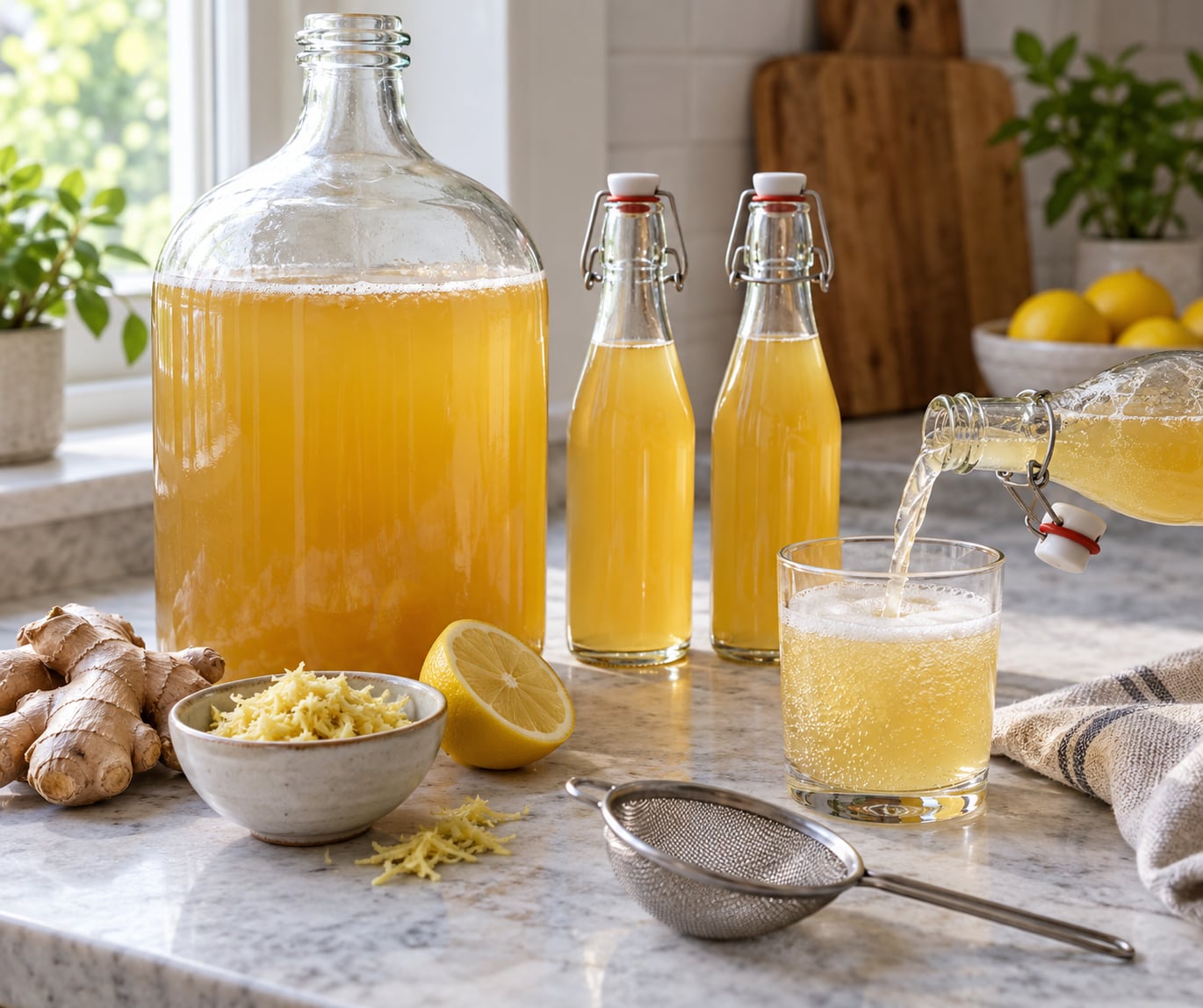
Knowing how to make ginger beer at home comes down to fresh ginger, sugar, filtered water and a starter culture — either a wild-yeast ginger bug or a packet of brewer’s yeast — fermented warm for about 48 hours, then bottled so the carbon dioxide stays trapped. Twenty minutes of work, two days of waiting, and a small mountain of bottles at the end.
The reason to bother is taste and control. Store-bought ginger beer is force-carbonated and sweetened to the point of syrup, while a fermented batch tastes sharper, spicier and more complex, and you decide how much sugar goes in. It is also the best Moscow Mule mixer you will ever find.
This guide covers everything for a two-litre batch, plus the three routes you can take and how to scale down to a single bottle. If you want a worked example first: the ginger bug method is the traditional one and gives the most complex flavour, brewer’s yeast is faster and far more predictable, and a soda stream skips fermentation entirely for a same-day drink.
Table of Contents
- What You Need
- Ingredients for a 2-litre batch
- Equipment
- Which route to take: ginger bug vs brewer’s yeast vs soda stream
- How to Make Ginger Beer at Home: Step-by-Step
- Prepare the Ginger and Citrus
- Mix the Ginger Beer Base
- Ferment and Carbonate: How to Make Ginger Beer Fizzy
- Chill, Bottle, and Store
- Common Mistakes
- Frequently Asked Questions
- Do I need a brewing kit to make ginger beer at home?
- How long does homemade ginger beer take to ferment?
- Why is my homemade ginger beer flat?
- Can I make ginger beer without yeast?
- How much sugar should I use for a less-sweet ginger beer?
- Can I bottle ginger beer while it is still fermenting?
- Conclusion
What You Need
The ingredient list is short, and every item is cheap and easy to source. The equipment list is shorter still if you already keep any glass bottles with caps.
Ingredients for a 2-litre batch
- 60 g fresh ginger root (about 12 cm / 5 inches), unpeeled, from the organic aisle if you can find it
- 200 g cane sugar (1 cup) — white sugar gives clean fizz, brown sugar or a spoon of molasses adds depth
- 2 litres filtered water, or cold tap water left to stand uncovered overnight so the chlorine dissipates
- 3-5 tablespoons ginger bug starter, or 1/2 teaspoon active dry brewer’s yeast, or 1/4 teaspoon champagne yeast
- Juice of 2 lemons (about 60 ml), plus the zest of one if you want more citrus oil in the aroma
- 1 teaspoon cream of tartar, optional — it adds acidity that mellows the heat of the ginger
- A pinch of salt, optional — a rounding error of salt cuts perceived sweetness more than anything else you can add
On the ginger, most people in home fermentation forums peel it because the skin looks muddy in a drink. I would wash it well and use it unpeeled: the skin carries much of the wild yeast and bacteria that make a bug method work. If your ginger is old and the skin is wrinkled, peel it and add a little extra culture instead.
On the sweetener, do not reach for anything zero-calorie. The culture eats real sugar, so artificial sweeteners produce a flat, lifeless batch that never carbonates and sometimes pulls an off-flavour. If you want less sugar, cut the real sugar. Sweeten the finished batch after bottling if you want the drink drier in the glass but still lively.
Equipment
- A large pot for the sugar syrup, or a microwave-safe jug
- A 2-litre glass jar, carafe or carboy with a lid
- Airlock and rubber bung, or a lid set slightly loose with a pinch of baking soda in the seal
- Fine mesh sieve, coffee filter or clean cheesecloth
- Two 1-litre swing-top (flip-top) bottles, or heavy plastic soda bottles
- A bottle capper for screw-tops, plus about six regular caps
- Cheesecloth or a paper towel and a rubber band for the bug jar
- An instant-read thermometer if you are using brewer’s yeast — the temperature matters
You do not need a brewing kit, a hydrometer or a pH meter. None of them. A home thermometer and clean glass are genuinely useful; everything else on that list you can improvise with a jam jar and a tea towel. Sanitising matters more than expensive gear: run your bottles through a hot dishwasher cycle or pour boiling water over them, and you have done enough for a low-alcohol batch like this one.
Skip the sanitising solution for the first run. Ginger beer is not a high-risk project the way homebrew is, and boiling water plus careful handling covers almost all of it.
Which route to take: ginger bug vs brewer’s yeast vs soda stream
No competitor I looked at puts the options side by side, and it is the first thing to decide, because it changes your timeline more than anything else in the recipe.
| Method | Active time | Total time to fizzy | Flavour | Alcohol |
|---|---|---|---|---|
| Ginger bug (wild yeast) | 20 min plus 3-5 days building the starter | 5-9 days | Complex, lightly vinegary, deepest ginger | Trace to about 1% |
| Brewer’s or champagne yeast | 20 min | 2-3 days | Clean, predictable, bright ginger | Under 1% |
| Soda stream, no fermentation | 10 min | Under an hour | Fresh, closest to ginger ale | None |
| Store-bought ginger ale | None | None | Sweet, blunt, force-carbonated | None |
My advice: make your first batch with brewer’s yeast, because it teaches you the timing without the unpredictability. Then build a ginger bug, feed it for a few days, and use it for a second batch when you want the real thing. People who keep both going say the bug route is worth it, and the cultures last for years if you feed them.
How to Make Ginger Beer at Home: Step-by-Step
Prepare the Ginger and Citrus
Wash the ginger under cold water and scrub the skin with your thumb. Grate it on the fine side of a box grater, or slice it into thin coins if you prefer a clearer drink. Finely grated ginger gives up its oils faster, which means stronger flavour in less time and usually a slightly cloudy batch; sliced ginger extracts more slowly and leaves sediment behind.
Zest the lemon before you juice it, then add the zest to the pot. The oils in the peel are most of what you smell when the bottle opens.
Heat 1 litre of your water with the ginger, citrus peel and salt. Bring it to a simmer, cover, and turn the heat down for 15 minutes. Do not boil hard — hard-boiled ginger tastes harsh and slightly bitter, which is the most common flavour complaint about homemade versions.
Strain through a coffee filter or a double layer of cheesecloth. Squeeze the solids hard to get every drop of ginger juice; that liquid is where most of the flavour lives.
Mix the Ginger Beer Base
Stir the sugar into the strained ginger liquid while it is still warm and dissolved, then add the remaining litre of cold water. Your finished wort should taste clearly sweet but not syrupy — somewhere near sweet iced tea. If you can only get it to dissolve in patches, warm the last of the water in a jug and swirl it in separately.
This is the step where beginners lose their culture. Yeast dies above about 40 C / 104 F, and a wild starter poured into near-boiling syrup dies just as thoroughly. Cool the wort to room temperature, roughly 20-25 C / 68-77 F, before anything alive goes in. Test it with a clean finger on the wrist if you have no thermometer.
If you want to measure sugar properly instead of tasting, a hydrometer reading of about 1.040-1.045 before fermentation gives a lively but drinkable batch. Without brewing equipment, taste and adjust: add a tablespoon of sugar per litre if it needs more body, or dilute with filtered water if it tastes cloying.
Stir in the lemon juice, the strained ginger juice and your starter. For a ginger bug, use 3-5 tablespoons of the active culture and a pinch of sugar. For brewer’s yeast, sprinkle 1/2 teaspoon of dry yeast over the surface and let it sit five minutes before stirring in, so you can see whether it rehydrated and looks alive.
If you are using a ginger bug for the first time, build it three to five days ahead: 2 tablespoons of grated ginger and 2 tablespoons of sugar in 250 ml of filtered water, covered with cheesecloth, fed daily with more ginger and sugar. It is ready when it smells sharp and fizzy and shows bubbles. People in r/gingerbeer keep these going indefinitely, draining off a cup or two every week to keep the culture fed, and passing some to friends.
How much of what for a smaller batch
| Batch | Fresh ginger | Sugar | Water | Starter |
|---|---|---|---|---|
| 750 ml | 25 g | 75 g | 750 ml | 1-2 tbsp bug, or 1/4 tsp yeast |
| 1 litre | 30 g | 100 g | 1 litre | 2 tbsp bug, or 1/3 tsp yeast |
| 2 litres | 60 g | 200 g | 2 litres | 3-5 tbsp bug, or 1/2 tsp yeast |
| 4 litres (1 gallon) | 110 g | 400 g | 4 litres | 6-8 tbsp bug, or 1 tsp yeast |
Ferment and Carbonate: How to Make Ginger Beer Fizzy
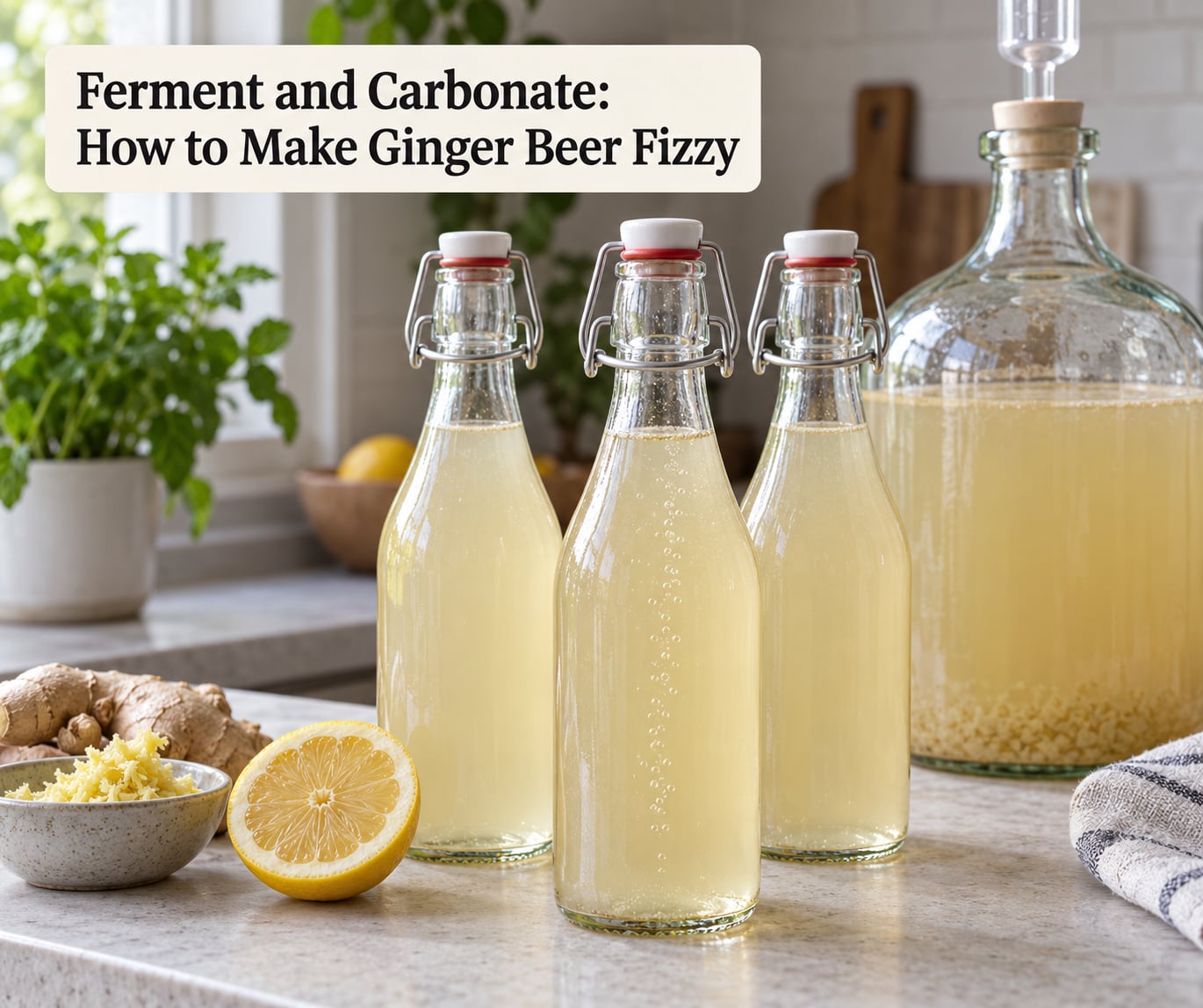
Transfer the wort to your clean jar, seal it, and leave it somewhere around 20-25 C / 68-77 F for 48 hours. Out of direct sunlight, out of a warm cupboard. Then put the lid back on loosely with the airlock fitted, and move on to bottling.
Watch three things rather than the clock. New bubbles clinging to the ginger and rising in the first few hours means fermentation has started. The airlock should begin bubbling within a day, sometimes within hours. And the aroma shifts from sweet ginger-syrup to a sharper, yeasty, almost beery smell.
Wild yeast and bacteria living on the ginger skin convert sugar into carbon dioxide and a little alcohol. While the wort sits open to the air that CO2 escapes and nothing happens. Bottle it, and the gas has nowhere to go but into the liquid. That trapped gas is your fizz.
Bottle at exactly 48 hours and you land on a gently sparkling drink with a little sweetness left. Wait five or six days and you get something drier, sharper and closer to a light kombucha, with a touch more alcohol. Forum regulars describe a long, slow 12-18 hour ferment as the route to the lowest-alcohol result, which matters if you are making this for someone avoiding alcohol or serving it to a mixed-age crowd.
Leave two fingers of headspace in every bottle, and never fill to the neck. Gas pressure needs somewhere to go, and a bottle filled to the shoulder is a bottle that can foam over the moment you open it or crack in the fridge.
Use swing-top glass bottles for reliable carbonation, or heavy plastic soda bottles if you are nervous about glass. Thin, cheap plastic bottles bulge and leak, and screw-tops with loose caps have a habit of going flat in a week. If you do use caps, cap them properly and do not retighten after a day — venting forever gives you a flat drink.
Chill, Bottle, and Store
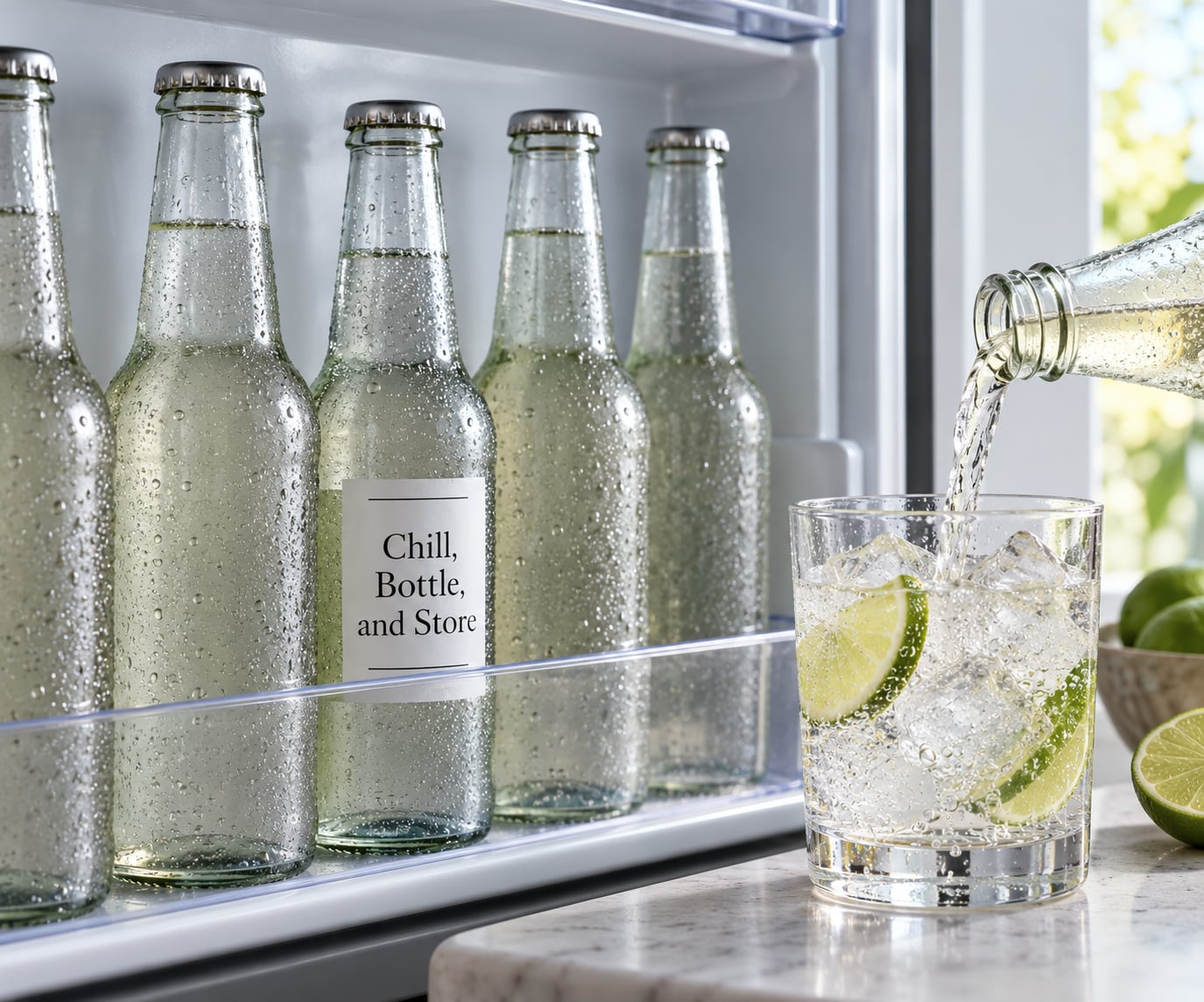
Bottled ginger beer needs 24 hours at room temperature to carbonate properly, then 2-3 days in the fridge. That room-temperature day matters: chilling too early puts the yeast to sleep before the CO2 has built, and you open a flat bottle three days later wondering what went wrong.
Before day three, do the burp test. Gently loosen one cap until it hisses, take the pressure off, and tighten it again. Repeat daily. Pressure builds every time you skip it, and a bottle that feels rock hard under your hand will geyser across your ceiling.
After 3-4 days, move everything to the fridge. Cold slows the culture right down and locks the carbonation in, which is exactly how you stop fermentation and keep the fizz. A batch made this way keeps 2-3 months refrigerated; past that the flavour flattens as the last of the culture dies.
If a bottle is rock hard, gurgles aggressively or looks slightly swollen, put it in the sink and open it very slowly over the plug hole. Never freeze carbonated glass, and never put a swollen bottle in a glass recycling bin.
Serve it over ice with a wedge of lime, or use it as the ginger component in a Moscow Mule, a Dark ‘n’ Stormy or a ginger beer shandy. Hold back a little sugar syrup and stir it in at the table for anyone who finds it sharp.
Common Mistakes
Flat ginger beer is the number one failure, and it is almost always one of four things: the culture died, there was not enough headspace or the sugar was too low, the wort was too hot when inoculated, or the sweetener was not real sugar.
| Symptom | Likely cause | Fix |
|---|---|---|
| No carbonation at all, flat soda | Culture killed by hot wort, or too little starter, or artificial sweetener | Cool to 20-25 C / 68-77 F before adding yeast, double the starter, use real cane sugar |
| Flat after opening, but sweet | Bottled too late, or caps vented instead of holding pressure | Bottle at 48 hours, cap tightly, stop daily burping once carbonated |
| Bubbles at the airlock then silence | Fermentation finished before bottling, so no CO2 was left to trap | Bottle as soon as the airlock slows, around day 2, even if the wort seems quiet |
| Gushes and foams everywhere | Too much headspace or over-carbonation from extra sugar | Bottle to a 2-finger headspace, burp daily, refrigerate sooner |
| Very sweet, barely fizzy | Sugar added too late in fermentation, or too much of it to begin with | Reduce sugar, or bottle earlier and finish with a small syrup at the table |
| Sour, kombucha-like, smells of vinegar | Fermented far too long at high sugar | Bottle at 48 hours, refrigerate, and shorten the next batch by a day |
| Bitter or harsh ginger bite | Ginger boiled hard, or steeped far too long | Simmer gently for 15 minutes only, and taste the syrup before bottling |
| Cloudy with thick sediment | Unfiltered ginger and yeast | Pour off the bottle carefully and leave sediment behind; it is harmless |
If you used a packet of baker’s yeast, throw the batch out and start again. Baking yeast is a different strain, it behaves unpredictably in a cold, weakly sweetened wort, and it reliably produces a flat drink. Brewer’s yeast or champagne yeast from a homebrew shop is a few pounds more and does what you need.
If your ginger bug is not bubbling, it is often not dead. Wild cultures go quiet in cold weather and pick up again when warmed and fed. Check the smell before you give up on it: sharp, fizzy and slightly vinegary means alive, even without visible bubbles. Feed it a fresh spoon of ginger and sugar and give it 24 hours.
The single habit that fixes most failures: taste and look at every stage. Taste the wort before inoculation, look for bubbles in the first six hours, smell the jar daily, and burp the bottles on a schedule you actually keep.
Frequently Asked Questions
Do I need a brewing kit to make ginger beer at home?
No. You need a large pot or jug, a clean glass jar with a lid, an airlock or a loose lid, a strainer, and two bottles that can hold pressure. A hydrometer, pH meter and sanitising solution are nice-to-haves, not requirements. Heat your bottles in a hot dishwasher cycle or pour boiling water over them instead. The culture does the real work, and your only thermometer need is making sure the wort has cooled to room temperature before you add yeast.
How long does homemade ginger beer take to ferment?
Plan on two days with brewer’s yeast and up to a week with a ginger bug. Most batches are bottled at 48 hours, given one day at room temperature to carbonate, and chilled for two or three days, so you drink something at around day four. Wild batches are slower and less predictable. Watch bubbles, the airlock and the aroma instead of the calendar, and remember that a longer ferment gives a drier, sharper, slightly stronger drink.
Why is my homemade ginger beer flat?
Four causes account for nearly every flat batch. The culture was killed by wort that was too hot, there was not enough starter for the sugar load, the sweetener was artificial or zero-calorie, or the bottles lost their pressure through loose caps and constant burping. If the wort was above 40 C / 104 F when you inoculated, that is the likely culprit. Fix the temperature, double the starter, use real cane sugar, and cap bottles properly.
Can I make ginger beer without yeast?
You can make ginger beer without any fermentation at all, using a soda stream. Force-carbonate a finished ginger syrup with cold filtered water and you have a drink in under an hour with a clean, sharp, ginger-ale character. You trade the complex fermented flavour and live cultures for speed and consistency. If you want fizz without a machine, the second option is to carbonate in a bottle using a small amount of dry yeast and sugar rather than a full fermentation.
How much sugar should I use for a less-sweet ginger beer?
Start by cutting your normal sugar by a third, which gives roughly 130 g for a two-litre batch, and bottle at 48 hours as usual so most of the sugar gets eaten. For a drier result, go to 100 g and bottle a day earlier. Adding sugar after fermentation does not help inside the bottle, because the yeast has already stopped, but a small syrup stirred in at the table lets each drinker choose their own level.
Can I bottle ginger beer while it is still fermenting?
That is exactly when you should bottle it, around the 48-hour mark. While the wort is open to the air, the carbon dioxide escapes and there is nothing left to make fizz. Bottling traps that gas so it dissolves into the liquid under pressure. Always leave two fingers of headspace, use pressure-safe bottles, and burp them once a day until they are hard, then refrigerate to stop the fermentation and lock in the carbonation.
Conclusion
Start with a one-litre batch of brewer’s yeast ginger beer: 30 g of grated ginger, 100 g of sugar, a litre of filtered water, and a third of a teaspoon of dry yeast added once the mixture is cool. Bottle at 48 hours, leave it a day at room temperature, then chill. That single test run teaches you the timing without any risk.
Three things decide whether a batch turns out well: the temperature when you add the culture, the sugar load, and the bottling moment. Get those right and the fizz and flavour mostly take care of themselves. When you are ready for the real thing, build a ginger bug, feed it daily for a few days, and keep it going for years.