The short answer: how to open a champagne bottle without spraying comes down to four things: chill the bottle until it’s cold, point the neck up and away from anyone, cover the cork with a towel, then turn the bottle slowly while holding the cork in place. You are listening for a long, quiet hiss, not a pop. Get those four things right and the foam stays in the glass. Updated for 2026, this is still the method most wine shops teach, and it takes about five minutes once the bottle is cold.
Temperature does most of the work for you. A bottle straight out of a warm room holds far more pressure than the same bottle that has been in a fridge, so the cork does more of the pushing. Cold is the single biggest reason a bottle opens quietly instead of spraying across the ceiling.
The rest comes down to restraint. Beginners tend to grip, yank, and let go all at once. Slow hands and a firm thumb keep the gas escaping over a few seconds rather than all in one hit.
Table of Contents
- What You Need
- Step-by-Step
- How to Open a Champagne Bottle Without Spraying
- Step 1: Chill the Bottle Thoroughly
- Step 2: Clear the Area and Cover the Cork
- Step 3: Remove the Foil and Wire Basket
- Step 4: Turn the Bottle Slowly
- Step 5: Control the Pour
- Common Mistakes
- Frequently Asked Questions
- How many twists to open champagne?
- Do you leave the wire cage on when opening champagne?
- How do you open a mini bottle of champagne with a plastic top?
- How do I open a champagne bottle that will not open?
- How do you open a champagne bottle without a bottle opener?
- Why do you put a spoon in open champagne?
- Conclusion
What You Need
None of this is specialist kit. Everything here is either already in your kitchen or costs less than a coffee.
- A properly chilled bottle. Around 45 to 50 degrees Fahrenheit for a standard bottle. This is the item that decides whether the rest works.
- A clean, dry dish towel or napkin. It gives your hand grip on the slippery neck and catches a small spray if one comes. Wet fabric gives you nothing.
- A sturdy surface with clear space above it. A wooden counter or a table away from a pendant light, a shelf edge, or a wall mirror.
- A clear serving area. No breakables overhead, nobody standing behind the bottle, and no curious toddler arms within reach.
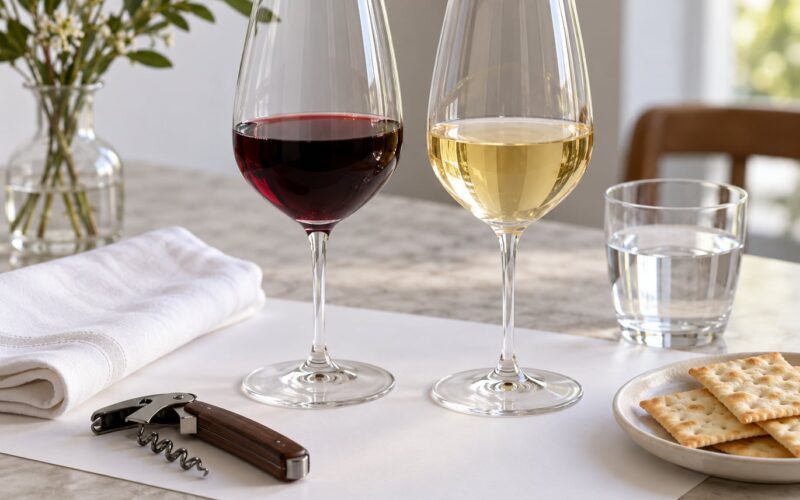
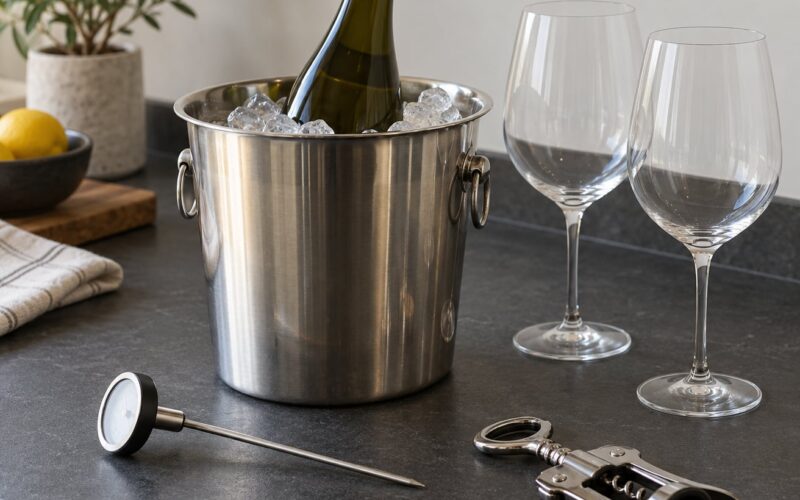
- A small knife or a waiter’s corkscrew. Optional, but it turns foil removal from a wrestling match into a clean slice.
- A flute or tulip glass. A tulip shape gives you more aroma than a narrow flute, and either one beats a shallow coupe if bubbles matter to you.
If you have nothing else, the towel and the cold bottle do most of the prevention work. Everything else is comfort.
Step-by-Step
How to Open a Champagne Bottle Without Spraying
Here is the whole method in one place, and it works whether you have a bottle of Champagne, prosecco, cava, or any other cork-sealed sparkling wine.
- Chill the bottle to about 45 to 50 degrees Fahrenheit.
- Wipe it dry, then point the neck up and away from people and breakables.
- Lay a clean towel over the cork and your hand.
- Cut the foil away, keeping your thumb on the cork the whole time.
- Untangle the wire cage, then leave it in place as a backstop.
- Turn the bottle slowly, never the cork, until you hear a gentle hiss.
- Stop, keep holding the cork, and wait for the hiss to fade to silence.
- Remove the cork, let the bottle settle, then pour slowly into a cold glass.
That is the sequence to remember. Every step after the first is about control, not force.
Step 1: Chill the Bottle Thoroughly
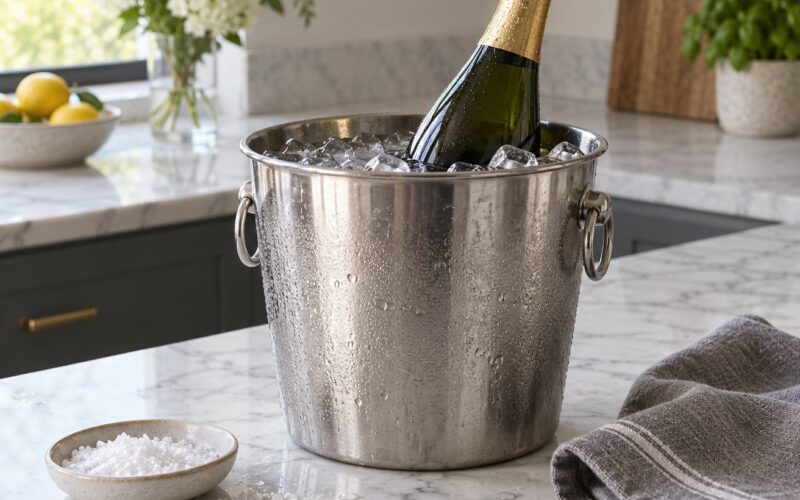
A standard 750 milliliter bottle needs roughly three to four hours in the refrigerator, or about 20 to 30 minutes in a bucket of ice and water. Water matters more than ice alone because it moves heat into the glass far faster than a pile of ice cubes does.
If you need it faster, the freezer works, but set a timer for 20 to 25 minutes and pull it the moment it goes off. Frozen wine slushes badly and expanded liquid can push a weak cork out on its own. Forget the timer and you have a different problem than spraying.
How do you know it is cold enough? The neck should feel noticeably cool and slightly damp, similar to a bottle that has just come out of a fridge. A bottle that only feels cool at the base is still too warm. If it is going straight into an ice bucket at the table, remember that a bucket chills the body of the bottle far faster than the neck, and pressure escapes through the neck.
Step 2: Clear the Area and Cover the Cork
Set the bottle on a solid surface with nothing fragile above it. A lamp hanging low over the counter is the classic scene for a ruined light shade, so move the bottle or open a different spot.
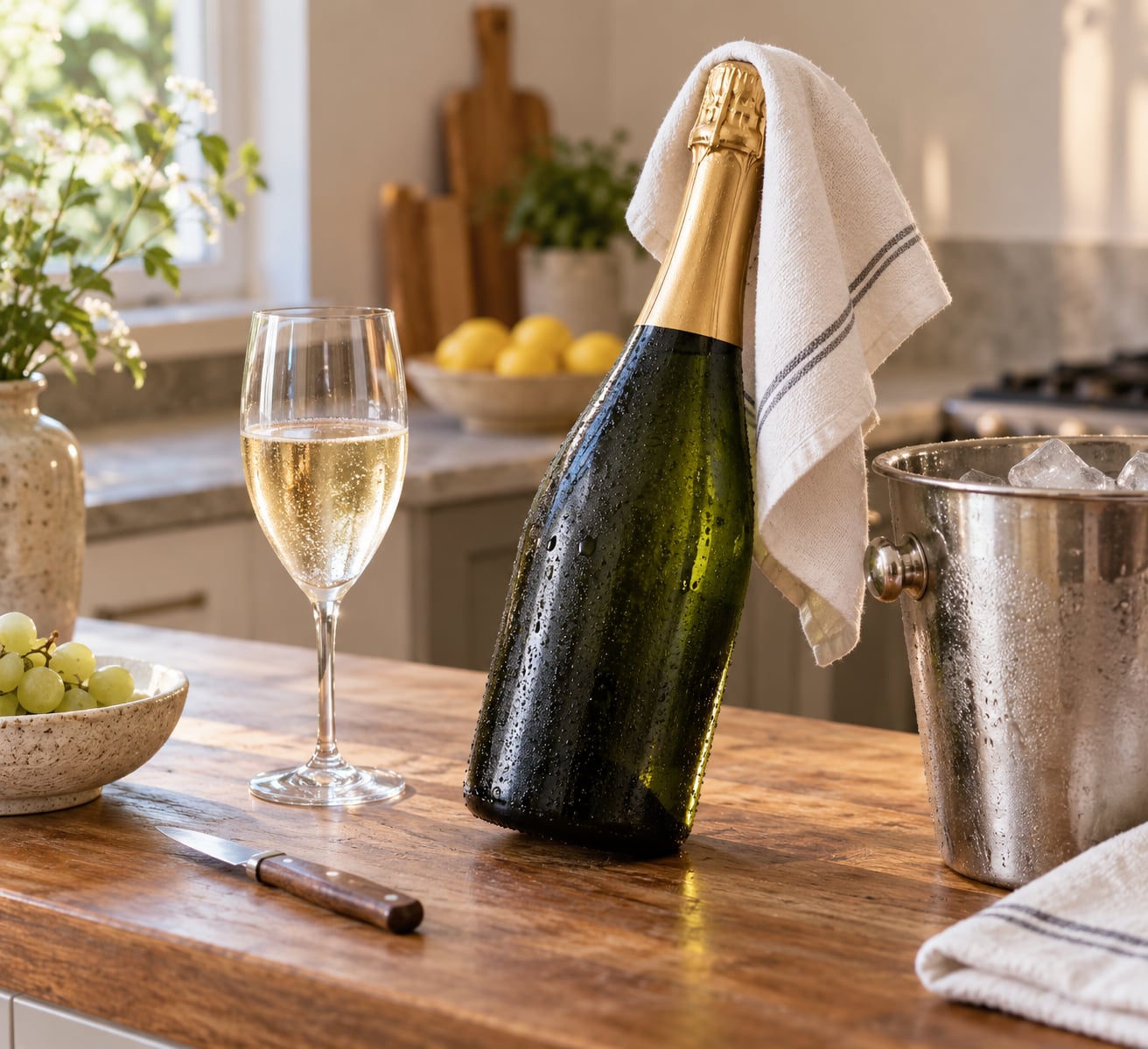
Tilt the bottle to roughly a 45-degree angle with the neck pointing up and away from your face and anyone standing near you. The angle matters because a cork that lets go at a slight diagonal is easier to control than one flying straight up a vertical neck, and it keeps the contents aimed at an empty floor instead of a wall.
Drape the towel over the cork and your gripping hand. Some people like two towels, or a towel wrapped around the neck and a second one over the cork. If a small spurt makes it past the cage, the towel turns a soaked hand into a damp one.
Step 3: Remove the Foil and Wire Basket
Dry the neck first. Water on the neck makes the cork slippery and slippery is exactly what you do not want right now.
Loosen the foil and peel it down from the lip. A knife blade run under the foil edge, or the small blade on a waiter’s corkscrew, makes this quick and safe. Leave the foil loose around the lower neck, bunched up like a collar. It costs nothing and gives your hand a second layer of grip.
Now put your thumb over the cork before you touch the wire. The cage, called a muselet, is what stops the cork from shooting out during this next step, so it stays on. Untwist the loop at the top and lift the cage away while the cork remains under your thumb. Some people like to leave the wire’s loop around the cork as a clip so nothing can launch, and that works fine too.
If you are left-handed, nothing changes. People who open with their right hand often rest the base against their hip or stomach, and the technique is identical for the other side.
Step 4: Turn the Bottle Slowly
This is the part everyone gets wrong. Hold the cork in place with your thumb and fingers, rest the base of the bottle against your hip or stomach, and rotate the bottle. You are not turning the cork. The cork stays motionless inside the neck while the bottle turns around it.
A quarter turn is often enough. If the bottle does not release after about half a turn, pause, check that your thumb is still on the cork, and continue more slowly. The goal is a soft hiss that lasts several seconds and then fades. The moment you feel the cork start to lift, stop turning and just hold. Letting the pressure do the work from there is what stops the spray.
If you hear a loud bang instead of a hiss, stop immediately, keep your thumb down, and wait it out. You cannot put the cork back, but you can prevent the rest of the wine from leaving the bottle, and a bottle that has gone half-empty still tastes fine once it settles.
Step 5: Control the Pour
Do not pour the instant the cork is out. Hold the bottle upright and give the pressure a few seconds to calm down, then tip it slowly into a cold glass at a slight angle so the wine runs down the inside wall of the glass rather than dropping straight in and churning the bubbles.
Start with a small pour, maybe a third of a flute or a fifth of a tulip, and stop. When the foam has settled to a thin layer, add more. For a larger pour, the two-pour method works best: part fill, wait, then finish. Poured in one go, sparkling wine foams over the rim and you lose the wine and the carbonation at the same time.
Ice cubes go in after the first pour, not before, so the bubbles are not shocked on contact. And no sparkling wine tastes better warm, so keep the bottle in an ice bucket between pours instead of on the table.
Common Mistakes
Nearly every spraying incident traces back to one of these six.
Opening a warm bottle. Fix: chill it. A room-temperature bottle carries noticeably more pressure and there is no technique good enough to compensate.
Aiming the neck at people or at a wall of glassware. Fix: tilt the bottle so the neck points up and toward an empty stretch of floor, and check behind you before you start turning.
Twisting the cork while turning the bottle. Fix: keep the cork completely still. If your fingers are rotating, you have switched the technique back to the loud version.
Pulling on the cork. Fix: never pull. If you want the cork, hold it and wait for it to rise on its own.
Removing the wire cage before you are ready to open. Fix: keep the muselet on as a backstop until the hiss starts, then let the cork come out with it.
Pouring too quickly after the cork comes out. Fix: settle for a few seconds, pour part way, wait for the foam to drop, then top up.
One more worth naming: the loud pop is not a sign of a good opening. Bar staff call it bad manners for a reason. A quiet sigh is the sign of a properly opened bottle, and it looks composed, which is half the point of the whole ritual.
Frequently Asked Questions
How many twists to open champagne?
Usually a quarter turn is enough, and half a turn is a reasonable ceiling. If the cork has not moved by then, pause, check that your thumb is still planted on it, and continue more slowly. The count matters far less than the speed. A fast half-turn pops the cork, a slow one lets the gas hiss out over several seconds, and that hiss is the sign you did it right.
Do you leave the wire cage on when opening champagne?
Yes, leave it on for the actual opening. The wire cage, or muselet, exists to stop the cork from shooting out as pressure builds. Loosen and lift the loop away while your thumb stays on the cork, but do not pull the cage off the neck until after the hiss. Taking it off early removes the one safeguard standing between a sigh and a spray.
How do you open a mini bottle of champagne with a plastic top?
There is no cork and no pressure to release, so the whole technique changes. Put the bottle in an ice bucket or the freezer for 15 to 20 minutes, dry it, then twist the plastic top counterclockwise until it comes free. Never point it at your face. Small bottles are easy to overpour, so pour half a glass, wait for the foam to drop, and top up if you want more.
How do I open a champagne bottle that will not open?
First make sure you are actually holding the cork down and turning the bottle, not twisting the cork itself. If the cork feels fixed and dry, run warm water over the neck for a minute to swell the cork slightly, then retry with a dry towel for grip. Never reach for pliers or a corkscrew to lever the cork out. If it still will not move, the safest route is to open it as slowly as possible and accept a small foam-out.
How do you open a champagne bottle without a bottle opener?
You do not need one. Champagne corks are hand-turned, which is the whole point of the twist method. A small knife or a waiter’s corkscrew only makes the foil easier to cut, and even that can be done by hand by pinching the loose end and pulling it along the seam. If the bottle also has a screw cap, a simple opener or a firm grip with a dry towel is enough.
Why do you put a spoon in open champagne?
It does not work. The spoon-in-the-neck trick has been repeated for decades, but a spoon does nothing to the gas already dissolved in the wine and it does not stop CO2 from escaping through the neck. A purpose-made sparkling wine stopper fitted tightly into the mouth of the bottle keeps bubbles far longer, and keeping the bottle cold helps even more. A spoon is just a decoy.
Conclusion
The whole method reduces to five things: a cold bottle, a towel on the cork, a 45-degree angle away from everyone, slow rotation of the bottle rather than the cork, and a pause the moment the hiss starts. That is the entire difference between a quiet sigh and a spray across your ceiling.
Start with the chilling, because it is the part people skip. If you get that right, the rest is just steady hands, and a bottle opened properly is the easiest kind of confidence to walk into a room with.