Sun tea is tea steeped in warm water for hours, and the warm water is the problem. Food-safety guidance puts the bacterial danger zone at 40-140°F (4-60°C), and sun tea on a warm day usually only reaches about 80-130°F, so it can spend the entire brew parked right in the middle of that range.
Learning how to brew sun tea safely comes down to one change: control the water temperature and the clock instead of handing both jobs to the sun. Steep in the refrigerator or with hot water, cap the total time, and get the batch cold fast.
That sounds like a compromise on a summer ritual, and honestly it is a small one. The flavor people remember comes from the long, gentle extraction, not from the glass jar sitting in the yard. One more thing worth saying plainly: putting the pitcher in the fridge afterward stops further growth, but it does not undo hours already spent warm.
Table of Contents
- What You Need
- Step-by-Step: How to Brew Sun Tea Safely
- Step 1: Choose a Clean, Heat-Safe Container
- Step 2: Use Fresh, Safe Water and Tea
- Step 3: Control Steeping Time and Temperature
- How to Brew Sun Tea Safely in Under Three Hours
- Step 4: Remove the Tea and Chill It Quickly
- Step 5: Refrigerate and Serve Safely
- Common Mistakes
- Frequently Asked Questions
- Is sun tea safe to drink?
- How long should tea steep for the best flavor?
- Can I make sun tea and refrigerate it later?
- Does adding sugar or fruit make sun tea safer?
- What is the safest way to make iced tea at home?
- How long can homemade iced tea stay in the refrigerator?
- The Short Version
What You Need
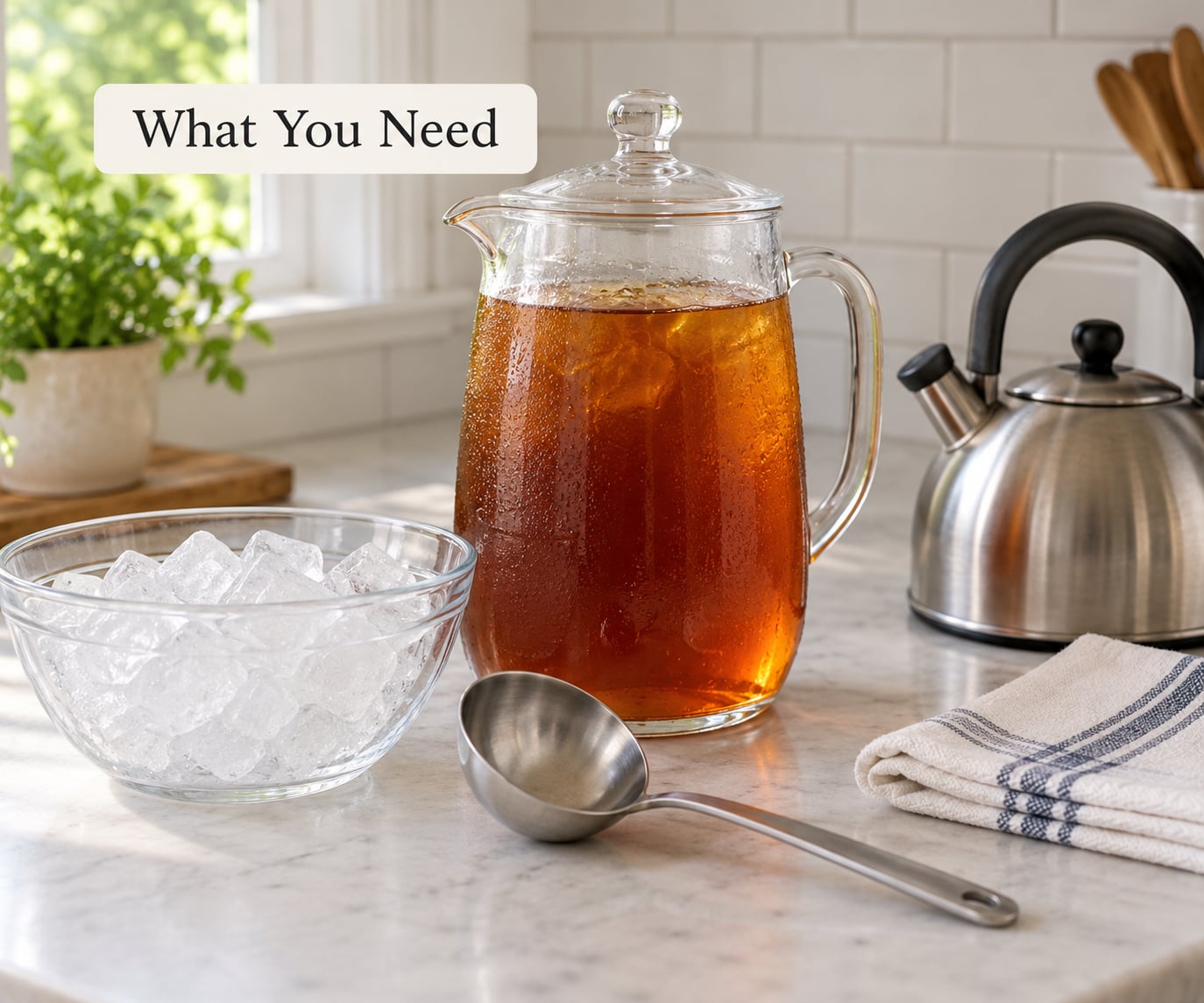
The good news is that almost all of this is already in your kitchen.
- A clean, heat-safe glass container with a tight-fitting lid. A wide-mouth mason jar or a glass pitcher both work. Narrower is better, because less liquid means less warm liquid sitting in the range.
- Fresh cold water from the tap, or filtered water if your tap water carries a strong chlorine or mineral taste.
- Tea bags or loose leaf. One bag per 8 ounces of water is a solid starting point for black tea, and a little gentler for green.
- A kettle for a controlled hot-water steep, plus a timer.
- A bowl of ice or a sink full of ice water for cooling the finished brew.
- A long-handled ladle or spoon so you can lift the tea out without splashing.
- A covered pitcher that fits in your refrigerator, with room around it for air to circulate.
Skip anything made of plastic if you can, and skip jars with a built-in spigot. Spigot jars are hard to clean inside the tap, and the tube plus the valve traps a permanent reservoir of old tea that never gets washed.
An ordinary sunny windowsill is optional, not necessary. This surprises people who assume the sun is the point, but sunlight is not what makes tea good and it is certainly not what makes it safe. On a sunny day the jar warms slowly and unevenly, which produces the long warm dwell that gives you trouble.
Step-by-Step: How to Brew Sun Tea Safely

Step 1: Choose a Clean, Heat-Safe Container
Start by washing the vessel the way you would any food-contact surface: hot soapy water, a thorough rinse, and air dry. For an extra margin, sanitize it in a solution of one tablespoon of unscented liquid chlorine bleach per gallon of water, then rinse well and let it dry completely.
Do this before every batch, not once a season. Sun tea is a long, warm, low-acid bath, and any bacteria that survive on a jar rim or a lid thread get a genuine opportunity to grow.
Glass wins over plastic here for a practical reason beyond tradition. Warm water increases the rate at which some plastic containers can leach, and a scratched or cloudy pitcher is much harder to clean than clear glass. If a container is cracked, deeply scratched, or has no idea when it was manufactured, stop using it.
Step 2: Use Fresh, Safe Water and Tea
Use water you would happily drink on its own. If your tap water is questionable, boil it first and let it cool, or use filtered water. Filtered water also tends to make a cleaner cup, since chlorine and heavy minerals both flatten aroma.
Then handle the tea itself. Dry tea leaves carry a small load of microbes from processing and handling, and a warm-water steep is a friendly environment for them. A quick pre-rinses handles it: dunk each tea bag in boiling water for one to two minutes, then discard that water and use fresh cold water for the actual brew.
That rinse takes almost no time and takes the raw-leaf variable out of the equation entirely. It also matters more for loose leaf than bags, since a bag keeps most of the dust and fragments contained.
Ratios are simple. One bag per 8 ounces of water, or roughly 15 grams of loose leaf per liter, gets you a strong summer batch that dilutes nicely over ice.
Step 3: Control Steeping Time and Temperature
This is where the safety lives. Instead of leaving an open container in sunlight, you choose the water temperature and you own a timer.
For black tea, bring water to a full boil, pour it over the bags, and steep 3 to 5 minutes. For green tea, use water around 175-185°F and steep 2 to 3 minutes, because boiling water scorches the leaves and pulls bitterness out of them. For herbal tea, which has no tannins to speak of, boiling water and 5 to 7 minutes is right.
That is the whole answer to how to brew sun tea safely: a short, owned steep instead of a long, accidental one. The temperature moves once, deliberately, instead of drifting upward for hours.
Long, sun-warm steeping does something different from a controlled hot steep: it extracts slowly over hours at a temperature that never gets high enough to kill anything. Tannins in black tea do have mild antibacterial activity, but researchers and food-safety specialists describe it as far short of what a warm brew needs to be self-protecting.
| Steep time | Where the water sits | Flavor outcome |
|---|---|---|
| 2 hours | Warm, roughly 80-110°F in open sun | Light, slightly thin, mild bitterness |
| 3 to 4 hours | Warm the whole way, sometimes reaching 130°F | The classic balance people chase |
| 5 hours or more | Warm for hours, sun may set and cool it | Astringent, flat, sometimes sour or off |
Look at that middle row honestly. It is the reason people keep the tradition, and it is also the row where bacteria get their longest uninterrupted head start.
How to Brew Sun Tea Safely in Under Three Hours
If you want to keep some of the ritual without the long warm dwell, cold-brew first and finish briefly in the sun. Put the tea bags in the refrigerator with cold water for 8 to 12 hours overnight, then set the pitcher outside for no more than an hour or two to pick up a little warmth and a sunlit taste.
The long extraction now happens at refrigerator temperature, where bacterial growth is essentially halted. You get most of the flavor and a fraction of the exposure.
Step 4: Remove the Tea and Chill It Quickly
Lift the bags out with your ladle at the end of the steep, or fish out loose leaf with a strainer. Press the bags against the side of the pitcher once so they give up what is trapped inside, then set them aside.
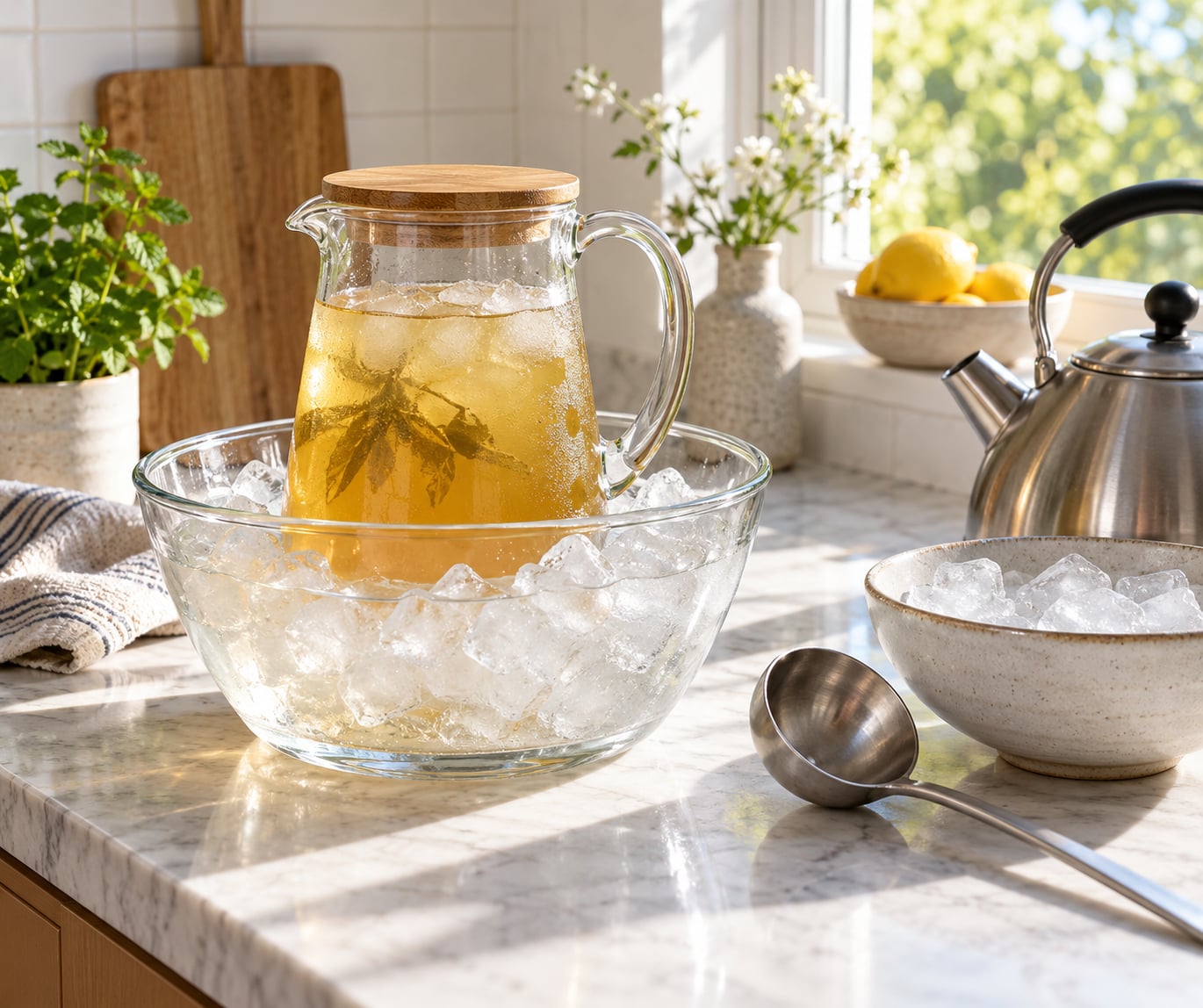
Now cool the brew fast. Set the pitcher into a sink or bowl filled with ice water and stir for a few minutes, or divide the tea among several shallow containers and set those on ice. Rapid chilling is what limits total time in the 40-140°F range, and it matters more than anything you do afterward.
You are aiming to get the tea down toward refrigerator temperature within about an hour, not to bring it to an ice-cold state. Cold drinks dilute and dull aroma, so cool it thoroughly, then serve it with plenty of ice.
Step 5: Refrigerate and Serve Safely
Cover the pitcher, write the date on it with a marker or masking tape, and put it in the refrigerator at or below 40°F (4°C). Leave some space around it so cold air moves freely.
Serve with a clean ladle rather than dipping a cup in the pitcher. That keeps the ice and fruit from carrying a spoon of tea back into the batch every round.
Drink it within 24 to 48 hours. If a batch has been warm or at room temperature for a long stretch before you got it cold, throw it out instead of refrigerating it and hoping.
Add sugar, fruit, mint, and lemon after the tea is chilled, never during the steep. Added sugar feeds whatever is present, and cut fruit sits in the liquid adding surface area and nutrients for growth.
Common Mistakes
Treating sunlight as a safety method. The sun on a typical jar does not generate anything close to a sanitizing temperature. A thermometer in a jar on a hot day usually reads 80-110°F, and that is a comfortable place for bacteria to multiply. Think of sun as flavor seasoning, not as a sterilizer.
Steeping indefinitely. “I’ll check it in a bit” is how a two-hour tea becomes a seven-hour tea. Set a timer when you start, not when you go to look.
Using a container that was not properly washed. The jar rim, the lid threads, and any spigot tube are where last batch’s bacteria wait.
Leaving the finished brew warm for hours. Chilling later does not reverse the warm time already served. The batch is either made safely from the start or it is not.
Covering a pitcher while the tea is still warm. A lid traps the steam and keeps the liquid parked in the danger zone. Chill first, cover second.
Refilling an old batch. Topping off a jar with fresh water and new bags dilutes the old liquid but leaves its bacterial load in place. Empty it, wash the jar, start again.
Adding sugar, fruit, or herbs during the steep. All three feed whatever organisms are present. Sweeten and garnish after chilling.
Then learn the discard signals, because you cannot see bacteria but you can see some of what they do. Pour it out if the tea is cloudy without sediment, if there are thick syrupy or stringy strands when you pour, if the smell is sour, fermented, or just plain off, if there are fuzzy white or green patches, or if the liquid fizzes when it should not.
That ropey, syrupy signature is associated with Alcaligenes viscolactis, a bacterium known for turning spoiled tea into visible slime. Salmonella and E. coli outbreaks have also been linked to homemade sun tea, and no home kitchen has a test for any of it.
A sour or funny taste deserves the same suspicion. People usually assume bitterness means over-steeped, but bitterness is astringency while sourness is fermentation, and one is a recipe problem while the other is a reason to pour the pitcher out.
Pregnant readers, young children, older adults, and anyone immunocompromised should skip slow warm steeps entirely and use refrigerator cold brew, where the water never enters the danger zone at all.
Frequently Asked Questions
Is sun tea safe to drink?
It is not reliably safe when brewed the traditional way. Sun tea sits at roughly 80-130F for hours, inside the 40-140F bacterial danger zone, without ever getting hot enough to kill what is on the leaves. Refrigerator cold brew or a hot-water steep followed by an ice bath gives you the same flavor with a fraction of the exposure, and that is what we recommend.
How long should tea steep for the best flavor?
For a controlled hot-water steep, black tea wants 3 to 5 minutes in just-boiled water, green tea 2 to 3 minutes around 175-185F, and herbal tea 5 to 7 minutes in boiling water. If you steep in the sun instead, treat anything past 3 to 4 hours as a flavor win you are not really paying for, since the extra time mostly buys bitterness and bacterial risk.
Can I make sun tea and refrigerate it later?
You can, but only if the tea did not spend long in the danger zone first. Refrigeration stops further bacterial growth; it does not reverse time already served warm. A batch that sat in the sun for five or six hours is not saved by the fridge. Chill the brew within about an hour of finishing the steep and get it cold before you cover it.
Does adding sugar or fruit make sun tea safer?
No. Sugar feeds whatever organisms are already present, and cut fruit adds surface area, moisture, and nutrients in a warm low-acid liquid. Add sugar, lemon, mint, and fruit only after the tea is chilled and refrigerated. The only additions that genuinely help are ones that speed the process up: a boiling pre-rinse for the tea bags and an ice bath for the finished brew.
What is the safest way to make iced tea at home?
Refrigerator cold brew is the safest and easiest. Put tea bags in cold water and leave them in the fridge for 8 to 12 hours, then strain. The water never leaves roughly refrigerator temperature, so there is no warm window at all, and the long slow extraction also pulls fewer bitter tannins than a hot steep. A hot brew poured straight over packed ice is the safe second choice.
How long can homemade iced tea stay in the refrigerator?
Use it within 24 to 48 hours, kept covered at or below 40F and handled with a clean ladle rather than a cup dipped into the pitcher. Discard it early if it turns cloudy, smells sour or fermented, develops syrupy stringy strands, or fizzes. If the batch ever sat warm or at room temperature for an extended stretch before you chilled it, skip the storage window and pour it out.
The Short Version
Start with the easiest fix: skip the warm hours entirely. Cold brew the tea in the refrigerator overnight, or do a short hot-water steep and drop the pitcher straight into an ice bath. Either way, sanitize the jar, keep the time on a timer, chill fast, cover, refrigerate, and drink it within two days. That is how to brew sun tea safely without giving up the ritual.
The glass jar on the porch is still worth keeping for the hour of sunshine at the end, just not for the four hours of warmth in the middle.
Reviewed for accuracy in 2026. Food-safety figures follow FDA and CDC guidance on the 40-140°F (4-60°C) danger zone. Talk to a doctor or a registered dietitian about personal advice, especially if you are pregnant, immunocompromised, or serving young children or older adults.