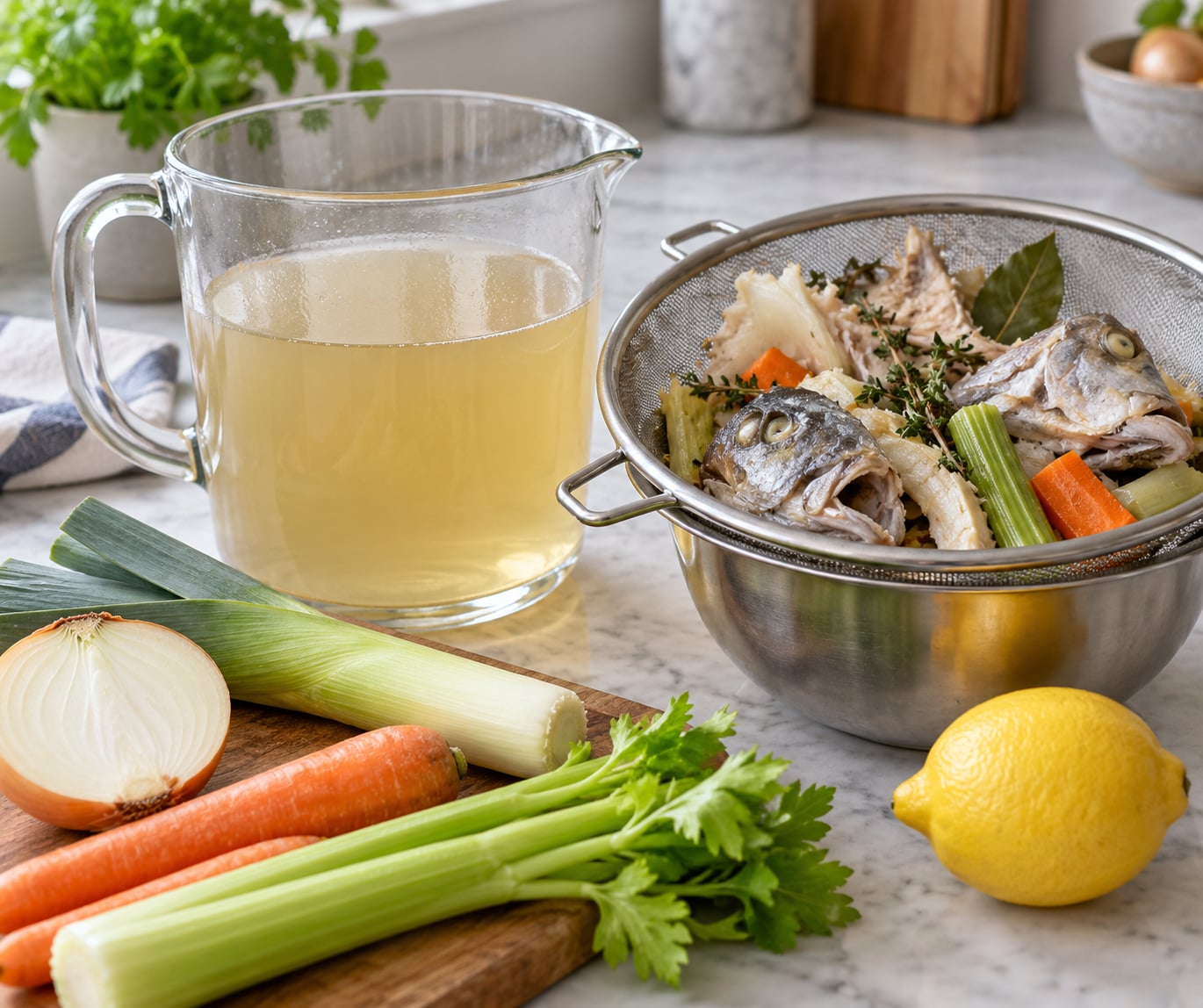
How to make fish stock from heads and bones takes about an hour, most of it hands-off. You trim the gills and organ meat off the frames, cover them with cold water, skim the foam once, then simmer gently for 20 to 30 minutes and strain. The result is a clean, briny broth that beats bottled stock in any chowder, bisque or paella.
The part that trips people up is time. A chicken stock wants four to six hours, beef wants twelve. Fish stock wants half an hour, and if you leave it going for six you will end up with something bitter and faintly rancid. Fish bones give up their gelatin quickly, and their oils turn unpleasant fast, so the whole thing is a short window.
I have ruined batches exactly that way. A slow Sunday project that I left on the hob while I was out, coming back to a pot that smelled like a fish bin. Now I set a timer, and the stock is better for it.
One naming note before you start, because it sends people looking in the wrong direction. A fumet is a French word for this broth, and it is also called fish frame stock or fish bone broth. It has nothing to do with fish sauce, the fermented condiment sold in bottles under names like nuoc mam or nam pla. Different product, different shelf, different job.
Table of Contents
- What You Need
- Step-by-Step: How to Make Fish Stock From Heads and Bones
- Prepare the Fish Heads and Bones
- Build the Aromatic Base
- Add Water and Simmer Gently
- Strain and Clarify the Stock
- Cool and Store the Finished Stock
- Common Mistakes
- Why is my fish stock bitter?
- Why is my stock cloudy?
- Why does my kitchen and my stock smell fishy?
- Why is my stock oily?
- Why is my stock weak or watery?
- Why is it too salty to drink?
- Is it safe to leave stock on the counter overnight?
- Tips for Better Fish Stock
- Frequently Asked Questions
- Do you have to remove the gills from fish heads for stock?
- How long should fish stock simmer?
- Should fish stock boil or just simmer?
- Which fish bones make the best stock?
- How much fish stock does one head make?
- How long does homemade fish stock keep?
- Conclusion
What You Need
You need roughly 1 pound (450 g) of fish frames and heads for a usable batch. A single head is not a batch, which is the other common misconception. You want about 3 to 4 quarts (3 to 4 litres) of finished stock out of that pound, so buy or save more than you think you need.
Frames come from mild white fish: flounder, cod, haddock, halibut, pollock, monkfish, sea bass, croaker. Monkfish heads are unusually good because the flesh is sparse and the head itself is full of flavour. Avoid oily fish for a clean stock. Salmon, mackerel, bluefish and sardine frames will give you a heavy, fishy, oily broth that no amount of skimming will rescue.
Ask your fishmonger for the heads and frames from whatever whole fish you buy. Most counters hand them over, since they are waste from their point of view. Say something like: “I’m buying two whole red snapper, could I keep the heads and frames for stock?” If you buy fillets instead, ask anyway. Many will keep a box behind the counter for cooks who ask.
Aromatics, all optional but all useful:
- 1 onion, halved or chopped (1 large, about 150 g)
- 1 leek or small fennel bulb, sliced (about 120 g)
- 1 carrot and 1 celery stalk, chopped (about 80 g each)
- 2 garlic cloves, crushed
- A few peppercorns, 1 bay leaf, a small handful of parsley stems and thyme sprigs
- Peel of 1 lemon or 1 orange, pinked, with no white pith
Liquid is simple: cold water, about 3 quarts (3 litres) to the pound of frames, plus an optional half cup (120 ml) of dry white wine. The wine is a flavour choice, not a technique step. It gives a slightly rounder, European profile that suits bisque and veloute. For a clean Spanish-style sopa marinera, leave it out and let the fish and tomato speak. Wine also boils off mostly, so it is not a rescue for a thin stock.
Equipment: a heavy stockpot with a lid, a spoon or small strainer for skimming, a fine-mesh sieve or chinois, and shallow containers or an ice bath for cooling. A digital thermometer is not required but takes the guesswork out of the simmer. An immersion blender is optional and only matters if you want body rather than clarity.
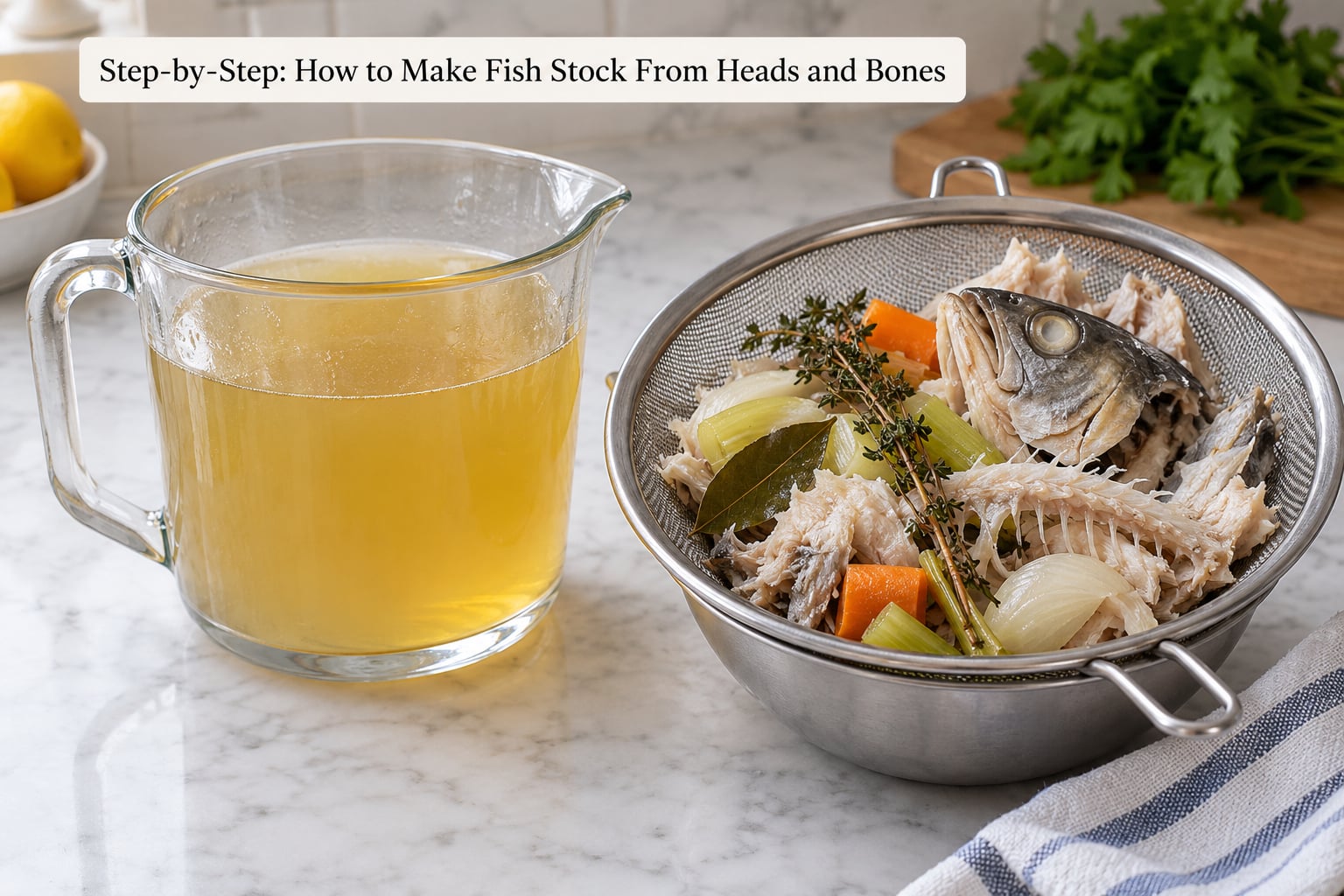
Step-by-Step: How to Make Fish Stock From Heads and Bones
Prepare the Fish Heads and Bones
Rinse every piece under cold running water until the water runs clear. Fish frames carry a surprising amount of loose flesh, membrane and blood along the spine, and that residue is the most common source of a muddy, cloudy pot. Use a brush on the rib cage if you want to be thorough.
Then cut out the gills. They are dark, feathery and bitter, and they will make the stock taste flat no matter how long you simmer. Use kitchen shears and snip them out from behind the head. While you are there, pull out the eyes and cut away any soft organ meat still attached inside the head, because that is where blood collects.
Trim any loose fatty tissue hanging off the frame. Do not trim the head’s cheeks or the collar, those are flavour. Keep the fins if you like, they contribute a little gelatin, but snip off the sharp spines on the tail and fin tips so nobody burns a finger or finds a splinter in the stock later.
Chop large frames into pieces that sit flat in your pot. A whole snapper frame will not fit in a home stockpot, and pieces that float half out of the water extract unevenly. Use cleaver or heavy knife and a stable board; ask the fishmonger to do it if the frames are big.
Optional but good: toast the trimmed pieces in a dry oven at 400 F (200 C) for 12 to 15 minutes until they smell nutty. This deepens the stock and is the technique behind richer Spanish and Italian versions. Skip it if you want the cleanest, most neutral result.
Build the Aromatic Base
Heat a glug of olive oil in the pot and sweat the onion over medium-low heat for 4 to 5 minutes until it looks soft and translucent. Add the leek or fennel, then the carrot and celery, and cook another 5 to 7 minutes until everything softens.
Add the garlic, peppercorns and bay leaf for the last minute, just long enough to smell them. Add the citrus peel and herb stems right at the end of the sweat. You are looking for vegetables that have lost their raw edge and taken on sweetness, with no colour. The moment onion or fennel browns, the stock will carry a dull, cooked-vegetable bitterness that lasts all the way to the bowl.
Then deglaze with the wine if you are using it, scraping the bottom of the pot, and let it reduce by about half, roughly 3 minutes. If you are skipping the wine, let the aromatics sit another minute to soften and move on.
Add Water and Simmer Gently
Tip the fish frames into the pot, then pour in cold water. Start cold on purpose. Cold-water extraction draws gelatin and flavour out slowly and evenly; water that is already hot sears the proteins on the surface and traps them inside, which is where cloudy stock comes from.
Use enough to barely cover the fish, about 3 quarts (3 litres) to a pound of frames. Push the frames down so they stay submerged, or lay a small plate or a few clean weights on top. Anything left in open air will not extract and will scorch when you reduce.
Bring it to one full boil over high heat. This is the only boil in the whole process. As foam rises, skim it off with a spoon or the side of a slotted ladle for two to three minutes until the surface clears to a fine shimmer. That white scum is protein and blood, and it is the single biggest reason home stocks turn cloudy. Skim it, do not try to strain it out later.
Drop the heat to the lowest setting. You want a lazy simmer: a bubble or two breaking the surface every second or two, not a rolling boil. Set the lid ajar, offset by the width of a wooden spoon, so steam escapes and nothing boils hard. Simmer 20 to 30 minutes for frames alone, which is the standard window and covers most home cooks.
If you built a stock with shellfish shells, fennel and tomato for a paella-style base, give it 45 to 60 minutes instead. Shells take longer to give up their flavour and the extra time is masked by the stronger ingredients. If you are using frames alone, treat anything past 40 minutes as the edge of too far.
Strain and Clarify the Stock
Turn off the heat and let the pot sit for two minutes so the solids settle and the surface fat rises. Skim off the floating fat cap; more fat means a heavier, fishier-tasting stock later, and it is easiest to remove while the liquid is still hot and quiet.
Ladle the liquid through a fine-mesh sieve set over a clean pot, then pass it through again through a chinois lined with damp cheesecloth if clarity matters. Double straining catches the fine bone chips and the little collagen fibrils that a single sieve lets through.
For body instead of clarity, put the strained solids back in the pot with a splash of the strained liquid and blend them to a rough paste with an immersion blender, then strain that through the sieve too. You lose a clear stock and gain a thicker, more gelatinous one that gives a bisque or a chowder real weight. Choose one or the other, not both.
Taste and season here, not before. Seafood frames carry a natural salinity that varies widely, and a spoonful of salt added at the start can make the whole pot undrinkable. Add salt in small increments at the end. A squeeze of lemon or a splash of sherry vinegar sharpens a flat batch without needing more salt.
If you need more intensity, reduce it. Put the strained stock in a wide pan over medium heat and simmer until it drops by about a third, tasting every couple of minutes. Reduction concentrates flavour and also makes the stock saltier, so go gently.
Cool and Store the Finished Stock
Cool fast. Set the pot in an ice bath and stir for a few minutes, or pour it into shallow containers and rotate them in the freezer for 20 minutes before refrigerating. A stockpot cooling on the counter overnight is how a batch goes off, and raw fish frames carry enough protein to make it happen.
Once cool, cover and refrigerate at 40 F (4 C) or below for 3 to 4 days. Fish stock keeps shorter than poultry stock, so plan on using it early in the week. For longer storage, freeze it in silicone ice-cube trays for a few cubes at a time, or in freezer bags laid flat so you can snap off what you need. Frozen stock keeps about 3 to 4 months. Label with the date and whether you added salt.
You can also freeze raw frames before you are ready to cook. Lay them flat in a bag so they do not thaw into one solid block, and use them within a month or two. Freezing does not harm stock-making, but very old frames smell increasingly, and that smell carries straight into the pot.
Common Mistakes
Why is my fish stock bitter?
Bitterness has three usual sources, and the first is the one that gets missed. Gills and organ meat left in the pot will make stock bitter no matter how well you skim. Second is over-cooking: past about 40 minutes on a gentle simmer, and especially with oily fish, the frame oils turn and start tasting rancid. Third is browned aromatics. Pull the fish and gills out first, keep the simmer under 30 minutes, and sweat vegetables only until soft.
Why is my stock cloudy?
Cloudiness is mostly about heat and protein, not about straining. You get it by starting in hot water, by skipping the initial skim, by letting the pot boil after the first boil, or by pressing the solids through the sieve. Fix all four: cold water, dedicated skimming, lid ajar on a lazy simmer, and never force the solids. Blending the strained solids also adds cloudiness on purpose, so that is a deliberate trade, not a mistake.
Why does my kitchen and my stock smell fishy?
A clean fumet should smell briny and sweet, not stale. Strong fishiness comes from oily species, from old frames, or from fish that sat too long before you started. Use white fish, cook frames within a day or two of buying them, and simmer gently, which keeps the volatile compounds that scream from boiling away. A lid ajar and a short cook are the whole answer. Strain through cloth and it mellows further.
Why is my stock oily?
You used salmon, mackerel, bluefish or sardine frames, or you skipped the fat skim. Oily fish adds body, but it also adds a weight that reads as fishy in anything that is not a stew. Skim the surface cap before straining, and skim again after straining. A spoon of olive oil stirred in at the end gives you the roundness without the slick.
Why is my stock weak or watery?
Usually it was not enough fish, or the fish was sitting above the water. One pound of frames for 3 quarts of water is the baseline, and pushing it thinner dilutes everything. Also check the lid: fully covered traps less, and 20 minutes is genuinely short. If you want more, add a second pound of frames rather than simmering the first one longer, since extra time costs you clarity and cleanliness.
Why is it too salty to drink?
Crustacean shells and briny fish frames carry a lot of salt, and water evaporates as you simmer, so salt concentrates over the cook. Never add salt during the simmer. Taste the strained stock, then add a little at a time. If you have overshot it, dilute with unsalted water or unsalted stock, or add a splash of cream or coconut milk in a sauce.
Is it safe to leave stock on the counter overnight?
No. Warm or room-temperature stock is a bacterial risk in any room, and fish stock is no exception because it smells pleasant. Cool it in an ice bath or in shallow containers within two hours, refrigerate promptly, and use it within 3 to 4 days. If it has sat out for more than a few hours at room temperature, discard it rather than tasting it.
Tips for Better Fish Stock
Add shellfish shells for a paella-style stock. Shrimp, lobster and crab shells bring a deeper, sweeter, more briny base than fish bones alone, and they pair with tomato, fennel and saffron. Give that version 45 to 60 minutes, and remember the shells bring salt with them.
Use bones from a grilled or roasted fish. Cooked frames have lost some moisture but gained roasted flavour, and they are a good use for a fish you charred. Scrape off the burnt skin and any blackened flesh before the frames go in, or you will import the char.
Build a vegetable-forward version with no fish at all when you want a lighter base. Sweat the same aromatics, add kombu for a minute before it hits the water, and let it simmer 30 minutes. It is not a fish stock, but it works in a chowder when you add the shellfish later.
Adjust the seasoning at the very end, and finish with acid. Lemon, sherry vinegar, dry white wine or a spoon of shellfish liquor all sharpen a stock that tastes flat but not thin. Add them off the heat so the aromatics stay lively.
Do not throw away the solids. The strained frames and aromatics are the base for fish cakes or croquettes, or you can break them down and fold them into a dog treat. Some cooks press them, mix with egg and breadcrumbs and shallow-fry. Either way, this is where the smell problem goes away, because nothing is left sitting in the sink.
Know the regional styles so you can pick a target. A French fumet is short, lean and usually wine-finished. A Spanish sopa marinera leaves out the wine and leans on garlic, olive oil and a little smoked paprika. A Cantonese-style fish soup broth is clear, seasoned more firmly with ginger and scallion, and pulled off the heat almost as soon as it is ready. All three start with the same trimmed frames and a gentle simmer.
Frequently Asked Questions
Do you have to remove the gills from fish heads for stock?
Yes, and it is the step most people skip. Gills are dark, feathery and bitter, so they flatten the stock no matter how carefully you skim and strain. Use kitchen shears to snip them out from behind the head, and cut away the eyes and any soft organ or blood tissue still attached inside. The cheeks and collar of the head are worth keeping.
How long should fish stock simmer?
Twenty to thirty minutes on a lazy simmer is the standard window for fish frames and heads alone. Bring it to one full boil first, skim the foam, then drop to the lowest heat with the lid ajar. A shellfish-and-tomato paella stock wants 45 to 60 minutes. Going much past 40 minutes with plain frames makes the oils turn and the stock tastes bitter and old.
Should fish stock boil or just simmer?
Boil it exactly once at the start, then keep it at a bare simmer for the rest of the cook. That first boil drives off the blood and protein scum you skim away. After skimming, any sustained boiling emulsifies those proteins back into the liquid and makes the stock cloudy and dull. You are aiming for one or two bubbles breaking the surface every second or two.
Which fish bones make the best stock?
Frames and heads from mild white fish are best: cod, haddock, flounder, halibut, pollock, monkfish, sea bass and croaker. Monkfish heads are a particularly good choice because the head carries a lot of flavour. Skip oily fish such as salmon, mackerel, bluefish and sardines if you want a clean-tasting stock, since their fat makes the finished broth heavy and fishy.
How much fish stock does one head make?
Not much on its own, which surprises people. One large head gives you roughly a cup or two, so treat a single head as a bonus rather than a batch. Aim for at least 1 pound (450 g) of heads and frames, which gives about 3 to 4 quarts (3 to 4 litres) of strained stock. Most fishmongers will keep the frames from a whole fish if you ask.
How long does homemade fish stock keep?
Refrigerated at 40 F (4 C) or below, it keeps 3 to 4 days, shorter than poultry stock. Cool it fast first in an ice bath or in shallow containers, then refrigerate within two hours. Frozen in bags or ice-cube trays it holds 3 to 4 months. Label with the date and whether you already salted it, because unseasoned stock is more useful.
Conclusion
Start with fresh, well-trimmed frames and heads, cut out the gills and organ meat, and cover them with cold water. Bring the pot to one boil, skim the foam properly, then hold it at the barest simmer for 20 to 30 minutes. That is the whole technique.
Strain it twice, season at the end rather than the start, and get it into the fridge or the freezer quickly. Used within a few days it becomes the base for chowder, bisque, paella, soup or a poaching liquid, and it costs you little more than asking for the scraps you were giving away anyway.