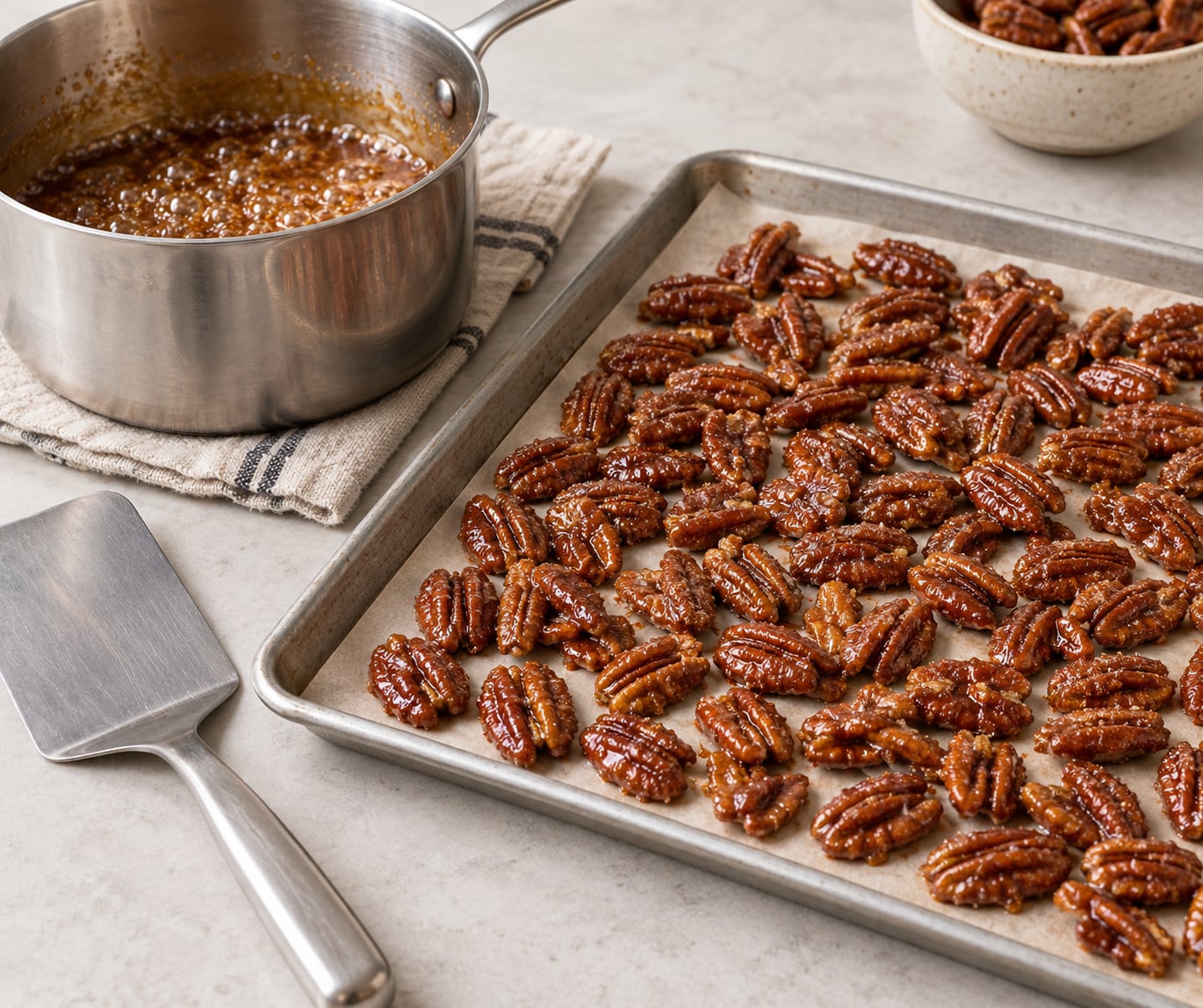
Candied pecans at home come down to three ingredients, a lined baking sheet and an oven: boil sugar with water until it thickens, stir in the pecans, spread them in a single layer, then bake until the coating looks dry instead of glossy. From the first boil to a jar of crisp nuts takes about an hour, and most of that hour is the oven doing the work unattended.
The method is forgiving. Sugar tells you when it is ready, and once the nuts go in the oven your only real job is spacing them out and letting them cool undisturbed. That is where most home batches go wrong, so the cooling step gets as much attention below as the boiling step.
What you end up with is a hard, brittle shell over a toasted nut. It snaps rather than bends, which is the difference between candy and the chewy sugar glaze that pools in the bottom of the pan.
Table of Contents
- What You Need
- Step-by-Step
- How to candy pecans at home by heating the sugar mixture
- Add pecans and coat them evenly
- Spread the pecans into a single layer
- Bake until the coating is crisp
- Cool the pecans, then store them airtight
- Common Mistakes
- The nuts are sticky and wet
- The coating slid off and left a hard puddle in the pan
- Everything fused into one sheet-sized slab
- The coating is uneven or some sugar is missing
- The nuts are hard and burned
- The finished texture is soft, not crisp
- The syrup crystallized into a grainy sand
- Flavor variations and other nuts
- Frequently Asked Questions
- Should candied pecans cool on the baking sheet?
- Can I candy pecans without a thermometer?
- Why did my candied pecans form one hard sheet?
- Can I add cinnamon, vanilla, or other flavorings?
- How long do homemade candied pecans stay fresh?
- Can I use this method for walnuts or other nuts?
- Conclusion
What You Need
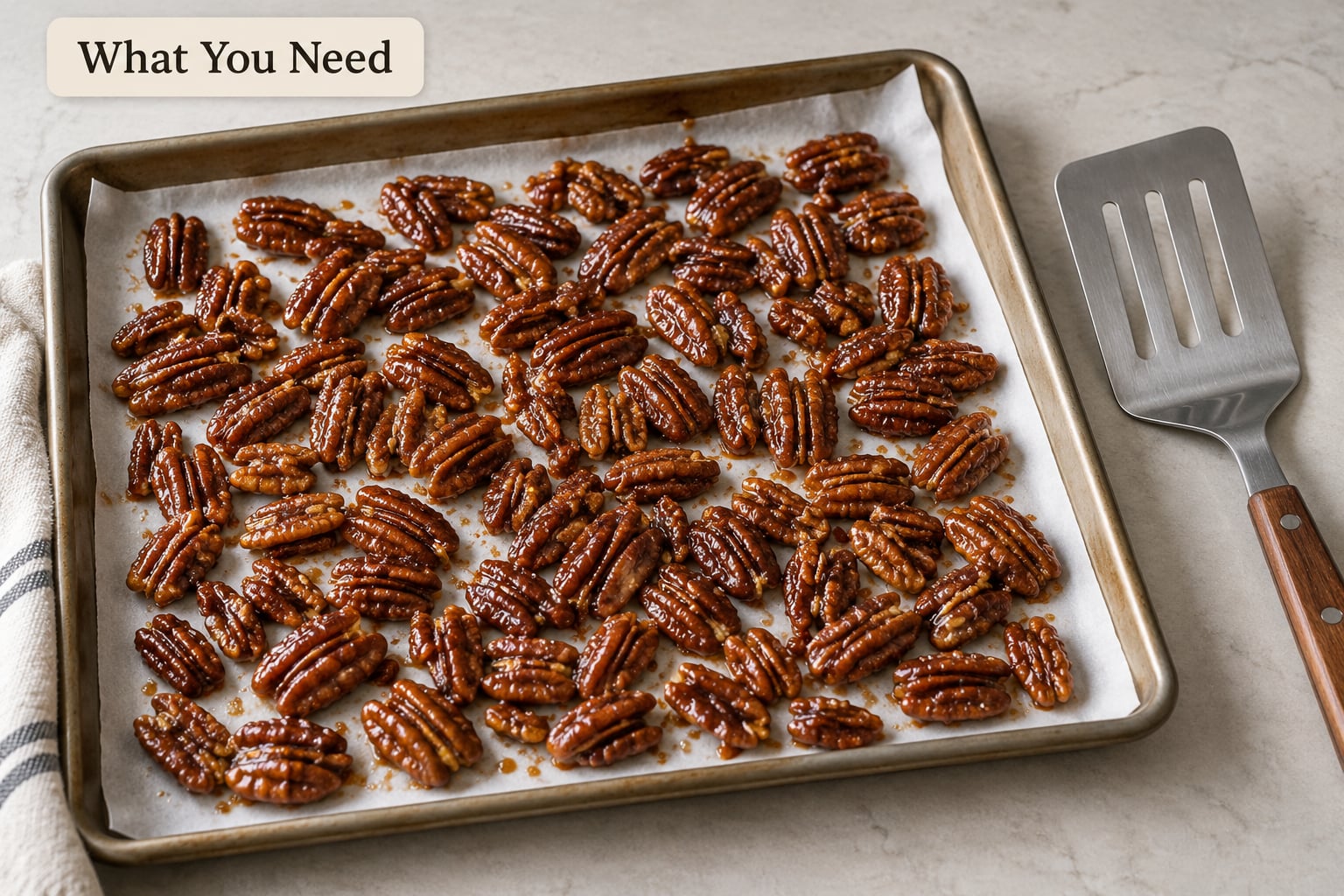
The base recipe is three ingredients: 2 cups of pecan halves, 1 cup of granulated white sugar, and 1/2 cup of water. A pinch of salt sharpens the sweetness and is the one addition most cooks keep permanently. That is the whole list for a plain batch of about 4 cups of finished pecans.
- 2 cups pecan halves, raw and untoasted
- 1 cup granulated white sugar
- 1/2 cup water
- 1/2 teaspoon fine salt
- 1 teaspoon vanilla extract, optional
Equipment matters more than most recipes admit. You need a heavy-bottomed saucepan with a lid, a rimmed baking sheet lined with parchment paper, a wide silicone or metal spatula, and a candy thermometer if you have one. The rimmed sheet is doing real work: syrup will spread to the edges as the nuts sit, and a flat rimless pan turns that into a burnt lacquer.
A silicone baking mat works as well as parchment and peels off more cleanly afterward, which is the swap many home cooks mention making after the first time they scraped caramelized sugar off foil with a spatula.
For a darker, more toffee-like nut, swap the white sugar for light or dark brown sugar and cut the water to 1/3 cup. Brown sugar carries its own moisture, so the same water amount leaves the coating soft instead of crisp. Expect the batch to take a few minutes longer to dry out, and stir constantly so the molasses-rich sugar does not scorch on the pan bottom.
Step-by-Step
This is the oven version of candying pecans, and it is the one I would hand a first-timer. A stovetop reduction finishes faster, but it goes from perfect to burned in about ninety seconds of inattention, and the oven holds a gentler heat that dries the syrup out gradually.
Read the cues rather than the clock. Every oven runs a little cool or a little hot, and the nut size and your sugar both shift the timing, so treat the minutes below as a range and let color and texture decide.
How to candy pecans at home by heating the sugar mixture
Combine the sugar, water and salt in the saucepan over medium-high heat and stir only until the sugar dissolves and the liquid comes to a rolling boil. From that point, leave it alone.
If crystals form along the sides of the pan while it boils, they are harmless — the liquid is still supersaturated and will pull them back in. Do not stir once boiling starts, because a splash of syrup turning back into the cooler pan walls can seed a grainy, gritty coating all over the nuts.
Let it bubble until it thickens noticeably and the bubbles get slower and heavier, roughly 6 to 8 minutes. If you have a candy thermometer, the useful reading here is 300 to 310°F (149 to 154°C), the hard-crack range where nearly all the water has boiled away and the syrup will set brittle as it cools. Without a thermometer, the visual cue is a syrup that sheets off a spoon rather than running off it in a steady stream.
Add pecans and coat them evenly
Take the pan off the heat and add the pecans all at once. Stir with a wooden spoon for 30 to 60 seconds, just until every piece looks glossy and the syrup clings instead of pooling.
The visual sign that the coating is ready: the nuts turn from matte to wet-looking, and when you lift one and set it down it leaves a thin trail rather than a puddle. The mixture will be well past comfortable to hold. A fingertip test at this stage burns badly, so use the back of a wooden spoon if you want to test a drop, and press it onto a cool plate for a few seconds to check the set.
Spread the pecans into a single layer
Scrape the nuts onto the parchment-lined sheet and use the wide spatula to pull any stuck clusters apart immediately. Space each piece so nothing touches, and do not press them down or pack them together.
Spacing is what produces individually coated, crisp pecans. Where nuts touch, the syrup welds them into one piece, and that piece keeps baking along the seams long after the exposed nuts have dried out.
Bake until the coating is crisp
Bake at 350°F (175°C) for 40 to 55 minutes, rotating the sheet once at the halfway mark. Stirring or flipping is not needed at this stage, and moving them around can tear the thin coating off.
They are done when the sugar looks dry and matte, with a fine crystal texture visible on the surface rather than a wet shine, and when a nut lifted with the spatula no longer leaves a sticky mark on the parchment. If the coating still looks glossy and tacky, give it another 5 minutes.
Watch the color more than the time. Pale gold is right; dark brown means the sugar has moved past candy into bitter caramel, and once it goes that dark it cannot be rescued. If it starts browning before the surface dries, drop the oven to 325°F (165°C) rather than pulling the batch early.
Cool the pecans, then store them airtight
Leave the sheet on the cooling rack and do not touch the pecans for at least 45 minutes, ideally an hour. Warm sugar is still soft even when it looks dry, and moving it early is the single most common reason a batch ends up sticky and fused to the parchment.
To test that the coating has fully set, tap one nut firmly with a fingernail. It should give a high, hollow clink and feel rock hard at the center, with no tackiness on the surface.
Store them in an airtight container at room temperature, separated from humid foods like fruit and bread, and they stay crisp for 2 to 4 weeks. For longer keeping, freeze them in a sealed bag for up to 3 months and let them come to room temperature in the closed bag before opening, so condensation never reaches the sugar.
Candied pecans make a salad topper, a waffle or yogurt topping, a cheese board addition, and the most popular item in a holiday gift tin. They also make a decent gift on their own, which is how most people end up making them by the pound.
Common Mistakes
The nuts are sticky and wet
The syrup never finished reducing, or the batch was moved before it cooled. If they are sticky but not hard, put the sheet back in a 300°F (150°C) oven for 10 minutes and cool again. Truly tacky nuts mean liquid was still in the syrup, so next time give the boil an extra 2 minutes and cool the full hour.
The coating slid off and left a hard puddle in the pan
The sugar never adhered to the nuts, which is a syrup problem rather than a nut problem. It usually means too much water for the amount of sugar, or sugar poured in after boiling began, which drops the concentration. Boil the full amount to a true hard-crack reading, and if the coating keeps failing, coat the bare nuts in a beaten egg white first, roll them in sugar, and bake — the egg white gives the sugar something to grip.
Everything fused into one sheet-sized slab
The nuts were too close together or the syrup was spread thick, and it welded as it cooled. Break it apart while it is still slightly warm, then put the pieces back in a single layer with gaps. Next time use a second sheet if your pan looks crowded.
The coating is uneven or some sugar is missing
The nuts sat in the syrup too long to stir, or the batch was spread before the coating thickened. Stir at the moment they go in, not before, and push them across the sheet so every piece gets dragged through the syrup.
The nuts are hard and burned
The oven ran hot, or the sheet sat too close to the element. Check your oven with a separate thermometer, and move the rack to the center next time. Once the sugar is dark brown, no rescue is possible, but pale batches with a bitter edge can sometimes be improved by tossing with a little extra sugar while still warm.
The finished texture is soft, not crisp
Chewy means the syrup stopped at the soft-crack range, somewhere around 235 to 240°F (113 to 116°C), and never got to 300°F. It also happens with brown sugar in the amounts many recipes publish, since molasses keeps the coating soft. Push the boil hotter next time and use white sugar.
The syrup crystallized into a grainy sand
A grain fell into the pot, or the syrup touched a cool side wall and you stirred it back in. Once crystals are large enough to see, the batch is unrecoverable. Use a clean pot with the sides wiped down, and cover it briefly if splatter starts forming a crust at the edge.
Flavor variations and other nuts
Vanilla extract stirred in with the pecans gives a deeper, less sharp sweetness. Cinnamon, pumpkin pie spice, or a pinch of cayenne and smoked salt all work at 1 teaspoon per 2 cups of nuts, added at the coating stage so they toast with the sugar. Orange or lemon zest goes in at the very end of baking for a bright finish.
Walnuts, almonds and cashews all take the same treatment at the same temperatures. Walnuts can turn bitter if pushed past dark gold, and large pecan halves or halves cut from larger pieces stay moist longer in the middle, so give them a longer bake and check the center rather than the surface.
Frequently Asked Questions
Should candied pecans cool on the baking sheet?
Yes. The sugar shell keeps hardening as the nuts cool, and moving warm pecans is what leaves a sticky, uneven coating or pulls the sugar off onto the parchment in patches. Give them at least 45 minutes on the sheet, ideally a full hour, until a nut tapped with a fingernail sounds hollow and feels hard at the center. Only then move them to a wire rack or into a jar.
Can I candy pecans without a thermometer?
You can. The visual cues work well: watch for a syrup that thickens into slow, heavy bubbles and sheets off the back of a spoon, then dries to a matte, faintly crystalline finish in the oven with no shiny spots left. The thermometer is helpful but not required, and many home cooks who candy pecans at home never use one. Judge by texture and color, not by the clock.
Why did my candied pecans form one hard sheet?
The nuts were touching when the syrup went into the oven, so the sugar welded them together as it cooled. Break the slab apart while it is still slightly warm, spread the pieces out with gaps between them, and bake five more minutes so the torn edges dry. Using two sheets when a batch looks crowded is the easier fix next time.
Can I add cinnamon, vanilla, or other flavorings?
Yes, and all of them go in at the coating stage so they toast with the sugar. Stir vanilla extract into the hot syrup right after the pecans go in, and add cinnamon, pumpkin pie spice, cayenne, or smoked salt at roughly 1 teaspoon per 2 cups of nuts. Citrus zest is best added after baking so it stays bright rather than bitter.
How long do homemade candied pecans stay fresh?
In an airtight container at room temperature, away from humid foods, they stay crisp for 2 to 4 weeks. For longer storage, freeze them sealed for up to 3 months and let them warm up in the closed bag before opening so condensation does not form on the sugar. Because the coating seals out air, they stay crunchier than plain toasted nuts for much longer.
Can I use this method for walnuts or other nuts?
Yes. Walnuts, almonds and cashews follow the same sugar-to-nut ratio and the same 350°F (175°C) bake. Watch them by color rather than time: walnuts go bitter at dark gold, and whole almonds usually finish faster than pecans. Keep each nut in a single layer, and check the center of a large piece before pulling the sheet.
Conclusion
To candy pecans at home, get the syrup right first: boil sugar and water without stirring until it sheets off the spoon, then coat the nuts and spread them with space between every piece. Let them cool a full hour on the sheet before anything else.
That is the whole method. Three ingredients, one pan, one oven, and about an hour from start to jar, which is a good trade for a nut that cracks instead of bends.