To descale an espresso machine you flush its water circuit — the tank, boiler or thermoblock, group head, portafilter and steam wand — with an acidic solution that dissolves limescale, then rinse it with several cycles of fresh water. Most home jobs take 30 to 60 minutes, need no tools, and are reversible if you follow the manual’s instructions.
The catch is that limescale is invisible until it isn’t. It narrows the passages, makes the pump work harder, drops brew temperature and clogs the steam wand. Owners on hard water who follow the community rule of descaling every 6 to 8 weeks with citric acid keep their machines years longer than those who wait for a warning light that their model may not even have.
Table of Contents
- What You Need
- How to Descale an Espresso Machine Step-by-Step
- How to Descale an Espresso Machine: Prepare the Machine
- Mix the Descaling Solution
- Run the Machine’s Descaling Cycle
- Clean the Group Head, Portafilter, and Steam Wand
- Rinse and Reassemble the Espresso Machine
- Test the Machine and Check Your Water
- Common Mistakes
- Frequently Asked Questions
- Can I use vinegar to descale an espresso machine?
- How often should I descale my espresso machine?
- Should I descale the water tank and water filter?
- What should I do if my espresso machine has a descale or water warning?
- Can I descale a machine with a built-in cleaning cycle myself?
- When should I call a technician instead of descaling the machine?
What You Need
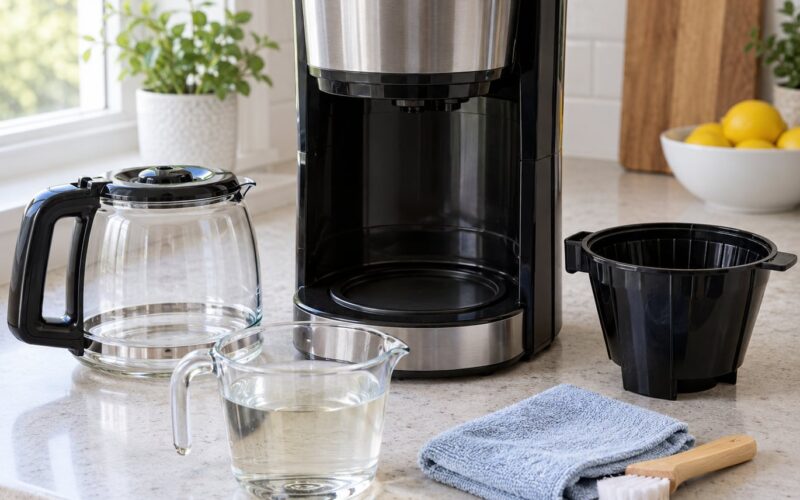
Almost every home machine can be descaled with things you already own. The only item you may need to buy is the solution itself.
- Descaling solution — either a ready-to-use liquid or a powder or liquid concentrate you dilute. Follow the ratio on the label, not a ratio you remember.
- About 1 liter of warm water for mixing, plus roughly 1.5 liters of fresh cold water for rinsing.
- A container holding at least 2 liters to catch what drains from the group head and wand. A large pitcher or a bucket works.
- Two or three clean towels and a soft cloth for the exterior.
- Your machine’s manual — not a general guide, the one for your model. It tells you the button combination, the correct solution and the tank volume.
- Basic tools — a flat-head or Phillips screwdriver and a group-head brush, only if your model needs them to reach the shower screen or a filter cartridge.
Before anything else, check whether your machine descales itself. Supermarkets, bean-to-cup and most capsule machines have a descaling program that heats the solution, runs it through the circuit in stages and tells you when to refill the tank or empty the container. If a manual mentions a “descale” or “calc” button, or a two-button press on the control panel, use that path rather than improvising.
Two things should never go into the water circuit: the water filter cartridge, which must be removed and set aside during a descale, and any detergent, dish soap or bleach. Vinegar is a separate argument, covered below.
How to Descale an Espresso Machine Step-by-Step
How to Descale an Espresso Machine: Prepare the Machine
Start by reading the descaling section of your manual. It takes two minutes and it will tell you the tank volume, the correct solution, whether the water filter comes out first and what the cycle sounds like when it runs.
Then let the machine cool. A boiler holds enough heat to scald you, and a thermoblock reheats in under a minute. Turn the machine off and unplug it, let it sit 20 to 30 minutes, and empty and rinse the water tank.
Remove the water filter cartridge if the machine has one, and keep it somewhere it will not get splashed. Pull out the portafilter, empty the drip tray, and give both a rinse. Run a couple of seconds of water through the group head and a short purge through the steam wand so you start the job with an empty circuit.
How do you know it worked: nothing comes out of the group head but clear water, and no water is still sitting in the tank when you pick it up.
Mix the Descaling Solution
Ready-to-use liquids are poured straight into the tank. Concentrates and powders need dilution, and the manual or label will give you a ratio such as one packet to 500 ml of water.
If you make your own, the figure the espresso community converges on is 10 grams of food-grade citric acid per liter of water. That dissolves ordinary kettle-scale deposits without the aggressive etching that a strong acid can do to aluminum and seals. Owners on Breville machines commonly mix at exactly that ratio, and it works.
Do not substitute vinegar unless your manufacturer explicitly permits it. Distilled white vinegar is around 5% acetic acid; mixed 1:1 with water that is roughly pH 2.4, which will swell rubber gaskets and O-rings over repeated cycles and can pit an aluminum thermoblock. It also leaves an odor in plastic tubing that lingers for days.
Two more cautions. Measure by weight or by the label’s spoon measure rather than eyeballing, because too little does nothing and too much wastes solution and can leave an acidic taste in the first shots. And never mix citric acid with bleach or with any detergent — the reaction releases gas.
How do you know it worked: the solution is clear, smells faintly sharp, and the powder has fully dissolved with no grit at the bottom of the jug.
Run the Machine’s Descaling Cycle
Pour the mixed solution into the water tank, seat it correctly on the base, put the container under both the group head and the steam wand, and start the program. A typical automatic cycle runs 20 to 25 minutes and pauses at intervals for you to top up the tank or empty the container.
Follow the machine’s own prompts. Resist the urge to pour the whole tank in at once on a machine with a smaller boiler — the point of the staged cycle is to let the acid sit in the boiler where the scale is, not to push it straight through.
On a semi-automatic machine with no descale program, you run it manually. Fill the tank, switch the machine on, and brew as normal into the container, then open the steam valve and let the wand run until the tank empties. A lever or manual machine works the same way: pump water through by hand, then run the steam wand.
Stop immediately if the machine beeps an unfamiliar alarm, leaks from somewhere it should not, or produces a smell that is not acid and vinegar-like but burnt or chemical. Those mean a wiring, pump or heat-exchanger problem, not a scale problem.
How do you know it worked: scale flakes or grainy white grit appear in the container, and the flow from the group head or wand is visibly stronger than before the job.
Clean the Group Head, Portafilter, and Steam Wand
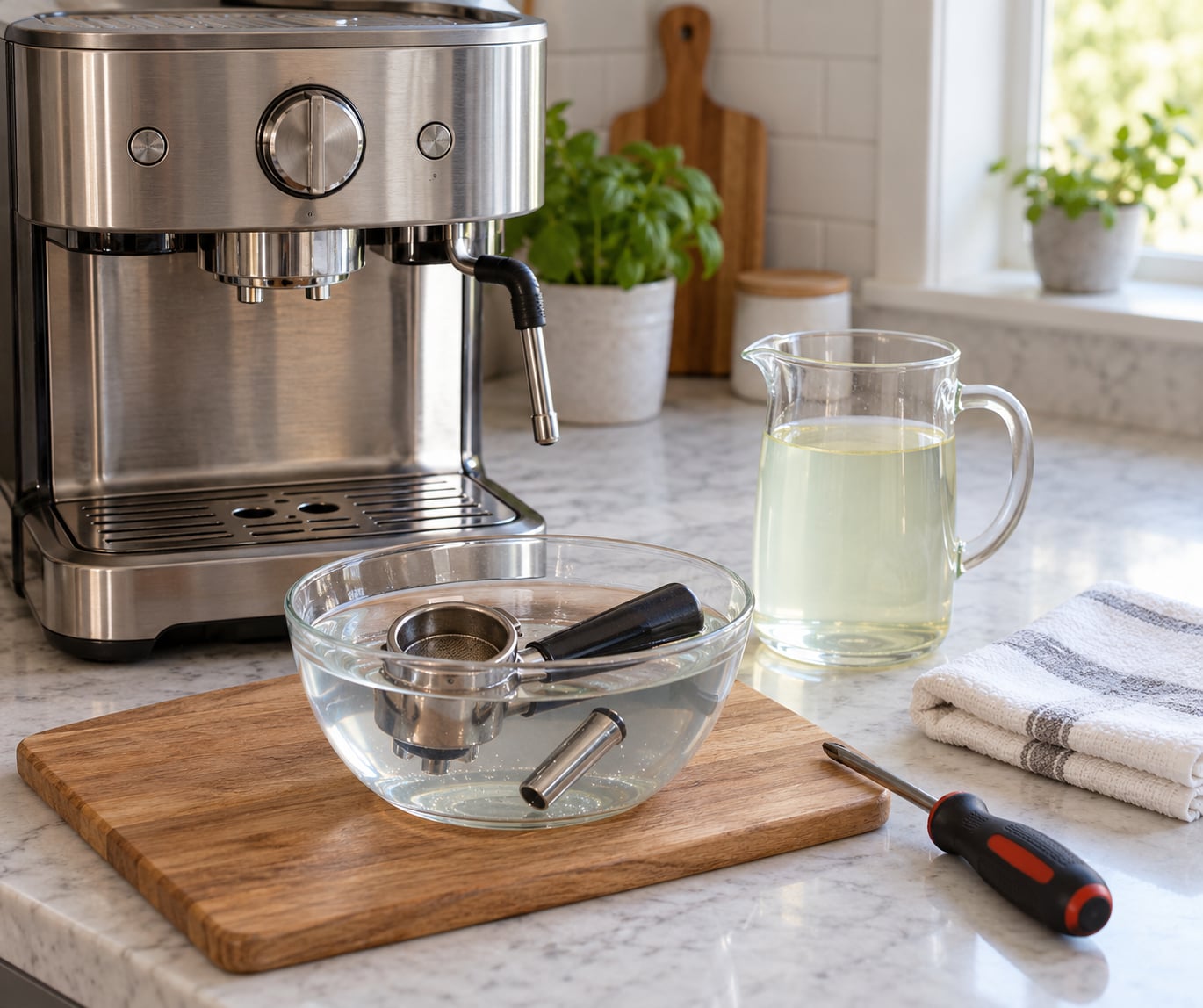
Many machines hold scale in places the cycle never touches, so treat these separately. Take the portafilter off and soak the body, basket and metal parts in warm solution for 20 to 30 minutes, then scrub with a brush and rinse. Do not soak the plastic handle on a wooden-handled portafilter.
On a semi-automatic, remove the shower screen if your manual allows it, soak it in the same solution, and clear limescale from the group head cavity with a group-head brush. That white crust around the dispersion area is where a lot of the buildup hides.
For the steam wand, fill it with solution from the tip, cover the tip with your finger to pressurize it, leave it for 10 to 15 minutes, then run steam for a minute to flush. Unscrew the tip when the model allows and soak it separately, since the holes clog first.
Never soak anything with a heating element, a sealed solenoid, electronics or a pump body. Those parts are not designed to be submerged and water in them voids the warranty.
How do you know it worked: the group head cavity is clean metal rather than white crust, and steam comes out of the wand tip freely rather than in one weak jet.
Rinse and Reassemble the Espresso Machine
This is the part people skip, and it is the part that produces a sour-tasting shot the next morning. Run two to three full cycles of fresh water through the machine with the container in place, brewing into the jug and then purging the steam wand for 20 to 30 seconds at the end of each one.
Rinse the tank, the portafilter and its basket, the shower screen, the steam wand tip and the drip tray separately under running water. Wipe the group head area and the exterior with a damp cloth, then put the water filter cartridge back in and seat the tank.
If the machine has a descale or clean-water indicator, it usually clears after the rinse cycles. If it does not, the machine may need a second rinse or a full power cycle.
How do you know it worked: the water coming out of the group head and the wand has no smell at all, and there is no film or white residue in the water you collect.
Test the Machine and Check Your Water
Run one blank shot with no coffee in the portafilter, then a normal test shot. Flow should feel like before the descale or better, pressure should return to the range your gauge shows, and the first espresso should taste like coffee rather than sourness or chemicals.
A sour or chemical taste means solution is still in the system, and more rinse cycles fix it. A sudden drop in temperature or weak pressure after a descale can mean a scale flake is lodged in the group head or boiler, which usually clears with a couple more flushes; persistent loss of temperature on an older machine is a sign it needs a technician.
Now think about when the next one is due. Water hardness is the deciding factor, and it varies enormously by region. Test your tap water with a hardness strip or a TDS meter — soft water sits under about 20 mg/L of calcium, hard water runs 80 to 120 mg/L.
On soft or filtered water, most manufacturers suggest a descale every 2 to 3 months. In a hard water area with several shots a day, the enthusiast standard is every 6 to 8 weeks, and that is closer to the truth. One owner on a Gaggia Classic in a hard water area with no filtration reports descaling about every two months, and a community-maintained guide for Rancilio Silvia users recommends a citric acid descale on the same 6-to-8-week cycle. Filtering the water or using a softener is what lets you slow that down.
How do you know it worked: a shot that tastes clean, a steam wand that heats quickly, and a pump that sounds like it always did.
Common Mistakes
Using vinegar when the manual says not to. Fix: use the manufacturer’s solution, or citric acid at 10 g per liter if you want to mix your own. Repeated vinegar cycles are the main reason some machines need gasket replacement sooner than they should.
Pouring in too much solution. Fix: measure the tank volume from the manual’s spec table and follow it. Overfilling on a small-boiler machine wastes solution and can push acidic water into places it should not sit.
Skipping the steam wand. Fix: run the wand after the main cycle and soak the tip separately. Steam is where scale concentrates fastest, and a partly blocked tip is the usual reason a wand stops steaming properly.
Not rinsing enough. Fix: run three fresh water cycles and one steam purge, then check the collected water for smell. If any is left, run another cycle.
Descaling a part the manual excludes. Fix: keep electrical, pump and sealed components dry, and never put the whole machine in a sink. Removing the water filter for the duration of the job is the single most commonly missed step.
Ignoring warning lights and error messages. Fix: descale when the indicator appears rather than waiting. On machines with no descaling program, watch for the symptoms instead: slowing extraction, weak pressure, a wand that takes longer to heat, or white crust around the group head.
Leaving the water filter in during the job. Fix: it becomes saturated with solution and can release it back into the tank afterward. Remove it, keep it dry, and reinstall it after the final rinse.
Routine maintenance beyond descaling keeps the intervals longer. Backflush the group head with cleaning tablets weekly on a semi-automatic, rinse the portafilter basket and shower screen after each use, purge the steam wand before and after steaming milk, and keep the drip tray from standing water. That is a few minutes a week, and it is the cheapest maintenance a machine gets.
Frequently Asked Questions
Can I use vinegar to descale an espresso machine?
Only if your manual explicitly allows it. Distilled white vinegar is roughly 5% acetic acid, and a 1:1 mix with water is aggressive enough to swell rubber gaskets and O-rings over repeated cycles and can pit an aluminum thermoblock. It also leaves an odor in plastic tubing for days. Most manufacturers state that vinegar voids the warranty. Food-grade citric acid at about 10 grams per liter of water is the safer DIY route when a branded solution is not to hand.
How often should I descale my espresso machine?
Every 2 to 3 months is the usual manufacturer guidance, but water hardness decides the real number. On soft or filtered water that is about right. In a hard water area with several espresso drinks a day, most experienced owners descale every 6 to 8 weeks instead. If your machine has a descale indicator, follow the light. If it does not, use flow and steam performance as your gauge: slower extraction and a wand that takes longer to heat both mean scale.
Should I descale the water tank and water filter?
Clean the tank, yes, but take the filter cartridge out first. Leave the cartridge out for the whole job, then rinse the tank thoroughly under running water. A filter left in during descaling absorbs the solution and can release it back into the tank later, which is a common cause of a chemical taste in the first shots after a descale. Do not soak or descale the cartridge itself; rinse it in fresh water only.
What should I do if my espresso machine has a descale or water warning?
Follow the machine’s own program if it has one, since the indicator usually clears only after the rinse cycles. Machines with no descaling program need a manual descale. If the light stays on after you have run three fresh water cycles, the machine may simply need a power cycle, and on some models the water hardness setting has to be corrected so it does not trigger again. If the warning relates to a leak, a pump or a heating fault rather than scale, stop descaling and get it serviced.
Can I descale a machine with a built-in cleaning cycle myself?
Yes, and you should use that cycle rather than improvising, because it heats the solution, holds it in the boiler, and divides the flush into stages with prompts for topping up the tank and emptying the container. Manual work is still needed on the portafilter, shower screen and steam wand tip, which the program does not touch. Set aside 30 to 60 minutes for the whole job, and a typical cycle itself runs 20 to 25 minutes.
When should I call a technician instead of descaling the machine?
Call a technician when the problem is not scale. Warning signs include a burnt or chemical smell that is not simply acid, water leaking from the body of the machine, a pump that runs but never builds pressure, an error message that returns after a full descale, and brew temperature that stays low after several rinse cycles. Scale flakes blocking a passage can sometimes be cleared with extra flushes, but a persistent loss of temperature or pressure on an older machine means the boiler or heat exchanger needs attention.
Start with the manual, use the solution it approves, and take the water filter out. Run the machine’s own cycle if it has one, soak the portafilter and steam wand while you wait, and finish with three rinse cycles plus a steam purge. Do that on a schedule that matches your water, and the descale itself stops being a chore.