Nuts go rancid because most of what is inside them is oil, and that oil is mostly unsaturated fat. When oxygen reaches those fats, they oxidise, and the reaction produces the sharp smell and bitter taste you have probably met in a bag of old walnuts. Learning why nuts go rancid and how to tell is mostly a matter of trusting your nose first, then checking the whole container rather than the one nut in your hand.
The good news is that timing is on your side. Airtight storage, a cool cupboard or the fridge, and a proper freezer plan will push rancidity months out. Updated for 2026.
Table of Contents
- Why Nuts Go Rancid?
- What Causes Nuts to Become Rancid?
- Rancid is not the same as stale, and neither is the same as mouldy
- Oxidative rancidity versus hydrolytic rancidity
- How Oxidation Changes a Nut’s Smell and Flavor
- Do rancid nuts always smell different?
- How to Tell if Nuts Are Rancid
- Five checks, in the order I use them
- Two false alarms people keep asking about
- When to trust the best-before date
- Can You Eat Slightly Rancid Nuts?
- If you have already eaten some
- How to Store Nuts So They Stay Fresh
- How long nuts keep by nut and storage method
- What to Do When Nuts Are Already Slightly Oxidized
- Frequently Asked Questions
- Can rancid nuts make you sick?
- Can I fix rancid nuts by roasting or baking them?
- Should I refrigerate nuts to keep them from going rancid?
- How long do nuts last before they taste rancid?
- Do rancid nuts always look or smell different?
- What to Do First
Why Nuts Go Rancid?
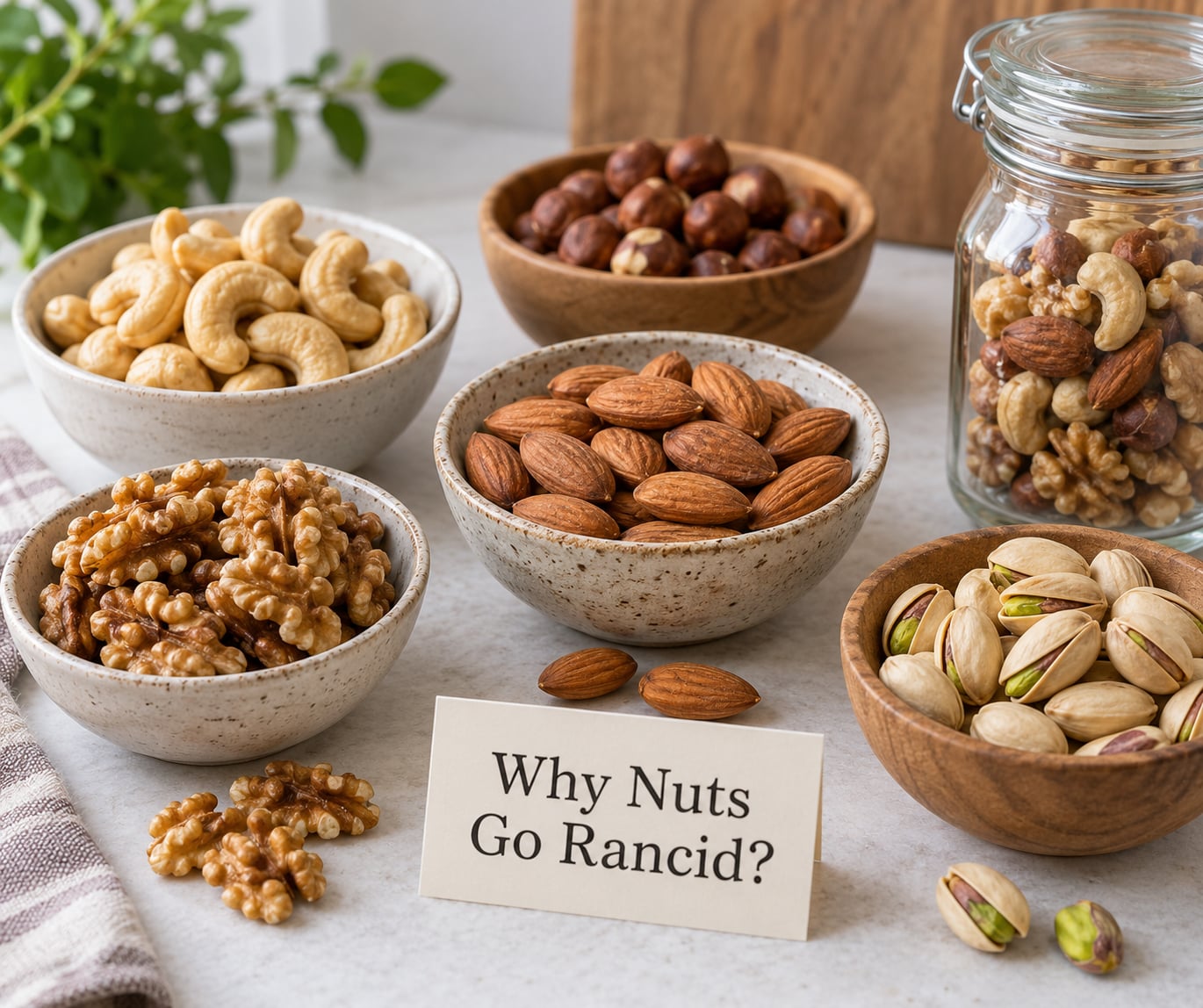
Nuts are roughly 40 to 80 percent oil by weight, and a large share of that oil is linoleic or alpha-linolenic acid, the polyunsaturated fats your body cannot make for itself. Those double bonds are exactly what makes the fats nutritionally interesting, and they are also what makes them reactive. Oxygen attacks the double bonds, the fat structure breaks down, and the breakdown products are what you smell and taste.
Four things speed the whole thing up: air, heat, light, and moisture. Take any one of them away and you slow the reaction considerably. This is the entire reason a jar of almonds survives in a fridge for half a year while the same nuts in a warm, open bag turn within a few weeks.
The smell is the giveaway because oxidation products are volatile. You notice them at concentrations far below anything you would notice in a nut that has only gone stale. The practical consequence is simple: once the oil has oxidised, the flavour is gone permanently, the nutrients that make nuts worth eating are partly degraded, and no amount of cooking will bring either back.
What Causes Nuts to Become Rancid?
Oxygen exposure is the cause. Everything else just controls how much oxygen reaches the fat and how fast the chemistry runs. Airtight packaging with nitrogen flushing or an oxygen absorber slows it down dramatically, which is why factory-packed nuts keep longer than nuts poured into a Tupperware at home.
Heat is the accelerator people forget. A cupboard above the oven or kettle adds warmth every time you cook, and warmth roughly doubles the oxidation rate for each step up. Freezing, at the other end of the scale, stops the reaction almost completely, which is why the freezer is the only real answer to bulk buying.
Light matters more than most home cooks expect. UV wavelengths drive photo-oxidation, and a clear glass jar on a sunny counter gets hit all day. Dark glass, a tinted plastic tub, or a closed cupboard all remove that factor for free.
Moisture and metal contact are the quieter ones. Residual moisture from washing, thawing or a damp spoon encourages mould and gives lipolytic enzymes something to work with. Trace metal ions from a wet or rusty scoop, a dented tin or a blade that sat on steel will catalyse peroxides into aldehydes far faster than plain oxygen would.
Then there is surface area. Shelling a nut, chopping it, or grinding it into flour breaks the seed coat, which is rich in phenolics that act as an antioxidant barrier. That is why chopped nuts in a baking tin go bad faster than whole ones in a jar, and why nut butter spoils faster than the nuts it came from.
Rancid is not the same as stale, and neither is the same as mouldy
Stale means the nut has lost crispness or aroma without the oil breaking down. It still tastes nutty, it is not unpleasant, and it is a texture problem. Rancid means the oil has oxidised, which is a chemistry problem you can smell. Mouldy means a fungus got in, which is a safety problem.
This distinction is where most confusion happens, because the three can coexist. A bag that is simply past its crunch is worth eating. A bag that smells like old cooking oil is not worth eating. A bag with grey-green fuzz on it needs to go, whole batch and all, because mould on nuts can produce aflatoxins and you cannot see how far it has spread.
One more thing worth stating plainly: chemical oxidation can happen under conditions where nothing looks wrong. No fuzz, no discoloration, no visible film. If the fat oxidised, it oxidised, and the nose catches what the eye cannot.
Oxidative rancidity versus hydrolytic rancidity
Whole or shelled nuts sitting in air go rancid by oxidation, as described above. Nut butters, nut milks and nut-flavoured drinks go rancid mainly by hydrolysis instead, because water lets lipolytic enzymes split the fats into free fatty acids. A recent review in the Journal of Food Composition and Analysis, by Zhou, Yan, Bi and Li, lays out this split clearly, and it explains why a jar of almond butter can taste harsh and soapy while the almonds beside it taste fine. The wet products need refrigeration and a clean spoon; the dry ones need air and light removed.
How Oxidation Changes a Nut’s Smell and Flavor
The first stage of oxidation produces peroxides, which smell faintly metallic. Those peroxides break down again into aldehydes and ketones, and one of those, hexanal, has a distinctly grassy or green-note smell. Continue the chain and you get the stale, waxy, almost varnished note that people describe as crayons or old paint.
In practice, three smells show up on rancid nuts, in rough order of severity. Old cooking oil or old frying grease is the most common report. Crayons, marker pen or fresh paint follows, especially in walnuts and pine nuts. A sour or vinegary edge shows up later, once free fatty acid levels climb. Some people also get a waxy or rubbery note, which tends to accompany texture problems rather than causing them.
Mild oxidation is genuinely hard to grade. A nut that smells only faintly of cardboard and tastes only mildly bitter may simply be a few weeks past its best. What separates that from real rancidity is intensity and persistence: genuine rancidity does not fade after one bite, it gets stronger, and it follows you through the rest of the meal. If the smell clears when the nut leaves your nose, you are probably looking at staleness.
Do rancid nuts always smell different?
Most of the time, yes, but not in every case. Some people have a lower sensitivity to the aldehydes that form, particularly after years of eating the same nut every day, which dulls the signal. Storage also matters: nuts kept airtight and frozen may develop the whole taste-and-aroma profile of rancidity while releasing almost nothing, because the volatile compounds are trapped rather than free to reach your nose.
That is the case where you taste a single nut rather than smell the bag. If it is sharply bitter with a lingering oily aftertaste, treat it as rancid regardless of how mild the aroma seemed.
How to Tell if Nuts Are Rancid
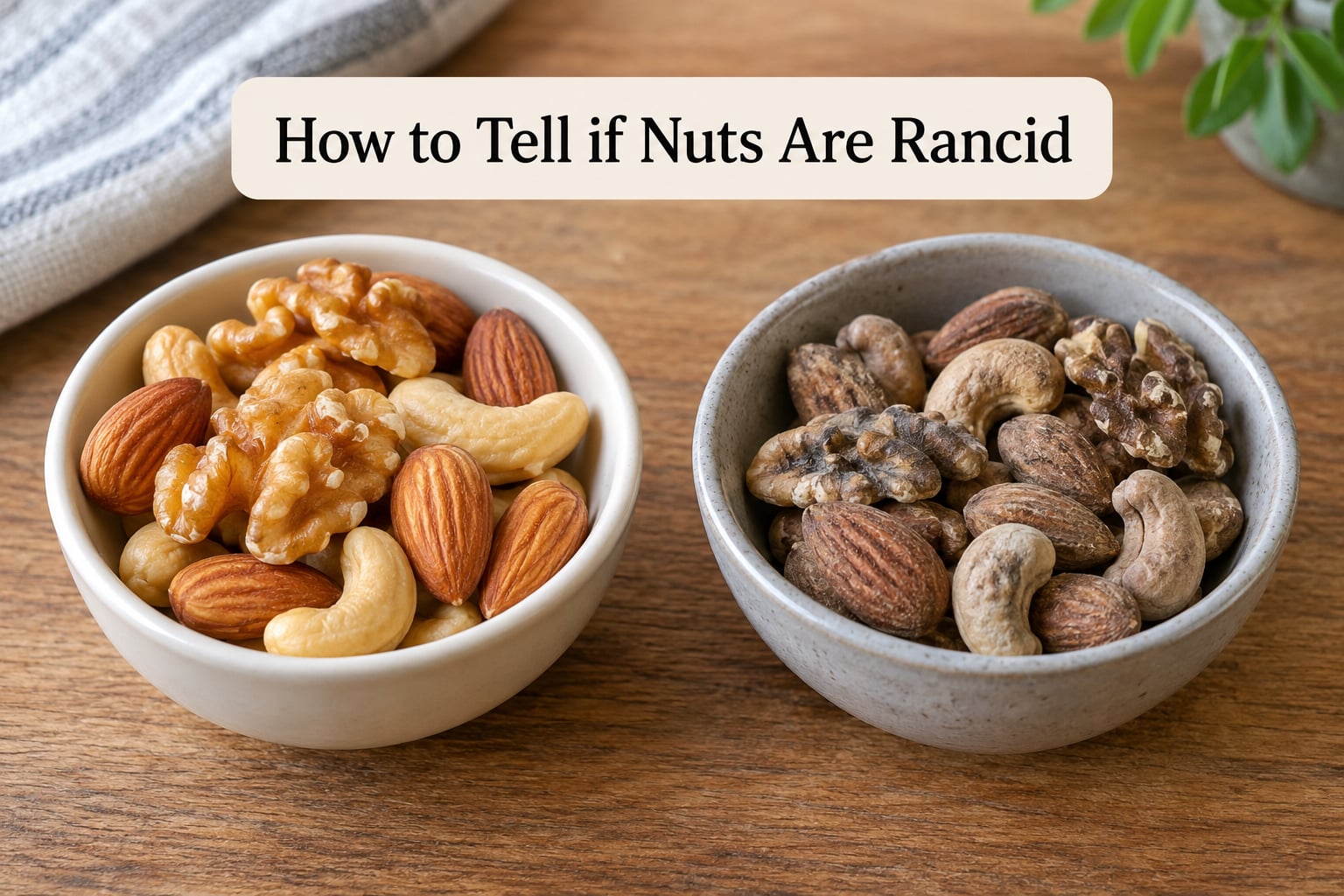
Check one nut and you are checking a sample of one. Open the container, hold a few nuts a few inches from your nose, and smell the group rather than a single kernel. Volatile oxidation products are far easier to detect in a handful than in one piece, and it costs you nothing.
Five checks, in the order I use them
- Smell the handful. Fresh nuts are mild, sweet and buttery.
- Smell again after chewing. Rancidity strengthens rather than fading.
- Taste one. Sharp bitterness with an oily aftertaste means rancid.
- Check texture. Waxy, rubbery or unusually soft kernels are suspect.
- Look at the whole container. Any fuzz, discoloration or dampness means discard.
Appearance alone is a poor test, which is exactly why the nose comes first. Darkening on the skin of a walnut or the dark flecks on a pecan can be variety, age or roasting, none of which mean rancidity. Pale, dull nuts that used to be glossy are a slightly better clue, since surface oils have oxidised or been absorbed, but again it is a hint rather than a verdict.
Two false alarms people keep asking about
Clumping. Nuts stuck together in a bag is one of the most-searched questions on nut forums, and the honest answer is that clumping proves nothing on its own. Static cling from low humidity, sugar residue from roasting, moisture that crept in through a bag seam, and genuinely oxidising oils can all make nuts stick together. Smell decides it. If they clump and smell clean, the cause is humidity, and drying them in a single layer for an hour fixes it.
Oily or shiny surfaces. Raw macadamias have a natural oil sheen that survives roasting, and it is widely mistaken for rancidity. A buyer on r/nuts once described being unable to tell whether a bag of macadamias was safe after reading that oily nuts signal spoilage. A fresh macadamia is glossy because its own lipids are intact and its seed coat is unbroken; a rancid one is dull on top and bitter on the tongue. Shine is not the signal. Bitterness is.
When to trust the best-before date
Treat printed dates as a shelf life under ideal conditions, not a safety cutoff. A best-before date assumes a cool, dark, sealed pantry, and most home pantries are none of those things. Open bags lose that guarantee immediately, so use the date on an open bag as a prompt to sniff, not as permission to skip sniffing.
Can You Eat Slightly Rancid Nuts?
Direct answer: mildly oxidised nuts are unlikely to make you sick, but they are also not worth eating. Rancidity is not the same hazard as microbial contamination. It is a quality failure with a nutritional cost, and once the oil tastes and smells wrong, there is no reason to put it in your mouth.
What you lose is measurable in principle. Oxidising lipids produce aldehydes including malondialdehyde and hexanal, which are the compounds researchers use to track lipid peroxidation in foods. At the same time the antioxidant content falls, since the tocopherols and phenolics that protected the fat are consumed doing that job. Long-term nut consumption is associated with lower cardiovascular risk, and the entire reason nuts are on the list is that fat content, so eating a bag that has quietly lost it is paying for the nuts and not getting them.
The health framing people usually meet is stronger than the evidence warrants for a single accidental mouthful. There is no established link between eating oxidised nuts occasionally and cancer. The practical advice from UC Davis Food Safety guidance and food-science reviews alike is to stop eating them rather than to worry about what already happened.
If mould is involved rather than oxidation, the calculation changes completely. Aflatoxin risk is the reason mouldy nuts get discarded whole, not skimmed and not cut around. Moisture, mustiness, or visible fuzz all point that way, and no cooking reliably destroys those toxins.
Children deserve a stricter line, as do anyone with a weakened immune system or a compromised gut. For them, an off-smelling batch is not a borderline call.
If you have already eaten some
Most people need to do nothing. A single serving of mildly oxidised nuts is not a medical event for an otherwise healthy adult. Drink some water, move on with your day, and stop using the bag. If you develop persistent nausea, vomiting or diarrhoea, treat that the way you would any foodborne illness, and if it does not settle, speak to a doctor.
How to Store Nuts So They Stay Fresh
Four rules cover nearly every case: airtight, cool, dark, and dry. Air out means oxygen in, cool slows the chemistry, dark blocks photo-oxidation, and dry keeps mould and hydrolysis out of the picture. Get those four right and you can choose your timeline from the table below.
Glass jars with clamping lids work well because you can see what is inside. Vacuum sealing is better still. Airtight plastic tubs are fine as long as the seal is intact, and the original factory bag is usually the weakest link in the chain, because it was never designed to be reclosed repeatedly.
Avoid the two classic mistakes: a container above the kettle or the oven, and a jar that gets opened every day without a fresh scoop. The second one is how bulk bags quietly fail, because repeated air exchange is the whole mechanism you are trying to stop.
How long nuts keep by nut and storage method
| Nut | Cool dark pantry | Fridge | Freezer | Stability |
|---|---|---|---|---|
| Walnuts | 2 to 4 weeks | 4 to 6 months | 12 months or more | High PUFA, turns first |
| Pecans | 1 to 3 weeks | 4 to 6 months | 12 months or more | High PUFA, turns first |
| Pine nuts | 2 to 4 weeks | 3 to 5 months | 10 to 12 months | Very high PUFA, fastest of all |
| Peanuts | 1 to 3 months | 5 to 8 months | 12 months or more | Moderate PUFA |
| Hazelnuts | 2 to 4 months | 6 to 9 months | 12 months or more | Mostly monounsaturated |
| Almonds | 3 to 5 months | 8 to 12 months | 18 months or more | Mostly monounsaturated |
| Cashews | 3 to 5 months | 8 to 12 months | 18 months or more | Mostly monounsaturated |
| Macadamias | 4 to 6 months | 8 to 12 months | 18 months or more | Very stable fat |
| Nut butter, opened | 1 to 2 months | 6 to 9 months | Not recommended | Hydrolytic risk, keep clean |
The pattern in that table is fatty acid chemistry, not marketing. Walnuts, pecans and pine nuts are dominated by polyunsaturated fats and carry the highest antioxidant load at the same time, so they run out of protection first. Almonds, cashews and macadamias lean on monounsaturated fat, which is far less reactive, which is why a homesteadier on r/homestead describing room-temperature tree nuts lasting about six months was describing the stable end of the list.
Buy whole and in-shell when you can. The shell and seed coat slow both oxygen transfer and moisture, and a r/selfreliance regular who decanted bulk buys into dated weekly portions reported cutting waste noticeably compared with one large open bag.
What to Do When Nuts Are Already Slightly Oxidized
There is no rescue for genuinely rancid nuts, but borderline batches get a real second chance. The test is intensity: if the smell and taste are faint and clear when you set the nuts down, you have room to use them quickly rather than bin them.
Use them first, in cooking, in the next few days. A savoury dish, a curry, a roasted vegetable tray or a salad dressing will absorb a mild off note that you would notice instantly eating them dry from the bag. Toast them in a hot pan or in the oven; the heat drives off volatile compounds and hides a little more of the problem, though it does not undo the oxidation.
Chopping and grinding make it worse, so do not process borderline nuts into flour or butter. Extra surface area accelerates the reaction you are already trying to outrun, and ground nuts give you no escape from the smell later.
What does not work: roasting, baking, air-frying, rinsing, drying in a low oven, or mixing fresh nuts in to disguise the taste. A user on a money-saving forum framed the taste problem plainly, that rancid oils belong in birds rather than people, and no cooking step reverses the chemistry. Heat stops the reaction; it does not reverse what has already happened.
Discard, without debate, when the smell is sharp at arm’s length, the taste is bitter on the first bite, any mould or dampness is present, or you are feeding a child. Those are not judgement calls.
Frequently Asked Questions
Can rancid nuts make you sick?
Occasional rancid nuts rarely cause illness. Oxidised oils are a quality and nutrition problem rather than a microbial one, though the by-products of lipid oxidation, including aldehydes such as hexanal and malondialdehyde, are exactly what food scientists measure to track spoilage. If mould, mustiness or dampness is present instead, discard the whole batch because aflatoxin risk cannot be judged by appearance. Anyone with a weakened immune system should treat off-smelling nuts as a discard, not a borderline call.
Can I fix rancid nuts by roasting or baking them?
No. Roasting and baking raise the temperature, which can drive off some volatile compounds and make a faintly oxidised nut taste better, but the fat itself has already broken down into peroxides, aldehydes and free fatty acids. Heat stops the oxidation from continuing; it does not reverse it. The best available option for borderline nuts is to use them quickly in a cooked dish where other flavours carry the load, and to discard anything that is sharply bitter or smells of old cooking oil.
Should I refrigerate nuts to keep them from going rancid?
It depends on how long you plan to keep them. A cool, dark, airtight cupboard is fine for almonds, cashews and macadamias for a few months, but walnuts, pecans and pine nuts go fast at room temperature and do much better in the fridge. Freezing suits bulk buys and nuts you will not touch for months, because cold stops the oxidation reaction almost entirely. Remember that a humid fridge is not a solution, so let cooled nuts dry fully before sealing them.
How long do nuts last before they taste rancid?
In a cool, dark, airtight pantry, expect two to four weeks for walnuts, pecans and pine nuts, one to three months for peanuts and hazelnuts, and three to six months for almonds, cashews and macadamias. Refrigerated, those figures stretch to four to twelve months depending on the nut. Frozen, most nuts keep a year or more. Printed best-before dates assume ideal storage, so an open bag should be sniffed rather than trusted on its date alone.
Do rancid nuts always look or smell different?
Not always. Visual signs are unreliable, and darkened walnut skins or dull surfaces can just as easily mean age, variety or roasting rather than rancidity. Smell is the dependable test: mild and buttery means fresh, while old cooking oil, crayon, greasy cardboard or a sour edge means oxidised oil. If a nut looks perfectly normal and still seems off, taste a single one and wait, because genuine rancidity intensifies rather than fading once it is in your mouth.
What to Do First
Open the container, smell a handful, then check the whole batch for fuzz, dampness or discoloration rather than judging the one nut in your hand. Discard anything that is sharply bitter or smells of old cooking oil, and use mildly off nuts soon in a cooked dish.
For the fresh lot, pour it into an airtight glass jar and put it somewhere cool and dark. If it is high-fat nuts such as walnuts, pecans or pine nuts, move the jar to the fridge; if you bought in bulk, split it into dated portions and freeze them. That single habit solves most of the rancid nut problems I have had in my own kitchen.