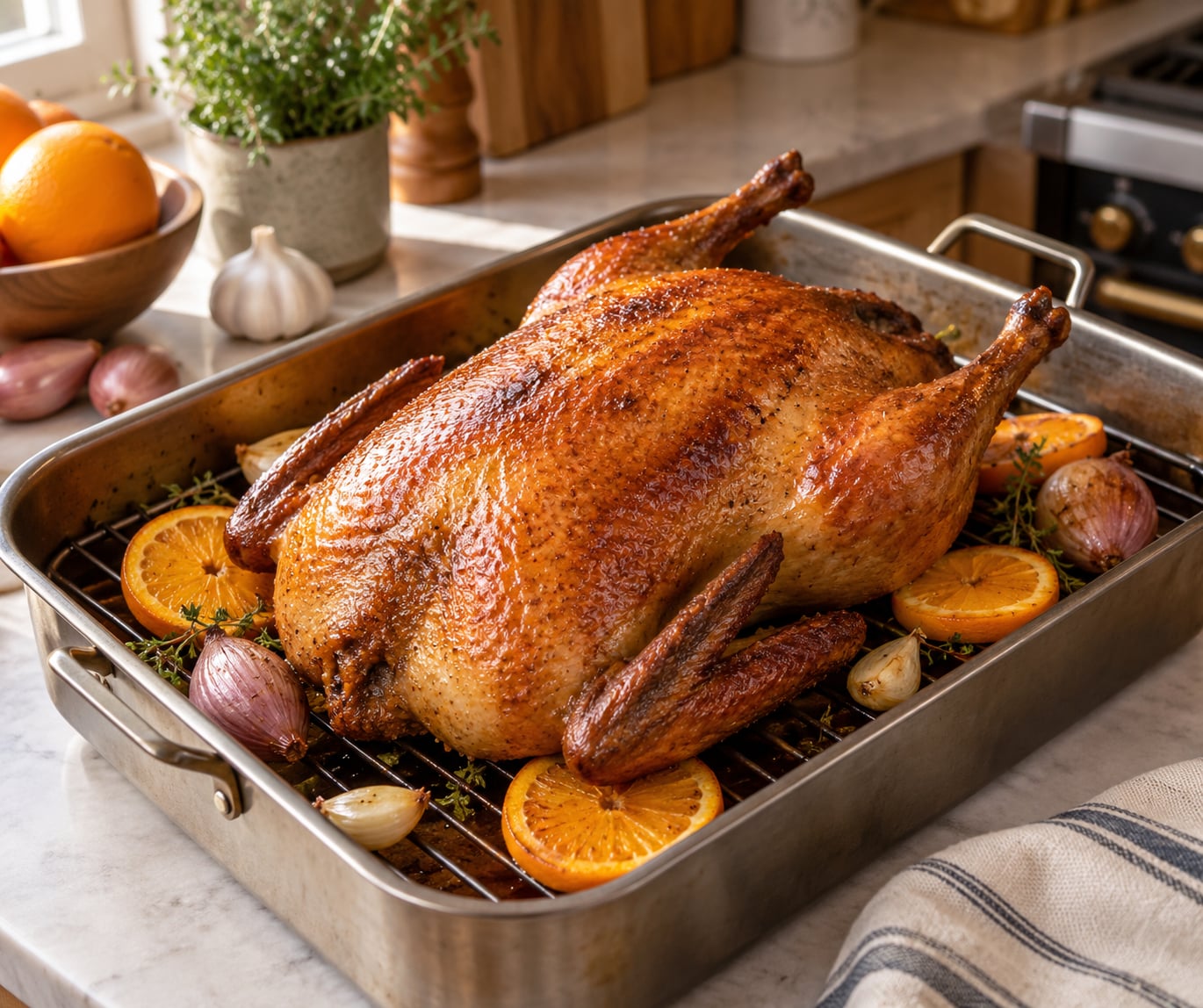
To cook a whole duck in the oven, blast it at 425°F / 220°C for 15 minutes, then lower the oven to 350°F / 175°C and roast until the thickest part of the thigh hits 165°F / 74°C, about 2 hours for a 5 to 6 lb bird. Dry the skin well, drain the fat twice, and skip the foil. That is the whole trick, and it is not complicated.
The part that trips people up is timing. Recipe cards rarely agree with each other, and a 6 lb duck in one oven is not the same bird as a 6 lb duck in yours. Home ovens run anywhere from 20 to nearly 90°F above the dial, which is why a thermometer beats the recipe every time.
Whole duck sounds intimidating because of the size, not the technique. Most people who try it once cook it again. Allow 15 minutes of hands-on prep, then roughly 20 minutes per pound of bird.
Method at a glance
- Prep: thaw in the fridge 2 to 4 days, remove giblets, pat the skin bone dry, salt it inside and out, chill uncovered 24 to 48 hours if you have the time.
- Roast: 425°F / 220°C for 15 minutes, drop to 350°F / 175°C, flip breast side down for the middle stretch, pour off the fat twice.
- Finish: check the thigh and leg joint at 165°F / 74°C minimum, then blast at 425°F / 220°C for 5 to 10 minutes to crisp the skin.
- Rest: 15 to 20 minutes before carving, loosely tented with foil.
Table of Contents
- What You Need
- Step-by-Step: How to Cook a Whole Duck in the Oven
- 1. Thaw, clean, and dry the duck
- 2. Set the oven and roasting pan
- 3. Roast the whole duck in the oven: 425°F first, then 350°F
- 4. Check doneness without touching bone
- 5. Rest, carve, and serve
- Common Mistakes
- Frequently Asked Questions
- How long do you cook a whole duck in the oven?
- Should you cover a duck with foil when roasting?
- What temperature should a whole duck reach to be safe?
- What is the preferred cooking method for duck?
- Should you score or prick the skin on a roast duck?
- Can you cook a whole duck ahead and reheat it?
- Conclusion
What You Need
The bird itself is the main item, and fresh or frozen both work. A frozen duck needs thawing in the refrigerator, which takes 2 to 4 days for a 5 lb bird, or about 24 hours per 4 to 5 lb. Never start it frozen or from the counter, and never microwave it to save time.
Whole ducks sold for roasting usually weigh between 4 and 8 lb, with 5 to 6 lb being the most common size. That is enough to feed six to eight people with leftovers. Buy one with a clear cavity and intact skin, and check the gizzard and heart are packed inside.
- A whole duck, fresh or frozen, 4 to 8 lb
- Kosher salt and black pepper, for seasoning under and over the skin
- Aromatics: 1 orange, 1 small onion or 2 shallots, 4 garlic cloves, a few thyme sprigs, bay leaves
- A deep rimmed roasting pan with a wire rack inside it
- An instant-read thermometer with a thin probe
- Kitchen twine for trussing, plus toothpicks if you want the cavity sealed
- Paper towels, which do more work than anything else in this recipe
A note on fat: duck fat is worth saving. A dry-bridged bird is even better, and dry-bridging means leaving the thawed duck uncovered on a rack in the refrigerator for 24 to 48 hours before cooking. Experienced cooks on cooking forums call it the single biggest upgrade to crispness, and it costs you nothing but fridge space.
Step-by-Step: How to Cook a Whole Duck in the Oven
1. Thaw, clean, and dry the duck
Thaw in the refrigerator until fully thawed. Pull the giblets and the large wad of fat from the cavity; excess fat sitting in there steams the meat and blocks heat from reaching it.
Score the skin in a diamond pattern, cutting only through the skin and a light film under it, never into the breast meat. If you break through, you have gone too deep, and juices will leak out through every cut.
Season under and over the skin with salt and pepper. Massage the cavity, tuck in the aromatics, and pull the legs together with twine without crushing the breast. Pat the skin thoroughly dry with paper towels inside and out, including the underside where it sits over the fat.
A wet surface steams instead of browning. Dry skin is the difference between crackling and flabby.
2. Set the oven and roasting pan
Place the rack in the lower-middle position and heat the oven to 425°F / 220°C. Put the wire rack inside your deepest roasting pan, a couple of inches above the bottom, and set the bird on it breast side up.
Elevating the duck on a rack is what stops the underside from stewing in its own fat. Leave room in the oven and keep the pan at least a rack away from the heating element.
For spatter control, fit a shallow pan underneath your rack to catch drips, and check it once mid-roast. If smoke is a worry, some cooks roast with the oven door cracked an inch or two and a roasting pan set low on the stove. Do not put a lid on the duck; it traps steam and softens the skin.
3. Roast the whole duck in the oven: 425°F first, then 350°F
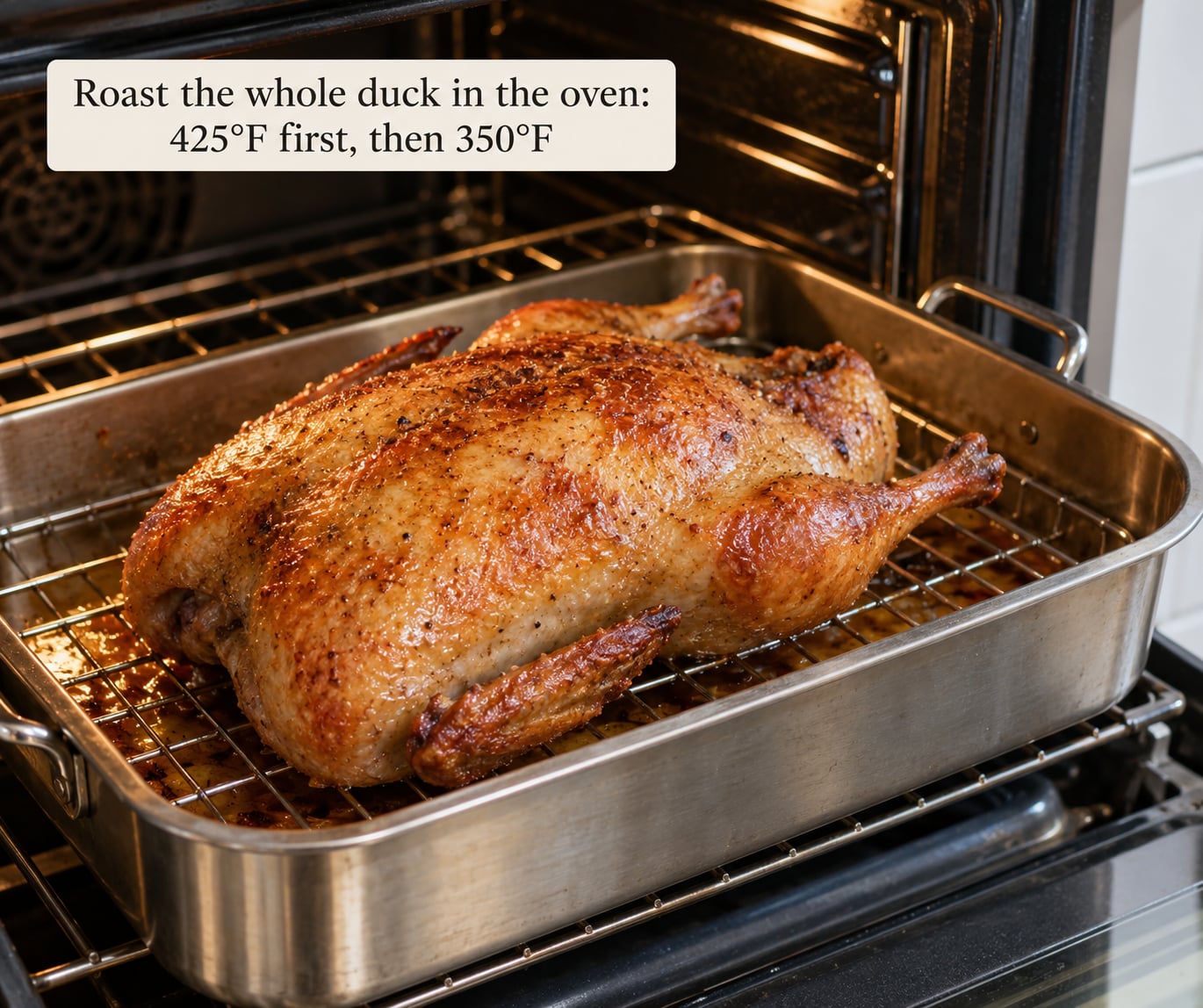
Roast at 425°F / 220°C for 15 minutes to set the skin, then drop the oven to 350°F / 175°C and continue. Most home cooks finish the bird breast side down for part of the cook so the underside crisps too, then flip back for the final stretch.
Two methods dominate, and both work:
- 350°F / 175°C with a 425°F / 220°C blast at the start and end — roughly 20 minutes per pound, skin crispens predictably, and it fits a weeknight-to-Sunday roast.
- 300°F / 150°C slow roast for 3 to 3.5 hours — gentler on the fat, more forgiving for large birds, and the route most repeat cooks describe as meat falling off the bone.
Whichever you pick, drain the accumulated fat after about 40 minutes and again at the halfway point. Greasy skin and an oven full of smoke come from fat sitting in the pan under the bird, not from fat on the bird.
Planning around weight rather than a recipe’s stated time:
- 4 lb: blast, then about 1 hour 15 minutes at 350°F / 175°C, total roughly 1 hour 30 minutes.
- 5 lb: about 1 hour 40 minutes at 350°F / 175°C, total roughly 2 hours.
- 6 lb: about 2 hours at 350°F / 175°C, total roughly 2 hours 20 minutes.
- 7 lb: about 2 hours 20 minutes at 350°F / 175°C, total roughly 2 hours 45 minutes.
- 8 lb and up: roughly 25 minutes per pound at 350°F / 175°C, or drop to 325°F / 165°C so the breast keeps up with the legs.
If the skin darkens well before the meat is done, tent loosely with foil rather than wrapping it, and lower the oven by 25°F. Browning and doneness are two different clocks.
4. Check doneness without touching bone
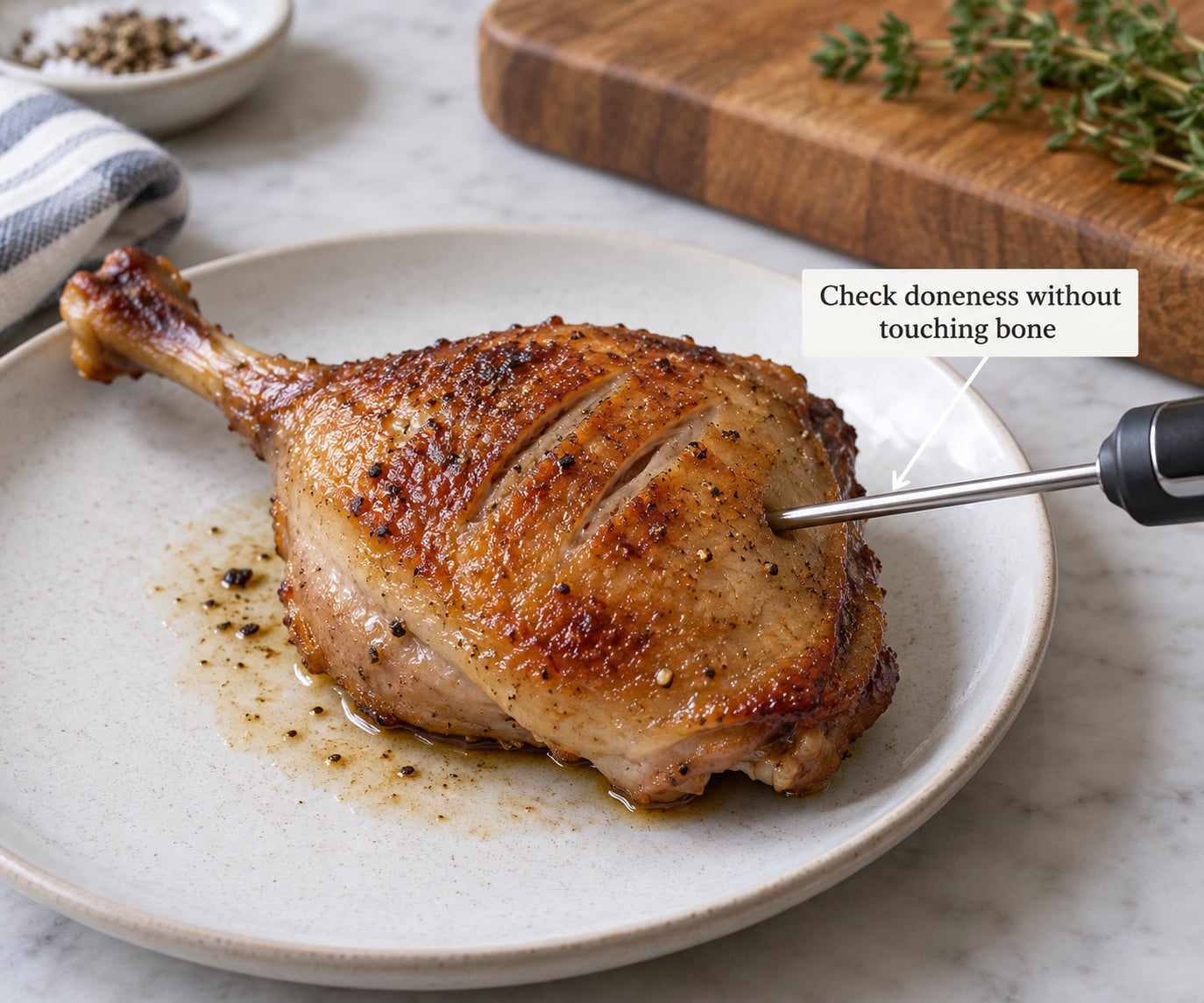
Start probing at about 75% of your estimated cook time, and probe the thickest part of the thigh and the leg joint, not the breast alone. Push the tip in without touching bone or hitting the roasting pan; a false reading is the most common thermometer error.
Poultry must reach 165°F / 74°C at the thickest part. For a roast duck that most cooks find rubbery above that range, aim for 175°F to 185°F / 80°C to 85°C in the thigh for tender, juicy meat. The leg should twist easily in the socket once it gets there.
If the thigh reads done and the breast does not, trust the thigh. Breast meat tightens as it cooks, so cover only the breast area and keep cooking until the leg loosens.
5. Rest, carve, and serve
Rest the duck 15 to 20 minutes, loosely covered with foil, before cutting into it. Resting lets the muscle fibres relax so the juices stay in the meat when you carve, and carryover cooking means the internal temperature keeps climbing slightly as it sits.
Resting does not undo the safety temperature. The bird is already cooked, and the carryover only pushes it further along.
Carve breast meat off the bone first with a sharp knife, slicing across the grain, then lift the legs off the sockets and pull the thighs free. A five-minute blast under a hot grill pan or under the broiler at the end of the rest will bring back the crackle if the skin softened in the oven.
Cooked duck is unfashionably fatty, so pair it with something sharp and acidic rather than another rich dish. A sharp salad, tart cherries, or a pan sauce built from the fruit and aromatics you put in the cavity all work.
Common Mistakes
- Skin not crispy. Usually moisture. Pat the bird dry, dry-bridge it in the fridge for a day or two, prick the skin all over with a fork, and finish with a 425°F / 220°C blast.
- Meat dry and ropey. You followed a long recipe time on a smaller bird. Time scales with weight, so use the thermometer, not the clock.
- Scored too deep. Once the skin is cut through into the meat, juices escape during a long roast. Score lightly on the breast, deeper on the fattier legs and back.
- Roasting from frozen or partially frozen. The outside burns long before the middle thaws. Thaw properly, always.
- Covering with foil or a lid. Steam softens skin. Leave the bird uncovered; tent loosely only if the skin is browning too fast.
- Never draining the fat. Fat pooling under the bird means spatter, smoke, and greasy skin. Drain at 40 minutes and again halfway through.
- Checking only the breast. The leg and thigh are the last to cook and the part most likely to be underdone.
- Crowding the oven. Two birds need 325°F / 165°C and extra air circulation, or the fat traps and neither crisps.
- Cutting in too early. Every peek costs you juice. Rest the bird properly and carve once.
- Trusting the oven dial. Ovens read hot. The thermometer decides when the duck is done.
Five habits cover most of it: dry the skin properly, score it shallowly, keep it uncovered, drain the fat twice, and check the thigh. Everything else is detail.
Frequently Asked Questions
How long do you cook a whole duck in the oven?
A 5 to 6 lb duck takes about 2 hours at 350°F / 175°C after a 15 minute blast at 425°F / 220°C. Budget roughly 20 minutes per pound, so a 4 lb bird needs closer to 1 hour 30 minutes and an 8 lb bird closer to 3 hours. Start checking the thigh about three quarters of the way through rather than trusting the clock alone.
Should you cover a duck with foil when roasting?
No. Leave it uncovered so the skin can dry out and crisp. Foil traps steam and the skin stays soft and flabby. If the skin browns too quickly before the meat is cooked through, tent a loose sheet of foil over the breast area only, leaving the legs and back exposed, and lower the oven temperature by 25°F.
What temperature should a whole duck reach to be safe?
The USDA safe minimum internal temperature for poultry is 165°F / 74°C, measured at the thickest part of the thigh without touching bone. Many cooks take whole duck further, to 175°F to 185°F / 80°C to 85°C, because breast and thigh are lean and turn rubbery just past the minimum. Medium rare duck breast is a texture choice, not a safety one.
What is the preferred cooking method for duck?
For a whole bird, roasting wins. The oven renders the fat layer under the skin evenly, and a two-stage temperature set crisps it: a short blast at 425°F / 220°C, then a slow roast at 350°F / 175°C or 300°F / 150°C, then a final blast. Confit, which poaches the bird submerged in fat, wins on tenderness and make-ahead convenience but never crisps the skin.
Should you score or prick the skin on a roast duck?
Yes, both, and both matter differently. Prick the skin all over with a fork so fat can escape and the skin can dry out. Score the breast in a shallow diamond pattern, cutting only through the skin and the thin film beneath it. Cut into the breast meat and juices will leak out for the rest of the roast.
Can you cook a whole duck ahead and reheat it?
Yes, though you will not get the same crackle back immediately. Roast to doneness, cool at room temperature, then refrigerate loosely covered for up to three days. Reheat uncovered on a rack in a 400°F / 205°C oven so the fat renders and the skin dries, roughly 25 to 30 minutes for a whole bird, using the thermometer rather than the clock.
If you remember nothing else from this guide: preheat the oven, dry the duck properly, and confirm the thickest part of the thigh reaches 165°F / 74°C before you carve.
Conclusion
Roasting a whole duck in the oven runs on five moves. Thaw it properly in the fridge, remove the giblets and cavity fat, then pat the skin bone dry and salt it inside and out. Roast at 425°F / 220°C for 15 minutes, drop to 350°F / 175°C, and plan on roughly 20 minutes per pound, draining the pan fat twice as it goes. Finish with a short blast so the skin crackles, check the thigh with a thermometer instead of the clock, and rest the bird 15 to 20 minutes before carving.
The bird is not the hard part. It is a hot oven and a dry skin, and once you have handled one whole duck the size stops being frightening.