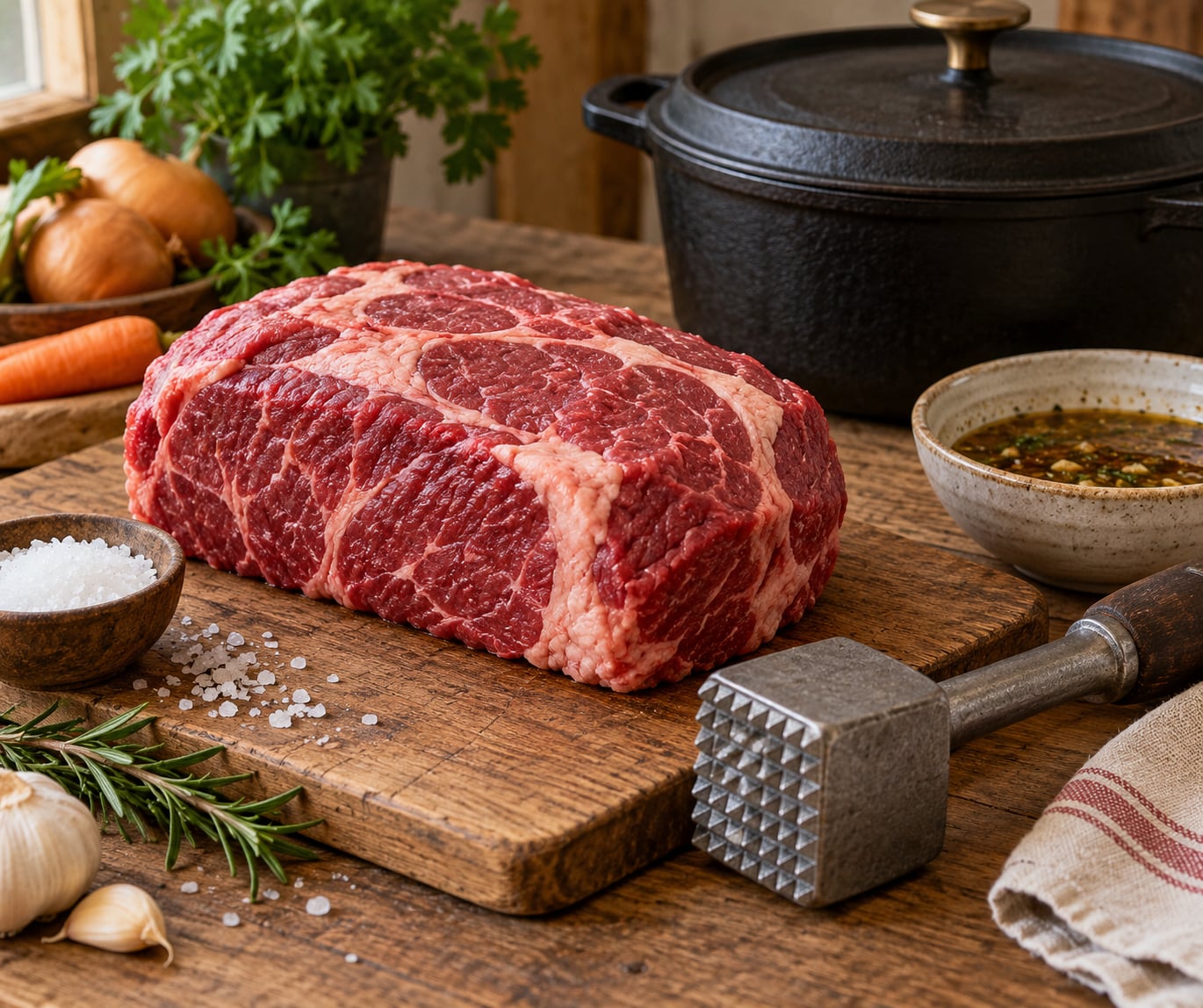
Tough beef is not bad beef. It is beef that has more collagen, more working muscle fibers and less fat marbled through it than a tenderloin, and knowing how to tenderize tough cuts of beef is mostly a matter of picking the right method for the cut in front of you. Two levers do most of the work: long, moist cooking for connective tissue, and prep that softens or seasons the surface. Match the method to the cut and dinner is handled.
Most of the methods here take under an hour of active time. Only the slow cook needs hours, and those hours are unattended.
Table of Contents
- What You Need
- How to Tenderize Tough Cuts of Beef: Step-by-Step
- How to choose the best method for tough cuts of beef
- Slow-cook tough beef until the connective tissue relaxes
- Dry-brine beef to improve seasoning and moisture
- Use an acidic marinade for a surface tenderizing boost
- Pound thick beef only when the cut needs it
- How to tell when tender beef is ready
- Common Mistakes
- Frequently Asked Questions
- What is the best way to tenderize chuck roast?
- Does boiling tenderize tough beef?
- Can marinating make brisket tender?
- How long can beef marinate in the refrigerator?
- Does baking soda really tenderize beef?
What You Need
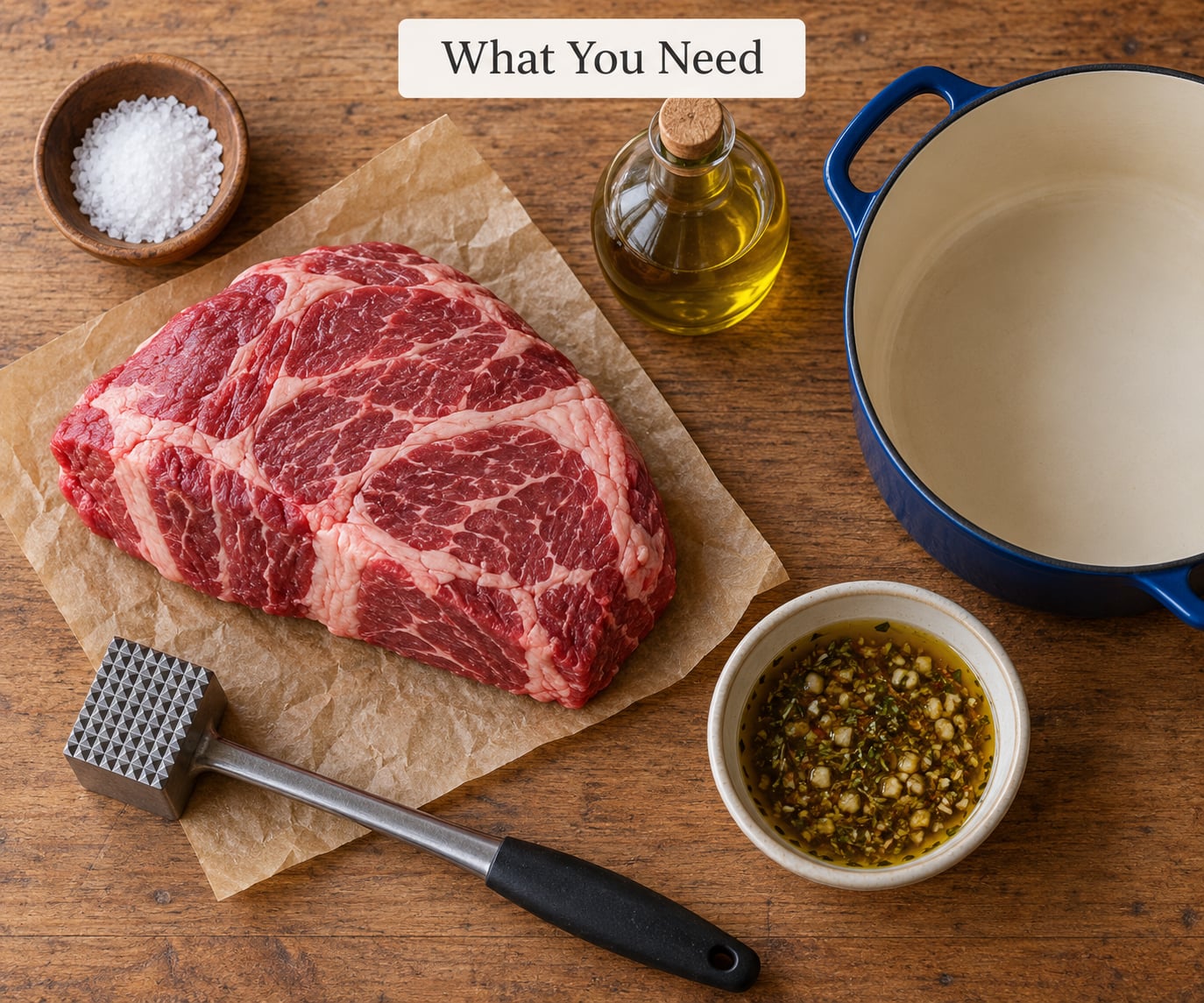
The gear list is short because the tools that matter are cheap and the ingredient that matters is salt.
- Dutch oven or heavy skillet with a lid for braising, so you get an even, gently wet heat.
- Instant-read thermometer for the oven, the smoker or a pot of water. This is the single tool that stops you from guessing.
- Sharp knife and a rimmed sheet pan set over a rack, so the beef can dry brine without sitting in its own liquid.
- Meat mallet, and a non-reactive surface to pound on: a cutting board covered with parchment or a heavy plastic bag.
- Kosher salt for dry brining. Its crystals are big enough to dissolve evenly over a whole surface. Keep fine sea salt for thinner cuts.
- Neutral oil such as vegetable or canola, which handles heat without tasting like anything.
- Acid such as red wine vinegar, rice vinegar, lemon or lime juice, plus optional yogurt for a gentler soak.
- Baking soda for velveting, which raises the surface pH so proteins do not squeeze tight when they hit the pan.
What you do not need is much. No mallet means you can use the bottom of a heavy glass or the flat side of a cleaver. No Dutch oven means a covered roasting pan or even a slow cooker on low works.
How to Tenderize Tough Cuts of Beef: Step-by-Step
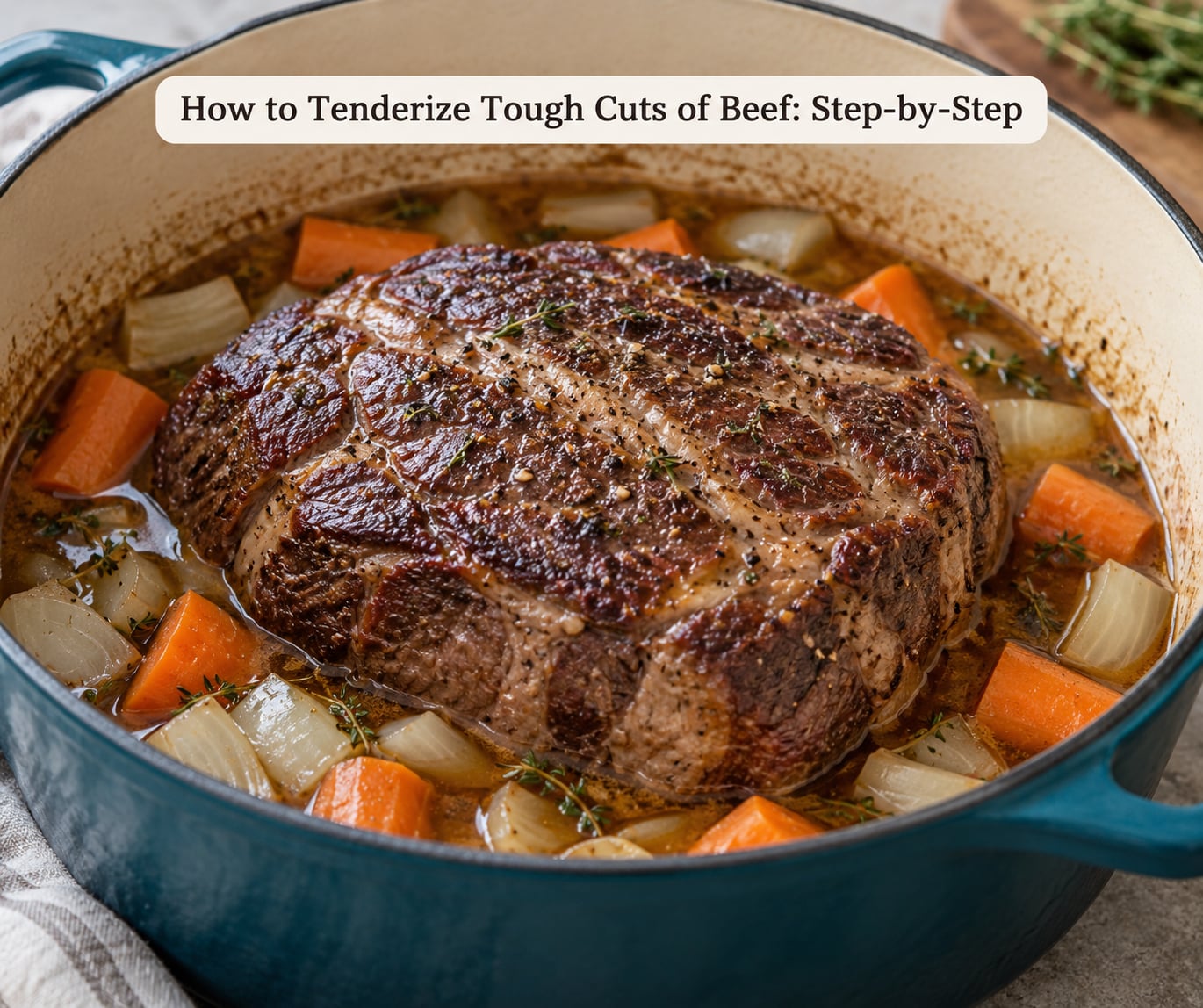
There are four methods that actually work, and they are not interchangeable. Here is how to tenderize tough cuts of beef by picking the one that fits the cut, then the detail for each.
How to choose the best method for tough cuts of beef
Start by asking what makes the beef tough. A cut is hard because of collagen, because of dense muscle fibers, or because of both.
Chuck, brisket, short ribs and beef shank are collagen-heavy. Collagen softens with moist heat, so the answer is low and slow cooking, not pounding. Pounding a chuck roast will flatten it and tear the fibers without dissolving anything.
Round cuts such as top round, bottom round and eye of round are lean and dense rather than collagen-heavy. Salting and slicing across the grain do more for them than a mallet, and a thin sear works better than a long roast.
Flank steak and skirt steak are long, thin and short-grained. They need almost nothing except a slice across the grain in thin strips, which is why they turn into fajitas and stir-fry so quickly.
Ribeye, NY strip, sirloin and tenderloin are already tender. Leave them alone. Pounding a marbled ribeye flattens the fat and dries the center, and salt is enough.
One warning worth knowing: some connective tissue does not soften at any temperature. Elastin, the springy silver stuff in a roast, turns to rubber if you cook it hard and fast. Trim it away or cook the roast until it falls into shreds, and cut around any piece left behind.
Slow-cook tough beef until the connective tissue relaxes
This is the method for chuck, brisket, short ribs and shank, and it is the one most people should reach for first.
- Brown the beef first. Pat it dry, salt it, then sear in batches in a hot oven-safe pot with oil. Crowding the pan drops the temperature and steams the meat instead of browning it.
- Add liquid halfway up the meat. Onions, carrots, aromatics and enough broth or wine to come to roughly halfway. The meat needs moisture to turn collagen into gelatin, and you need liquid to keep the bottom from scorching over three hours.
- Cover and cook low. In the oven at about 300F with the lid slightly ajar, chunks of beef take 2 to 3 hours and a whole roast takes 3 to 4. On a smoker, 225 to 250F and considerably longer is the norm.
- Check for collapse. A spoon slides into the meat with no resistance, and a fork twists a chunk apart without warning. That is the sign, not the clock.
Whole cuts still need at least 145F internally, with a three-minute rest, per USDA guidance. Collagen-heavy beef usually passes 200F before it gives up, so read tenderness alongside temperature rather than instead of it.
Dry-brine beef to improve seasoning and moisture
Dry brining is salt plus time, and it works on almost every cut. It seasons the deeper layers, holds moisture in the meat during cooking, and gives the muscle fibers something to relax against.
Salt the entire surface, all four sides and the edges, at roughly 1 teaspoon of kosher salt per pound of beef. Uneven salting is the mistake that makes the center bland while the outside is over-seasoned, so rub the salt in rather than sprinkling it on.
Wait at least 30 to 45 minutes before cooking. The longer window is 4 to 24 hours, uncovered on a rack in the refrigerator, which gives the salt time to move deeper. Do not seal it tightly; trapped moisture dulls the surface you wanted to sear.
Rinse only if the recipe you are following is already salty. For most steaks, pat dry and cook as-is.
One caution from the forums, and it is well founded: salting a thin steak for many hours can leave it so tender it falls apart under a spatula. Give thin cuts 30 minutes, thick cuts the long rest.
Use an acidic marinade for a surface tenderizing boost
Acid works on the outside. It loosens surface proteins and shortens what the first bite has to chew through, and it carries flavor along with it. It does nothing to collagen deep inside a two-pound chuck roast, so if you are marinating a whole roast, you are seasoning it rather than tenderizing it.
Build the marinade in roughly equal parts: one part acid, one part oil, one part salt, plus aromatics like garlic, pepper and herbs. Yogurt is the gentler option, and its lactic acid works with less bite.
Time matters more than anything else here. Give a thick steak 30 to 60 minutes and thin slices up to 2 hours. Yogurt marinades can go to about 4 hours. Beyond that, acid keeps chewing away at the surface until the beef turns mushy and flavorsless, which is the failure mode people hit most often.
Marinate under 40F in the refrigerator and no longer than two days. If the marinade touched raw beef, throw it out or boil it hard for five minutes before using it as a sauce. Never pour it back over cooked meat cold.
Pound thick beef only when the cut needs it
Mechanical tenderizing breaks the muscle fibers so the knife does less work. That is genuinely useful on a thick, coarse cut like a hanger steak, a boneless short rib or a skirt steak folded over.
Put the beef between two sheets of parchment or inside a heavy bag on a cutting board. Use the textured side in a steady grid, not a single hard swing. Hit the whole surface until the thickness is even, about three-quarters of an inch for a steak you plan to grill.
Lift the mallet and check the thickness by eye. When you see raw patches or the meat starts to feel gelatinous, stop. Use the flat side only for a thin cut that needs flattening rather than fiber-breaking.
No mallet? The bottom of a heavy glass, the flat of a wine bottle, or repeated fork punctures all work, and the bottom of a glass is what most home cooks reach for. Fork punctures are the weakest option, since they mostly let juice leak out during cooking.
How to tell when tender beef is ready
Tenderness and doneness are two separate checks, and you need both.
For safe eating, USDA guidance puts whole cuts of beef at 145F with a three-minute rest. Steaks usually pull off the heat well before that, at 125 to 130F for medium rare, then finish on carryover heat during the rest.
For connective tissue, a skewer or thin probe should slide into the meat with almost no drag, and a chunk should start to fall apart when you lift it. That happens somewhere around 200 to 205F, which is why a collagen-rich roast needs much more heat than safety requires.
Rest steaks 5 to 10 minutes and roasts 20 to 30 before slicing, then cut across the grain. Resting lets the juices redistribute instead of running out onto the board.
Common Mistakes
Cooking tough beef to death. There is no fix for muscle fibers that have tightened and squeezed out all the fat. Start checking early and pull the moment a probe goes in easily.
Leaving baking soda or acid on too long. Both are useful in short windows and destructive in long ones. Rinse the baking soda off thoroughly, or the surface tastes soapy; keep the acid soak under a couple of hours.
Salting one side. Salt the whole surface, edges included, and give it 30 to 45 minutes minimum. Salting and searing immediately leaves the outside salty and the center under-seasoned.
Crowding the braise. Brown in batches. A crowded pot steams, and you lose the flavor that a slow cook otherwise builds for three hours.
Boiling as a shortcut. Boiling softens collagen, but leaches flavor and leaves the meat waterlogged. If you want tenderness fast, use a 3 to 4 hour braise at a gentle simmer instead of a hard boil.
Cutting with the grain. This is the most common slicer’s mistake. Fibers running away from you read as tough no matter how well the beef was cooked. Look for the direction of the streaks and cut perpendicular to them.
My short list, if you remember nothing else: salt generously and wait, keep the braise covered and warm, and stop while the meat still has a little resistance. It finishes while it rests.
Frequently Asked Questions
What is the best way to tenderize chuck roast?
Low and slow moist heat. Chuck is full of collagen, and collagen only softens with time and liquid. Sear the roast in batches, add broth so it comes about halfway up the meat, then braise covered at roughly 300F for 3 to 4 hours. Salting it overnight helps seasoning and moisture, but a mallet or a strong acid marinade does very little for a whole roast.
Does boiling tenderize tough beef?
Yes, but it is a blunt tool. Boiling is what turns collagen into gelatin, so the texture softens, yet the meat loses its flavor to the water and can end up waterlogged and stringy. A gentle braise at 300F with aromatics and wine gives you the same collagen conversion with all the seasoning still in the meat.
Can marinating make brisket tender?
Partly, and it is the surface part only. Acid and salt marinades loosen the outside of the brisket and season it, while a short soak in pineapple or kiwi juice adds enzymes that nibble at surface proteins. Inside a thick brisket, it is heat and time doing the work. Salt it, then smoke it low until the flat passes a probe around 200 to 205F.
How long can beef marinate in the refrigerator?
Keep it under 40F and no longer than two days, and that is the outer limit for safety. Acidic marinades should be much shorter than two days in practice: 30 to 60 minutes for a thick steak, up to 2 hours for thin slices, about 4 hours for yogurt. Longer than that, the surface turns mushy.
Does baking soda really tenderize beef?
Yes. A thin coating of baking soda raises the surface pH, so proteins stay relaxed instead of tightening hard when the beef hits the pan. Use about half a teaspoon to one teaspoon per pound, work it into the surface, wait 15 to 30 minutes and no longer than 45, then rinse and pat dry. Skip the rinse and you get a soapy, bitter-tasting crust.
Start with the cut, not the method. Collagen-heavy beef such as chuck, brisket and short ribs goes in the oven low and covered, salted first and given three or four hours. Lean dense cuts get the salt and a slice across the grain. Thin short-grained cuts need nothing but a sharp knife. And whichever route you take on how to tenderize tough cuts of beef, rinse the baking soda off before it hits the pan. That one step is the difference between velveted and soapy.