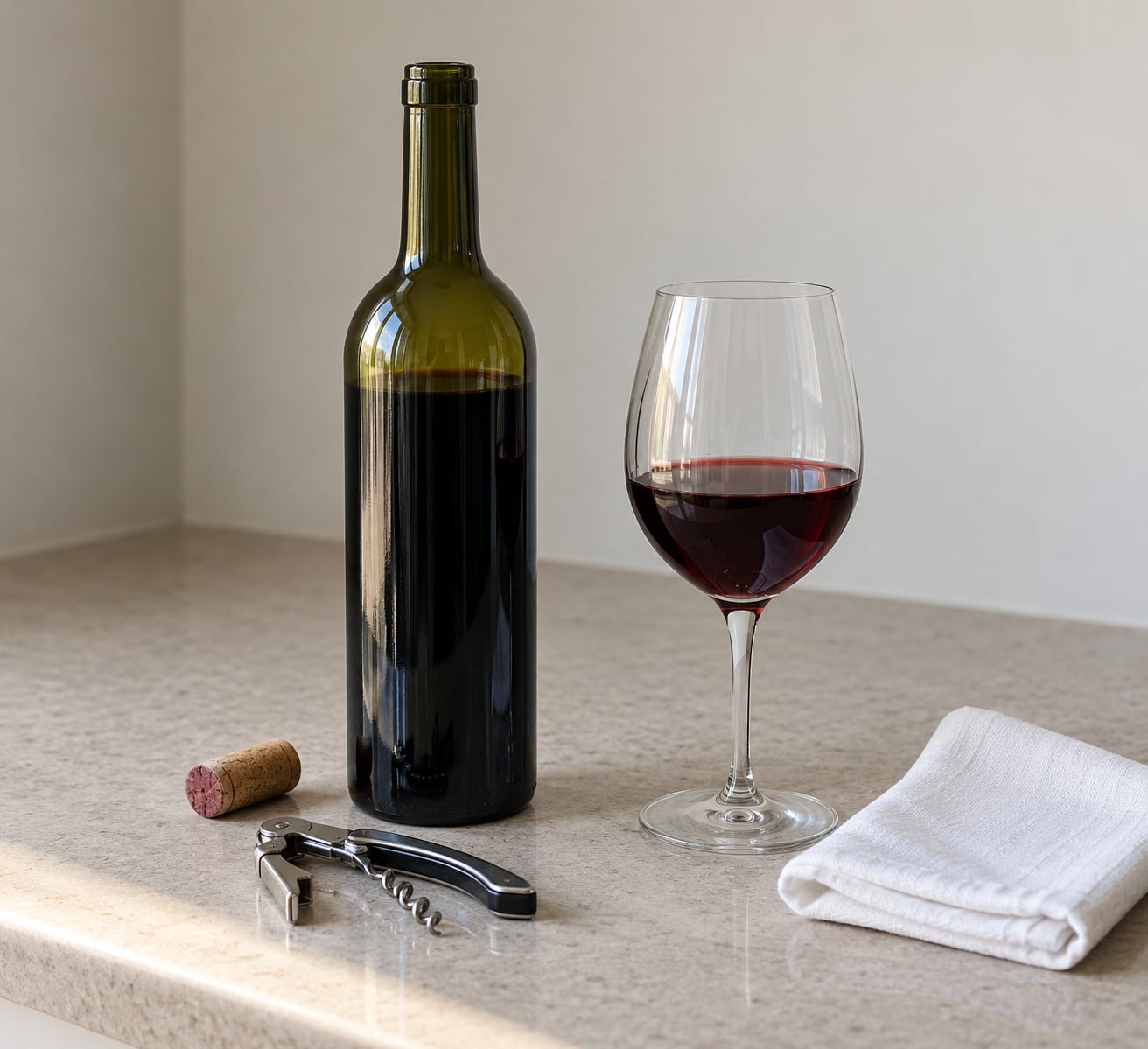
Bad wine is easy to spot once you know the signs. A vinegar or nail-polish smell, a brown or orange colour in a wine that should be pale, unexpected bubbles in a still wine, or a flat sour sip all point one way. And the good news first: bad wine tastes unpleasant, but it will not make you sick.
Here is how to tell if a bottle of wine has gone bad, in the order I would actually do it. Start outside the bottle, move to the glass, then commit to a small taste. The whole check takes about two minutes and saves you from pouring a whole bottle down the sink on a hunch.
Table of Contents
- What You Need
- Step-by-Step: How to Tell if a Bottle of Wine Has Gone Bad
- Check the Label, Bottle, and Storage History
- Look at the Wine’s Color and Clarity
- Smell the Wine for Vinegar, Nail Polish, or Mustiness
- Taste a Small Pour and Listen to the Texture
- Common Mistakes
- When to Discard the Wine
- Frequently Asked Questions
- Can you tell if wine is bad just by smelling it?
- Does bad wine make you sick?
- What does wine that has turned to vinegar smell like?
- Is sediment in an old bottle of wine bad?
- Can I use wine that smells bad for cooking?
- How long can an opened bottle of wine stay good?
- Bottom Line: What to Do First
What You Need
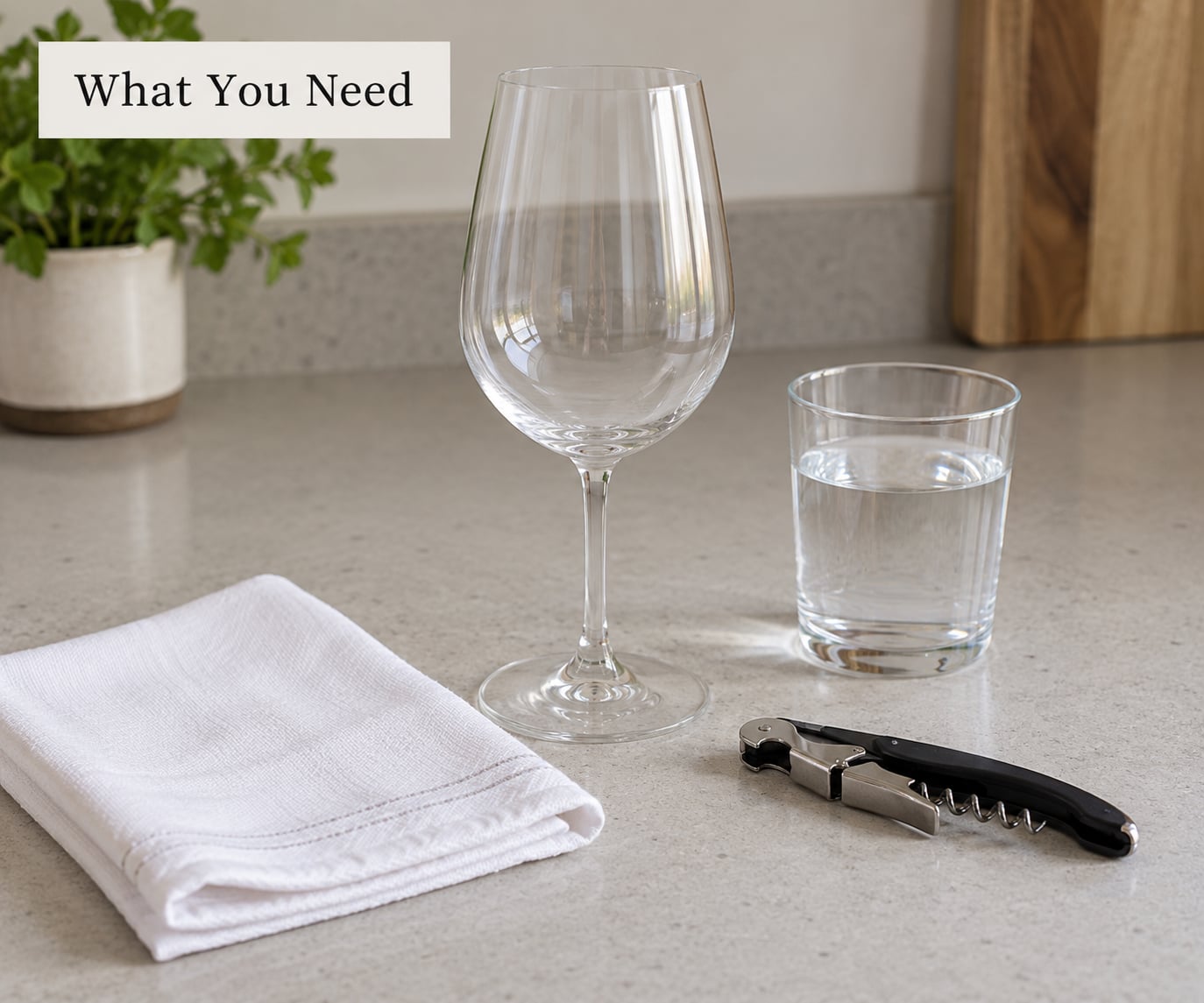
You do not need any of this to be a sommelier. You need a way to smell, something to see clearly, and a small amount of water to reset your palate between wines.
- A clean, neutral-smelling glass. Rinse it with cool water and skip the detergent, which leaves a residue that flattens everything you smell afterwards. If you have two glasses, one stays clean as your reference.
- Daylight or a bright white light source. Colour is the first sign of oxidation and you cannot judge it in a dim kitchen. Hold the glass against a white sheet of paper or a white wall.
- A bottle opener or corkscrew. A taste of cork and the smell of the bottle neck tell you things the glass never will.
- A glass of water and something bland to eat. Plain crackers work. Your palate gets tired after a few sips, and a tired palate is how sound wine starts to taste off.
- A spoon, optionally. It is not essential, but a small spoonful from the glass gives you a concentrated read on the aroma.
- A decanter, if the wine is young. Air is the single most effective thing you can do for a slightly oxidised bottle, and decanting is how you do it without waiting.
Step-by-Step: How to Tell if a Bottle of Wine Has Gone Bad
Check the Label, Bottle, and Storage History
The outside of the bottle answers a surprising number of questions before the wine ever meets a glass. Most of the damage wine suffers happens at the closure, where oxygen gets in.
Look at the fill level first. Wine in a sound bottle sits up into the shoulder or higher. A liquid line well below the shoulder, or a wide air gap between the cork and the wine, means liquid has left or evaporated, and with it the freshness. If you have another bottle from the same case standing around, compare the two fill levels side by side. That comparison catches more problems than a tape measure ever will.
Next, run a finger along the label and the neck. Sideways seep stains on the label, a sticky ring, or a faint tide mark running from the lip downward all point to a leaking closure. Check that the cork is not pushed out even slightly. A cork sitting proud of the neck by a quarter inch is the classic sign of heat expansion or a botched seal. Look at the capsule too: pinholes, rust-coloured corrosion, or a torn foil means air has had a path in.
Finally, ask the boring question: where has this bottle been? Wine stored in a hot car, on a sunlit shelf, or in a cabinet next to the oven will have cooked, and no amount of wishing will undo that. A bottle that spent its life in a temperature-stable dark cellar has a very different outlook from one that moved houses twice. Judge the storage, not the vintage alone. A 30-year-old wine stored well is often better than a two-year-old wine that sat in a hot garage, and a 20-year-old bottle with a sticky neck is a problem no matter what the critics said about the vintage.
Look at the Wine’s Color and Clarity
Tilt the glass so the wine spreads into a thin film against the glass and hold it up to the light. You are looking for three things: a colour that has drifted away from what the wine should be, a cloudiness, and anything solid.
White wine should be pale lemon through straw. Move from gold to amber to deep brown and you are watching oxidation happen in stages, usually because of heat. Red wine normally runs from ruby at the young end to brick or orange at a mature one. An old bottle that is brick-orange with soft, round edges is normal; a young, cheap red that is already orange-brown and flat is not. That is the difference between aged and bad, and it takes no vocabulary at all, just the age of the wine next to the colour in front of you.
Now the clarity. Protein haze is a whitish cloud that forms when a wine chilled too hard and the proteins bonded together. It looks alarming and is largely a cosmetic fault: the aroma flattens in the glass but the wine often comes back after warming to room temperature. Genuinely spoiled wine goes hazy from bacteria, and it does not clear when you warm it.
Sediment is not a sign of spoilage. Wine that has been lying on a cork will drop tartrate crystals, small clear or off-white grains, and older reds drop real sediment that looks like brick dust at the bottom of the bottle. Both are harmless and normal. What is not normal is a thick, cloudy, brown floc suspended in the wine rather than settled.
Finally, unexpected bubbles in a still wine mean a secondary fermentation, also called refermentation. Tiny streams of pinprick bubbles clinging to the glass are a fault. A fully fizzing bottle with a bulging cap or a frothy lip has a bigger problem and should not be opened at all.
Smell the Wine for Vinegar, Nail Polish, or Mustiness
Smell is the decisive test. The prevailing view in wine circles is simple: if it smells fine, it tastes fine, and when both disagree, trust the nose. Most people describe the sequence as look, then smell, then taste, but the truth is that the first two catch nearly everything.
Swirl the glass to open it up, sniff, and then sniff again with your nose near the rim. What you are looking for:
- Vinegar or sharp acetic sharpness. This is the bacterial fault, caused by bacteria and oxygen turning the alcohol into acetaldehyde and then acetic acid. It smells like household vinegar, or like nail-polish remover, and no amount of aerating fixes it.
- Wet cardboard or damp basement. That is cork taint, caused by TCA, trichloroanisole, a chemical that has migrated into the cork. A lightly corked bottle may simply taste muted, and a heavily corked one will hit you with damp, mouldy cardboard right in the nose.
- Musty, dusty, mouldy cellar. A closed, airless basement smell with no fruit under it. This is a storage problem, and it is not pleasant.
- Rotten eggs or burnt match. Sulfur and sulfur dioxide, sometimes from a faulted fermentation, sometimes from an old bottle. A small amount under a nice ripe wine is a winemaking quirk. A heavy dose of struck match is a spoiled bottle.
- Sherry, bruised apple, cooked apple, soy sauce. A light dose of these in a mature red is ordinary aging. In a young wine, or combined with a flat finish, it is oxidation.
- Sherry-like or nutty notes in a young, cheap wine. That is a sign the wine has been sitting in poor storage long enough to oxidise. It should not taste like an old fortified wine.
And the aromas that look alarming but are not faults? Leather, tobacco, petrol, forest floor, dried fig, mushroom, and cedar in a well-aged red are exactly what long aging produces. A good bottle of Bandol or a mature Cabernet will smell like a woodland floor in autumn, and that is the wine doing its job, not failing. If fruit, acidity and structure are still underneath those notes, the bottle is old, not bad.
Taste a Small Pour and Listen to the Texture
Once it has passed smell, take a small sip rather than a full pour. A sip lets you decide before you have committed a glass, and it is far more honest than drinking half a bottle hoping for the better of it.
What bad wine tastes like is mostly a lack and a sharpness. Vinegar-like sourness on the front of the palate. A flat, dull, one-dimensional finish that vanishes immediately, like a wine with its fruit drained out. Cooked apple or bruised apple flavours in a red that should taste fresh. A prickly, fizzy, slightly sweet feel in a still wine, which is the refermentation showing up on the tongue. And a sherry-vinegar tang that hits the back of the throat and lingers.
Pay attention to the finish, because that is where faults announce themselves last and most clearly. A sound wine leaves something behind: fruit, tannin grip, a lift in the mouth. A faulty wine stops. It finishes like nothing is happening.
Before you tip the rest of the bottle, try the airing test. A young red with a slightly flat, dull nose often recovers within an hour of being decanted or poured into an open glass, because oxygen is exactly what it was short of. If the wine improves on the palate after fifteen minutes, it was under-oxygenated, not spoiled. If nothing changes and the sourness is still there, you have your answer.
On safety: no, bad wine will not poison you. Wine at around 12 percent alcohol and pH well under 4 does not support the bacteria that cause food poisoning, which is why vinegar has kept for centuries as a preservative. Your mouth, nose and palate are not going to be harmed by a bad sip either. The one genuine health exception is sulfites, which are present in almost all wine: if you are sulfite-sensitive, wine can trigger hives, rash, itching and swelling. That reaction happens with perfectly good wine too, so it is not a sign that a bottle has gone bad.
What bad wine still has is the alcohol. Oxidation does not change the ethanol content, so a bottle that tastes like vinegar will still get you drunk. It also means a bottle left open far too long is not harmless, just unpleasant.
On shelf life once opened, the useful reference is this: sparkling wine 1 to 2 days; light whites and rosés 2 to 4 days; reds and rich whites 3 to 6 days; dessert and fortified wines anywhere from 1 to 3 weeks. A vacuum sealer, a quality vacuum pump, or a transfer into a smaller bottle all buy you a few extra days.
Common Mistakes
Almost every bad judgment call I see comes down to trusting the wrong signal. These are the recurring ones.
Judging by colour alone. A colour change means something, but it means it in the context of the wine’s age and style. A 20-year-old Nebbiolo going brick-orange is correct. A three-year-old Syrah doing the same is a storage failure. Colour without age is a coin flip.
Trusting the cork as proof of anything. A cork that looks clean tells you nothing about whether the wine behind it is sound. The one useful thing to check is whether the cork has been pushed out or is sitting proud, and that is a storage clue rather than a verdict. TCA lives in the wood and is invisible from the outside.
Calling sediment spoilage. Sediment and tartrate crystals are normal in many wines, especially older reds and anything stored on its side. They settle; they are not a fault. Only suspended cloudiness that does not clear is worth worrying about.
Pouring a big glass before deciding. Once you have committed a large pour, you tend to finish it. Take a sip, make the call, then pour the rest if it deserves it. This is also the polite way to avoid handing something questionable to a friend.
Serving a doubtful bottle to guests. You do not owe anyone a bottle you are not sure about. Guests are the worst possible tasting panel because nobody wants to be the one who complains.
Assuming old means bad. This is the most expensive mistake. Plenty of sound 15- to 30-year-old bottles develop petrol, leather and forest-floor notes that read as faults to an untrained nose and are the entire point of the wine. Age the wine first, smell it second.
Believing a friend’s tasting note. “It tastes a bit oxidised” from someone who does not drink much is close to meaningless. Fault vocabulary is specific: corked, oxidized, refermented, light-struck, cooked. Vague impressions are worth less than your own nose.
When to Discard the Wine
Discard when the signals are strong and agree. One mild clue on its own is a judgement call; several faults stacked together are a verdict.
| What you notice | What it means | What to do |
|---|---|---|
| Clear vinegar or nail-polish smell, sharp sour taste | Oxidised, acetic acid from bacteria and oxygen | Pour it out. Cooking will not rescue the taste |
| Damp basement or wet cardboard | Cork taint from TCA | Drink it quickly if you can, or discard |
| Brown whites, orange young reds, bruised apple | Oxidation from heat or age | Discard if the fruit is gone |
| Musty, mouldy cellar smell with no fruit | Bad storage, long air exposure | Pour it out |
| Bubbles in a still wine, sweet fizz on the tongue | Refermentation | Open with caution over the sink, then discard |
| Flat, dull, sour, with no finish | Oxidised beyond recovery | Cook it, or pour it out |
| Whitish haze that clears as it warms | Protein haze, mostly cosmetic | Drink it at room temperature |
| Cracked glass, seeping wine, froth at the lip | Package failure | Do not drink it at all |
Before the bin, there are two rescue paths. A sound but tired red or a white gone slightly flat still has acid and structure, and a splash in a stew, a risotto, a pan sauce or a braise will disappear completely into the dish. That works because the cooking drives off the volatile compounds that make the wine smell wrong. It does not work for vinegar-like wine, where the acidity is the problem and would make the dish sharper.
If a bottle from a restaurant or a shop faults, say so at the table and ask for another. Restaurants will usually replace a corked bottle; nobody is going to hand you back an oxidised one and argue. If you opened it at home, nothing is owed to you, which is why a light corked taste is less of a crisis than people treat it as.
Frequently Asked Questions
Can you tell if wine is bad just by smelling it?
Usually, yes. Vinegar, nail polish, damp cardboard, musty cellar and rotten egg smells are all detectable in the nose, and the general view among drinkers is that smell catches a faulty bottle before taste does. Taste confirms what the nose flagged. A lightly corked bottle is the exception: it may simply taste muted with no obvious aroma, which is why a small sip still matters.
Does bad wine make you sick?
No. At around 12 percent alcohol and a low pH, wine does not support the bacteria that cause food poisoning, which is why wine has been used as a preservative for centuries. Bad wine tastes unpleasant and may give you a headache or an upset stomach, but it is not a food-safety risk. The one real exception is sulfite sensitivity, which can cause hives, rash and swelling in some people, and that happens with perfectly sound wine too.
What does wine that has turned to vinegar smell like?
Sharp, piercing household vinegar, sometimes closer to nail-polish remover. The chemistry is bacteria and oxygen converting the alcohol into acetaldehyde and then acetic acid, and the taste matches: a hard sourness on the front of the palate that hits the back of the throat. Heat is the usual accelerator. This fault cannot be reversed by airing the wine, and it is one of the few problems cooking will not hide.
Is sediment in an old bottle of wine bad?
No. Older reds drop real sediment, and wines stored on their side form harmless tartrate crystals that look like clear or off-white grains. Both settle to the bottom and can be poured off with care when decanting. Sediment that is suspended in the wine, thick and brown, or that does not clear when the bottle warms is a different story, and points to bacterial haze rather than normal settling.
Can I use wine that smells bad for cooking?
Yes, for many faults. A tired, flat, slightly oxidised red still has acid and body, and a splash in a stew, risotto, braise or pan sauce disappears into the finished dish as the cooking drives off the volatile compounds. It does not work for vinegar-smelling wine, where extra sharpness would make the dish worse, nor for a wine showing refermentation or signs of package failure.
How long can an opened bottle of wine stay good?
Expect 1 to 2 days for sparkling, 2 to 4 days for light whites and rosés, 3 to 6 days for reds and rich whites, and 1 to 3 weeks for dessert and fortified wines. A vacuum sealer, a vacuum pump, or decanting leftovers into a smaller bottle buys a few extra days, and refrigeration slows things down for reds as well as whites. Taste it before you pour it for guests, not after.
Bottom Line: What to Do First
Check the fill level and the neck, tilt the glass to the light, then sniff. If the nose flags vinegar, wet cardboard or mustiness, pour a sip, taste it, and decide from there. If it smells clean, it is almost certainly fine to drink, however old the label says it is.