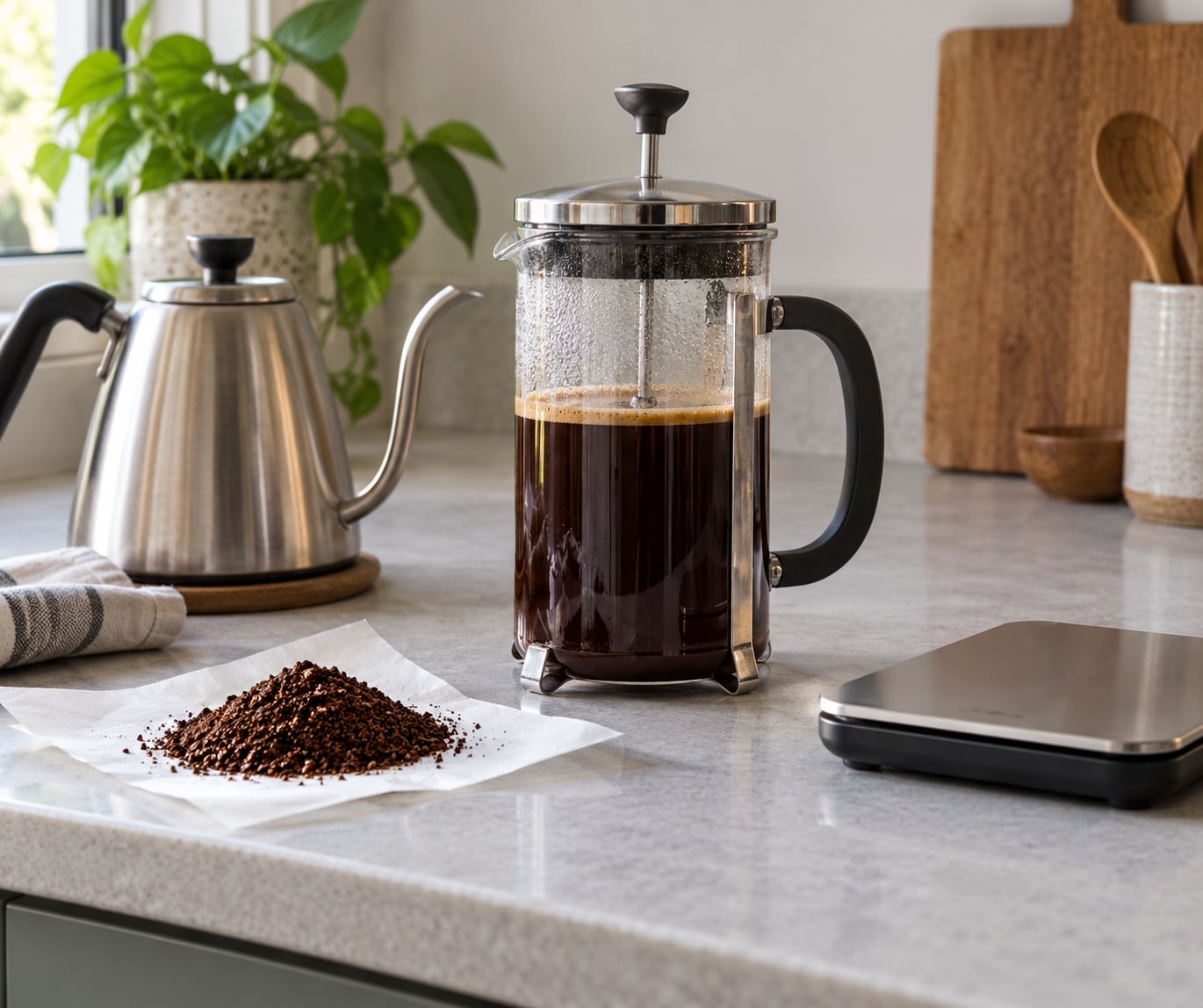
To use a French press correctly, measure 2 tablespoons of coarse, sea-salt-textured grounds for every 6 ounces of water, pour water that has been off the boil for about 30 seconds, steep for exactly 4 minutes, then plunge slowly and stop just above the settled bed. The whole job takes about six minutes and costs you almost nothing.
That one sentence covers the four variables that decide the cup. A French press is an immersion brewer, so water sits directly on the grounds and extraction happens by diffusion across the entire surface of the coffee bed. There is no flow to slow down and no filter paper to catch what the mesh misses. Grind size, ratio, temperature and time are the only dials you have.
Which makes it forgiving in one way and blunt in another. Get those four right and the result is a rich, full-bodied cup with almost no bitterness. Get them wrong and nothing downstream rescues you, because there is literally no further step between the water and your mug.
If you are starting from scratch, work through the method below once at the standard ratio before changing anything. Adjustments are much easier to make when you know what the baseline cup tastes like.
Table of Contents
- What You Need
- Starting Measurements for a 34-Ounce Press
- How to Use a French Press Correctly: Step-by-Step
- Step 1: Heat the Water and Rinse the Beans (Before 0:00)
- Step 2: Add Coarse Grounds to a Dry Press (0:00)
- Step 3: Pour All the Water in One Steady Stream (0:00 to 0:20)
- Step 4: Break the Crust at 0:30
- Step 5: Steep Undisturbed Until 4:00
- Step 6: Plunge Slowly and Stop at the Top of the Bed
- Step 7: Decant Immediately and Drink the Rest Within the Hour
- How to Use a French Press Correctly for Best Flavor
- Coffee-to-Water Ratio and How to Scale It
- Do You Need to Bloom in a French Press?
- Common French Press Mistakes and How to Fix Them
- How to Clean a French Press Without Leaving Bitter Flavors
- Frequently Asked Questions
- What grind size is best for a French press?
- How hot should the water be for French press coffee?
- How long should coffee steep in a French press?
- Should I plunge the French press immediately or let it steep first?
- Can I use a paper filter in a French press?
- How do I keep French press coffee from tasting bitter?
- Where to Start Tomorrow Morning
What You Need
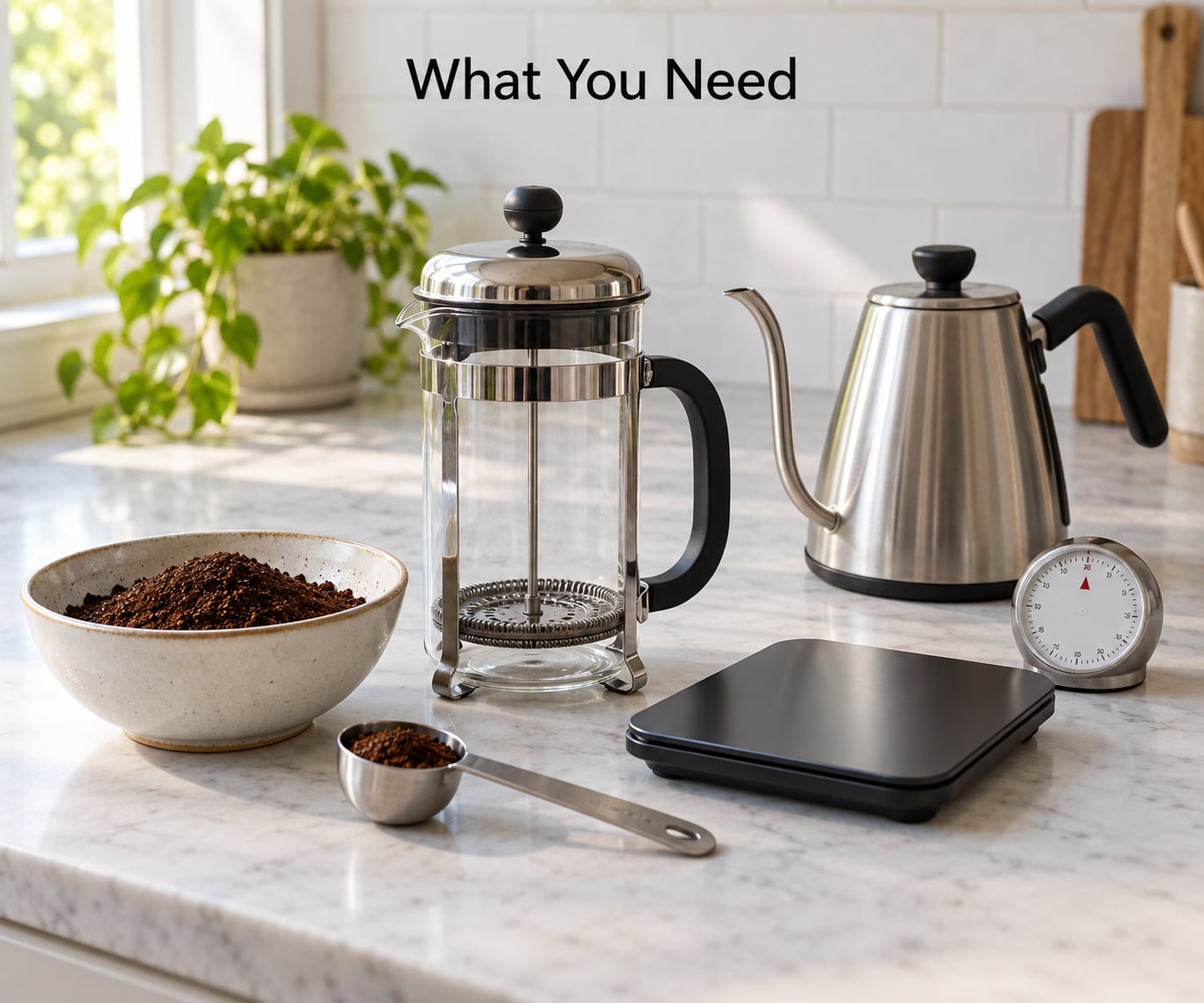
Not much, which is the appeal. Here is the honest list.
- The press itself. Any plunger coffee maker with a metal mesh filter. Glass and stainless steel both work; the stainless versions just insulate the coffee better while it sits.
- Fresh coffee, ground coarse. Roughly the size of sea salt or kosher salt. A burr grinder gets you there easily. A blade grinder produces dust at the bottom of the bag, and those fines are the main reason a home press turns muddy.
- Filtered water. Cold, filtered tap water is the standard choice. Water is nearly all of the finished cup, so any chlorine taste or hardness you can taste in a glass of water, you will taste in the coffee.
- A way to heat water. A kettle with a temperature setting is genuinely useful. Without one, boil your kettle, pour the water into a heatproof jug, and wait 30 seconds before it touches the grounds.
- A scale or measuring spoon. A gram scale makes ratios repeatable. A standard tablespoon works fine, you just have to accept a little drift and adjust from there.
- A timer. Phone timer is plenty. Steep time is the variable people are worst at eyeballing.
Optional but useful: a spoon for breaking the crust, an airtight container for beans you did not finish, and a second mug so you are not pouring the first serving straight on top of the sediment.
Starting Measurements for a 34-Ounce Press
A 34-ounce press is the one most people buy. Manufacturers call it an 8-cup press, but that assumes four-ounce servings. Filled properly it gives you about four real eight-ounce mugs plus a small one.
- Coffee: 8 tablespoons of coarse grounds, which lands somewhere between 55 and 60 grams depending on how loosely you pack them. Weigh it once and you will know your own tablespoon.
- Water: 32 ounces, or just under a liter. Do not fill to the top line. The bed needs room to swell as it releases carbon dioxide, and a full press is a press that overflows.
- Temperature: Water a few degrees below boiling, about 200°F.
- Time: 4 minutes of contact, timer started the moment you finish pouring.
Fill the whole press and you have a bigger batch rather than a stronger cup, which is why larger batches go flat in the second half. If you are brewing for more than two people, brew twice instead of once. I know that sounds fussy, but over-extracting a large batch to compensate is worse than the extra minute.
How to Use a French Press Correctly: Step-by-Step
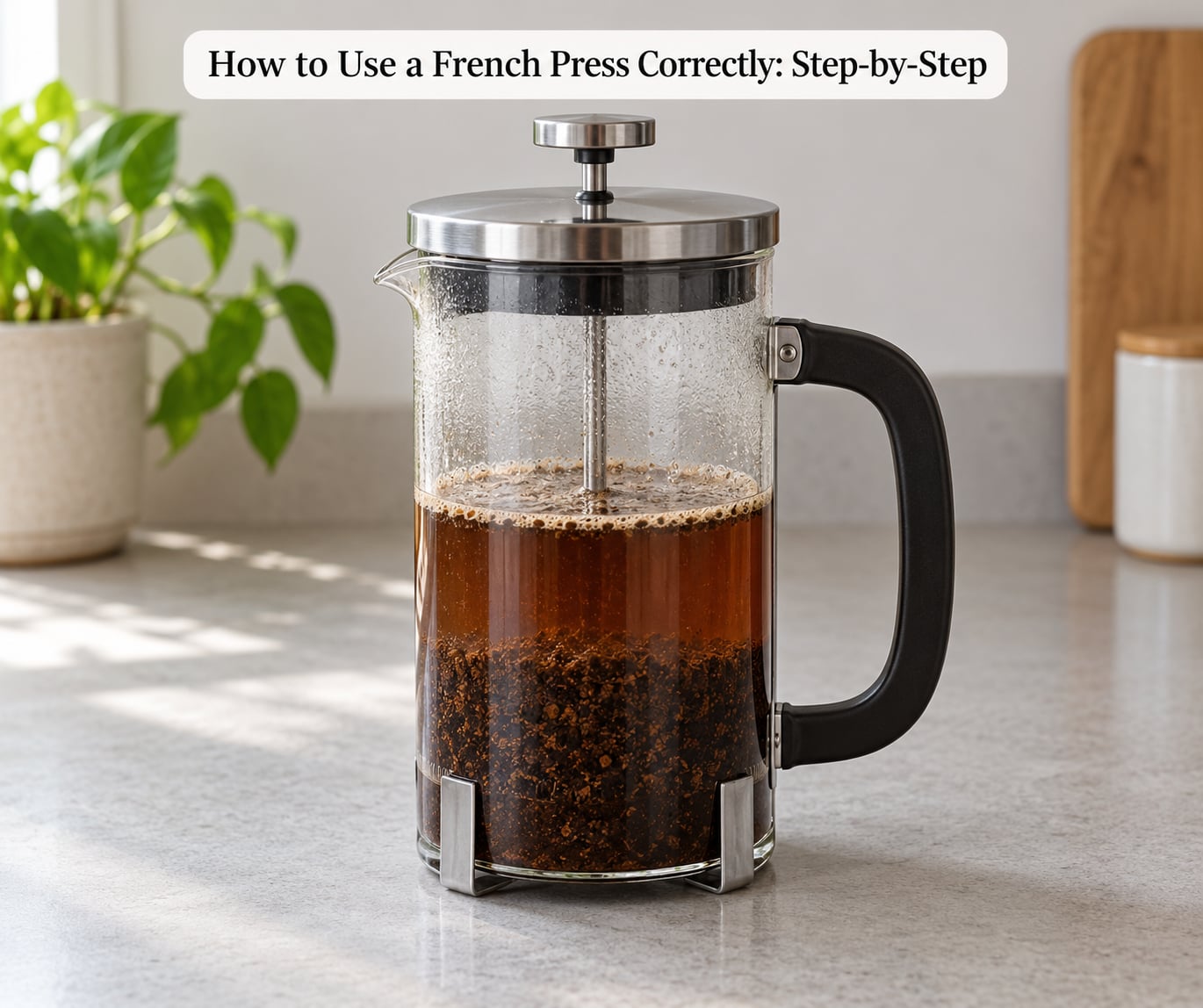
Seven steps. The clock starts at the first pour.
Step 1: Heat the Water and Rinse the Beans (Before 0:00)
Bring water to a boil, then let it rest 20 to 30 seconds. This lands you near 200°F, which extracts sweetness and acidity without pushing hard into the bitter compounds that only come out at scalding temperatures. If you have a variable-temperature kettle, set it to 200°F and skip the guessing.
Measure your coffee while the kettle finishes. If you are using beans rather than pre-ground coffee, this is also the moment to weigh out 55 to 60 grams for a full press.
Step 2: Add Coarse Grounds to a Dry Press (0:00)
Yes, you just put coffee grounds in the French press. Grounds go into the empty carafe first, water second. Loading them dry means they land evenly instead of clumping into one side, and it gives you the chance to shake the press flat on the counter so the bed sits level before anything wet happens.
Your cue: when you look at the dry grounds, they should look granular, not powdery. If you cannot see individual particles, grind coarser.
Step 3: Pour All the Water in One Steady Stream (0:00 to 0:20)
Pour the full 32 ounces steadily over the grounds. Do it in one pass rather than in small splashes, and do it in a spiral so the water lands evenly instead of drilling one crater into the bed. A steady pour takes about 20 seconds and gives you time to start your timer as it finishes.
A gooseneck kettle makes this effortless. If you have a standard kettle, pour from a low height and move your wrist around the carafe. The water does not need to be violent, it just needs to be even.
Step 4: Break the Crust at 0:30
About 30 seconds in, a layer of foam or crust will have formed on the surface. Stir gently with a spoon so every ground gets wet, then let the bed settle. Skim any foam off the top if it looks like it is climbing toward the lid.
Does this really matter? Some people argue a French press does not need a bloom because the grounds get fully submerged anyway, and they are not wrong that a separate pre-wet is optional. But breaking the crust at 30 seconds is not a bloom. It is simply making sure the upper layer participates in the brew instead of floating dry until it drops.
Your cue: the surface should settle flat within about a minute, with a dark bed at the bottom and clear-ish water above it.
Step 5: Steep Undisturbed Until 4:00
Put the lid on and leave it alone. This is the step people ruin most often, usually by scrolling something on their phone while the timer runs. Every stir and swirl keeps extracting, and an immersion brew has no way to stop itself.
Four minutes is the sweet spot for a coarse grind at standard temperature. At three minutes you get a lighter, brighter cup with more of the fruit and acidity in it. At five or six, expect the wood and ash notes to start showing up.
Your cue: nothing visual, which is exactly why you need the timer. Put the lid on and step away from the counter.
Step 6: Plunge Slowly and Stop at the Top of the Bed
Remove the lid, skim any remaining foam off the surface, then lower the plunger slowly, about 10 to 15 seconds for a full press. Slow is the instruction people skip. Shoving the plunger down pushes fines through the mesh and aerates the coffee, and both of those land in your cup as grit.
Stop when the mesh reaches the top of the settled bed. Do not squeeze the last drops through the grounds. Water trapped under the mesh is a small, bitter, silty layer, and pushing it through is the single most common self-inflicted mistake in this method.
Your cue: the mesh should sit just above the coffee bed with a thin layer of grounds visible above the metal. Anything that needs force is going too far.
Step 7: Decant Immediately and Drink the Rest Within the Hour
Pour every serving out of the press right away. This is the step people skip when they only have one mug, and it matters more than it looks like it should.
Coffee left sitting on the grounds keeps extracting at room temperature with no timer running. Ten minutes of that contact is roughly a minute of hot brewing, and it is why a French press that tasted great at the first sip can taste flat and slightly sour by the last. Some sediment will still make it into the mug. That is normal for immersion and it is not a sign you did anything wrong.
If you want a cleaner cup, let the press sit for a minute after plunging and pour carefully, or strain through a paper filter as you serve. Expect some sediment either way.
How to Use a French Press Correctly for Best Flavor
Five variables move the cup, and each one has a predictable direction of travel. Once you know which way each knob turns, you can diagnose any bad cup without guessing.
Grind size is the one that matters most. Coarse, sea-salt or kosher-salt texture is the target. Finer than that and the extraction rate jumps, the bed turns to sludge, and the fines that escape the mesh make the cup gritty and heavy. Coarser than that and the water slides past the grounds instead of pulling from them, leaving you with something thin and sour no matter how long you steep.
Ratio sets strength. More coffee per ounce of water means more extracted solids, so more body and more intensity. Less coffee means less. Strength and extraction are not the same thing, which is why you can have a weak-tasting coffee that is also bitter, and it confuses people constantly.
Temperature moves along the acidity-to-bitterness axis. Hotter water pulls faster and harder. Cooler water is gentler. For dark roast, drop toward 195°F and pull the steep shorter if the cup is harsh. For light roast, go to 205°F and let the full four minutes do their work, because light roast needs both the heat and the time to give up its sugars.
Steep time is your extraction dial. Under four minutes, lighter and brighter. Over four, darker and more bitter. Treat it as fine adjustment: change it by 30 seconds, not by two minutes.
Pouring technique decides how much sediment you fight. Pouring straight down into one spot drives fines to the bottom of the mug. Hovering slightly and stopping just above the liquid surface keeps the bed undisturbed. Some people press the mesh, invert the whole press upside down, and pour from the top so coffee falls clear of the grounds. It works, it feels theatrical, and it is not necessary.
Coffee-to-Water Ratio and How to Scale It
The Specialty Coffee Association gold cup standard sits at roughly one gram of coffee per 16.5 grams of water. That works well for filter brewing and lands a little weak for immersion, where fines are not being filtered out. Most people settle between 1:15 and 1:17, with darker roasts toward the tighter end and lighter roasts toward the looser end.
Here is the same ratio in four units, so you can use whichever you have.
| Press size | Water | Coffee by weight | Tablespoons | Level scoops (about 2 tbsp) | Cups, 8 oz |
|---|---|---|---|---|---|
| 8 oz press | 8 oz | 13 g | 2 | 1 | 1 |
| 17 oz press | 16 oz | 26 g | 4 | 2 | 2 |
| 34 oz press | 32 oz | 52 g | 8 | 4 | 3 to 4 |
| 51 oz press | 48 oz | 80 g | 12 | 6 | 5 to 6 |
Two caveats worth reading. First, tablespoons are volume and grams are weight, and a tablespoon of coarse coffee is somewhere between 5 and 7 grams depending on how tightly the grinder packed it. Weigh your own scoop once and write the number on the bag; that single habit removes most ratio guesswork.
Second, do not scale by increasing steep time. A 51-ounce press does not need six minutes. It needs the same four minutes and roughly 1.5 times the coffee per ounce, because contact time controls extraction while quantity controls strength.
Water temperature by roast:
| Roast level | Water temperature | Steep time | Ratio |
|---|---|---|---|
| Dark roast | 195 to 201°F | 3 to 4 minutes | 1:15 |
| Medium roast | 200 to 205°F | 4 minutes | 1:16 |
| Light roast | 202 to 205°F | 4 to 5 minutes | 1:17 |
Light roast is the harder case, which surprises people who assume darker is the difficult direction. Light beans are denser and less soluble, and they usually need the hotter water and the extra minute to avoid tasting thin and grassy.
Do You Need to Bloom in a French Press?
Short answer: not a separate bloom step, but yes to breaking the crust partway through.
A bloom is soaking grounds with a small amount of water to release the carbon dioxide trapped inside them. Fresh beans have a lot of that gas, and it pushes water away from the grounds, which slows early extraction. In a pour-over, the bloom fixes this before the main pour. In a French press, the grounds go fully underwater right away, so the trapped gas has less time to do damage on its own.
What still matters is the crust. Fresh coffee degasses as it hits the water, and that gas forms the foamy layer you see at 30 seconds. If you leave it floating and undisturbed, the top of the bed sits above the water for a while and extracts more slowly than the rest, which shows up as an uneven cup. Stirring gently at 30 seconds fixes that in a few seconds and costs you nothing.
Community advice on this question converges on the same place. The most-upvoted approach in coffee forums is 22 grams of coffee to 350 grams of water off the boil, a gentle push-down on the crust 30 seconds after pouring, and pressing at the four-minute mark. Note that no separate pre-wet appears anywhere in it.
So skip the dedicated bloom. Break the crust at 30 seconds, keep the rest as is, and spend your effort on grind size instead. That variable has a far bigger effect on the finished cup than anything you do in the first 30 seconds.
Common French Press Mistakes and How to Fix Them
Nearly every disappointing French press is one of seven things going wrong. Here they are by symptom, because that is how you notice them in the mug rather than in the process.
| What the cup tastes like | Likely cause | The fix |
|---|---|---|
| Bitter, harsh, drying | Water too hot, steep too long, or coffee too fine | Cool the water to about 200°F, drop to 3 minutes 30 seconds, and grind one step coarser |
| Sour, thin, no sweetness | Under-extraction from too coarse a grind or too short a steep | Grind one step finer, add 30 seconds, or add 1 to 2 tablespoons of coffee per press |
| Weak, watery, thin body | Ratio too loose | Add a tablespoon or two, or shorten the water by 4 ounces rather than steeping longer |
| Muddy, thick, silty | Grind too fine, or pressing the plunger through the bed | Grind coarser and stop the plunger at the top of the grounds |
| Gritty at the bottom of the mug | Fines pushed through the mesh by a fast plunge | Plunge over 10 to 15 seconds and pour without disturbing the bed |
| Tastes fine hot, flat and sour cold | Coffee left sitting on the grounds after plunging | Decant the whole press immediately into mugs or a carafe |
| Bitter no matter what you change | Old coffee, or oils gone rancid on the press | Buy fresher beans, store them airtight away from light, and wash the carafe |
Mistake 1: Grinding too fine. This one causes most of the complaints online. Fine grounds extract fast, block the mesh, and produce a bed that behaves like wet cement. Plunging it forces fines straight through into your cup, and you get grit on top of the bitterness. Grind coarser and stop pushing the plunger. If your cup already tastes bad, throw it out and start over rather than trying to rescue it.
Mistake 2: Pouring boiling water on the grounds. Water straight off a rolling boil scorches light roasts and drives wood notes out of dark ones. Thirty seconds of rest is not superstition; it moves the water down to roughly 200°F, which is where sweetness lives without the harsher compounds coming along.
Mistake 3: Over-steeping. Longer than four minutes with a coarse grind at full heat is the fast track to bitterness. Set the timer and step away from the counter. If you are also on your phone during the steep, you have already lost the timing, so put the phone in another room.
Mistake 4: Plunging too early. Pressing before four minutes leaves coffee under-extracted, which reads as watery or weak. The bed will still be loosening up and releasing gas at two minutes, so plunging then traps that unevenness in the cup.
Mistake 5: Squeezing the plunger all the way down. Water trapped under the mesh is concentrated and slightly bitter, and forcing it through pushes fines as well. Stop with the mesh at the top of the bed and leave roughly an inch of grounds above it.
Mistake 6: Pouring the water in little splashes. A heavy pour in one spot is fine if it lands evenly, but dribbling in stages means the bed gets soaked, drained, and soaked again. Extraction and dilution happen at different rates when the water level rises and falls, and you get a cup that tastes both thin and harsh at once. One steady pour solves it.
Mistake 7: Forgetting to decant. Covered above, and worth repeating because it is the most common reason a French press gets a bad reputation. The press is not a carafe. Everything that happens after plunging should happen in your mug.
How to Clean a French Press Without Leaving Bitter Flavors
Coffee oils oxidize. A press that has not been washed in a few weeks starts adding a flat, stale, faintly rusty note to every brew, and most people assume their beans went bad instead.
After each use, tip the grounds out, rinse the carafe and plunger under hot water, and run a brush or a spoon handle around the mesh. Once a week, wash everything with dish soap, paying attention to the mesh, where particles lodge and eventually clog the holes.
For a deeper clean, fill the carafe with equal parts water and white vinegar, leave it an hour, rinse twice, and let it air dry fully before reassembling. If the mesh holes look blocked, soak just the plunger assembly in a solution of warm water and a spoon of baking soda for 20 minutes, then push a soft brush through it. Skip the dishwasher if the maker says to; high heat warps the plastic on many presses and a warped lid ruins the seal.
Store leftover beans airtight and away from light, and buy amounts you will finish within about a month. Freshness is not a marketing line here. It is the difference between a cup that tastes like coffee and one that tastes like coffee-colored water.
Frequently Asked Questions
What grind size is best for a French press?
Coarse, about the size of sea salt or kosher salt. You should be able to see individual particles when you pour grounds into your palm. Finer grounds extract too quickly, clog the mesh, and produce a muddy cup that pushes fines through into your mug. Coarser than kosher salt and the water slides past the grounds instead of extracting from them, which tastes thin and sour. If in doubt, grind one step coarser than whatever setting you have been using.
How hot should the water be for French press coffee?
About 200u0026deg;F, or 30 seconds after a rolling boil. Boiling water scorches light roasts and pulls harsh wood notes out of dark ones. Use a variable-temperature kettle set to 200u0026deg;F if you have one, and 205u0026deg;F for light roast. Dark roast actually prefers something cooler, around 195u0026deg;F, with a slightly shorter steep. If your tap water has a strong chlorine taste, let the boiled water sit uncovered longer so it can off-gas.
How long should coffee steep in a French press?
Four minutes for a coarse grind at standard temperature. Start the timer the moment you finish pouring. Under four minutes gives you a brighter, lighter cup with more fruit and acidity showing; over four starts pulling the wood and ash notes that read as bitterness. Use a timer rather than eyeballing it, since immersion keeps extracting until you stop it. Adjust in 30-second steps once you have a baseline cup you like.
Should I plunge the French press immediately or let it steep first?
Let it steep. Give it the full four minutes with the lid on, undisturbed, then plunge. Pressing early leaves the coffee under-extracted, so it tastes watery, and the bed is often still releasing gas and settling at that point. When you do plunge, take 10 to 15 seconds over the full travel and stop with the mesh just above the settled bed. Forcing the plunger through the grounds pushes fines into your cup and adds bitterness.
Can I use a paper filter in a French press?
You can, but not inside the press. Most presses are not designed for it: the paper sits above the plunger mesh, so it cannot filter the water that is already in the carafe. The practical use is straining as you serve, which gives you a noticeably cleaner cup at the cost of some body. Clamp standard cone filters to the top of the carafe, or use a fine-mesh metal strainer. Expect some sediment either way, since immersion brewers always leave a little behind.
How do I keep French press coffee from tasting bitter?
Work down this order: shorten the steep to 3 minutes 30 seconds, cool the water to 200u0026deg;F by letting it rest 30 seconds off the boil, grind one step coarser, and add a tablespoon of coffee per press if you are underdosed. If it is still bitter, stop squeezing the plunger through the bed and decant immediately, because coffee left on the grounds keeps extracting with no timer running. Old coffee and a press with rancid oils will also add a bitter note that no adjustment to the method will fix.
Where to Start Tomorrow Morning
Weigh 55 grams of coarse coffee, pour 32 ounces of water that rested 30 seconds off the boil, start a timer, break the crust at 30 seconds, plunge at 4:00, and pour every mug out immediately. That is the whole method.
Make that cup twice before you change anything, then adjust one variable at a time. Bitter means hotter, longer, or finer. Sour and thin means cooler, longer, or coarser. Gritty means grind coarser and stop pressing through the bed. Once you can read those three signals in a cup, you can fix any French press without a recipe in front of you.