To pick a wine for a dinner party, start with the main course, choose a style that flatters it, and pick a bottle forgiving enough for a room full of different tastes. Buy about one bottle per two wine-drinking guests, plus one bottle of sparkling for the toast. That is the whole method. Everything below is the detail that makes it work on the night.
I host four to six people most weeks, and the bottles that land well are rarely the interesting ones. A crisp dry white that handles roast chicken on Tuesday and curry on Thursday, or a soft red with no sharp tannin, carries a table better than something clever. Clever bottles get complimented once. Friendly bottles get drunk.
Last reviewed October 2026. Pairing rules are preferences, not laws, so treat everything here as a strong starting point you can adjust.
Table of Contents
- What You Need
- Step-by-Step: Match Your Dinner Party to a Wine
- 1. Start with the dinner menu
- 2. Choose a wine style that matches the food
- 3. Think about your guests and the occasion
- 4. Set a budget and compare labels
- 5. Buy enough and prepare the bottles
- 6. Taste, serve, and make a final check
- Common Mistakes
- Frequently Asked Questions
- How much wine should I buy for a dinner party?
- What wine is easiest to serve with a varied dinner menu?
- How do I choose wine if I know very little about it?
- Should I serve red wine with fish or white wine with meat?
- What temperature should I serve wine at a dinner party?
- Is an expensive bottle of wine better for entertaining guests?
- A Reliable Starting Point
What You Need
You can do this with what is already in your kitchen plus one shopping trip. Gather these before you start choosing.
- The menu written out, including the main course and the sauce that comes with it
- A rough count of who actually drinks wine, including yourself
- A budget ceiling you are comfortable holding to without wincing
- Fridge space or an ice bucket for chilling
- One wine glass per guest, plus two spares
- A corkscrew that works, or a screw-cap bottle so nothing depends on it
- Optional: the same wine you used in the recipe, a tasting note, or a recommendation from a shop you trust
If you cooked with wine, pour a small glass of it aside before it hits the pan. It is free pairing advice and it tells you how a guest will perceive the finished dish.
Step-by-Step: Match Your Dinner Party to a Wine
1. Start with the dinner menu
Read the menu as one dish, not five. The main course sets the wine. The starter and the sides get a veto, not a vote.
Look at four things: how the food was cooked, how rich it is, how acidic or spicy it is, and what the sauce is doing. Grilled and smoked food wants a wine with some weight and a little smoke of its own. Cream, butter and cheese want acidity to cut through. A tomato sauce adds acidity and sweetness at once, which is why a red with soft tannin usually handles it better than a delicate one.
If your starter argues with your main course, serve that bottle as an arrival drink and open the dinner wine once the plates are down. That two-stage plan is what most hosts settle on: something light while people arrive, then a bottle built for the food.
2. Choose a wine style that matches the food
Translate the menu into a style before you translate it into a grape. Two or three candidates in mind makes shopping ten minutes faster.
What you are chasing is balance. Wine people talk about body (weight in the mouth), tannin (the drying grip, mostly in reds) and acidity (the lift that makes food taste more like itself). One informal rule in wine writing splits the impression roughly into thirds: acidity, tannin, and everything else (alcohol, oak, sugar). It is shorthand, not science. The practical version is simpler: food wants a wine with lift, and tannin needs fat or protein to soften it.
| Main course | Style that fits | Grapes to look for |
|---|---|---|
| Roast chicken, turkey, pork in a buttery sauce | Medium white or light red | Chardonnay, Pinot Noir |
| Steak, beef stew, braised short ribs | Medium to full red | Merlot, Cabernet Sauvignon, Cotes du Rhone, Rioja |
| Fish, shellfish, ceviche, light seafood | Crisp white or sparkling | Sauvignon Blanc, Pinot Grigio, Prosecco |
| Pasta with tomato or cream sauce | Medium red or medium white | Beaujolais, Pinot Noir, Sangiovese, Chardonnay |
| Roasted vegetables, mushrooms, lentils | Light red or medium white | Pinot Noir, Gamay, Cotes du Rhone |
| Spicy food, chili, curry, jerk | Off-dry white or sparkling | Riesling, Prosecco |
| Bruschetta, salads, antipasti, charcuterie | Crisp light white | Pinot Grigio, Sauvignon Blanc |
Two styles carry most dinner parties on their own: a medium-bodied red with soft tannin, or a crisp dry white with real acidity. Sparkling is the strong third choice, because it crosses courses and forgives a lot. Beaujolais is the reliable red for poultry and lighter dishes, Cotes du Rhone handles beef and sausages, and Rioja gives you tannin without the grip.
3. Think about your guests and the occasion
You are picking for a room, not for yourself. Three things change the answer: how many guests drink wine, what they already like, and how formal the night is.
Count drinkers honestly. Assume roughly three quarters of your guests drink wine, plan for the rest with beer, a good sparkling water and one decent no-alcohol option, then add those non-drinkers to your water and soda count. Budget about half a bottle per wine drinker, and one sparkling bottle on top for the toast. That matches the table further down.
Ask one question in the group chat if you can: red, white or either. It takes a minute and removes most of the guessing. If guests describe themselves as liking sweet wine, do not buy bone dry for them; if they only ever drink beer, a lighter red like Gamay or a chilled Pinot Noir is a safer bet than a heavy Cabernet.
Match formality to the bottle. A weeknight pasta night and a holiday table do not need the same thing. If the menu splits into a light first course and a heavy main, serve two bottles, one red and one white, and expect guests to take from both. A roughly even split between red and white is the usual outcome at a mixed table, and it gives you less risk than betting on one style.
If you are a guest rather than the host, check whether the party is bring-your-own. Corkage fees at restaurants and private clubs can run well above what you paid for the bottle, and the social worry is usually sounding pretentious rather than the money. Choose something mid-range and say one plain sentence: “I brought something for the table.” That does the job.
4. Set a budget and compare labels
Decide what a bottle is worth to you before you shop, in three bands: everyday, mid-range, and a splurge for a specific occasion.
At the everyday level, buy a familiar grape from a straightforward region and buy the same bottle every time. At the mid-range level you gain better fruit and a little more length, which matters when you are serving people who drink wine every day. At the splurge level, spend on one bottle that genuinely interests you rather than on the whole case, because nobody wants a case of a wine they have never tasted.
What to compare on the label: grape or blend, region or appellation, vintage, sweetness, and alcohol content. A label that gives you all five is far easier to buy six of on a Saturday afternoon.
Why buy the same bottle repeatedly instead of a pricier one? Consistency. You cannot substitute courses mid-meal, and a mixed bag of bottles means some guests drink something they can never find again.
At the shop, give the staff four things: the main course, the number of guests, whether you need red or white, and the band you are in. If the dinner is heavily sauced, ask for two bottles from a warm-climate region, which tends to be softer and more forgiving. Avoid asking only “what is your favourite?” You will get a personal favourite, not a party bottle. Buy the label you already know for the main pour, and let the shop’s second suggestion be your upgrade for the second bottle.
5. Buy enough and prepare the bottles
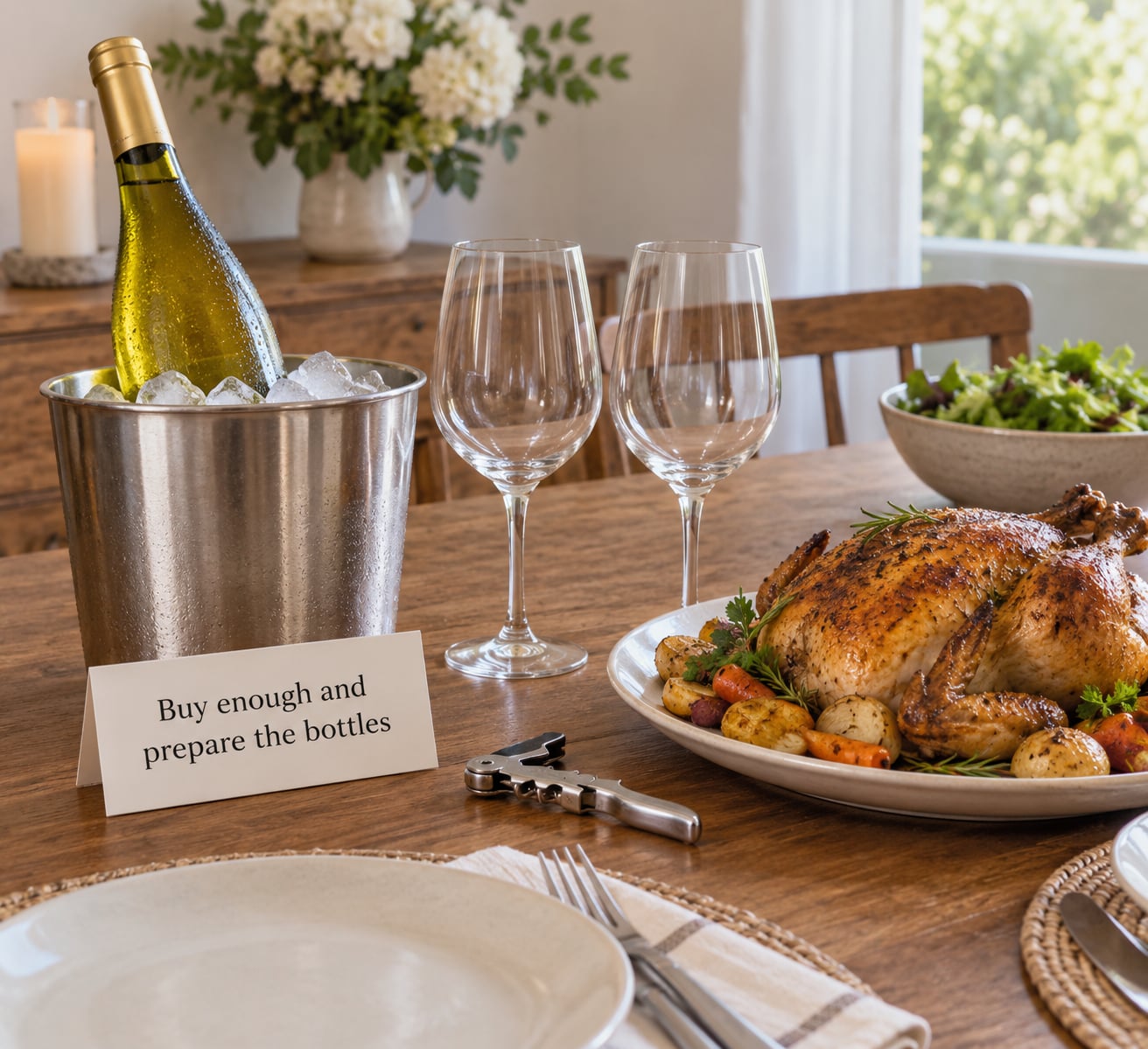
A standard 750 ml bottle holds about 25 ounces. At a 5-ounce dinner pour that is five glasses; at a generous 6-ounce party pour, four. Most guests take two or three glasses across an evening because dinner takes time and nobody drinks wine and nothing else all night.
The rule of thumb: one bottle per two wine drinkers, rounded up, plus one bottle of sparkling for the toast.
| Guests | Guests you can expect to drink wine | Bottles for dinner | Plus sparkling for the toast |
|---|---|---|---|
| 6 | 4 to 5 | 2 | 1 |
| 8 | 6 | 2 | 1 |
| 10 | 7 to 8 | 2 to 3 | 1 |
| 12 | 9 | 3 | 1 |
| 16 | 12 | 3 | 1 |
| 20 | 15 | 4 | 1 |
For twenty guests, expect around fifteen to drink wine, so four bottles for dinner plus one sparkling is the honest answer. For ten people, two bottles works only if most of your guests are drinking beer or something else, because two bottles is eight to ten glasses in total.
Timing matters as much as quantity. Screw-cap bottles can go in the fridge at any point. Corked reds need to come out of the fridge about an hour ahead so they lose that flat chill. Chill whites and sparkling for three to four hours, longer if the bottle is large. If you forgot until the afternoon, an ice bucket with ice and water chills a bottle in roughly twenty minutes, faster than ice alone.
Set out one glass per guest plus spares. Decanting is optional at a dinner party: a young, tannic red gains from ten minutes in a decanter, and an older bottle with sediment needs to stand upright ahead of time so the sediment stays in the bottle. Everything else can be opened right before you sit down.
6. Taste, serve, and make a final check
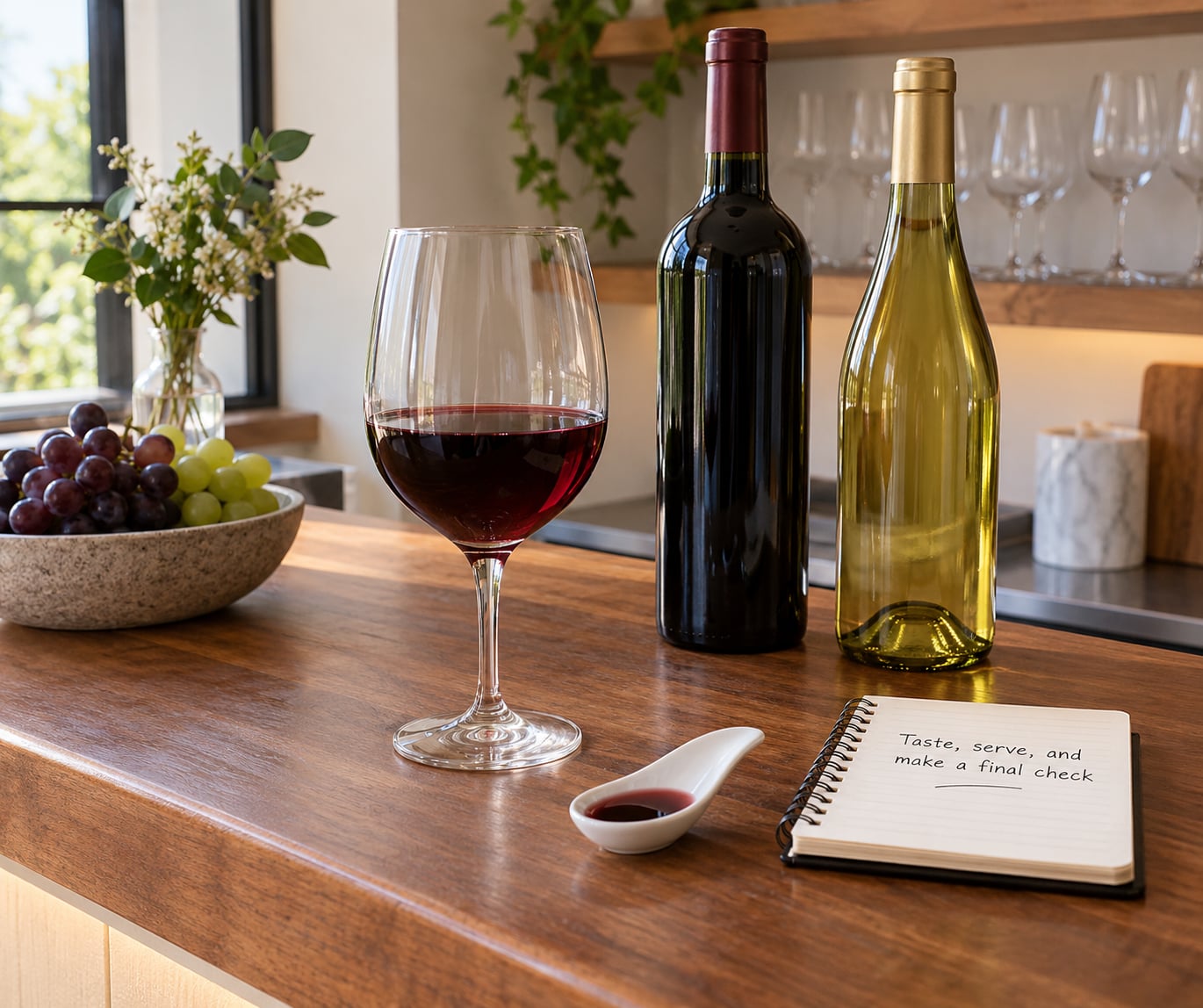
Open one bottle about fifteen minutes before guests arrive and taste it yourself. Check four things: aroma, sweetness, acidity and structure. Is it dry or noticeably sweet? Does it smell of fruit, earth or oak? Does it feel light or heavy in the mouth? Is there any harsh tannin left on your teeth? That last one tells you whether it needs food, more chilling, or a different bottle.
One sentence about the wine is enough at the table. Something like “dry white, light and crisp, nice with the chicken” tells guests everything they need. Nobody expects a tasting note.
| Wine style | Serve at | Why |
|---|---|---|
| Sparkling and Prosecco | 40 to 46 F | Cold keeps the bubbles tight and the fruit bright |
| Crisp dry whites, Riesling, Pinot Grigio | 48 to 54 F | Too cold mutes aroma; this is just below cellar temperature |
| Oaked Chardonnay and fuller whites | 52 to 58 F | A touch warmer releases the oak and texture |
| Light reds, Pinot Noir, Gamay | 56 to 62 F | Cooler keeps them fresh and avoids a cooked edge |
| Full reds, Cabernet, Syrah, Malbec | 60 to 65 F | Fuller reds need warmth to soften tannin |
The 75-85-95 shorthand in wine circles means roughly this: open a light red near 75 F, let a fuller one reach its best around 85 F, and past about 95 F the fruit starts to taste cooked and the alcohol flattens everything. If in doubt, serve the red slightly cooler than you think you should.
If something feels off once guests are eating, fix it fast and without apology. Too warm means an ice bucket and five minutes. Too cold means hold the bottle at the table for a minute or two. Too sweet means pair it with something salty or acidic, or shift the pour toward the second bottle you have hidden back. Genuinely mismatched means pour smaller and top up more often; nobody notices a half glass nobody can assess.
Common Mistakes
- Choosing by grape alone. “Pinot Noir is good” tells you nothing about dinner. Fix: match the cooking method and sauce first, then use the grape as a starting point inside that style.
- Pairing with the starter and ignoring the main. The main course decides. Fix: pick the dinner wine first and let the starter ride on it.
- Serving red too warm. Warm reds taste flat and alcoholic past about 65 F. Fix: pull corked reds out of the fridge an hour ahead and keep bottles in an ice bucket.
- Serving white too cold. Ice-cold whites taste muted. Fix: take the bottle out of the fridge five to ten minutes before opening so the aroma can come through.
- Buying too little. This is the most common party failure. Fix: count wine drinkers, multiply by three glasses, then divide by four pours per bottle and round up.
- Buying too much. Leftover bottles sour within days. Fix: buy your minimum plus one bottle, and save one for a weeknight rather than the trash.
- Assuming a pricier bottle impresses more. Guests remember whether the wine went down easily, not what it cost. Fix: spend more only on a style you genuinely want to taste.
- Trying to please every possible taste. You cannot. Fix: choose the style most of the table will finish, offer a second option in the other color, and stop thinking about it.
Two habits cover most of the rest. Chill and open early, not at the last minute. And buy the same bottle twice rather than two different ones, so a guest who dislikes the first can still have the second without you buying a backup for every course.
Frequently Asked Questions
How much wine should I buy for a dinner party?
Plan one 750 ml bottle per two wine-drinking guests, rounded up, plus one bottle of sparkling for the toast. A bottle gives four generous 6-ounce party pours or five 5-ounce dinner pours. Most guests drink two or three glasses across an evening, so for twelve guests with nine wine drinkers you want three dinner bottles and one sparkling.
What wine is easiest to serve with a varied dinner menu?
A medium-bodied red with soft tannin, or a crisp dry white with good acidity, handles more dishes than anything else. A dry Cotes du Rhone, a Gamay or an unoaked Chardonnay will cross poultry, pasta, roast vegetables and mildly spiced food. Sparkling wine is the other easy answer because it works through several courses.
How do I choose wine if I know very little about it?
Ask a shop for two bottles in your style from a region you trust, give them your main course and your budget, and buy the same label twice. Or pick a wine you already drink and find a dish it goes with. You do not need vocabulary to choose well, you need a main course and a plan.
Should I serve red wine with fish or white wine with meat?
The old rule that fish takes white and meat takes red is a starting point, not a law. Salmon or tuna handled in a rich sauce can take a lighter red, and a roast chicken with cream sauce takes Chardonnay all day. Match weight and sauce: light food to lighter wine, heavy food to fuller wine, and let acidity do the rest.
What temperature should I serve wine at a dinner party?
Sparkling and Prosecco at 40 to 46 F, crisp dry whites at 48 to 54 F, light reds at 56 to 62 F, and full reds at 60 to 65 F. Take white bottles out five minutes before opening so they are not ice cold, and pull corked reds out of the fridge an hour ahead so they lose the flat chill.
Is an expensive bottle of wine better for entertaining guests?
Not for the guests. A better bottle is a matter of quality, not politeness, and nobody at a table can tell which one costs more. Spend more only when you want to taste something specific yourself. For hosting, a reliable label you can buy six of is the better choice every time.
A Reliable Starting Point
Write down the main course. Pick one style that fits it, usually a medium red with soft tannin or a crisp dry white. Choose a label you can buy several of without wincing, count your wine drinkers, and buy one bottle per two of them plus a bottle of sparkling for the toast.
Chill the whites and let the reds come out of the fridge an hour early. That is the entire plan, and it will carry a table further than any expensive bottle nobody enjoys.