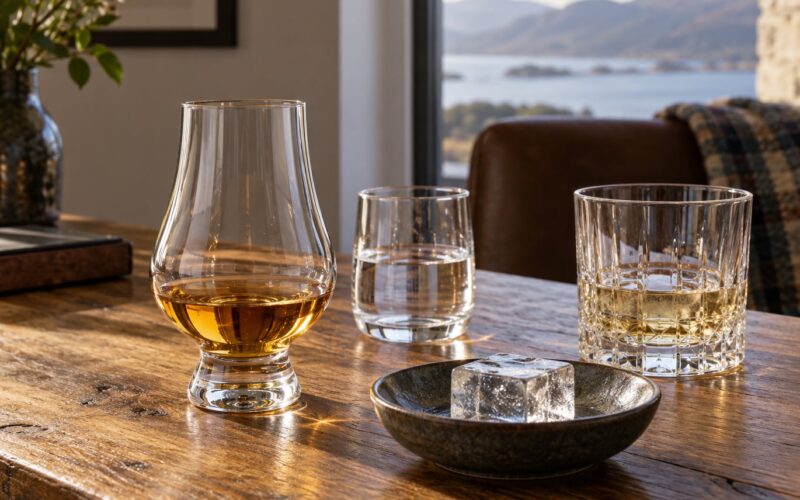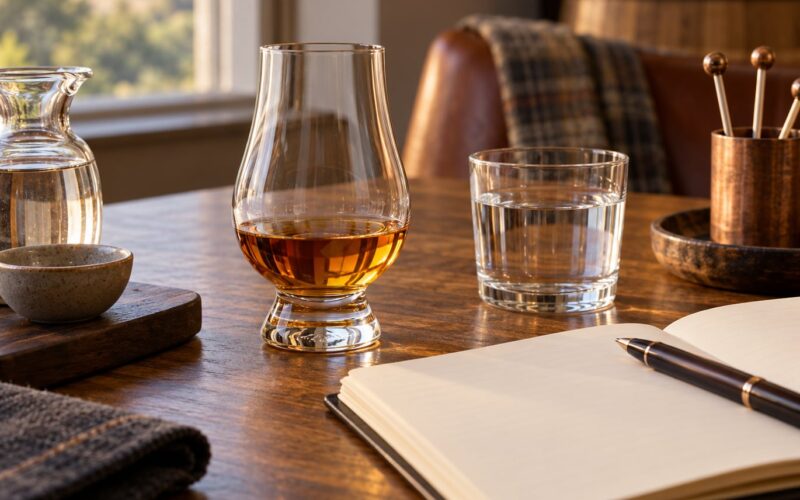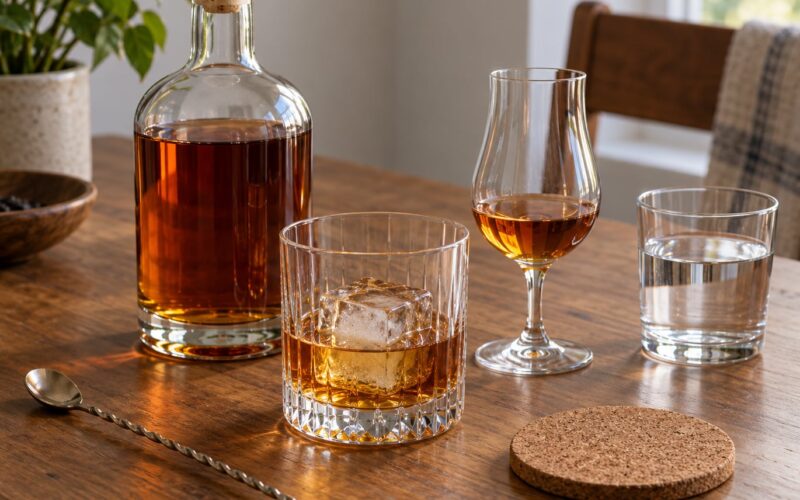
To drink mezcal and actually taste the smoke, pour a small measure, swirl the glass gently to lift the aromatics, smell it with your nose just above the rim, then take a tiny sip and move it across your tongue before you swallow. Smoke registers mostly through aroma, not taste, so the smelling step is the one that matters.
That is the whole trick, and it is the step most people skip. Mezcal’s smoke is volatile. It lifts off the pour and dissipates in seconds, so if you dump the smell and go straight to the glass, there is nothing left to perceive but alcohol heat.
This guide takes about ten minutes to read and five minutes to practice at home. No bar kit required.
Table of Contents
- What You Need
- Three expressions to compare
- Glassware, and a home substitute
- Water and a palate reset
- Accompaniments you can skip at first
- Glossary of the terms you will meet
- Why Mezcal Tastes Smoky (and Why It Is Not a Flavoring)
- Good smoke versus a burnt defect
- How to Drink Mezcal and Taste the Smoke, Step by Step
- Step 1: Choose a Mezcal to Taste
- Step 2: Look, Smell, and Taste in That Order
- Step 3: Add Water or Ice Deliberately
- Step 4: Retaste and Name the Smoke
- Tasting Notes and How to Reset Your Palate
- Smoke character by agave variety
- Three ways to reset between pours
- Common Mistakes
- Judging the first aroma as the whole aroma
- Shooting it
- Filling the glass with ice
- Expecting liquid smoke
- Confusing bitterness with smoke
- Adding orange and worm salt on the first pour
- How Do Mexicans Drink Mezcal?
- Is Mezcal Hard on Your Liver?
- Frequently Asked Questions
- Should mezcal be chilled or served at room temperature?
- Is mezcal hard on your liver?
- How do Mexicans drink mezcal?
- What makes mezcal taste smoky?
- What is the correct way to drink mezcal?
- What do you drink mezcal with?
What You Need
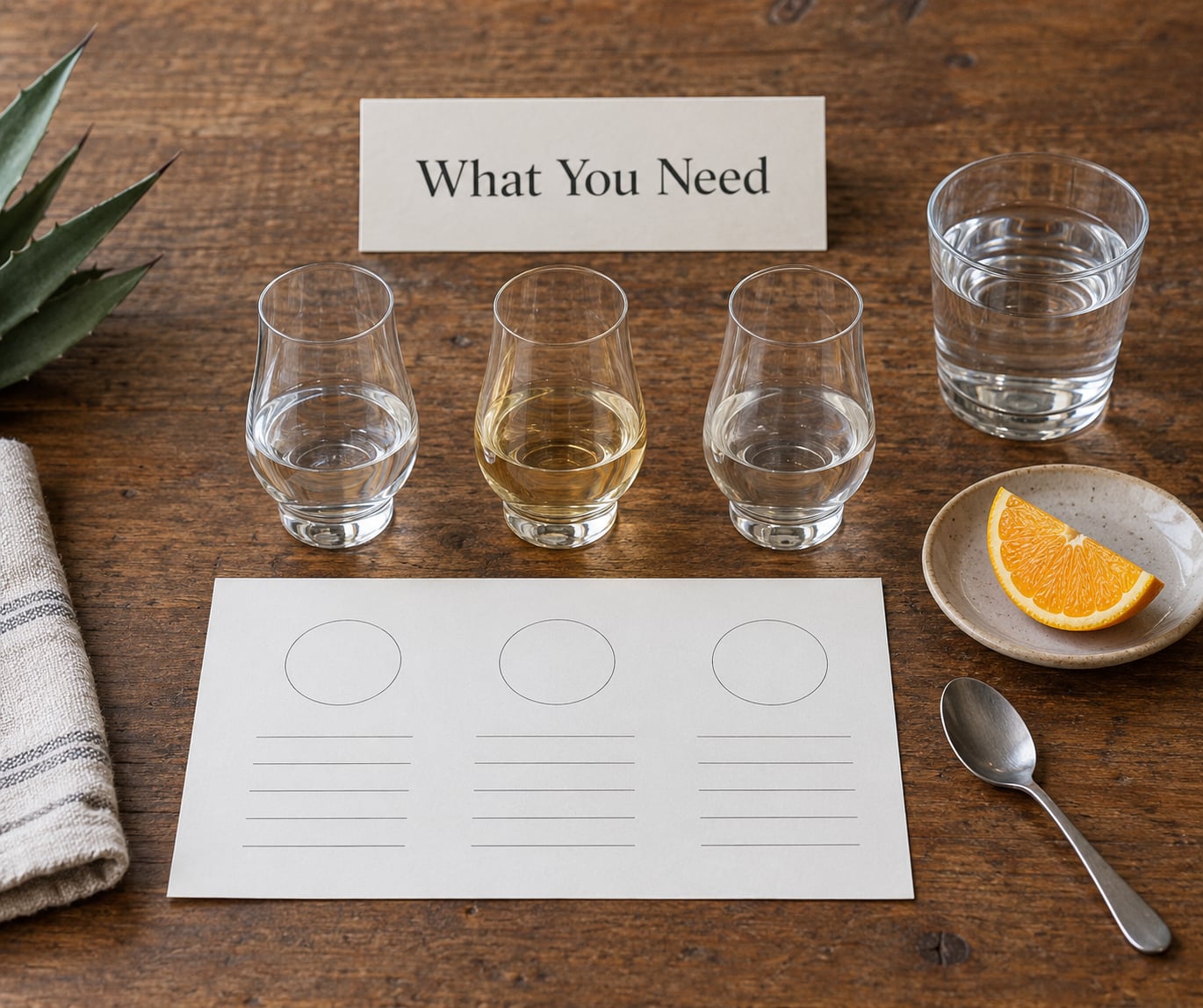
You need very little. The whole method works with three glasses and a water bottle.
Three expressions to compare
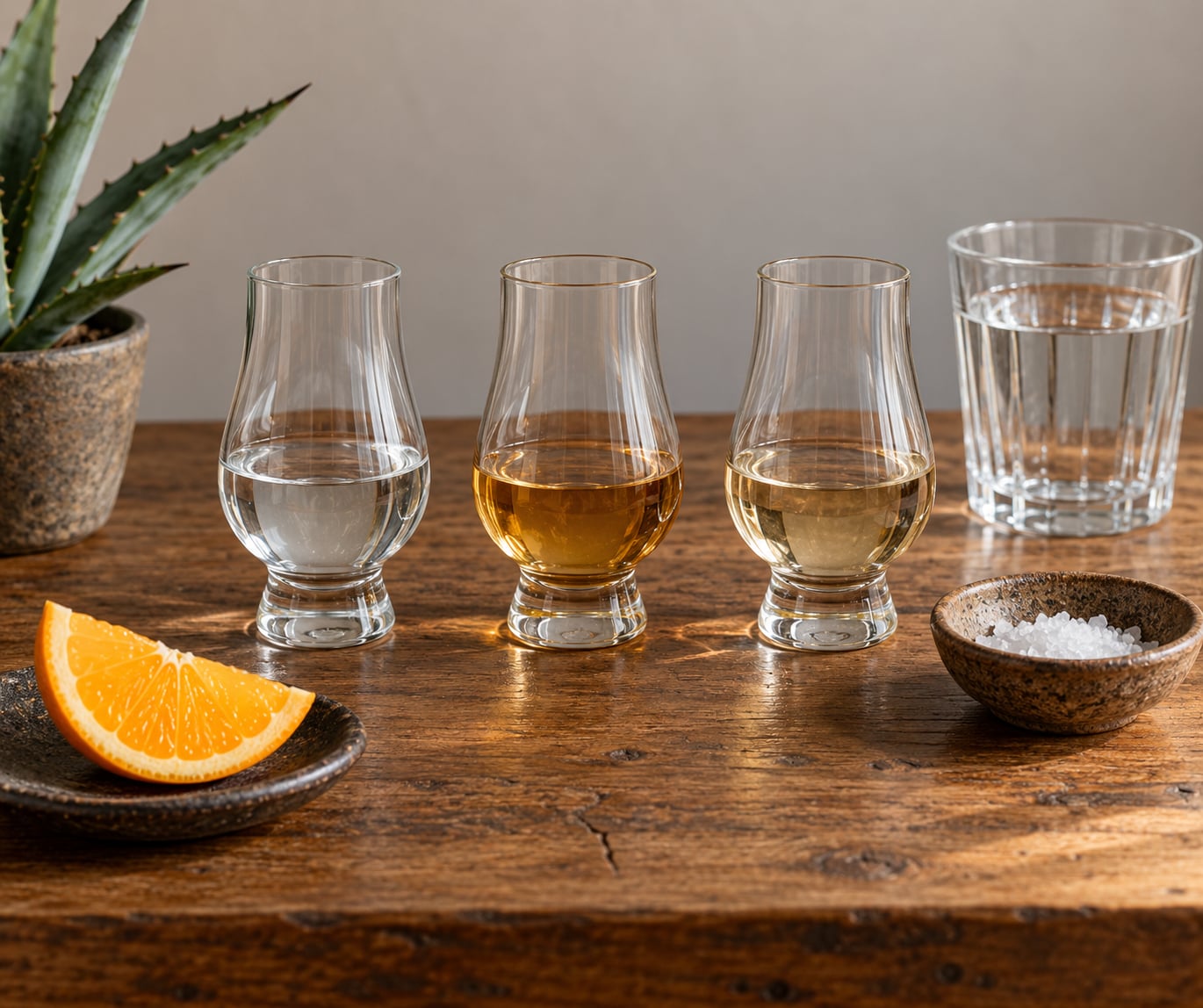
A current blanco or joven made from espadín agave, an aged expression such as a reposado or añejo, and one deliberately smoky mezcal. Pour about 30 ml of each, which is barely two fingers in a small glass. Comparing three side by side teaches your palate more in one sitting than a bottle and a week of guessing.
If you only have one bottle, work through it in three stages: neat, then diluted with a few drops of water, then with an orange slice. The progression shows you what the spirit is doing on its own before you add anything.
Glassware, and a home substitute
A copita, a small tulip-shaped clay or ceramic vessel with a waisted middle, is the traditional pouring glass. A veladora is a small straight-sided clay cup. A jícara is the shallow, wide-rimmed bowl carved from the gourd of the jícama plant, which gives it a much wider aroma surface. All three are inexpensive and none of them is essential.
At home, use a small stemmed tasting glass or a shot glass with a slightly wider mouth. The wide rim matters more than the material, because more surface area means more aromatic surface. Skip large wine glasses for the first pour; the volume of air dilutes the aroma and you will chase your nose around the bowl.
Water and a palate reset
Keep a small glass of room-temperature water within reach. Dilution is a technique here, not a rescue from bad liquor.
Accompaniments you can skip at first
A slice of orange and sal de gusano, the salt blend mixed with dried chile worm, are the classic Oaxaca service. Both change the flavor noticeably, so save them for pour two or three. If you want to taste the spirit cleanly, smell your fingers before you eat anything, since lingering food flavors distort everything that follows.
Glossary of the terms you will meet
| Term | What it means |
|---|---|
| Perlas | The tiny bubbles that form when you swirl. More perlas usually means a higher proof and more aromatic lift. |
| Legs | The trails that cling to the inside of the glass. They describe viscosity, which tracks how long the aroma keeps coming. |
| Besos | The kiss. Leaning in to smell the pour with your nose close to the glass rather than holding it at arm’s length. |
| Smoke | The aroma of roasted agave. Most of it arrives through the nose, not the tongue. |
| Finish | What stays after you swallow. A long, smoky finish usually means a well-made spirit with real structure. |
| Sal de gusano | Worm salt, a salt mixed with toasted and ground chile worm. |
Why Mezcal Tastes Smoky (and Why It Is Not a Flavoring)
Mezcal is an agave spirit distilled from roasted agave. Before distillation, the piñas are cooked in an underground earth oven, a palenque, buried under hot stones and sometimes lit with wood. That roasting is the sole source of the smoke flavor.
Nothing smoky is added. No flavoring, no additive, no injected smoke. If a mezcal tastes smoky, it is because the agave was roasted and the smoke compounds were captured in the cooked plant and carried through the still.
This is the single most useful thing to understand when learning how to drink mezcal. Smoke that comes from roasting behaves like a real flavor that moves and changes in the glass. Smoke added as a gimmick sits on top of the aroma and never develops.
Good smoke versus a burnt defect
Good smoke smells like wood, char, dried herbs, sometimes camp coffee or even a bit of leather. It arrives as an aroma, not a taste on the tongue.
A burnt or over-roasted pour smells flat, acrid and papery, closer to charcoal that has cooled. When you can only find that, the agave was pushed too far in the pit rather than the mezcal being smoky by nature.
If a smoky mezcal from a respected producer still reads as harsh to you, that is usually a dilution and technique problem rather than a quality problem.
How to Drink Mezcal and Taste the Smoke, Step by Step
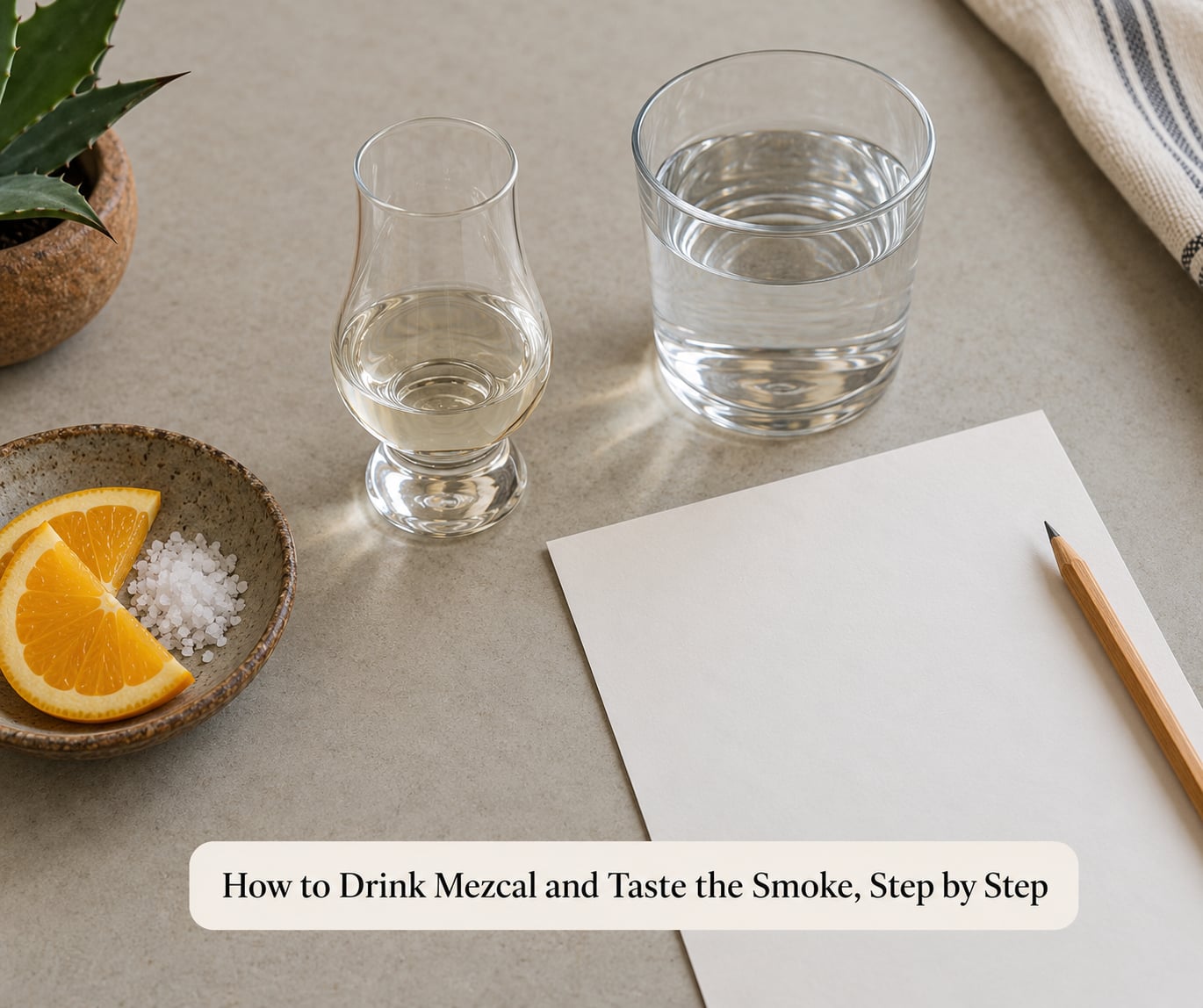
Run all four steps with every pour. Even a single-mezcal evening improves when you keep the sequence fixed.
Step 1: Choose a Mezcal to Taste
Start with something that makes the mechanics visible. If you only drink one style, begin with a joven, because there is no oak on it and every aroma you detect comes from the agave and the roasting.
Then compare against a smoky bottling so you know what you are looking for. Age adds a separate layer of oak, vanilla and dried fruit that can be mistaken for the roast, so hold a smoky and an aged example apart in your notes rather than merging them.
Write down the agave variety and age category before you taste. The words joven, especial, reposado and añejo tell you how much time passed between the still and the glass, and that is exactly the information you need to explain a note later.
Step 2: Look, Smell, and Taste in That Order
Hold the glass up to a window or a white sheet of paper. Good mezcal is clear and luminous, and an unfiltered bottling may carry visible wisps or a slight haze, which is normal and not a flaw.
Swirl once, gently. Agitate too hard and you knock off the lighter aromatic compounds you came for. Watch for perlas rising in the film that coats the glass and for legs running down the inside.
Now bring the glass close and smell with your nose near the rim. This is besos, the kiss. Do not sniff hard through your mouth or hold the glass out at arm’s length. Take two or three small, quiet inhalations instead of one deep one.
On the first inhale you will mostly get roast and alcohol. On the second, if you wait a few seconds between them, the fruit, floral or mineral notes arrive. Pour one and keep sniffing, and within a minute the aroma is largely gone. That fading is normal.
Next, taste. Take a sip about the size of a teaspoon, let it sit on the front of your tongue, then move it slowly across the palate and along the sides before swallowing. Do not roll it like a shot. The goal is to notice where the flavor changes as it moves.
Step 3: Add Water or Ice Deliberately
Wait about thirty seconds after the first aroma pass before touching anything. Diluting too early gives away the neat character you came to learn.
Then add water in increments, five drops at a time, and re-smell before you re-sip. In most cases the smoke becomes obvious at around a third to a half of the glass diluted. That is because water lowers the alcohol concentration, which lets the volatile aromatic compounds escape more freely and reach your nose.
Ice does the same thing faster and less precisely. One or two cubes in a small glass is fine on a warm afternoon, but a glass full of ice mutes the aroma and drops the temperature below the range where the nose works well. Plenty of good mezcal is served over ice in Mexico, so this is about technique at home, not about rules.
If the spirit still bites hard after dilution, the alcohol is simply high. Return to the tasting next week rather than pushing through it.
Step 4: Retaste and Name the Smoke
Sip the diluted pour again and describe the smoke in words that match what you actually smell. Vague notes do nothing. Specific ones let you compare the next bottle.
Roasted or charred describes a wood and char aroma like a clean grill. Herbal covers the green, anise, dried grass and wild-vegetation notes common in less-roasted mezcal. Mineral points to wet stone, clay and a saline quality. Sweet smoke reads as cooked agave, brown sugar or caramel underneath the roast.
Green smoke means fresh or vegetal, with a bitterness that usually comes from greener agave or a lighter roast. Lingering smoke is what stays in the empty glass and in the back of your throat for minutes afterward, and it is usually a sign of a spirit with real substance behind it.
Then name what came before and after the smoke, because it rarely drinks alone. Tropical fruit, citrus, floral notes like honeysuckle, cooked corn, olive oil or dried herbs all appear under the roast in well-made mezcal.
Tasting Notes and How to Reset Your Palate
Write notes in four columns and you will find smoke much faster than describing it in a paragraph.
| Stage | What to look for | What it tells you |
|---|---|---|
| Aroma | Roast, herbs, fruit, mineral, oak | Roasting level, agave variety and how much time the spirit spent in wood |
| Front of palate | Sweetness, salt, acidity, carbonation | Balance and whether the pour will pair well with food |
| Middle | Body, texture, alcohol warmth | Proof and whether it feels thin or creamy |
| Finish | Length and character of what remains | Quality of the spirit and how long it will stay with you |
Smoke character by agave variety
Agave variety changes the smoke before roasting even starts. These are general tendencies rather than rules, since a palenque cook can push any of them in a different direction.
| Agave | Typical smoke character | Other notes you may find |
|---|---|---|
| Espadín | Moderate, fairly even roast with sweet and green edges | Tropical fruit, cooked agave, herbs |
| Tobalá | Drier, more mineral, sometimes dusty | Hay, wet stone, dried fruit |
| Tepeztate | Deeper and darker, with an earthy weight | Molasses, black pepper, tobacco |
| Arroqueño | Pronounced, woody and sometimes resinous | Pine, anise, dried plum |
Three ways to reset between pours
Smoke becomes invisible when your palate is coated. Between samples, take a few sips of plain water, eat a small piece of plain bread or a neutral cracker, and wait about sixty seconds before sniffing the next pour again.
Avoid anything strongly flavored between samples. Salty snacks and chocolate both distort the next aroma more than most people expect, which is why experts taste a flight clean before adding anything to the glass.
Smell your fingers too. Olive oil, garlic and hand sanitizer all wreck the next aroma, and you will blame the mezcal for it.
Common Mistakes
Almost every beginner problem comes from rushing one of the four steps. The fixes are simple once you know what went wrong.
Judging the first aroma as the whole aroma
The first smell off a fresh pour is loud and mostly roast plus alcohol. Give it three passes with a few seconds between them and the fruit, floral and mineral layers show up underneath.
Shooting it
A shot kills the entire method. Everything that makes mezcal worth drinking happens in the first three seconds after the sip and is gone before the alcohol lands. Pour small, sip smaller.
Filling the glass with ice
Cold dulls the nose and ice mutes the aroma you came for. Add a splash of water instead, or use a single cube so the spirit stays comfortably cool and still smells of something.
Expecting liquid smoke
Campfire is not the target flavor. People who expect a smoky barbecue taste describe mezcal as harsh, because they are hunting for an intensity that was never there. Aim for wood, char and herbs sitting underneath fruit.
Confusing bitterness with smoke
Bitterness arrives on the tongue as soon as the sip lands and stays dry at the back of the mouth. Smoke arrives through the nose and lingers as an aroma. If you can taste it, it may be a roast that went too far, so taste again diluted before judging.
Adding orange and worm salt on the first pour
Both are excellent and both change the flavor substantially. Taste the spirit clean at least once so you know what you are tasting before the salt and citrus take over.
How Do Mexicans Drink Mezcal?
In practice, mezcal is a social, long-sitting drink. It is poured into small cups in a mezcaleria or at a family gathering, refilled steadily, and sipped over hours alongside food rather than consumed in a single round.
The pour is small and so is the sip. Toast with a raise of the cup, sip, eat something, repeat. Sipping alongside a meal is normal and it keeps you at a pace where you can still taste the fifth cup.
Is Mezcal Hard on Your Liver?
There is nothing specific to mezcal that damages the liver. It is distilled ethanol like any other alcoholic spirit, and the guidance that applies to all alcohol applies here: moderate intake, drink slowly, eat food, and stay hydrated.
Mezcal bottles usually range from about 38 to 55 percent ABV, so a 30 ml pour carries real alcohol. That is why small pours and slow sipping are not only better for flavor. Anyone with a liver condition, or who takes medication that interacts with alcohol, should ask a doctor before drinking.
Frequently Asked Questions
Should mezcal be chilled or served at room temperature?
Room temperature, or slightly cool, shows mezcal at its most expressive. Chilling suppresses the volatile aromatics that carry the smoke, so the spirit tastes flatter and more alcoholic than it is. In a warm room, a single ice cube or a short stay in the fridge for a few minutes works well. Going much colder closes the nose down and you lose most of what you came to taste.
Is mezcal hard on your liver?
No more than any other distilled spirit. Mezcal is ethanol, so the standard alcohol guidance applies: moderate amounts, sip slowly, eat food and stay hydrated. Because most mezcal runs between roughly 38 and 55 percent ABV, small pours matter more here than in a lower-proof cocktail. Anyone with a liver condition or a medication interaction should speak with a doctor first.
How do Mexicans drink mezcal?
Small cups, small sips, and a long sitting. Mezcal is poured generously into small cups at a mezcaleria or family gathering and refilled steadily over several hours, with food alongside. The custom is to toast by raising the cup, sip, eat, and repeat. Orange with sal de gusano is traditional, though plenty of drinkers taste the spirit clean first.
What makes mezcal taste smoky?
The agave is roasted before distillation, buried in an underground earth oven called a palenque with hot stones and wood. Smoke compounds settle into the cooked plant and come through the still in the distillate. Nothing smoky is added to the spirit. That is the difference between a genuine roasted note that develops in the glass and a gimmick that smells flat and one-dimensional.
What is the correct way to drink mezcal?
Pour about 30 ml into a small wide-rimmed glass, swirl once, smell with your nose near the rim, then take a teaspoon-sized sip and move it across the tongue before swallowing. Wait thirty seconds, add a few drops of water, and taste again. Orange and sal de gusano are good on the second or third pour rather than the first.
What do you drink mezcal with?
Start with food that has its own character: grilled or roasted meat, charred vegetables, aged cheese, chocolate, chapulines with lime, or tropical fruit such as pineapple or mango. On the drink side, an orange slice with sal de gusano is the classic move, and mezcal makes an easy Negroni, Paloma or smoky margarita. Keep the first tasting flight salt-free so you can taste the spirit itself.
Start tonight with one joven, a small glass, and the four steps in order: pour, observe, smell, sip, then dilute. Write three words in your notes before you pour water and three words after, and the next bottle will read like a completely different drink.