How to make puff pastry at home is mostly a temperature problem, not a technique problem. You roll a flour-and-water dough around a slab of very cold butter, chill it so the butter firms back up, then roll and fold it three to six times before baking in a very hot oven. Get the cold-but-but-pliable butter right and the layers build themselves; let it soften and you get a greasy, flat sheet no amount of extra folding will rescue.
The rough puff method below is the friendliest place to start. It works the butter into the flour instead of enclosing a butter block, so there is no sealing step to get wrong, and most people get a usable batch in about an hour of active work plus chilling time.
The honest catch: chilling is passive, and there is a lot of it. Budget three to four hours end to end, most of it spent in the refrigerator. Beginners on cooking forums keep naming the same thing as the deciding factor, keeping everything cold and working fast.
Table of Contents
- What You Need: Flour, Salt, Ice Water, Cold Butter
- Step-by-Step: How to Make Puff Pastry at Home
- Mix the Dough and Keep It Shaggy, Not Smooth
- Chill and Roll the Dough: Cold Dough, Even Thickness
- Add the Butter Block So It Cannot Escape
- Roll and Fold the Pastry: Book Fold or Letter Fold
- Repeat the Folds and Chill Between Every Cycle
- Shape and Cut After the Final Chill
- Egg Wash and Bake at 400F for 25 to 28 Minutes
- Common Mistakes and the Fix for Each One
- Frequently Asked Questions
- Can I make puff pastry without a rolling pin?
- Do I need to rest puff pastry between every fold?
- Why does my puff pastry not puff up in the oven?
- Can I use unsalted butter instead of salted butter?
- How long can homemade puff pastry be kept before baking?
- Conclusion: Measure, Chill, Fold
What You Need: Flour, Salt, Ice Water, Cold Butter
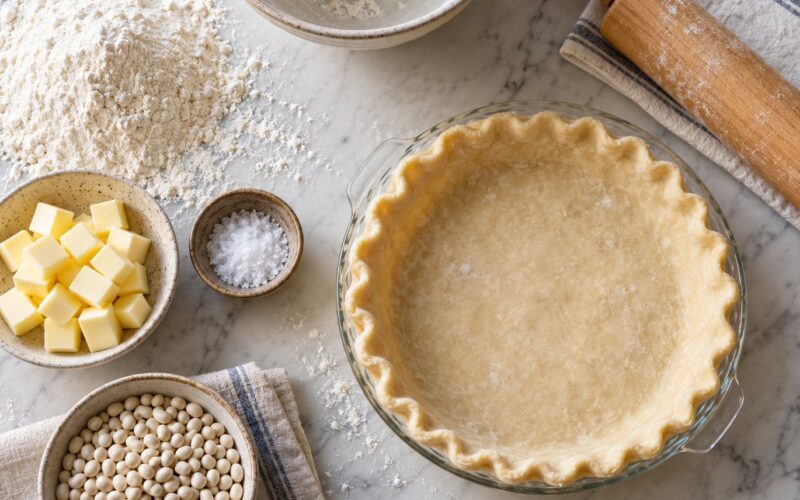
Puff pastry is a four-ingredient dough plus salt, which means the ingredients are not where the difficulty lives. Here is the rough puff version, with the weights that actually matter.
- All-purpose flour, 2 cups (250 g) for the dough, plus another 1/2 cup (60 g) for the work surface.
- Unsalted butter, 1 cup (225 g), cold cut into 1/2-inch cubes. European-style with 82 to 86 percent fat is the better buy because less water means less bleed-through when you roll.
- Ice-cold water, 1/2 to 3/4 cup (120 to 180 ml). Start at the low end and add more as needed. A squeeze of lemon juice or a teaspoon of vinegar helps tighten the gluten.
- Kosher salt, 1 teaspoon. Iodine-based table salt can taste bitter in baked pastry; kosher salt has none of that.
- Granulated sugar, 1 teaspoon, optional. Traditional sweet puff pastry includes it; savory applications skip it.
For equipment, a rolling pin, a bench scraper or knife, parchment paper, plastic wrap, and a baking sheet that fits your fridge. A pastry blender works; a food processor does not, because the blades warm and shred the butter into flour paste. If you want the speed of a machine, freeze the butter hard and grate it on the large holes of a box grater instead.
A pasta roller is genuinely useful here, and enthusiasts who own one say it is the single change that made their lamination even. Set it to the thickest setting to start and work down one notch at a time.
Step-by-Step: How to Make Puff Pastry at Home
Mix the Dough and Keep It Shaggy, Not Smooth
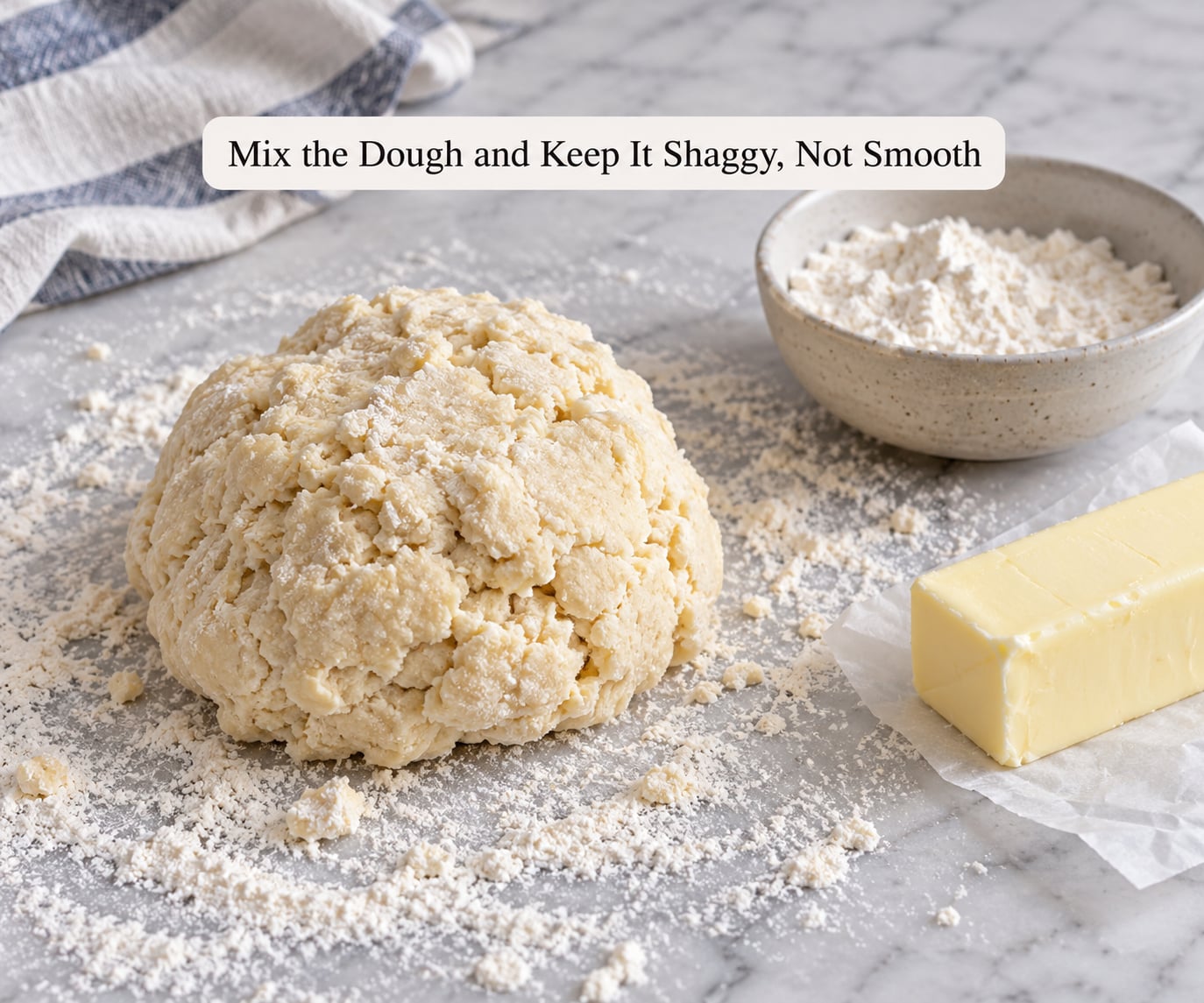
Whisk the flour, salt, and sugar in a wide bowl so the salt is evenly distributed. Add the cold butter cubes and rub them through the flour with your fingertips until the largest pieces are about the size of a pea and everything is coated in coarse crumbs.
Pour in 1/2 cup of ice water and stir with a fork until a shaggy clump forms. Add the rest a spoonful at a time. The dough is ready when squeezing it holds together and a few crumbs still break loose.
Do not knead it. A smooth, tight ball means you have developed the gluten, and the pastry will spring back under the rolling pin instead of rolling. Scrape it onto a work surface, press it into a rough rectangle, wrap it, and refrigerate for 30 minutes or up to overnight.
Chill and Roll the Dough: Cold Dough, Even Thickness
Unwrap the dough onto a lightly floured surface and strike it with the rolling pin to flatten it. Roll into a rectangle roughly 12 by 8 inches, about 1/4 inch thick, dusting the surface sparingly.
Flour is the most common reason dough tears and layers disappear. Too much flour on the bench makes the outside of the sheet dry, and dry dough will not laminate. A light dusting per pass is plenty. If the dough grabs the counter, rest it under a clean towel for 5 minutes rather than adding more flour; the gluten relaxes and it rolls without sticking.
You want the dough and the butter at roughly the same stage. Around 55 to 60F is the working window enthusiasts on r/pastry aim for. If your kitchen runs warm, do the first roll in short bursts and go back to the fridge between them.
Add the Butter Block So It Cannot Escape
This step applies to traditional reverse lamination, where the butter is sealed inside the dough rather than rubbed in. Pound or roll your cold butter into a neat square about the same width as your dough rectangle and a third as tall.
Set the dough rectangle down the long axis of the counter, with the short edges nearest you. Lay the butter square in the center, leave a border of dough all the way around, then fold the near dough strip up and over the butter, press it to seal, and do the same from the far side. Pinch the seams closed.
Seal every edge properly. Any gap is an escape route, and butter that leaks during rolling smears instead of layering. Dust the top lightly and roll the sealed packet into a 12 by 4 inch strip, keeping the butter centered the whole time.
Roll and Fold the Pastry: Book Fold or Letter Fold
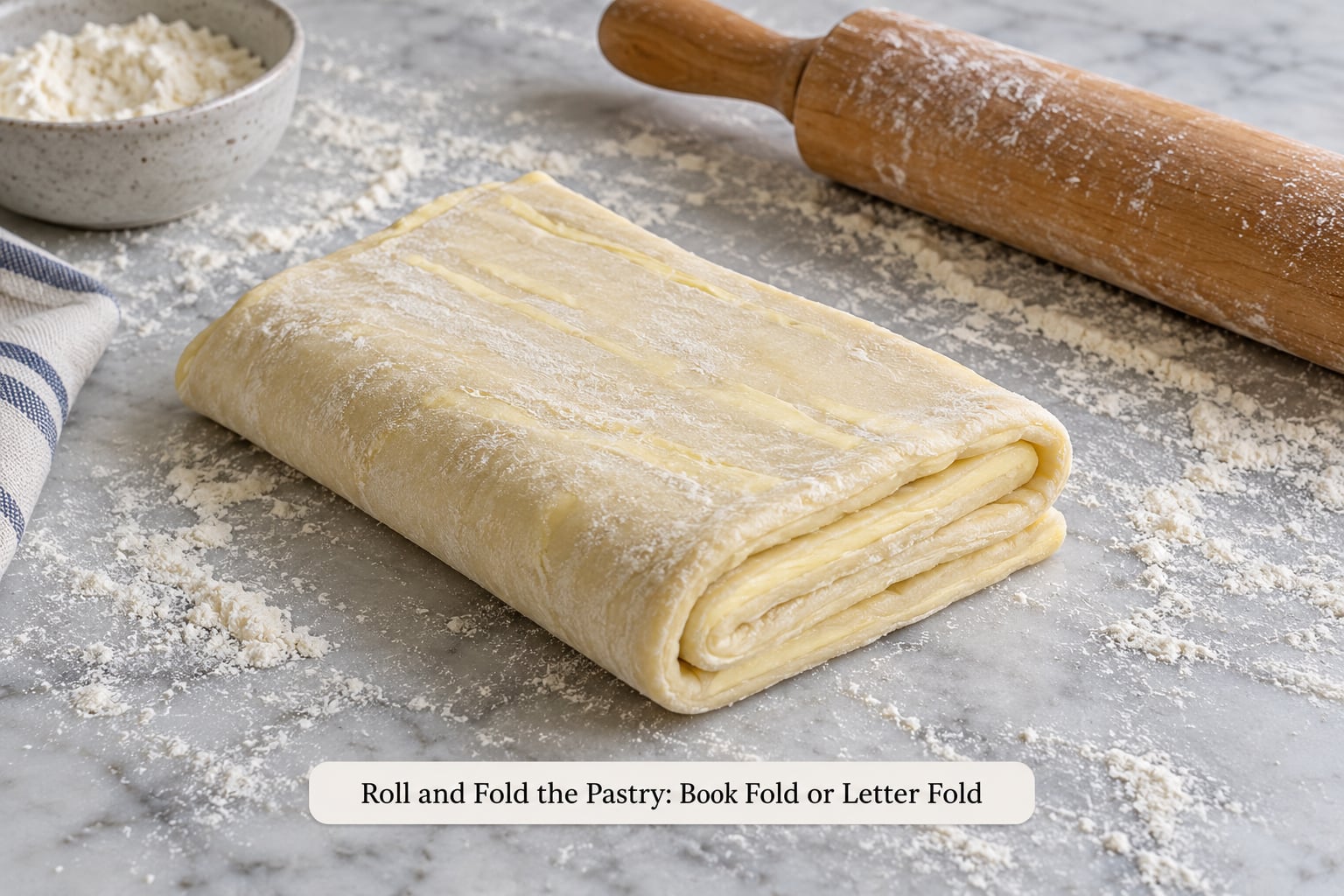
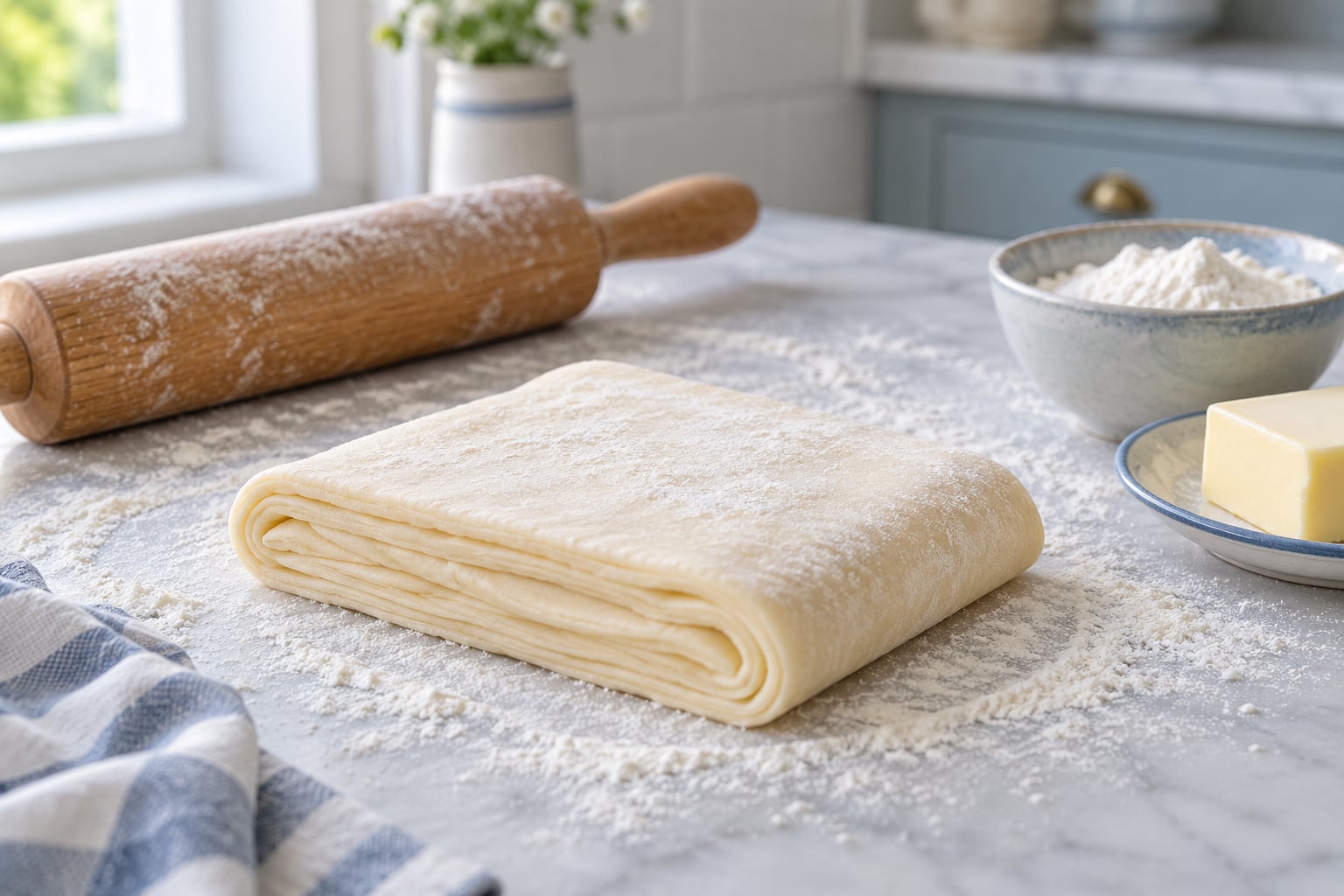
Rolling in the same direction every time matters more than the shape. The classic strip is rolled 3 times as long as it is wide, then folded in thirds like a business letter: the far third toward the center, the near third over the top, and you end up with a compact three-layer block. A book fold, by contrast, is simply a fold in half.
Each single fold roughly triples the layer count. Six folds gives you around 729 layers, and 730 is the usual number quoted for classic full puff pastry, so the math is not decoration. Three folding cycles of two folds each is plenty for home baking and easier to keep even.
Turn the dough a quarter turn after every fold so it relaxes in both directions and does not stretch into a long oval.
Repeat the Folds and Chill Between Every Cycle
Rest the dough 30 minutes in the refrigerator after each folding cycle, which means rolling and folding, chilling, then rolling and folding again. Twenty to 30 minutes in the freezer works too when you are in a hurry, and that shortcut is the reason many beginners manage this on a weeknight.
You can skip the rest after the very first roll if your kitchen is genuinely cold. You cannot skip it after the second and third, because the butter needs to re-solidify before it can be rolled without smearing.
The signs to look for: the dough is firm enough to roll without sticking, and when you press a finger into the side of the block the butter leaves an indentation but does not ooze. If it bends without cracking, it is too cold. Give it 10 more minutes on the counter.
Shape and Cut After the Final Chill
Shape after the last chill, not before. Chilled dough holds its layers under the knife; warm dough compresses and the layers you built flatten into a dense sheet.
Use a sharp knife or bench scraper and cut straight down in one confident stroke, no sawing, and do not rotate the blade. Sawing drags and merges the layers you spent three cycles separating.
For turnovers, palmiers, and vol-au-vents, cut clean shapes on parchment and chill the pieces again for 15 minutes before they go near the oven. Transferring dough with a bench scraper instead of your hands keeps the edges from sealing shut under your fingers.
Egg Wash and Bake at 400F for 25 to 28 Minutes
For a plain sheet, prick it all over with a fork or skewer. For filled pastries, skip docking the top and let the egg wash and the filling vent instead.
Beat one egg with a tablespoon of water and brush it on thinly. A heavy wash pools and burns before the pastry is set.
Bake at 400F (205C) for 25 to 28 minutes on a middle or upper rack. Hot oven, cold dough, that contrast is the whole mechanism: the butter’s water flashes to steam and forces the layers apart before the gluten sets.
It is done when the pastry is uniformly deep golden, the layers separate visibly at the cut edges, and a skewer comes out with no damp dough clinging to it. Cool on a wire rack, not a plate, so steam escapes rather than softening the base.
Common Mistakes and the Fix for Each One
Almost every failed batch traces back to butter that got warm, flour that got overworked, or a pan that trapped steam. Work down this list in order.
The dough sticks to the counter and tears. Usually too little rest, not too much flour. Cover and rest 5 to 10 minutes, then roll again. If it still grabs, add a tablespoon of flour and a tablespoon of ice water and knead briefly.
Butter leaks out during rolling. The butter softened before you sealed it in. Chill the block 15 minutes, and if the dough is greasy, add a tablespoon of flour to the dough itself and chill again before rolling.
Layers come out uneven or invisible. You rolled too thin in places or the butter smeared. Roll to a consistent 1/4 inch, keep rolling in the same direction, and rest 30 minutes between every cycle so the butter resets.
The pastry shrinks in the oven or comes out dense. The dough was kneaded smooth and gluten was overdeveloped, or the butter melted and spread instead of steaming. Work the dough only until it clumps, and use high-fat European butter.
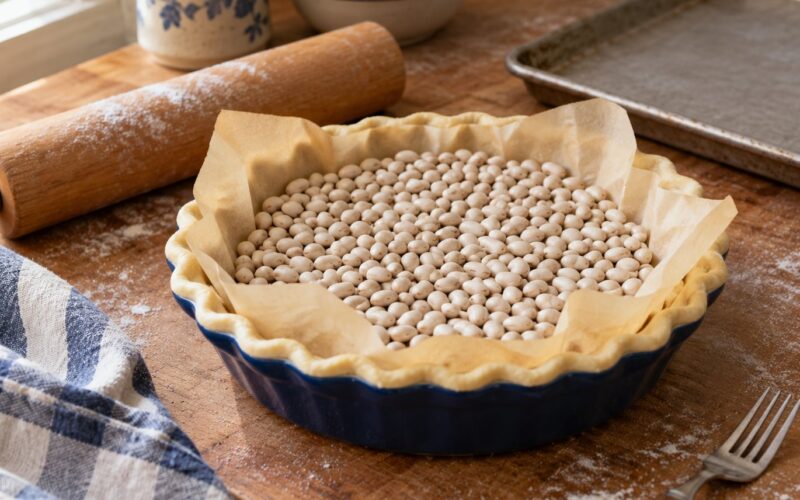
The base is soggy. Steam from the filling or the pastry itself had nowhere to go. Prick plain sheets, bake on a heavy preheated sheet, and cool on a wire rack. Filling goes in after a partial blind bake rather than before.
It bakes flat and dull with no rise. Too warm a kitchen, or a rolled block with no visible butter streaks in it. Chill harder and longer, and check the layer count by slicing a small offcut open before you commit to a full bake.
Stored pastry turns soft and heavy. Airtight wrapping traps moisture. Keep baked pastry in a loose paper bag or an inverted paper towel on a rack at room temperature for a day, then freeze it for anything longer.
The general fix for almost all of it: work cold and work fast. A warm kitchen is the most common environmental problem here, and the butter is usually a symptom of it rather than the cause.
Frequently Asked Questions
Can I make puff pastry without a rolling pin?
You can, but expect more work. A straight-sided glass bottle, a wooden spoon handle, or even the flat side of a butter wrapper wrapped in parchment will roll a small sheet. Keep rolling strokes in one direction and use even pressure, because an improvised pin concentrates force in a narrow band and thins the center faster than the edges. A pasta roller is the better budget upgrade if you plan to make this more than once.
Do I need to rest puff pastry between every fold?
Rest 30 minutes in the refrigerator after each folding cycle, not after every single fold. Folding, chilling, then folding again is the standard rhythm. You can skip the rest after the first roll if your kitchen is genuinely cold, but do not skip it after the second and third cycles, because the butter has to firm back up before it can be rolled without smearing into the dough.
Why does my puff pastry not puff up in the oven?
Three causes cover almost every case: the butter was too warm and melted into the dough before baking, the dough was kneaded smooth and the gluten fought the rise, or the sheet was underdocked and weighed down. A fourth common one is a cool oven. Check the dough for visible butter streaks by slicing an offcut open, and bake at 400F (205C) rather than letting the oven run low.
Can I use unsalted butter instead of salted butter?
Unsalted is the standard choice, because the salt level in salted butter varies by brand and can push a small batch of dough past seasoned. If you want to use salted butter, reduce the added salt to about a quarter teaspoon and taste the dough before the first fold. Skip the lemon juice when the butter is salted, since you already have more salt than the dough needs.
How long can homemade puff pastry be kept before baking?
Refrigerate unbaked dough in an airtight box for up to four days, and freeze it flat in a bag for up to three months. Thaw frozen dough in the refrigerator overnight rather than on the counter, then roll it while it is still cool and firm. Baked pastry keeps a day at room temperature in a loose bag, or two to three months in the freezer.
Conclusion: Measure, Chill, Fold
If you only remember one thing from how to make puff pastry at home, start with a scale and a cold fridge. Weigh the flour and butter, cut the butter into pea-sized pieces, and give the dough its full 30 minutes before you touch a rolling pin.
That is the entire balance: firm butter, cold dough, and folds you do not rush. Everything else, the fold style, the number of cycles, the parchment versus a baking sheet, is a detail you can adjust once the basics hold.