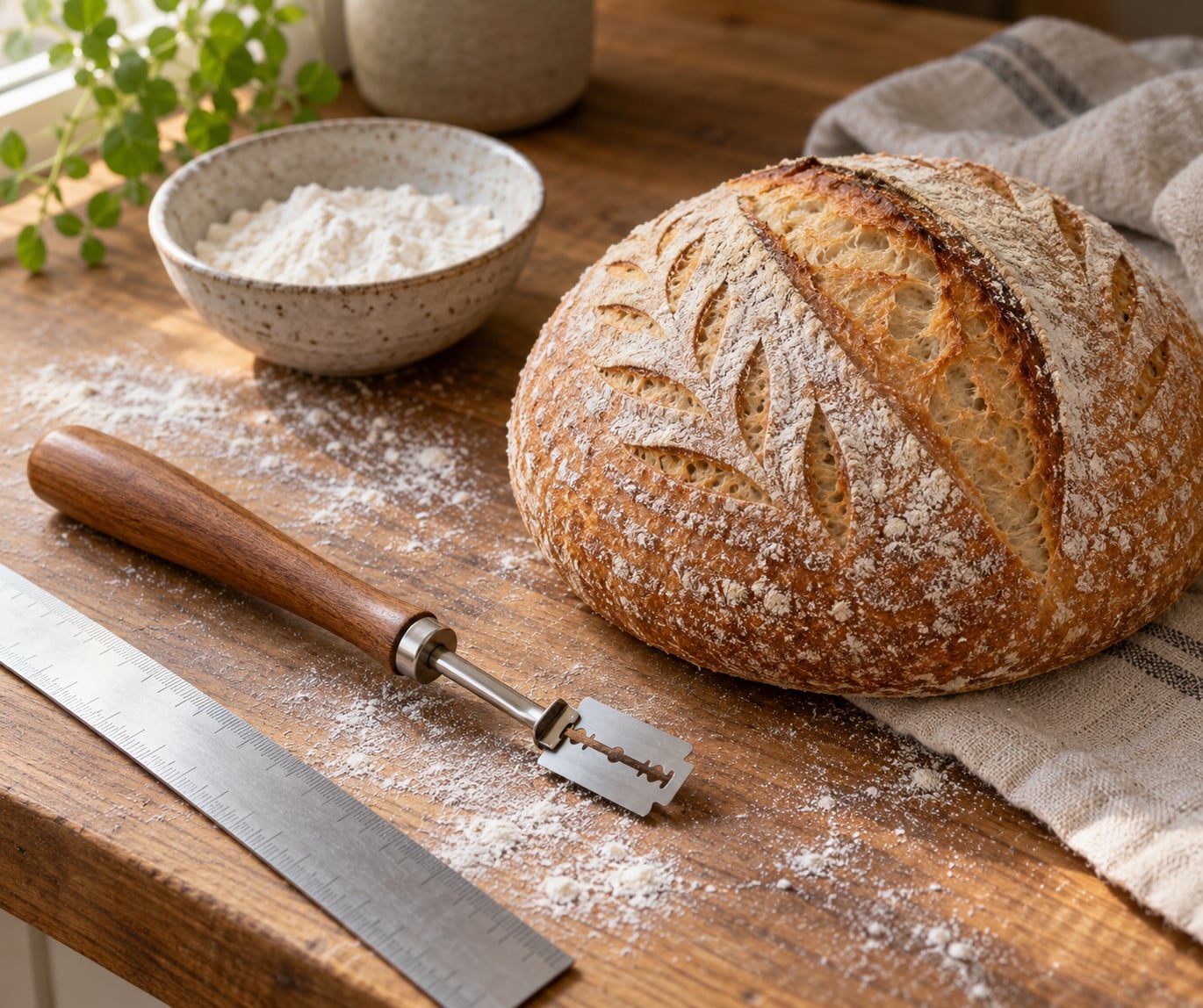
Score sourdough bread with a sharp blade in one decisive stroke, about 1/4 to 1/2 inch deep, on cold dough taken straight from the refrigerator, immediately before the loaf goes into the oven. Hold the lame at a shallow angle, begin where you want the ear to start, and finish in a single movement without sawing back and forth.
Scoring is the deliberate cut you make in the top surface of a shaped loaf so the dough has one chosen place to open. As a cold loaf hits a hot oven, yeast activity spikes and internal moisture turns to steam, so the expanding gas pushes hard against a crust that is already beginning to set. The score breaks the surface tension at that line, and the loaf opens there instead of tearing open wherever the surface happens to be weakest.
Leave the loaf unscored and it usually bursts at its side or bottom, giving you a ragged blowout and a denser crumb right where it tore. The cut also decides whether the finished loaf opens flat or lifts into a raised ear, and whether a slice through the middle reads as a circle or an oval. Scoring takes five seconds, and it is the part of the bake most often ruined by hesitation.
Table of Contents
- What You Need
- Step-by-Step: How to Score Sourdough Bread
- 1. Check That the Loaf Is Ready to Score
- 2. Choose a Pattern That Matches the Loaf Shape
- 3. Position the Blade and Score Confidently
- 4. Handle and Bake the Loaf Immediately
- Common Mistakes When Scoring Sourdough Bread
- Frequently Asked Questions
- When should I score sourdough bread?
- How deep should I score a sourdough loaf?
- Should I use a razor blade or a bread lame?
- Do I need to proof sourdough after scoring?
- Why did my sourdough loaf open unevenly after scoring?
- Conclusion
What You Need
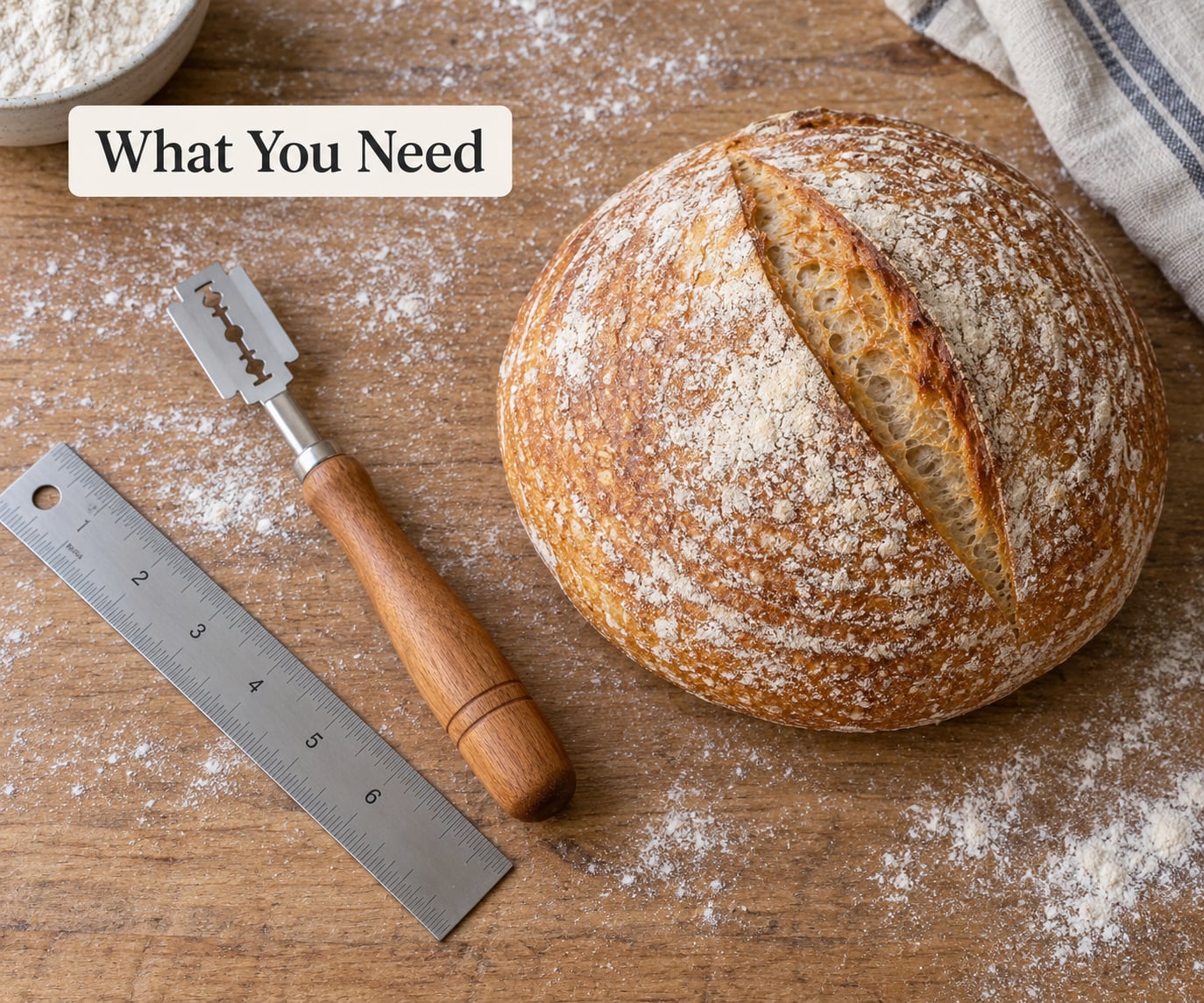
A lame is the only tool you truly need. The word is French for blade, and a lame is simply a handle that holds a double-edge razor blade at a fixed angle so you do not have to think about it mid-cut. Everything else on this list makes the stroke easier, not mandatory.
- A bread lame with a fresh double-edge razor blade. Double-edge blades are thin, so they slice with almost no downward force. Change the blade the first time it drags, and treat that as the replacement schedule; most bakers get ten or so clean loaves out of one.
- Spare blades. Keep two or three in a small tin. A blade that has gone dull mid-session is the fastest way to tear a loaf.
- Rice flour. A light dusting before you invert a loaf onto parchment dries the skin so the blade glides instead of gumming up.
- Parchment paper or a bench scraper. Cold dough sticks to almost everything. This is how you move the scored loaf into the Dutch oven or onto a stone without touching the cut.
- A ruler or a piece of string. Optional, but on your first few batards it keeps the line straight and parallel to the long axis, which is harder than it looks.
A box cutter, a paring knife or a chef’s knife will make the cut. They will not make it as clean, and a dull knife drags the surface instead of opening it.
Step-by-Step: How to Score Sourdough Bread
1. Check That the Loaf Is Ready to Score
Score a fully proofed loaf. The signs are a domed, pillowy top, a skin that looks tight and slightly shiny, and a dough that jiggles like a water balloon when you nudge the basket. It should spring back slowly rather than snapping into shape.
Do not score a loaf that is visibly deflating at the sides, sitting in a sad collapsed dome, or so soft that your finger leaves a permanent dent. That dough has already lost the gas it needs for oven spring, and cutting it will just open a flat, weak slit. If the shape has slumped, let it go back to the fridge, reshape it, and score it next time.
Take the loaf out of the refrigerator, turn it seam-side down onto parchment, and keep it out only as long as the cut takes. Cold dough is firm enough to take a clean slice; room-temperature dough is soft enough to drag the blade and tear the skin.
2. Choose a Pattern That Matches the Loaf Shape
Match the pattern to the shape, because the loaf expands at right angles to the cut. A single long slash down a batard gives you height across the middle and an oval cross-section. Cuts perpendicular to the long axis give you a wider, flatter loaf with a top that opens in several places.
| Loaf shape | Pattern | Angle | What you get |
|---|---|---|---|
| Boule | One straight slash across the top | About 45 degrees | A clean cross-section and even rise, no dramatic ear |
| Boule | Single vertical cut straight down | 90 degrees | A wide, flat bloom, the traditional round loaf look |
| Batard | One slash along the long axis | 20 to 30 degrees | The highest rise and the best chance at a lifted ear |
| Batard | One slash along the long axis | 45 degrees | A moderate ear and a reliably round profile |
| Oblong or baguette | Three or four diagonal cuts | 30 to 45 degrees | Raised ridges and a lighter, more open crumb |
| Wet or high-hydration dough | Chevron or curved slashes | About 45 degrees | Control over where a slack dough opens, fewer blowouts |
| Any shape | Cross, diamond or hashtag | 45 degrees | Decoration. Learn it after your first dozen loaves |
One thing to set straight early: a boule is not traditionally scored for an ear. Round hearth loaves go for an even rise and a controlled cross-section, while dramatic ears belong to batards and baguettes. Trying to force a tall ear from a boule is a common beginner detour.
3. Position the Blade and Score Confidently
Hold the lame the way you would hold a pencil, tilted so the blade meets the dough at 20 to 45 degrees rather than stabbing straight down. For a batard, start at the back end where the ear will hinge and draw the blade toward you in one smooth pass, finishing slightly past where you began. Pulling toward your body rather than away keeps the cut from lifting the dough as you go.
Aim for 1/4 to 1/2 inch deep. Cut by sound and feel, not by sight; the crust hides the blade, so you will not see your depth. A shallow 20 to 30 degree cut that travels the length of a batard is the classic ear-maker, because it lifts a flap of crust as the loaf expands.
You will see advice online telling you to cut 1 to 1.5 inches deep, and it is worth understanding why most home bakers should not follow it. A cut that deep in a home-sized loaf removes too much of the loaf’s structural wall and often collapses under its own weight as the loaf rises, which is the reason The Fresh Loaf’s tutorial, citing Hamelman’s Bread, warns about very deep cuts. A quarter inch is plenty on a boule; half an inch at most, and only for a high-hydration dough that needs a bigger opening.
Make one pass. Never saw back and forth, never stop halfway to look, and never go back over the same line to make it deeper. A tentative half-cut and a second attempt together produce a ragged, torn opening that deflates tension instead of releasing it. Move at the speed of a confident swipe.
A clean score looks like a sharp open line with a visible lip along one edge and smooth, unfrayed walls when the loaf bakes. A ragged one looks torn and fuzzy, with dough sticking to the blade on the way out.
What is the 7 minute rule? It means waiting until the loaf is in the oven, roughly seven minutes after baking starts, then scoring it through the oven door glass with a long-handled blade, on the theory that by then the crust has set enough to stay open. It is a real technique with a real following, and it is aimed at commercial ovens where you cannot reach the dough. For most home bakers it is not worth it: the dough is fragile, the door opening drops the temperature, and scoring cold before it goes in is more reliable.
4. Handle and Bake the Loaf Immediately
Do not proof the loaf after scoring. Once the cut is made the surface is exposed and the loaf has less structural integrity, and a second rise in the fridge or on the counter tends to blur the line rather than sharpen it. Score it, get it in the oven, and let the heat do the rest.
Move the loaf by the parchment, the basket or the peel underneath it. Your hands should never touch the score. When you turn a boule out of a banneton, put the cut face down onto the parchment, roll the loaf gently onto its cut side, and lift the paper straight into the Dutch oven or onto the stone.
Steam and a covered pot change the result without changing the cut. A covered Dutch oven traps moisture, keeps the crust flexible longer and gives the loaf more time to expand before the outside sets, which usually makes an ear easier to get. On a baking stone with no steam, the crust tightens faster, the bloom is more even, and the ear tends to be lower.
One practical note on timing: flour the surface and score before you brush on water, oil or seeds. A wet or seeded skin makes the blade stick badly, and the drag is what turns a clean line into a tear.
Common Mistakes When Scoring Sourdough Bread
Cutting too shallow. A slice that barely breaks the surface may close again before the loaf has expanded. Fix: go to at least 1/4 inch, and lengthen the cut rather than deepening it on a boule.
Cutting too deep. The opening can collapse inward as the loaf rises, leaving a sunken seam. Fix: stay at 1/2 inch or less on a home loaf, and score a wet dough slightly deeper than a stiff one because it needs more room to open.
Hesitating mid-cut. Stopping and looking is the single most common beginner error, and it is what produces a ragged tear instead of a clean line. Fix: decide the whole line before the blade touches the dough, then move without stopping.
Sawing back and forth. Repeated strokes tear the skin. Fix: one pass, slightly faster than feels comfortable.
Inconsistent angle. Straight down at 90 degrees gives a flat bloom; a very shallow cut on a boule often never opens. Fix: 45 degrees for round loaves, 20 to 30 degrees along a batard’s long axis.
Scoring too early or too late. Score too early and the cut relaxes and closes during the rest; score a loaf that has over-proofed and the surface is soft, warm and torn-prone. Fix: score cold from the fridge, straight into a hot oven.
A wet or sticky surface. Blade drag and torn crust. Fix: dust rice flour over the skin, and score before wetting or seeding.
A dull blade. The cut drags, the skin tears and you press harder, which deflates the loaf. Fix: replace the blade at the first hint of drag rather than pressing through.
And if the score looks fine but the loaf still comes out low and flat, the cut is usually not the culprit. Check these in order:
- Fermentation state. Dough that ran past its bulk or final proof has lost the gas for oven spring. Shorten bulk fermentation in 30-minute steps and the rise improves, at the cost of a slightly less even crumb.
- Hydration and slack dough. Very wet dough spreads during shaping and in the oven. Handle it with gentler pre-shaping and more tension, and give it a chevron or curved score rather than one long line.
- Shaping tension. Bakers on forum boards consistently rate surface tension on the skin as a bigger factor than any scoring variable. A loose, slack skin expands in whatever direction it wants.
- Cold proof length. A short retard means less-developed flavor and less firm dough, which makes a cleaner cut harder.
- The score itself. Only after the first four are right is it worth re-cutting deeper at a shallower angle.
On confidence, the fix is rehearsal. Take an old foam floral block or a scrap of dough and practice the stroke a dozen times before it counts, checking depth with a fingertip and angle against the block. Ten minutes of that does more for your scoring than any new tool.
Frequently Asked Questions
When should I score sourdough bread?
Score your sourdough bread immediately before it goes in the oven, while the dough is still cold and firm straight from the refrigerator. Cold dough cuts cleanly without dragging or tearing the skin. Never score a loaf that is warm and soft, and never score it during a second rise, because the cut relaxes and closes during the wait.
How deep should I score a sourdough loaf?
Cut about 1/4 inch deep on a round boule and up to 1/2 inch on a batard or a very wet, high-hydration dough. Advice to cut 1 to 1.5 inches applies to large commercial loaves and removes too much structure from a home loaf, which can collapse as it rises. Judge depth by feel, not by sight, since the crust hides the blade.
Should I use a razor blade or a bread lame?
Use a bread lame holding a fresh double-edge razor blade if you can. The thin, sharp blade slices with almost no downward force and the handle keeps a consistent angle. A box cutter or paring knife will work but tends to drag and tear the surface unless it is genuinely sharp. Replace the blade the first time you notice any drag.
Do I need to proof sourdough after scoring?
No. Proofing after scoring is not recommended, because the exposed cut loses structural integrity and the line tends to blur rather than sharpen during a second rest. Score the loaf cold, move it without touching the cut using parchment or a peel, and get it into the hot oven within a minute or two so the cut opens under oven spring.
Why did my sourdough loaf open unevenly after scoring?
An uneven opening usually comes from the dough, not the cut. Check fermentation state first, then hydration and shaping tension, because slack dough spreads in whatever direction it likes. A wet or seeded surface also makes the blade drag and tears the line. Score cold, use rice flour to dry the skin, and keep the cut parallel to the long axis of a batard.
Conclusion
Start with one clean, confident slash on a fully proofed loaf straight from the fridge, about a quarter inch deep at a 45 degree angle. Then adjust from there: a longer, shallower cut along the long axis for height and an ear, deeper only for very wet dough, and a cross or chevron once your shaping tension is solid.
Cut a slice while the loaf is still warm and butter it while it’s still soft enough to smear. That is the whole reward.