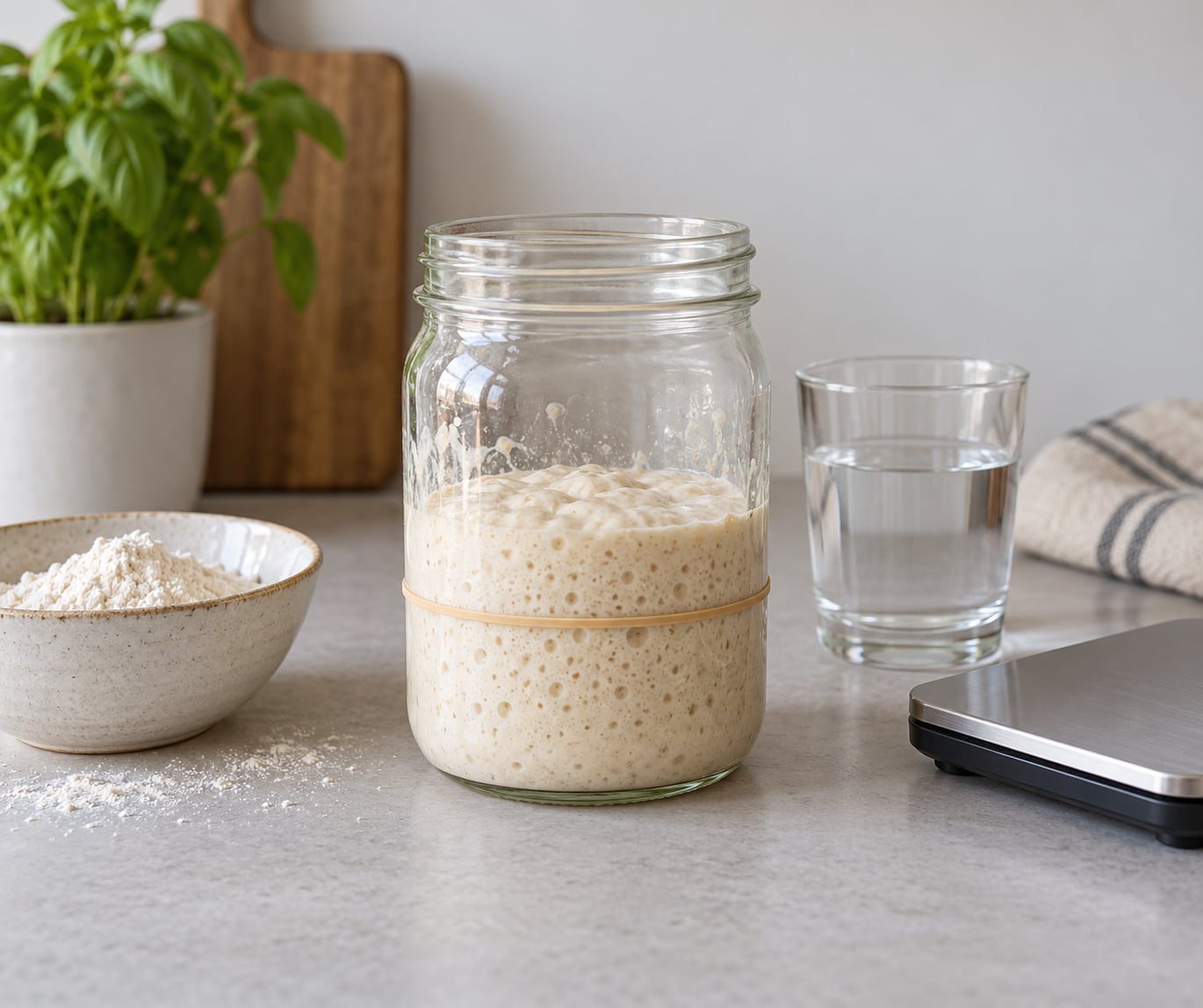
How to feed and maintain a sourdough starter comes down to one rule: take out a portion, throw it away, then add equal parts fresh flour and water by weight. Feed it on a schedule that matches how often you bake, judge it by how far it rises rather than by the clock, and it stays strong for years. The whole routine takes about five minutes of active time.
If you have ten minutes, here are the five things that matter:
- Weigh everything. A digital scale that reads grams is the one tool that changes your results. Cups do not work here.
- Discard first. Remove starter before adding the fresh flour and water, not after.
- Add equal parts. 50 g starter, 50 g flour, 50 g water is the standard daily feed.
- Cover loosely. A lid set on top, not screwed down. The culture needs gas exchange.
- Judge by doubling. Ready means roughly twice the starting height, bubbly and domed. A rise in 4 to 8 hours at 75 to 80°F means an established starter.
A sourdough starter is a living culture of wild yeasts and lactic acid bacteria held in a slurry of flour and water. Feed it and the organisms eat fresh starch, multiply and give off the carbon dioxide that lifts bread. Ignore it and everything runs out of food at once, so the culture goes dormant and then sour.
Table of Contents
- What You Need
- Step-by-Step: How to Feed and Maintain a Sourdough Starter
- How to Feed a Healthy Starter
- Check the Rise and Activity
- Choose a Feeding Schedule
- Store the Starter Between Feedings
- Use the Maintained Starter in Bread
- Common Mistakes and How to Fix Them
- Frequently Asked Questions
- How often should I feed a sourdough starter?
- Should I discard some starter before feeding it?
- Can I feed sourdough starter with whole wheat flour?
- How do I know when my sourdough starter has peaked?
- Can I refrigerate a sourdough starter between feedings?
- How do I revive a sourdough starter after several weeks?
- How often should I feed a sourdough starter?
- Should I discard some starter before feeding it?
- Can I feed sourdough starter with whole wheat flour?
- How do I know when my sourdough starter has peaked?
- Can I refrigerate a sourdough starter between feedings?
- How do I revive a sourdough starter after several weeks?
- Build a Reliable Starter Routine
What You Need
You need remarkably little. Most people already own three of the four items, and the specialty items are optional.
- A wide-mouth glass jar. Clear so you can watch the rise, no shoulder or narrow neck so you can clean it, and at least three times the volume of your feed. A straight-sided pint mason jar works well.
- A digital kitchen scale that reads to one gram. Volume measurements drift badly here: a quarter cup of flour and a quarter cup of water is closer to 200% hydration than 100%.
- A rubber band to mark the starting level of every feed.
- Unbleached all-purpose flour or a bread flour. Plain cheap flour is fine. Avoid self-rising flour because of the baking powder, and avoid any salted flour.
- Room-temperature water from the tap. Chlorine-sensitive starters do better with water that has sat out uncovered overnight, though most municipal water is fine.
- A kitchen thermometer. Optional but useful. Temperature drives peak time more than anything else you control.
For flour, whole wheat and rye speed things up rather than slowing them down, which surprises people. A blend of 20 to 30 percent whole wheat or rye gives the bacteria extra nutrients and produces a more sour, more complex starter. A 100 percent white flour starter works, it just ferments a little more slowly and tastes milder. Some bakers keep two starters, one white and one rye-heavy, and feed them on different days.
Step-by-Step: How to Feed and Maintain a Sourdough Starter
How to Feed a Healthy Starter
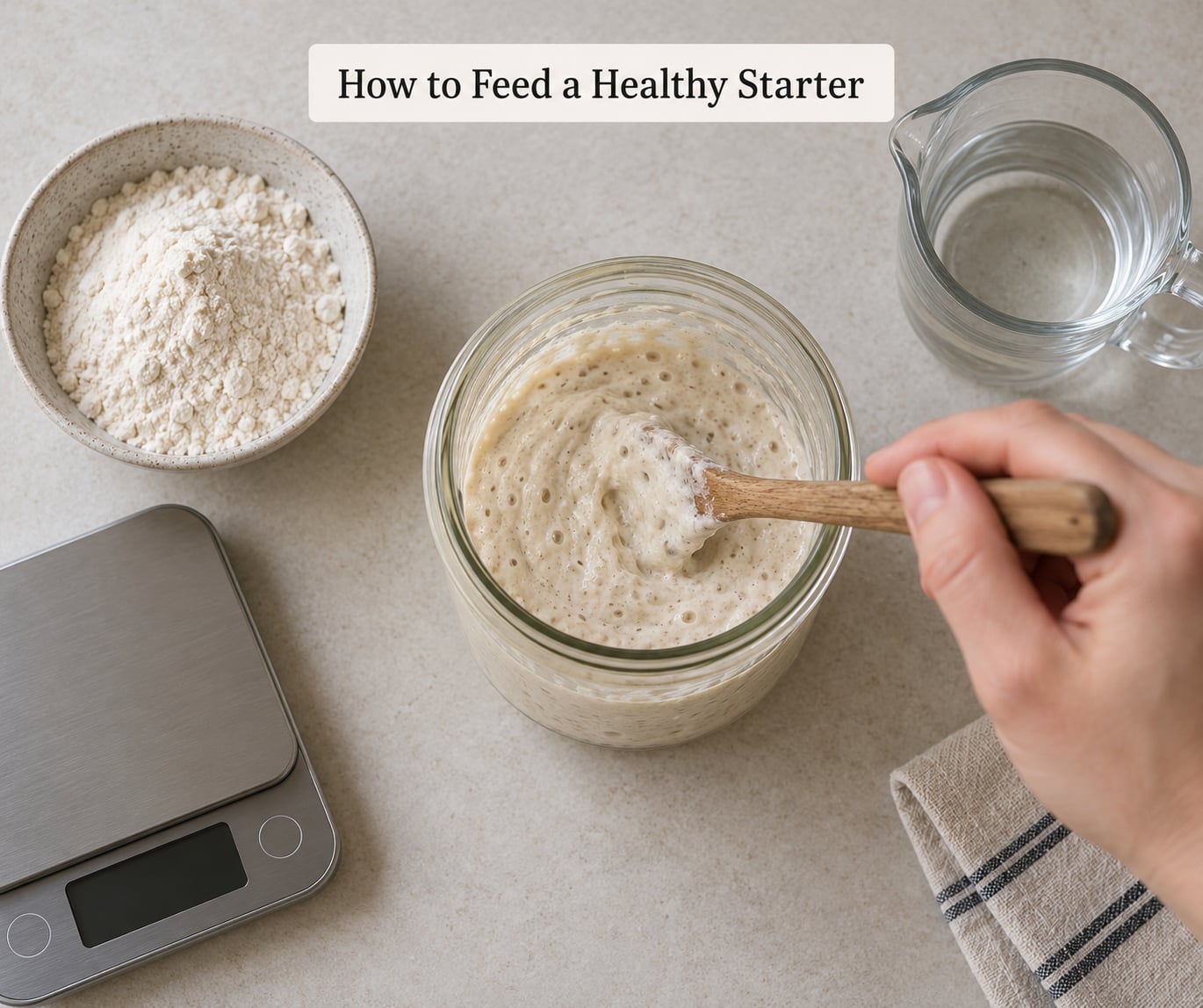
Put the empty jar on the scale and tare it. Add your starter. For a countertop routine, 50 g of active starter is plenty, and for a fridge starter many bakers drop to 20 g to keep flour waste low.
Now discard. Spoon out all but 50 g back into the jar you feed from, or dump it in the compost. You do this because the culture has a fixed appetite: it can only eat so much flour at once. Without discarding, each feed would need more flour than the last, and the container would overflow within a few rounds. Long-established bakers call this the flour treadmill, and it is the single biggest reason people quit.
Zero in on the scale to 50 g. Add 50 g flour and 50 g water for a 1:1:1 feed. Stir with a chopstick, spoon or silicone spatula until there are no dry pockets left, then scrape the sides of the jar clean. Scrape-down time is what separates a smooth starter from a lumpy one that never mixes properly.
The finished mixture should look like thick pancake batter. It should be smooth, pourable, and drip off the spoon in a slow ribbon. If you see dry flour caked on the bottom or floating on top, keep mixing. Somewhere between 100 and 150 mixes with a rubber spatula is the advice people repeat on forums, and it sounds silly until the first time you skip it.
Set the lid on loosely. A mason jar ring with the rubber gasket removed is the standard setup, because a sealed jar builds pressure and can pop its lid. Put a cloth over the top or secure the ring one turn past finger-tight.
Check the Rise and Activity
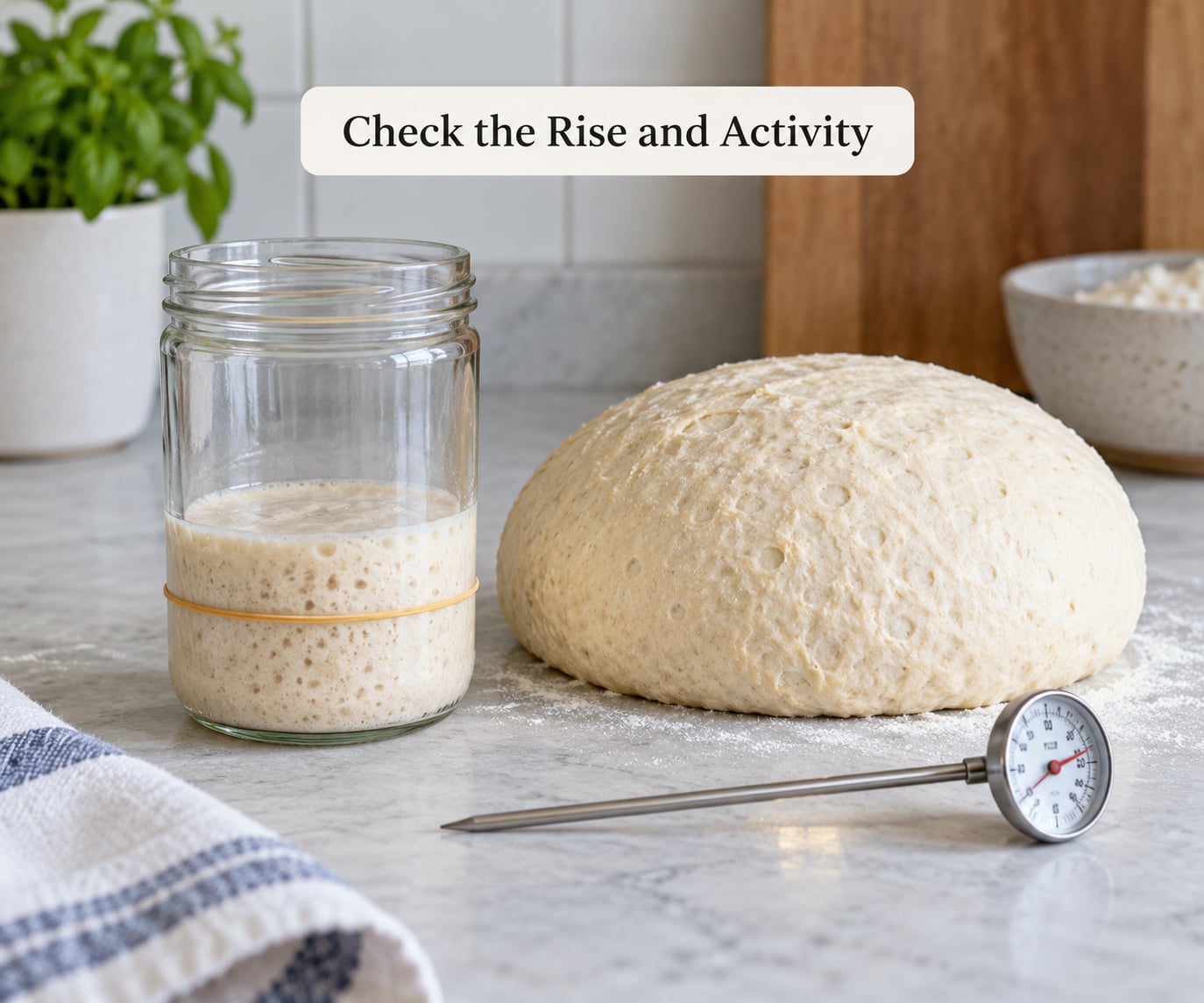
Slide the rubber band down the jar to the level of the mixture right after you mix it. Then stop guessing and watch the jar.
An established starter roughly doubles in 4 to 8 hours at 75 to 80°F. You will see the mixture climb the sides, a domed top, and bubbles or streaks along the glass. When it peaks it holds for a while and then falls back, the top turning concave. That collapse is called hooching, and it means the culture has eaten everything available. For a levain build in a bread recipe, you want the peak, not the fall.
Write down the elapsed time each time you feed. After three or four feedings you will know your starter’s peak time at your kitchen temperature, and you can stop relying on a recipe’s estimate. Bakers who keep a log rarely have a disappointing loaf. Warm kitchens speed everything up: a starter that peaks in five hours in August may need ten in January, so cold water and a cooler spot on the counter are the usual winter adjustments.
Choose a Feeding Schedule
Match the interval to how often you bake. There is no single correct answer, and there is no shame in baking once a month.
| How often you bake | Where it lives | Feeding ratio | Feed every |
|---|---|---|---|
| Two or more times a week | Counter, room temperature | 1:1:1 or 1:2:2 | Every 12 to 24 hours |
| Once a week | Refrigerator | 1:2:2 | Every 5 to 7 days |
| Once or twice a month | Refrigerator, small portion | 1:5:5 or 1:10:10 | Every 2 to 4 weeks |
| Rarely or only holidays | Freezer or fully dried portion | 1:10:10 | Freeze; revive 48 hours ahead |
The bigger the ratio, the more flour and water you add relative to the starter, and the longer the culture takes to consume all of it. A 1:10:10 feed keeps a starter perfectly alive for weeks in the fridge because there is simply more food sitting there. The cost is a large jar of discard to deal with when you do finally bake.
| Ratio | Example weights | Time to double at 78°F | Best for |
|---|---|---|---|
| 1:1:1 | 50 g starter, 50 g flour, 50 g water | 4 to 6 hours | Daily counter care, keeping a strong starter |
| 1:2:2 | 50 g starter, 100 g flour, 100 g water | 6 to 8 hours | Bakers who bake every two or three days |
| 1:5:5 | 20 g starter, 100 g flour, 100 g water | 12 to 18 hours | Fridge maintenance with less discard |
| 1:10:10 | 10 g starter, 100 g flour, 100 g water | 18 to 24 hours | Long cold storage, occasional bakers |
You’ll also see ratios written with slashes, like 1/1/1 or 1/3/3. Those are fractions of a cup by volume, not by weight, and they are the source of a lot of confusion. The 1/3/3 rule means one-third cup of starter, one-third cup of water and one-third cup of flour, which lands somewhere near 150 to 160 g each in a typical kitchen. It works, but convert it to grams once and you get a repeatable feed instead of an approximation.
Store the Starter Between Feedings
The refrigerator slows the culture to a near stop. It does not kill it. A fridge starter at 1:2:2 fed weekly is the setup most experienced bakers recommend, precisely because it cuts both flour waste and jar washing.
Feed the starter, let it come up to room temperature and finish its rise, then refrigerate it. Putting a jar in the fridge while it is still flat and slack feeds the bacteria without giving the yeasts a real workout, and the starter comes out sluggish and sour. Waiting for the rise to finish before refrigerating gives you a culture that wakes up fast. One to two hours on the counter after a morning feed is usually enough.
For longer absences, go bigger on the ratio before you refrigerate. A 1:5:5 or 1:10:10 feed in the fridge holds for two to four weeks. Beyond a month, freeze a portion: 30 g of active starter, 30 g flour and 30 g water mixed in a bag or tub, frozen solid. To revive, move it to the fridge the night before, then feed it twice at 12-hour intervals on the counter, using 1:1:1 the first time and 1:2:2 the second. A fully dried starter on the counter rehydrates the same way, just add 30 g water and wait an hour before feeding.
Before you travel, freeze a backup portion rather than trying to hand off a jar. Experienced bakers keep three: an active counter portion, a fridge portion that never gets fed for a few weeks, and a dried or frozen one. If the worst happens you have two chances to rebuild from.
Use the Maintained Starter in Bread
A maintained starter is useless in a jar. The point of the whole routine is the portion of active starter you hold back to build a levain with.
Work out how much starter your dough needs. If a recipe calls for 200 g of starter at 100% hydration, feed 100 g starter with 100 g flour and 100 g water. After four hours you have roughly 200 g of risen starter at 100% hydration, so you use all of it, or 150 g of it and scale your remaining flour and water down to match. If the starter is at 75% hydration instead, that same 200 g contains only 50 g of flour and 150 g of water, so subtract those from your formula before adding anything else.
Many recipes also ask for a levain, which is simply starter fed ahead of time and then used at its peak. Feed your starter at 12 hours before you plan to mix, with a ratio big enough to leave you a usable amount after the rise. A 1:5:5 or 1:10:10 build at 24 hours ahead gives a light, barely sour levain with plenty of leavening power left for the dough itself.
Feed a slightly larger amount than you need. Underfeeding your levain or using a starter that has already peaked and fallen is the most common reason a dough spreads flat in the oven.
Common Mistakes and How to Fix Them
Almost every problem people post about sourdough comes down to one of six things. Find your symptom in the table, apply the fix, and skip the rest.
| Symptom | Likely cause | Fix |
|---|---|---|
| No rise at all after 12 hours | Cold kitchen, or the starter was too small relative to the feed | Move to a warmer spot, switch to 1:1:1, and try again |
| Rises then falls flat again | Hooched, the culture ate everything and started acidifying | Use it earlier, feed a larger ratio, or build a new levain |
| Thin and runny after feeding | Water carried over in the starter, or a 100% hydration feed went slack | Feed with slightly less water next time; a stiffer starter is easier to handle |
| Smells like acetone or nail polish remover | Starvation acid, or a very small feed of very active starter | Feed 1:5:5 or 1:10:10 immediately and let it warm up |
| Pink, orange or black streaks | Bacterial contamination, commonly from fruit or a dirty utensil | Discard the whole jar contents. Do not attempt to rescue it |
| Dark liquid pooling on top | Hooch, a harmless byproduct of a long, warm, overfed starter | Pour it off and feed with a larger ratio |
Hungry versus dead is the question that comes up most often, and there is a clear way to tell them apart. A hungry starter is slow but not finished. It smells sour or boozy, sits flat for the first few hours, then creeps upward slowly, and it responds to a bigger feed within a day. A dead starter does nothing at all. No gas, no new bubbles, no sour or fruity smell beyond plain rot, and a 1:1:1 feed at 78°F still sits flat after 24 hours. Dead means the culture never fully established, usually from a jar that sat unrefrigerated and unfed for weeks.
A starter can still be revived when it is merely dormant. Two consecutive 1:1:1 feeds at 12-hour intervals, with the jar somewhere warm, usually brings a fridge starter back. If two or three rounds of that produce nothing, start over with fresh flour and water. It takes about seven days of daily feeding to build a usable starter, and you cannot shortcut that.
On mold, triage by color. Pink, orange and black mean discard everything, because those come from bacteria you do not want in your bread and no amount of feeding removes them. White or grey fuzzy growth with a clean smell underneath is sometimes flour that never got mixed in. Scoop out an inch from the surface, feed what is underneath, and watch it closely for a few days.
Discard is a nuisance, not garbage. Bake it into pancakes, crackers, biscuits or quick breads, stir it into scrambled eggs, or keep it in the fridge for up to a week for later baking. If you bake rarely, the scrapings method removes discard entirely: wet a wooden spoon or spatula with water, scrape the sticky starter off the jar walls into a small container, then feed that residue with roughly 30 g flour and 30 g water. The amount of starter stays small and constant.
Frequently Asked Questions
How often should I feed a sourdough starter?
Feed it daily if it lives on the counter, every two or three days if you bake that often, and once a week from the refrigerator. The interval follows your baking frequency, not a fixed rule. If a starter on the counter misses a day it gets hungry rather than dead, and a fridge starter at a generous ratio holds for two to four weeks without attention.
Should I discard some starter before feeding it?
Yes, unless you use the scrapings method. Remove the starter first, then add flour and water, so you are feeding a known weight instead of a growing one. The discard exists because the culture can only eat so much at once. Keeping it means using more flour every feed, and the container overflows within a few rounds.
Can I feed sourdough starter with whole wheat flour?
Yes, and many bakers prefer a blend of 20 to 30 percent whole wheat or rye with unbleached all-purpose. Whole grain flour ferments faster because the bacteria use the extra nutrients, so a starter fed this way usually peaks sooner and tastes more sour. A 100 percent whole wheat starter also works, though it gets runnier and rises fast.
How do I know when my sourdough starter has peaked?
It has roughly doubled from the rubber band mark, the top is domed rather than flat, and bubbles show along the sides of the jar. Peak means maximum height just before the fall. If it rises and then deflates and slumps, that collapse is hooch, and the starter has already gone past the point you wanted for a levain.
Can I refrigerate a sourdough starter between feedings?
Yes, and most experienced bakers do it. Feed the starter, let it finish its rise at room temperature, then refrigerate. A fridge starter fed weekly at 1:2:2 keeps for months. Skipping the room-temperature rise before chilling gives you a sluggish starter that takes extra feeds to wake up.
How do I revive a sourdough starter after several weeks?
Move it to the fridge the night before, then feed it twice on the counter at 12-hour intervals. Use 1:1:1 for the first feed and 1:2:2 for the second, keeping the jar somewhere warm. Most dormant starters are back to doubling within 24 to 48 hours. If three rounds produce nothing at all, start a fresh starter.
How often should I feed a sourdough starter?
Feed it daily if it lives on the counter, every two or three days if you bake that often, and once a week from the refrigerator. The interval follows your baking frequency, not a fixed rule. If a counter starter misses a day it gets hungry rather than dead, and a fridge starter at a generous ratio holds for two to four weeks without attention.
Should I discard some starter before feeding it?
Yes, unless you use the scrapings method. Remove the starter first, then add flour and water, so you are feeding a known weight instead of a growing one. The discard exists because the culture can only eat so much at once. Keeping it means using more flour every feed, and the container overflows within a few rounds.
Can I feed sourdough starter with whole wheat flour?
Yes, and many bakers prefer a blend of 20 to 30 percent whole wheat or rye with unbleached all-purpose. Whole grain flour ferments faster because the bacteria use the extra nutrients, so a starter fed this way usually peaks sooner and tastes more sour. A 100 percent whole wheat starter also works, though it gets runnier and rises fast.
How do I know when my sourdough starter has peaked?
It has roughly doubled from the rubber band mark, the top is domed rather than flat, and bubbles show along the sides of the jar. Peak means maximum height just before the fall. If it rises and then deflates and slumps, that collapse is hooch, and the starter has already gone past the point you wanted for a levain.
Can I refrigerate a sourdough starter between feedings?
Yes, and most experienced bakers do it. Feed the starter, let it finish its rise at room temperature, then refrigerate. A fridge starter fed weekly at 1:2:2 keeps for months. Skipping the room-temperature rise before chilling gives you a sluggish starter that takes extra feeds to wake up.
How do I revive a sourdough starter after several weeks?
Move it to the fridge the night before, then feed it twice on the counter at 12-hour intervals. Use 1:1:1 for the first feed and 1:2:2 for the second, keeping the jar somewhere warm. Most dormant starters are back to doubling within 24 to 48 hours. If three rounds produce nothing at all, start a fresh starter.
Build a Reliable Starter Routine
A sourdough starter is easy to keep as long as the schedule matches your kitchen and your baking. Here is the whole thing on one page:
- Every feed: tare the jar, weigh 50 g of starter, discard the rest, add 50 g flour and 50 g water, mix until smooth, mark the level, cover loosely.
- Counter bakers: feed every 12 to 24 hours at 1:1:1 or 1:2:2. Weekly bakers: feed 1:2:2 and refrigerate after the rise has finished.
- Occasional bakers: feed 1:10:10 before refrigerating, then feed every two to four weeks.
- Before a trip: freeze a 30 g backup portion and stop worrying about the jar.
- Before baking: bring the starter out, feed it twice at 12-hour intervals, and build the levain with more flour than you think you need.
- Never bake from a jar that shows pink, orange or black.
Start tomorrow by writing down one rise test: the feed weight, the room temperature, and the hours until the rubber band mark doubled. Do that four times and you will have a schedule you can trust in any season, which is the difference between maintaining a sourdough starter by feel and actually knowing what it is doing.