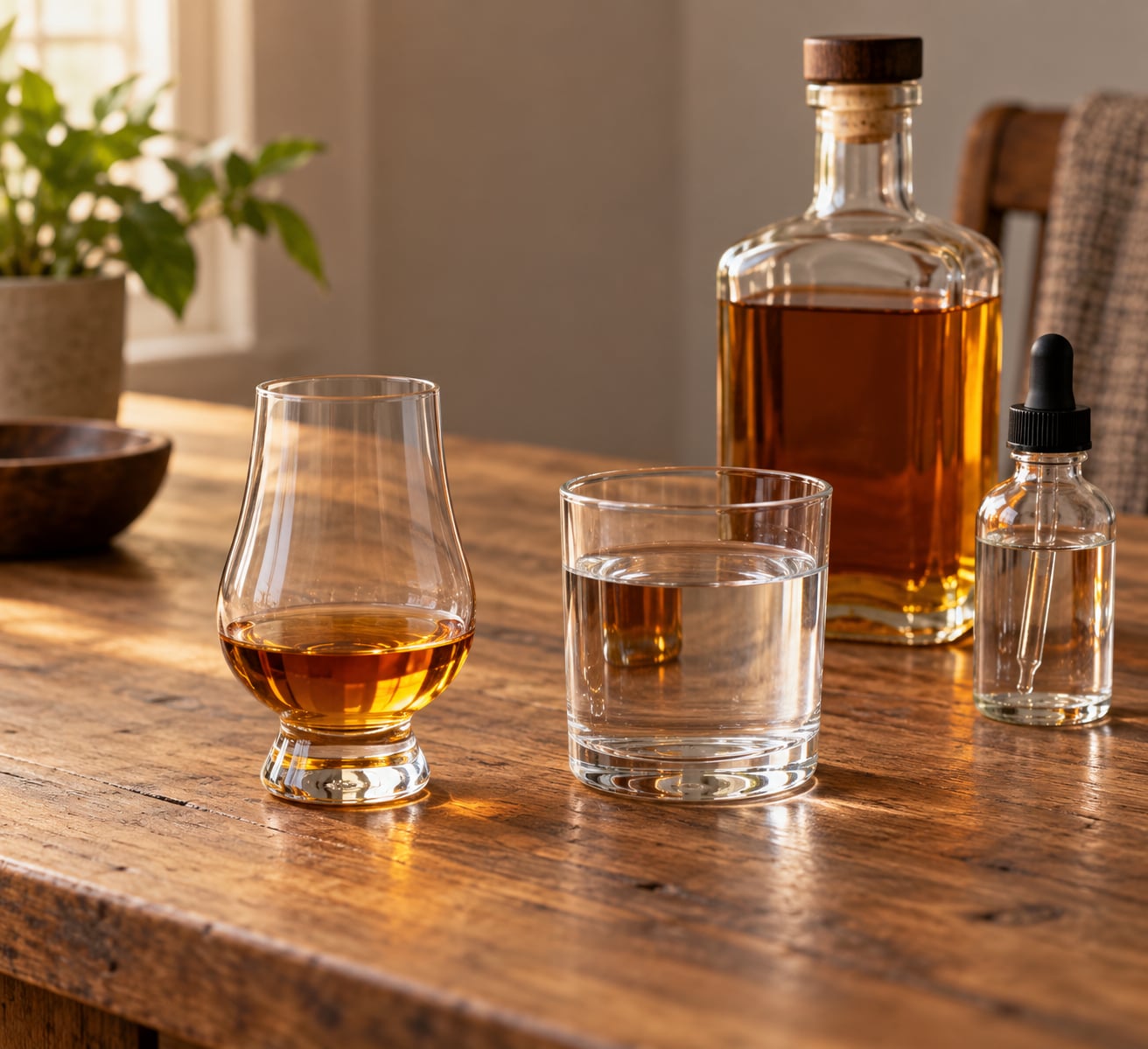
Whiskey is not a shot drink, and the fastest way to enjoy it is to stop treating it like one. Pour an ounce or two, smell it before you sip, take one small slow taste, then add a few drops of water or a large ice cube until it tastes the way you like it. That is how to drink whiskey for beginners, and the whole routine takes about five minutes.
Updated for October 2026.
Nobody is born knowing this. Most people meet whiskey for the first time through a mixer, a bad sip someone ordered neat, or a glass someone pushed across a bar. A lot of beginners decide they hate the stuff on the spot, and then spend years ordering the same drink without ever finding out what the spirit actually tastes like underneath.
The trick is that whiskey sits at 40 to 50 percent alcohol with no sugar in it to soften the edges. Drink it fast and all you register is heat. Drink it slowly and you get vanilla, caramel, oak, fruit, and smoke. Same bottle, completely different experience, and the difference comes down to technique rather than which bottle you picked.
Table of Contents
- What You Need
- Step-by-Step: How to Drink Whiskey for Beginners
- 1. Start with a Beginner-Friendly Whiskey
- 2. Choose the Right Glass
- 3. Pour a Small Measure
- 4. Look at the Whiskey
- 5. Smell Before You Taste
- 6. Take a Small First Sip: How to Drink Whiskey Without Burning
- 7. Add Water or Ice
- 8. Finish and Compare
- Common Mistakes
- Frequently Asked Questions
- Should beginners drink whiskey neat or with ice?
- Why should I smell whiskey before drinking it?
- What is the best whiskey for someone starting out?
- Does adding water or mixers make whiskey less enjoyable?
- Is an expensive whiskey automatically better for beginners?
- How much whiskey should I pour for tasting?
- Conclusion
What You Need
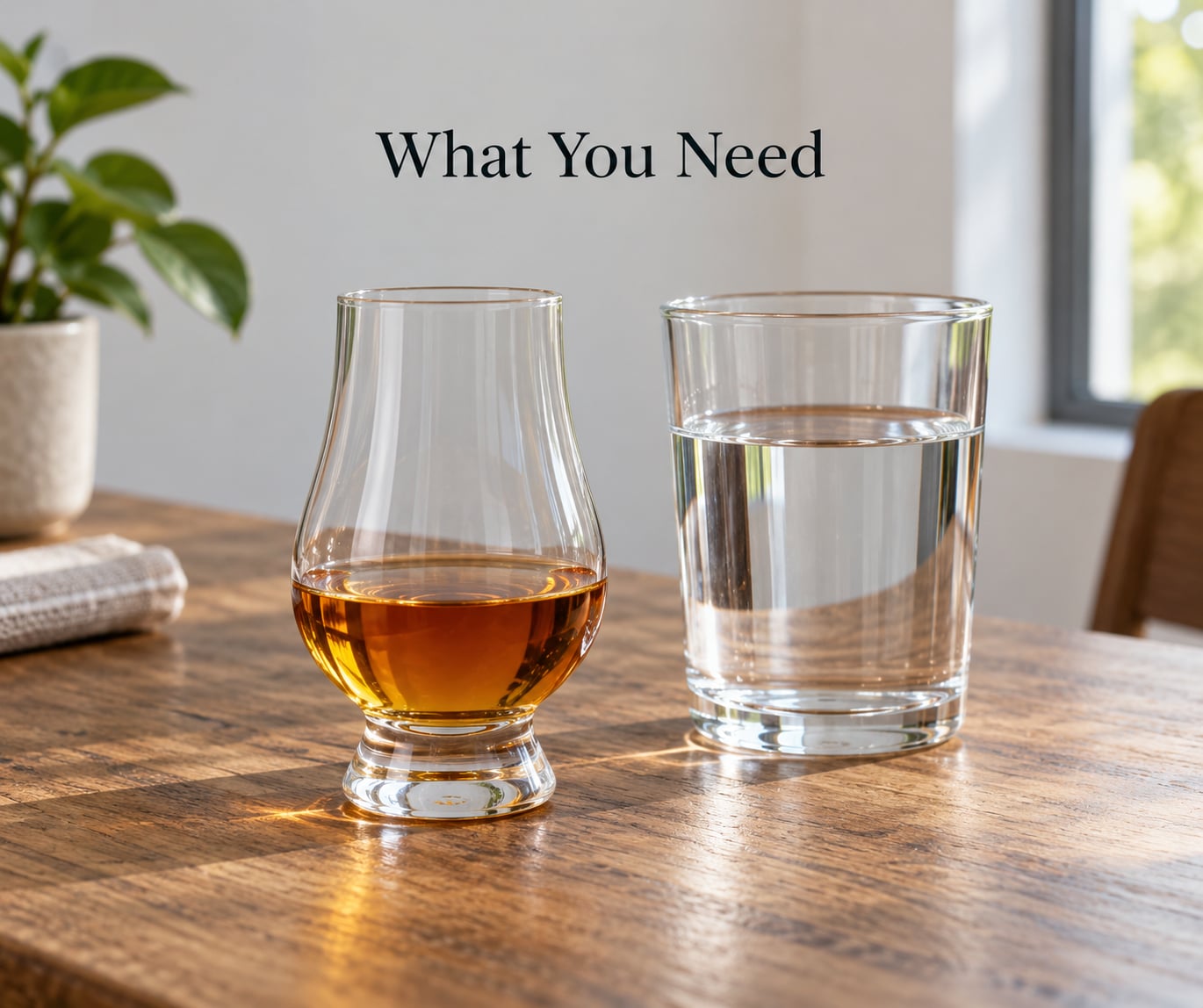
The equipment list is genuinely short, which is good news because it means nothing here needs buying before you start.
- Whiskey. Any bottle, as long as you avoid very high-proof spirits and heavily smoky ones on your first night. A bourbon, a Tennessee whiskey, an Irish whiskey, or a blended Scotch will all work.
- A glass. A small tasting glass or a tulip-shaped nosing glass is ideal. A plain tumbler or rocks glass is perfectly fine for casual drinking.
- Still water. Room-temperature tap water in a separate glass. This is the tool that fixes almost every beginner complaint.
- Ice. Optional. One large cube melts slower and dilutes less than a glass full of small cubes.
- Something to eat. Not equipment exactly, but eating something before you start keeps the alcohol from hitting your stomach at full strength.
A nosing glass is the only upgrade worth making, and even that is optional. It has a wide bowl that narrows at the top, which traps aroma instead of letting it escape.
A dropper or a small water pitcher helps too, since you want two or three drops of water, not a splash. Most people pour too much water and then wonder why they cannot taste anything.
Step-by-Step: How to Drink Whiskey for Beginners
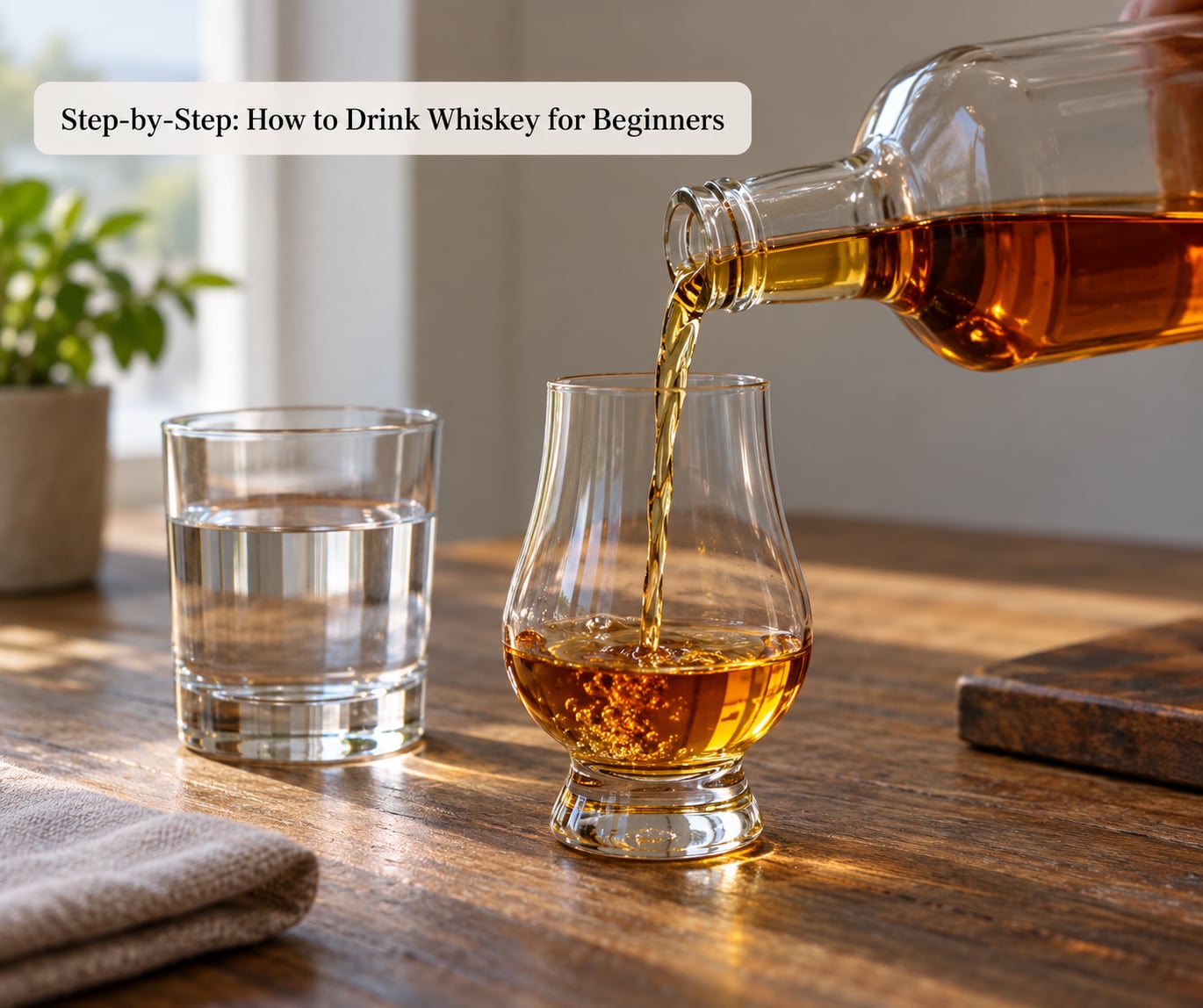
These eight steps are the whole method. You can do them in any order of seriousness, but doing them in order means the first glass teaches you something instead of just burning you.
1. Start with a Beginner-Friendly Whiskey
Style matters more than any other choice on your first night. Bourbon and Tennessee whiskey are forgiving, with vanilla, caramel and soft oak in most bottles. Irish whiskey is lighter and fruitier, often with a gentle finish. A blended Scotch is smooth and consistent, which makes it a safe introduction to whisky flavors without the smoke shock of an Islay single malt.
Read the label for two things: the style and the proof. Anything at or above 100 proof will feel aggressive, and heavily peated Scotch is a genuinely bad first purchase for most people. Age statements matter less than beginners think, so do not chase a fifteen-year bottle to prove you are serious.
2. Choose the Right Glass
A tulip or Glencairn-style tasting glass is best because the shape concentrates the aroma. A rocks glass with a wide mouth works too, though more of the scent escapes. If you only own a tumbler, use it.
One rule matters more than the glass itself: hold it by the base or the stem, never wrap both hands around the bowl. Your palms warm the whiskey, and warm liquid gives up its aroma far more slowly than cool liquid.
3. Pour a Small Measure
Pour one to two fingers, roughly 1 to 2 ounces or 30 to 60 milliliters. That is a fifth to a third of a standard drink, and it is enough to nose properly and take several real sips instead of one big one.
Oversized pours are the most common beginner error. You cannot taste anything in a large glass, and you will drink far more than you intended before you notice the strength. Leave a third of the glass empty so you have room to swirl.
4. Look at the Whiskey
Tilt the glass against a light-colored background and look through it. You are checking clarity and color depth. A deeper amber usually suggests more time on the wood or a warmer climate, while a pale straw color points to a lighter or younger spirit.
Watch the legs as the liquid runs back down the side of the glass. A thicker, slower-moving film hints at a richer, more viscous whiskey. None of this tells you quality. Plenty of mediocre whiskey looks gorgeous, and color is mostly an honest clue about style and age rather than a quality score.
5. Smell Before You Taste
Start with a gentle sniff at the rim, then swirl the glass gently and sniff again. Swirling releases more aroma from the surface. Do not plunge your nose into the glass, since that gives you mostly alcohol.
Look for broad families rather than exact words. Fruit means apple, pear, cherry or citrus. Grain and cereal suggest bread dough or malt. Vanilla, caramel and butterscotch point to oak and American barrels. Spice covers clove, cinnamon and pepper. Floral, nutty and herbal are their own categories, and smoke sits on top of everything else.
Two people nosing the same whiskey will describe it differently, and both can be right. Aroma vocabulary is a shared language, not a personality test, so borrow whatever words feel close and move on.
6. Take a Small First Sip: How to Drink Whiskey Without Burning
The first taste should be about the size of a sip of hot coffee. Put it on the front of your tongue, move it around a little to coat the mouth, then swallow. Do not chew it, and do not try to identify six flavors at once.
Ask three simple questions. Is there sweetness, and where does it sit on the tongue? Is there heat, and is it warming or sharp? How long does the taste stay after you swallow, which is what tasters mean by the finish?
This is where beginners usually quit. The first sip of a 90-proof bourbon will sting, and that sting is alcohol doing its job, not a flavor defect. If it is unpleasant, add water or ice and try again. Nothing about sipping slowly makes you a snob.
7. Add Water or Ice
Add two to four drops of room-temperature water first. Water lowers the alcohol concentration and releases aromas that were locked behind the alcohol, so a whiskey that seemed flat and hot can turn sweet and layered with almost nothing added.
Ice does something different. It cools the liquid and dilutes it slowly, which softens the burn over the course of a drink. One large cube is better than a small glassful because a drink with less melt keeps its flavor for longer. Whiskey stones do the same job with no dilution if you dislike thin drinks.
A splash of soda water, ginger ale or cola also works well, and there is nothing embarrassing about it. That is a genuinely common path into whiskey, and mixing it is fine.
8. Finish and Compare
Note three things and move on: body, or how thick the drink feels, the balance between sweetness and spice, and how long the finish lingers. Then, if you want more, taste a second style next to it. Leave a little in the first glass so you can compare the two at the end.
Comparison beats hunting for a perfect bottle. Drink bourbon next to Irish whiskey, or neat next to with a splash of water, and you will learn more in ten minutes than from a month of reading tasting notes.
Common Mistakes
Nearly every problem beginners hit has a simple fix, and most of them are habits rather than taste preferences.
- Pouring too much. A 3-ounce pour feels reasonable in the bottle and overwhelming in the glass. Fix: one to two fingers, every time, at least for the first few drinks.
- Rushing the aroma. Downing a sip before smelling anything wastes the most informative thirty seconds in the whole process. Fix: one gentle sniff, one swirl, one deeper sniff.
- Treating neat as a test of endurance. Finishing a glass without adding anything does not prove you like whiskey. It only proves you can handle alcohol. Fix: add water or ice whenever the heat bothers you.
- Using too much ice. A tumbler full of small cubes melts into a watered-down drink before you finish it. Fix: one large cube, or a couple of whiskey stones.
- Chugging to keep up. Whiskey hits harder than most drinks because there is no mixer diluting it. Fix: sip at conversation speed, eat something, and stop for water between glasses.
- Expecting the notes reviewers describe. Caramel and vanilla are a description, not a checklist you must find. Fix: judge what you actually taste and compare against your own last glass.
- Assuming higher proof means better whiskey. Strength is a packaging choice, not a quality ranking. Fix: choose a 40 to 45 percent bottle for learning and move up later if you want to.
- Drinking on an empty stomach. Alcohol burns hardest with no food in you. Fix: eat before the first pour, and keep something salty nearby.
One habit worth adding: sip slowly, eat, and do not drive. Nothing about learning a spirit requires drinking more than you feel.
Frequently Asked Questions
Should beginners drink whiskey neat or with ice?
Either one is fine. Neat gives you the full flavor and the full alcohol hit, while a large ice cube softens the burn and slows dilution, which makes it the gentler place to start. Try neat first for one sip, then add ice if it feels too hot. Many beginners permanently drink it on the rocks and never look back.
Why should I smell whiskey before drinking it?
Smelling primes your palate and lets you notice aromas before alcohol numbs them. Your nose also detects far more detail than your tongue, so a whiskey can smell of vanilla and oak while tasting mostly of heat to an untrained sip. Swirl, sniff twice, then taste. The flavors you find in the glass are much easier to recognize when you have already smelled them.
What is the best whiskey for someone starting out?
A bourbon, Tennessee whiskey, Irish whiskey or blended Scotch at 40 to 45 percent alcohol is the safest starting point. Avoid cask-strength bottles over 100 proof and heavily peated Scotch, since both are common first-purchase traps. Pick something mildly flavored, drink it neat with water beside it, and move to stronger styles once you know you enjoy plain whiskey.
Does adding water or mixers make whiskey less enjoyable?
No. A few drops of room-temperature water lower the alcohol concentration and release aromas that were hidden, which is why distilleries and tasters add it. Ice, soda water, ginger ale and cola are all legitimate ways to drink whiskey, and many enthusiasts started with whiskey and cola. The only thing water cannot do is change which whiskey is in the glass.
Is an expensive whiskey automatically better for beginners?
No. Price tracks rarity, branding and age statements more than drinkability, and a young bourbon with good craft can be far more approachable than an expensive smoky single malt. Spending more does not make the first sip easier. Buy an affordable bottle in a style you already like, learn the vocabulary on it, and treat expensive bottles as something to explore later rather than a reward you have earned.
How much whiskey should I pour for tasting?
Pour one to two fingers, about 1 to 2 ounces or 30 to 60 milliliters. That gives you enough to swirl, nose and take several small sips, and it keeps your alcohol intake predictable. If you are comparing two whiskeys, pour the same amount of each and keep a little in the glass so you can revisit it.
Conclusion
Pour one to two fingers, smell it before you taste it, take one small slow sip, and adjust with water or ice until it is comfortable. That is the entire beginner method, and it takes less time than reading this paragraph did.
Everything after that is preference. If you only ever drink it with cola, that is a perfectly good way to drink whiskey. If you want to know how to drink whiskey for beginners without hiding it behind a mixer, give the eight steps above one honest try, and give the bottle a second pour before you judge the whole category.