Crystallization is not a heat problem. It happens when dissolved sugar finds something to attach to, so the fix is a spotless pan, sugar you never stir once it boils, and one interfering agent to keep crystals from forming in the first place. Here is how to make caramel without it crystallizing, in the order that matters.
A grainy batch usually takes about 15 minutes to cook and about 2 minutes to ruin, and the ruin happens in a window you can see coming. Most of the trouble traces back to four things: a dirty pan, a spoon in the sugar, splashed sugar drying on the pan walls, or cold cream hitting very hot sugar. Fix those and smooth caramel is close to automatic.
Table of Contents
- The Five Rules That Prevent Crystallization
- What You Need
- How to handle hot caramel safely
- Why Caramel Crystallizes (the Short Science)
- Step-by-Step: How to Keep Caramel From Crystallizing
- 1. Prepare the Pan and Work Area
- 2. Heat the Sugar Gradually
- 3. Keep the Caramel From Crystallizing
- 4. Add Butter or Cream at the Right Moment
- 5. Cool Without Seeding Crystals
- 6. Use the Caramel Safely
- Dry Method vs Wet Method: Which One Crystallizes Less
- Interfering Agents: What to Add and How Much
- Common Mistakes
- Is it crystallized or just burned?
- How to Rescue Crystallized Caramel
- How to Tell When Caramel Is Ready
- Frequently Asked Questions
- Why does my caramel crystallize every time, even when I do not stir it?
- Does stirring really cause caramel to crystallize?
- Can you reheat grainy caramel and make it smooth again?
- Should I use caster sugar to avoid crystals?
- Why is my caramel hard and glassy even though nothing burned?
- How long does caramel take to harden on popcorn?
- Conclusion
The Five Rules That Prevent Crystallization
- Use a clean, dry, heavy-bottomed pan with no residue and no grease.
- Stop stirring the moment the sugar boils and swirl the pan instead.
- Wash sugar splashed up the pan walls down with a wet pastry brush.
- Add one interfering agent per cup of sugar: corn syrup, glucose syrup or a teaspoon of lemon juice.
- Warm the cream and butter before they go in, and pull the pan off the heat the moment you add them.
Those five cover roughly nine in ten crystallization failures. The rest are timing mistakes, which we get to below.
What You Need
You need very little, which is part of why this technique frustrates people. The recipe is sugar, a heat source and attention.
- A heavy-bottomed saucepan, 2 to 3 cups wide. Thin pans spike in temperature and scorch the sugar before it dissolves. Skip non-stick; the coating has nothing to do with the result and the dark colour you are looking for is easier to read on plain metal.
- Granulated white sugar. One cup is the base for roughly a cup of sauce. Superfine works and dissolves faster; caster works and pours better; brown sugar and raw sugar carry molasses and water, and both push you toward the wet method instead.
- A neutral interfering agent. Light corn syrup, liquid glucose or glucose syrup, about 1 tablespoon per cup of sugar. This is the single most reliable insurance policy in the whole process.
- An acid, if you want it. A teaspoon of lemon juice or a small pinch of cream of tartar per cup of sugar.
- Heavy cream and butter for a sauce. 1/2 to 3/4 cup of cream and 2 tablespoons of butter per cup of sugar, both at room temperature or gently warmed.
- A silicone spatula or a whisk. Wooden spoons shed fibres, and fibres are nucleation sites.
- A pastry brush and a cup of water. Cheap, and the only tool that solves the splashed-sugar problem.
Optional: an infrared thermometer reads the pan surface where a contact thermometer is awkward in foaming caramel. You do not need one for a plain caramel sauce, and a thermometer tells you less than your nose does about flavour.
How to handle hot caramel safely
Molten sugar above 350F behaves like cooking oil and causes deep burns. Clear the area, dry every surface, use a long-handled spoon, and never pour water into hot caramel outside the rescue step below, where the small measured amount boils away instantly. Keep children and pets out of the kitchen for the ten minutes this takes.
Why Caramel Crystallizes (the Short Science)
Crystallization is how dissolved sucrose in molten caramel reorganizes into visible sugar crystals, turning a smooth glossy sauce dull, thick and grainy. Sugar stays dissolved only while the caramel is hot and supersaturated, meaning it holds more sugar than it could at that temperature. Touch a seed crystal, a leftover sugar grain, dust, grease or a metal utensil to that supersaturated liquid and the molecules latch on and multiply in a chain reaction, interlock into a rigid lattice and turn the fluid caramel solid and sandy.
That is why a good caramel can still turn grainy hours later in the fridge, and why crystallization has nothing to do with burning. Burnt caramel tastes bitter and smoky and smells acrid. Crystallized caramel tastes clean and tastes exactly right. Two completely different failures, and popular recipes constantly confuse them.
Once sucrose breaks down into glucose and fructose, which cooks call invert sugar, it stops forming the same lattice and the problem largely disappears. An interfering agent is just a way of getting some invert sugar into the pot without souring the flavour.
Step-by-Step: How to Keep Caramel From Crystallizing
1. Prepare the Pan and Work Area
Wash the pan, dry it completely and put it on the heat for a moment to evaporate any film of water. Water in the pan is a nucleation site and a splash hazard at the same time.
Check the sugar too. If it has a faint grey cast or smells mineral, swap it; old or low-grade sugar crystallizes more readily because mineral content invites nucleation. Pour fresh sugar straight from the bag into a cold pan rather than scooping it with a wet spoon, because that spoon carries water and residue into the pot.
Set out everything else before you heat anything. Sugar goes from invisible to dangerous faster than you can chop an onion, so have the cream, butter, salt and your heatproof landing spot within arm’s reach.
2. Heat the Sugar Gradually
Pour the sugar into the centre of the dry pan, not around the edge, and set it over medium-low heat. Let the edges melt first on their own. There is no stirring in this stage and no splash of water anywhere near the pan.
As the edges melt you can gently tilt the pan so the clear syrup reaches the still-granular centre. That is the only motion you want. You are looking for a moment when the pan holds a clear, colourless liquid with no grainy sugar left in it. That clear stage is what sugar and water look like before any colour arrives, and if your sugar and water never reach colour, keep cooking until roughly half the water has evaporated.
Then raise the heat to medium and leave it alone. Do not stir, do not shake, and do not touch the pan. If you feel the urge to check, tilt it and look at the colour.
3. Keep the Caramel From Crystallizing
This is the whole ballgame: once the sugar boils, the pan stays hands-off until the colour you want is in front of you. Any grain or scratch on a spoon gives the supersaturated syrup a place to start, and the reaction then runs through the whole pan in seconds.
Meanwhile, sugar splashes up the sides as the syrup bubbles, dries there and forms a crust of hard crystals. Those crystals fall back into the liquid and seed it all at once. Dip a pastry brush in water and wipe the walls down a few times during the cook. That sounds counterintuitive, because water and sugar should not mix, but the wall moisture evaporates instantly while the dry sugar crust does not come back.
If crystals start forming anyway, add a tablespoon of water and let it boil back out while you keep the heat moving. Slowing the cook and adding a second type of sugar both interrupt the chain reaction, and you can still reach good colour, just more slowly.
4. Add Butter or Cream at the Right Moment
Wait for the amber colour you actually want before dairy goes in, not before. Pale caramel blended with cream gives a thin, sweet sauce; a deeper amber gives you a sauce with flavour and body.
Warm the cream first, or let it sit at room temperature until it feels like nothing much colder than the kitchen. Cold cream hitting caramel at 350F drops the temperature of the whole pan hard, and that temperature drop is another nucleation event, which is exactly how you get a grainy sauce from a colour you nailed perfectly.
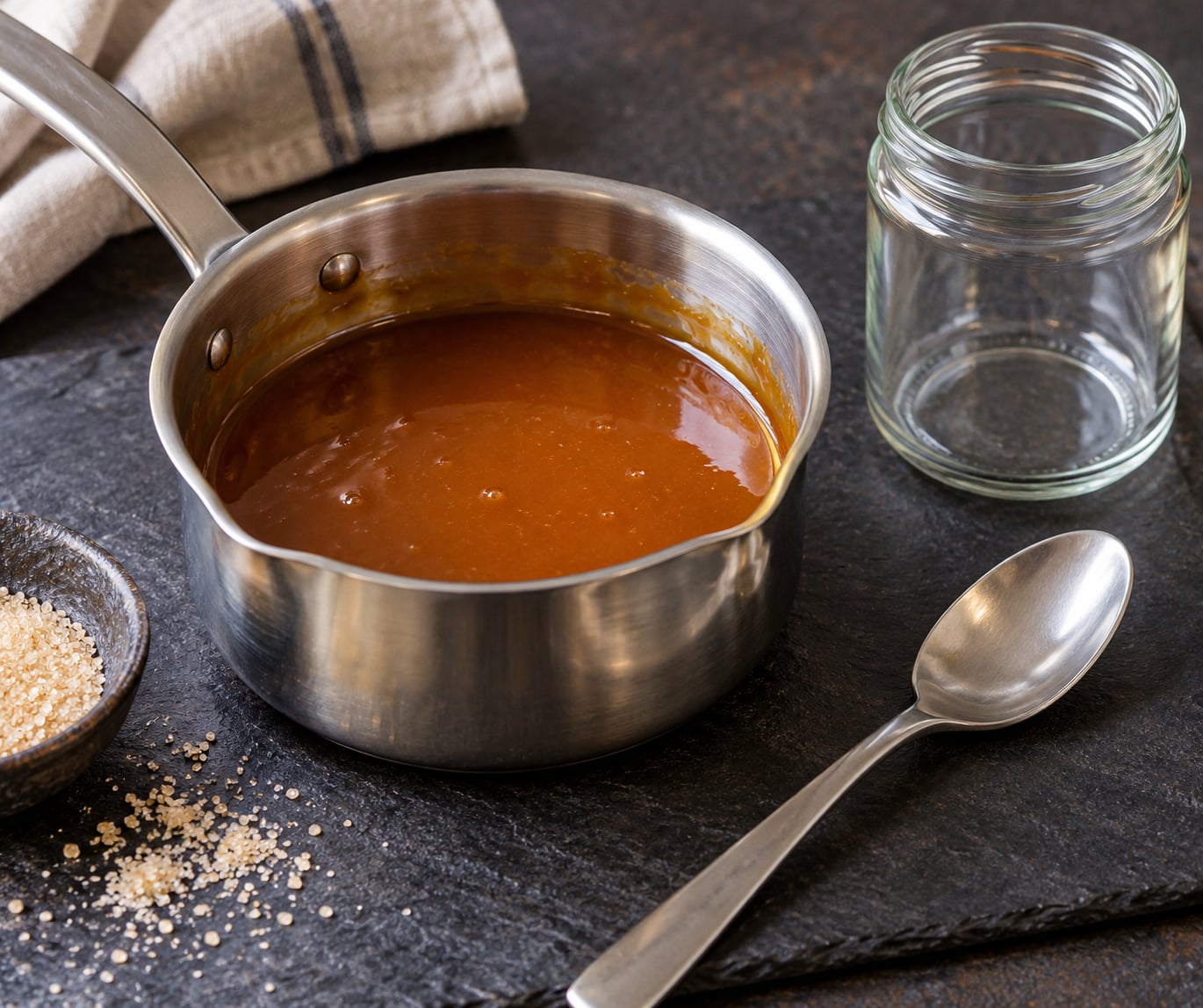
Take the pan off the heat, add the butter, then pour in the warm cream in a steady stream while whisking. It will foam hard and sputter, so keep the whisk moving and the pan away from your face. Once the foam settles, return it to low heat and cook for a few minutes until it thickens enough to coat the back of a spoon, then add salt and vanilla.
Avoid cold cream, cold butter, and adding dairy before the colour is right. Those three together account for most split, greasy caramel sauces.
5. Cool Without Seeding Crystals
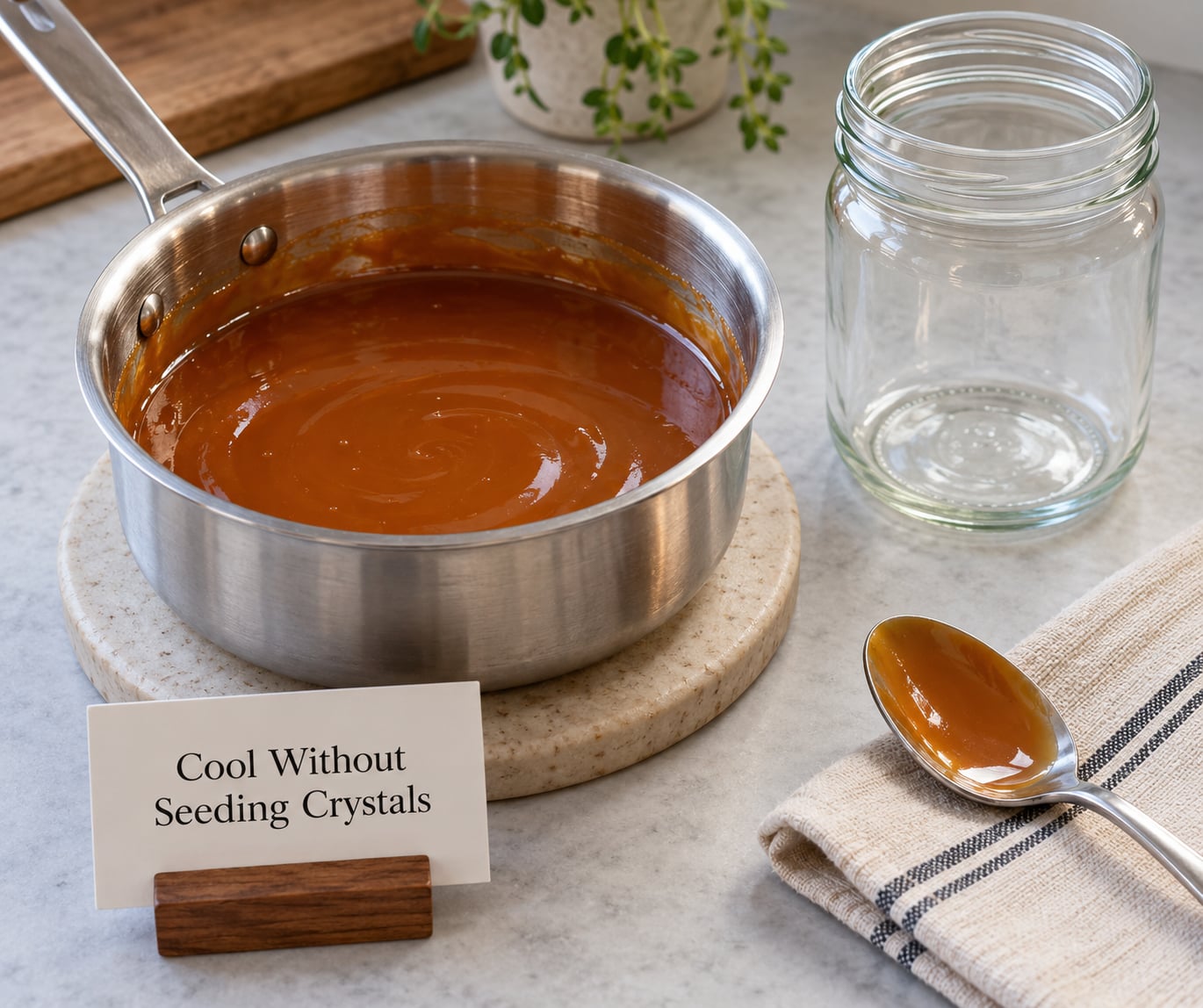
Serve it warm, or pour it into a jar and leave it to set undisturbed. Do not stir it while it cools, do not cover it while a skin is forming, and do not scrape the sides of the pan while the sauce is still warm and tacky. Each of those puts a fresh nucleation site into a solution that is still supersaturated and still wants to crystallize.
A perfect batch can still turn sandy days later if it was stored without an interfering agent, because cooling slowly gives crystals all the time they need. Adding corn syrup or glucose at the start is what keeps a stored sauce pourable for a week in the fridge.
6. Use the Caramel Safely
Pour through a fine sieve if you want a completely glassy sauce, since straining removes the last stray crystals. Strain over a bowl rather than back into the pan, and dip items into a shallow dish rather than holding them over the saucepan.
For a drizzle, let the sauce cool for 10 to 15 minutes until it runs slowly off a spoon, then pour it over the dessert from a height. For caramel candies or flan, pour while the caramel is still fluid into the mould, otherwise it hardens where it lands and leaves a gap at the base.
Dry Method vs Wet Method: Which One Crystallizes Less
Both methods make the same sauce. They differ in how much risk you take on and how much control you keep, which is why a wet method is the safer starting point for a first batch.
| Factor | Dry method | Wet method |
|---|---|---|
| Water added | None | About 1/4 cup per cup of sugar |
| Crystallization risk | Higher. Any splash on the walls forms seed crystals | Lower. Boiling water dissolves splashed sugar before it dries |
| Control over colour | Faster. The colour moves quickly near the end | Slower and gentler, which buys you thinking time |
| Flavour depth | Deeper and more toffee-like | Slightly lighter and cleaner |
| Best for | Salted caramel sauce, caramel popcorn, candies | Creme brulee, flan, first attempts, drizzle sauces |
The dry method is where crystallization shows up, because the sugar touches nothing but a bare hot pan. The wet method dissolves and boils at once, so a splash back onto the wall simply dissolves again. The trade is speed and depth against reliability.
Interfering Agents: What to Add and How Much
All amounts below are per cup of granulated sugar. Pick one, not all of them.
| Agent | Amount | How it works | Flavour impact |
|---|---|---|---|
| Light corn syrup | 1 tablespoon | Adds glucose, which resists the sucrose crystal lattice | Neutral, slightly thinner sauce |
| Liquid or glucose syrup | 1 tablespoon | Same mechanism, more concentrated | Neutral |
| Lemon juice | 1 teaspoon | Acid hydrolyses sucrose into invert sugar | A faint sharpness that works well with salted caramel |
| Cream of tartar | 1/8 teaspoon | Acid hydrolysis, no liquid added | Very slightly tart |
| Honey | 2 tablespoons | Glucose and fructose already inverted | Floral note and a darker colour; cooks faster, so watch it |
| Gelatin | 1 leaf, bloomed in the water | Swollen protein chains physically disrupt crystal growth | Neutral, useful in large syrup batches |
| Vodka | 1 tablespoon, added off the heat | Alcohol lowers the freezing point and evaporates late | Faintly boozy if it does not cook off; a splash of rum does the same job |
Vinegar does the same job as lemon juice, splitting sucrose into glucose and fructose and lowering the pH enough to block crystal formation. Lemon juice is the better choice at home, because a teaspoon of vinegar leaves an edge you can taste in a sauce meant to taste sweet.
Common Mistakes
| What you see | What caused it | How to fix it |
|---|---|---|
| Grainy sauce, even though you did not stir | A seed from dust, grease, a wooden spoon fibre or a dirty pan | Wash the pan and sugar thoroughly, use a silicone or metal utensil, add an interfering agent |
| Hard crystals stuck on the pan walls | Sugar splashed up during the boil and dried | Wipe the walls with a wet pastry brush several times during the cook |
| It seizes the instant the cream went in | Cold dairy dropped the temperature sharply | Warm the cream, take the pan off the heat, pour in a stream while whisking |
| Greasy separation, oily puddle on top | Dairy added too early, or the sauce boiled after the dairy | Add dairy only at colour, off the heat, then bring back to a gentle simmer |
| Sugar and water refuse to turn colour | The wet method needs the water to evaporate, and nobody raised the heat | Keep it at a steady simmer until roughly half the water is gone, then let it climb |
| Hard and glassy once poured | Poured too cool, or stored without an interfering agent | Pour while fluid, and add corn syrup next time so it stays soft |
| Caramel popcorn turning grainy in the bowl | Large batches sit too long and cannot be stirred | Use 1 tablespoon corn syrup or glucose per cup of sugar and drizzle rather than dump |
Is it crystallized or just burned?
Crystallized caramel is pale or normally coloured, smells sweet, and feels sandy between the teeth. Burnt caramel is dark brown to near black, smells acrid and smoky, and tastes bitter even before you notice the colour. If the flavour is right and the texture is wrong, it is crystallization, and it is fixable. If the flavour is bitter, no amount of reheating will save it.
How to Rescue Crystallized Caramel
It can be saved, contrary to what several recipes claim. One widely read guide states that crystallized caramel cannot be fixed and must be thrown out, and that advice is simply wrong for the mild cases that matter most.
Add 2 to 3 tablespoons of water to the grainy caramel and reheat it slowly over low heat, stirring this time because the crystals are already there and stirring cannot make things worse. Give it 15 to 25 minutes of gentle heat, swirling often, until the sandiness disappears. The water dissolves the crystals and boils away, taking the grain with it.
Start over instead if the graininess covers more than about half the batch, if there is a burnt smell underneath it, or if the caramel is dark enough that reheating will only drive the bitterness further. Those batches are not worth the effort.
For a sauce that has split rather than crystallized, let it cool completely, then blend it on high to emulsify the butter back into the sugar. That handles a greasy separation, not crystals.
How to Tell When Caramel Is Ready
Trust colour and smell over numbers, because the right endpoint depends on what you are making. Pale golden at around 320F gives a light sauce for crème brûlée. Deep amber at around 340-350F is where toffee and salted caramel flavour lives, and that is the stage where dairy should go in. Anything darker than deep amber is heading for bitter.
Viscosity is the second signal. The sauce should run off a spoon in a slow ribbon rather than a fast stream, and it should coat the back of a spoon in a thin even film. Aroma is the third: at deep amber the kitchen smells like roasted nuts and toffee, while a burnt caramel smells acrid and unmistakably different.
A thermometer is useful for candy work with a known target, and largely useless for a sauce judged by nose and colour. Cooks who worry about scorching will scorch it anyway by watching a number instead of the pan.
Frequently Asked Questions
Why does my caramel crystallize every time, even when I do not stir it?
Not stirring is only one of several causes. Dust, grease, a wooden spoon fibre or residue in the pan are all nucleation sites, and so is sugar that splashed up the walls and dried into a crust. Old or store-brand sugar with higher mineral content also crystallizes more readily. Add an interfering agent such as 1 tablespoon corn syrup per cup of sugar and wipe the walls with a wet pastry brush, and the problem usually disappears.
Does stirring really cause caramel to crystallize?
Yes, once the sugar reaches a boil. Stirring puts scratches and loose crystals from the utensil straight into supersaturated syrup, and crystallization then runs through the whole pan within seconds. Before the boil, a gentle swirl or a short stir to help the edges melt is harmless. After the boil, keep your hands off and tilt the pan instead.
Can you reheat grainy caramel and make it smooth again?
Usually, yes. Add 2 to 3 tablespoons of water to the grainy caramel and reheat it slowly over low heat for 15 to 25 minutes, stirring gently this time. The water dissolves the crystals and boils away, taking the graininess with it. Start over if more than half the batch is grainy or if there is any burnt smell underneath the sweetness.
Should I use caster sugar to avoid crystals?
Caster sugar works well and dissolves fast, which makes it easier to keep the sugar in suspension. Superfine dissolves even faster. Neither one prevents crystallization on its own. What matters far more is a clean pan, no stirring after the boil, and an interfering agent. Brown sugar and raw sugar are different again, since molasses and moisture push you toward the wet method.
Why is my caramel hard and glassy even though nothing burned?
Temperature and storage. Poured too cool, caramel sets into a hard glassy shell instead of staying pourable, and caramel made without an interfering agent can crystallize and harden in the fridge within days. Cook to a deeper amber, pour while the caramel is still fluid, and add 1 tablespoon of corn syrup or glucose per cup of sugar next time so it stays soft.
How long does caramel take to harden on popcorn?
A thin drizzle on popcorn sets in about 5 to 10 minutes at room temperature. A thick poured coating sets in 15 to 20 minutes. Large batches crystallize more often because you cannot stir them continuously and they sit longer, so add 1 tablespoon of corn syrup or glucose per cup of sugar and drizzle the coating over the popcorn in several thin passes rather than pouring one heavy layer.
Conclusion
Start with a clean, dry, heavy-bottomed pan and fresh sugar, add one interfering agent, and heat steadily without touching a spoon once it boils. Wipe the walls down as it cooks, add warm dairy only at the amber colour you want, and pour while the caramel is still fluid.
Most batches that crystallize were lost to a dirty pan, a splash of sugar drying on the wall, or cold cream hitting hot sugar. Those three are easy to fix and account for nearly every grainy sauce I have seen.