You cannot fully stop fresh juice from separating, because pulp and fiber are denser than the liquid around them and gravity wins over time. What you can do is slow it down: remix gently, keep the juice cold, fill the container to the top, and limit air. Most batches are perfectly fine to drink once you stir the sediment back in.
Separation is not spoilage. A layer of pale pulp at the bottom of a jar is the clearest sign that your juice is raw and unprocessed, not that it has gone bad. Store-bought juice stays uniform because it is homogenized or pasteurized, which is also why it tastes flatter.
This guide covers the whole job: what to have on hand, the order of steps that actually recombines a split batch, the containers and temperatures that slow settling, and how to tell settling apart from spoilage before you throw a good batch away.
Table of Contents
- What You Need
- Step-by-Step
- How to Keep Fresh Juice from Separating Before You Mix It
- Slowly Recombine the Liquid and Sediment
- Use a Blender or Whisk for Thick or Pulpy Juice
- Choose a Container That Helps Prevent Settling
- Shake the Closed Container Before Every Use
- Common Mistakes
- Settling or spoilage
- Frequently Asked Questions
- Why does my fresh juice separate so quickly?
- Is it okay to shake a bottle of separated fresh juice?
- Can I use a blender to remix juice that has separated?
- How long does homemade fresh juice last in the refrigerator?
- Should I add a thickener to stop fresh juice from separating?
- Conclusion
What You Need
Nothing here is specialty equipment. You are working with things most kitchens already have.
- A tall, narrow-bottom glass — the shape slows visible settling better than a wide bowl, and it is what you drink from.
- A long spoon — long enough to reach the sediment at the bottom of a jar. A short teaspoon leaves the last layer behind.
- A covered pitcher or bottle — with a lid that seals. For travel, a mason jar with headspace is workable, but narrower is better.
- A rubber spatula — for scraping the settled pulp off the bottom of the juicer and back into the pitcher.
- A blender or hand whisk — only useful for thick, pulpy, or green juice. A blender does more harm than good on thin citrus juice.
- A fine-mesh strainer (optional) — for people who want a clearer drink and do not mind thinner juice.
No thickener is required. Most home cooks fix a split batch in under a minute with a spoon.
Step-by-Step
How to Keep Fresh Juice from Separating Before You Mix It
Fresh juice separates because it is a suspension, not a solution. Solid particles of pulp, fiber, and oil float in a watery liquid until gravity pulls the heavier stuff to the bottom. The best treatment depends on what is in the glass, so identify the juice first.
- Watery citrus juice — orange, lemon, grapefruit. It separates fastest because there is almost nothing to suspend, so a light stir fixes it in seconds.
- Pulpy fruit juice — apple, pear, pineapple, watermelon. The pulp is soft and mixes back in easily.
- Oil-containing vegetable juice — carrot, beet, celery. These separate into visible layers because the oil and water parts refuse to combine, and they need a whisk or blender rather than a spoon.
Knowing which one you are holding tells you how hard to work at it. Trying to fix oily carrot juice with a spoon is why so many people give up and pour the batch out.
Slowly Recombine the Liquid and Sediment
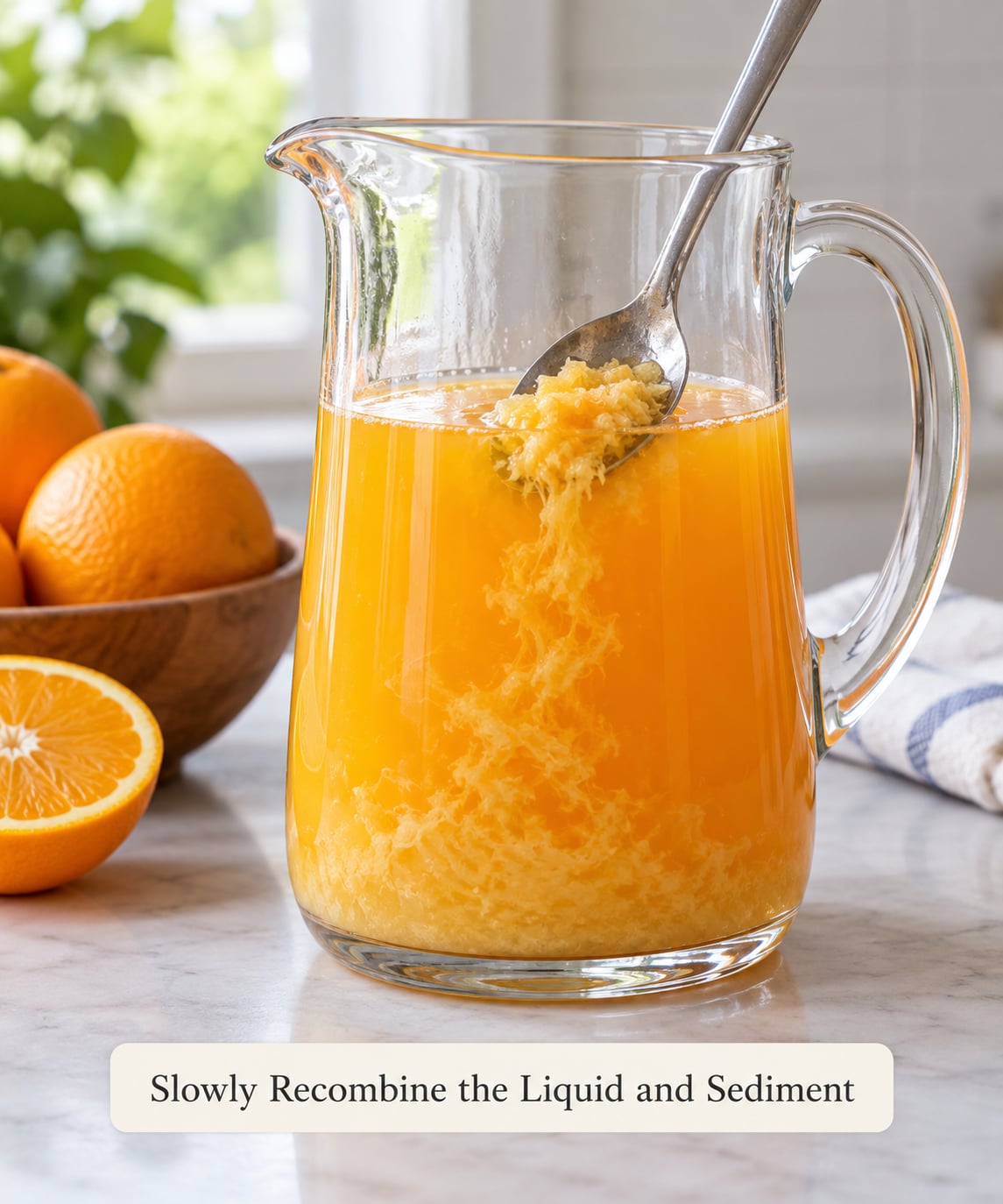
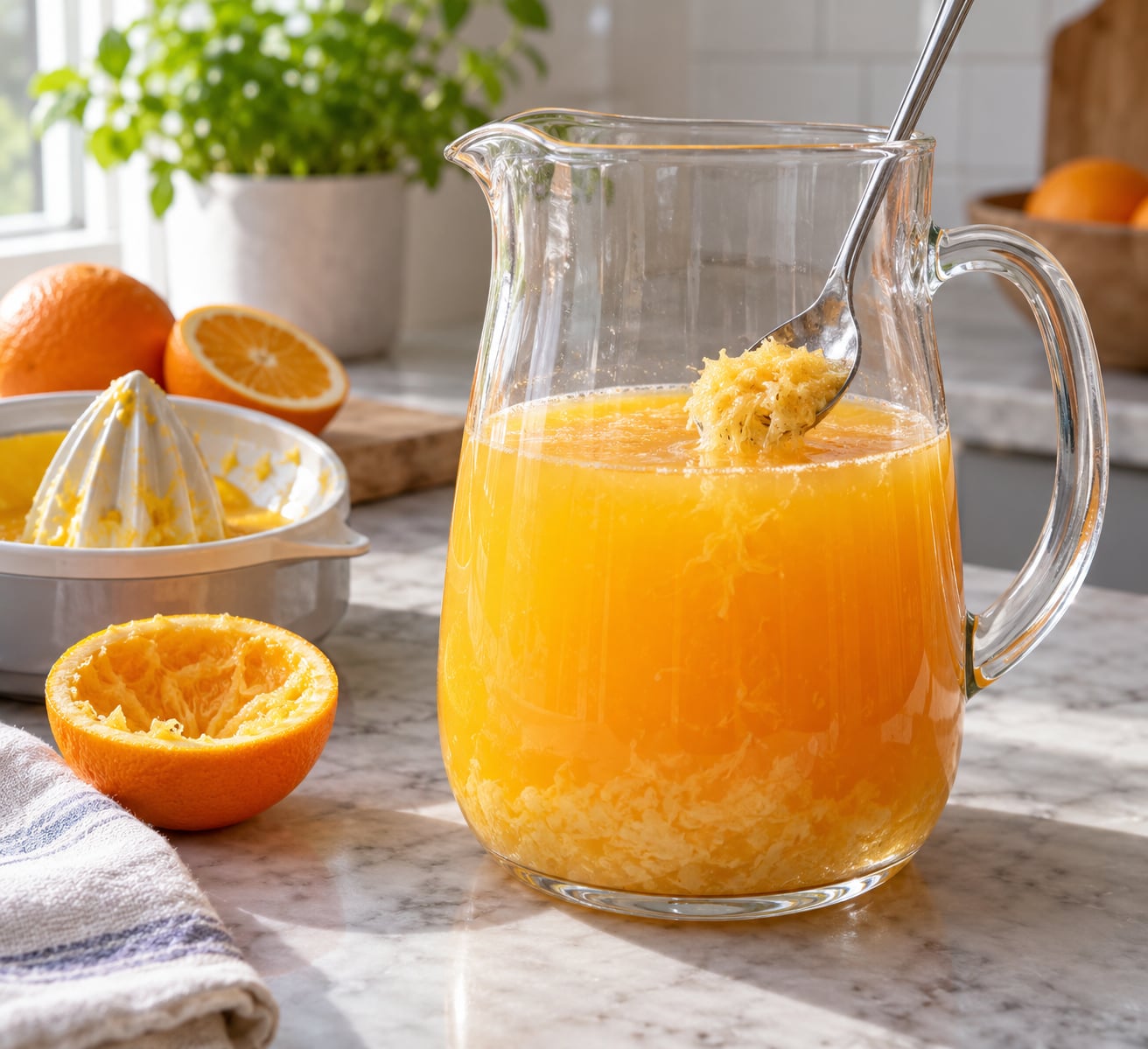
This is the base technique for thin or pulpy juice, and it works on anything that is not oily. Set the container down for a minute so the liquid and sediment are clearly separated, then stir the settled material loose from the bottom.
Add it back slowly rather than dumping it in at once. Scoop a little liquid into the sediment, stir that mixture, then pour it back into the jar and repeat. You are building an even blend instead of creating more layers to fix.
Stir gently with a long spoon, moving through the bottom of the container rather than just circling the top. You are looking for an even color and no distinct layer at the base, which takes about thirty seconds of slow stirring.
If a film has hardened on the surface, scrape it in with the spoon. It will not dissolve fully, but it breaks up and disperses well enough to drink.
Use a Blender or Whisk for Thick or Pulpy Juice
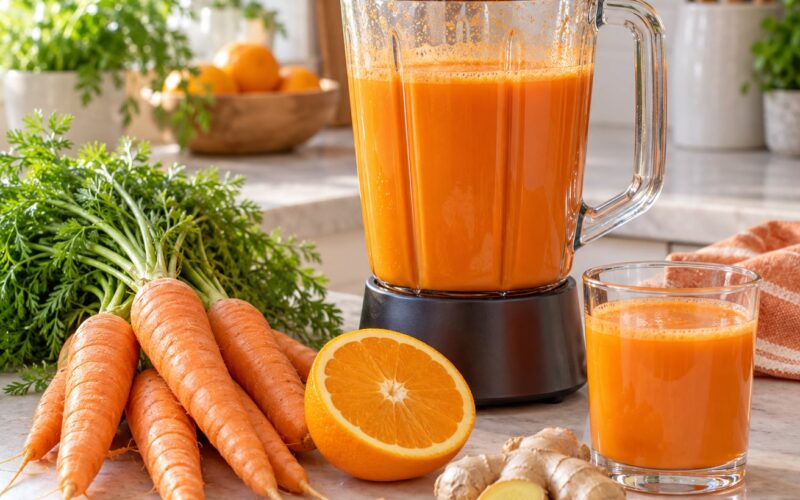
Green juice, carrot juice, and beet juice hold a lot of fiber, and a spoon often leaves you chasing clumps around the bottom. A hand whisk breaks them up; a blender gives you a genuinely uniform result in a few seconds.
For a blender, fill the jug no more than halfway. A full jug has nowhere for the pulp to go, it blends unevenly, and the motor struggles. Pulse in short bursts rather than running continuously, and stop once the color looks consistent.
Whisk works well too and keeps more air out of the juice. Keep the container open and tall so you are not trapping splashes, and use a light wrist.
Do not blend sealed hot juice. Pressure and heat together can force the lid off the jug, which is a genuinely dangerous way to lose a batch.
Choose a Container That Helps Prevent Settling
The honest answer is that serving fresh juice right away beats any container trick. But if you are storing it, the shape matters. A narrow-bottom glass or bottle slows the visible settling compared with a wide jar or a bowl, because the particles have less room to fall through.
A pitcher with a tight lid works well for a few hours on the counter before anyone drinks from it. A shaker cup is genuinely useful if you are carrying juice to work, since it mixes on the spot.
Leave as little empty space above the juice as you can. That headspace is where air sits, and oxygen in contact with fresh juice speeds both oxidation and the breakdown that leads to visible settling.
No container stops separation permanently. If you are serving the same batch to three people over two days, pour fresh servings from the main pitcher rather than pouring the whole batch back and forth — each transfer aerates it.
Shake the Closed Container Before Every Use
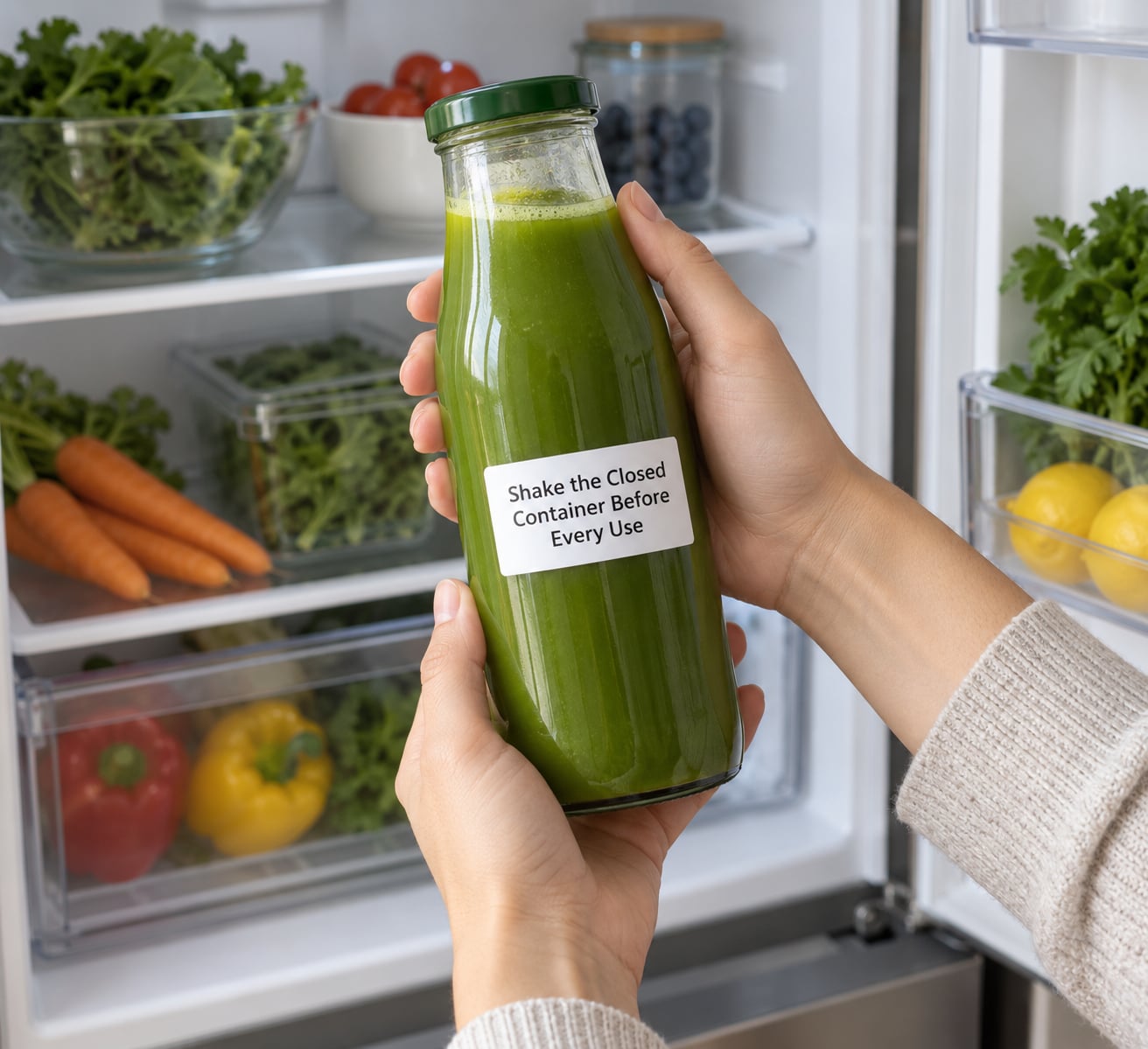
This is the last step and the one people skip. Seal the pitcher or bottle, refrigerate it promptly, and then shake or stir again immediately before serving. Shake gently with the container closed, turning it end over end a few times.
A gentle shake on a sealed container recombines the juice without forcing air into it, which matters because aeration is one of the things that speeds up both oxidation and separation in the first place. A short, controlled shake is better than thirty seconds of frantic wrist action.
Avoid vigorous shaking of a completely full container. That is how you get foam, and foam traps oxygen against the juice surface. Leave a finger of room, or use a wide-mouthed bottle you can invert instead of shaking.
Common Mistakes
Most ruined batches come down to one of these six, and every one of them has a simple correction.
- Pouring only the watery top layer — You end up with a thin drink and a jar of sludge. Stir from the bottom every time you pour.
- Treating every juice the same — Citrus needs a spoon. Carrot and beet juice need a whisk or blender. Using the wrong tool on oily vegetable juice is the number one reason people give up on green juice.
- Adding a lot of ice or extra water — Ice dilutes the flavor and the water changes the density balance, which makes the remaining pulp settle harder. Use a few cubes and drink it soon after.
- Filling the blender all the way up — It blends unevenly and can force the lid off. Half full is the working maximum.
- Storing juice in a narrow-opening bottle with big headspace — Air does the damage. Fill to the shoulder of the container and keep it sealed.
- Leaving fresh juice out of the refrigerator — Warmth speeds settling and oxidation. Get it chilled within a couple of hours of pressing, and keep it at or below 40 degrees F.
Two smaller habits help too. Skip the whipped, foamy look — aerating juice in a blender for the sake of foam costs you shelf life. And give green juice and celery juice realistic expectations; they carry the most fiber, so they separate faster than apple juice will ever do.
Settling or spoilage
These look different, and the difference matters.
| What you see | What it means | What to do |
|---|---|---|
| Pale pulp settled at the bottom, clear liquid above | Normal settling | Stir or shake and drink |
| Fizzing when opened, sour or fermented smell | Spoilage | Discard it |
| Brown, dull color with a layer on top | Oxidation, still drinkable | Stir in and use quickly |
| Visible fuzzy growth or film that does not disperse | Mold | Discard the whole batch |
| Frozen or slushy after thawing | Damage from freezing | Safe, but expect thinner flavor |
Smell is the fastest test. Fresh separated juice smells like the produce it came from. If it smells sour, boozy, or vinegary, the separation is not your problem.
Frequently Asked Questions
Why does my fresh juice separate so quickly?
Fresh juice is a suspension rather than a solution, so gravity pulls heavier pulp and fiber particles down through the liquid. Speed depends on how much solid material is in the juice and how little body the liquid has. Clear citrus juice with almost no pulp settles fastest. Green, celery, and root juice carry heavy fiber, so they drop out quickly too. Warm temperature and air exposure both accelerate it.
Is it okay to shake a bottle of separated fresh juice?
Yes, and it is the standard fix. Close the lid, turn the bottle end over end several times, and you have recombined a split batch in a few seconds. Shake gently rather than hard, because a sealed bottle shaken violently traps air and creates foam that speeds oxidation later. If the bottle is completely full, invert it a few times instead.
Can I use a blender to remix juice that has separated?
You can, and for green or root juice it gives the best result. Fill the jug no more than halfway and pulse in short bursts until the color looks even. A full jug blends unevenly and can throw the lid off. For thin citrus juice a blender is overkill, and a long spoon stirs it back together just as well in a fraction of the time.
How long does homemade fresh juice last in the refrigerator?
Unpasteurized fresh juice keeps its best flavor for about 24 to 48 hours when sealed and kept at or below 40 degrees F. Green and vegetable juices tend to hold their quality slightly longer than fruit juices, which oxidize faster. Use a clean container and a tight lid, and treat anything that smells sour or fizzy as spoiled rather than separated.
Should I add a thickener to stop fresh juice from separating?
Usually not. Pectin, xanthan gum, and gum arabic do slow settling, but they change the mouthfeel and can make fresh juice taste coated, which defeats the point of pressing your own. A squeeze of lemon or lime is the more useful addition because the citric acid lowers the pH and slows the reactions behind settling. Skip any powder unless you are blending juice into smoothies.
Conclusion
Start with the spoon. Stir the settled pulp back up from the bottom of the container slowly, adding a little liquid at a time until the color is even, and the batch is drinkable in about thirty seconds. That is how to keep fresh juice from separating in the moment.
For tomorrow, adjust based on what you are holding. Citrus needs a spoon and no more thought. Green, celery, and root juice need a whisk or a half-full blender. Store everything sealed with minimal headspace at or below 40 degrees F, and shake it gently right before you pour.
Set realistic expectations after that. You are slowing physics, not defeating it. If a batch smells sour or fizzes when opened, that is spoilage, not settling, and it goes in the sink.