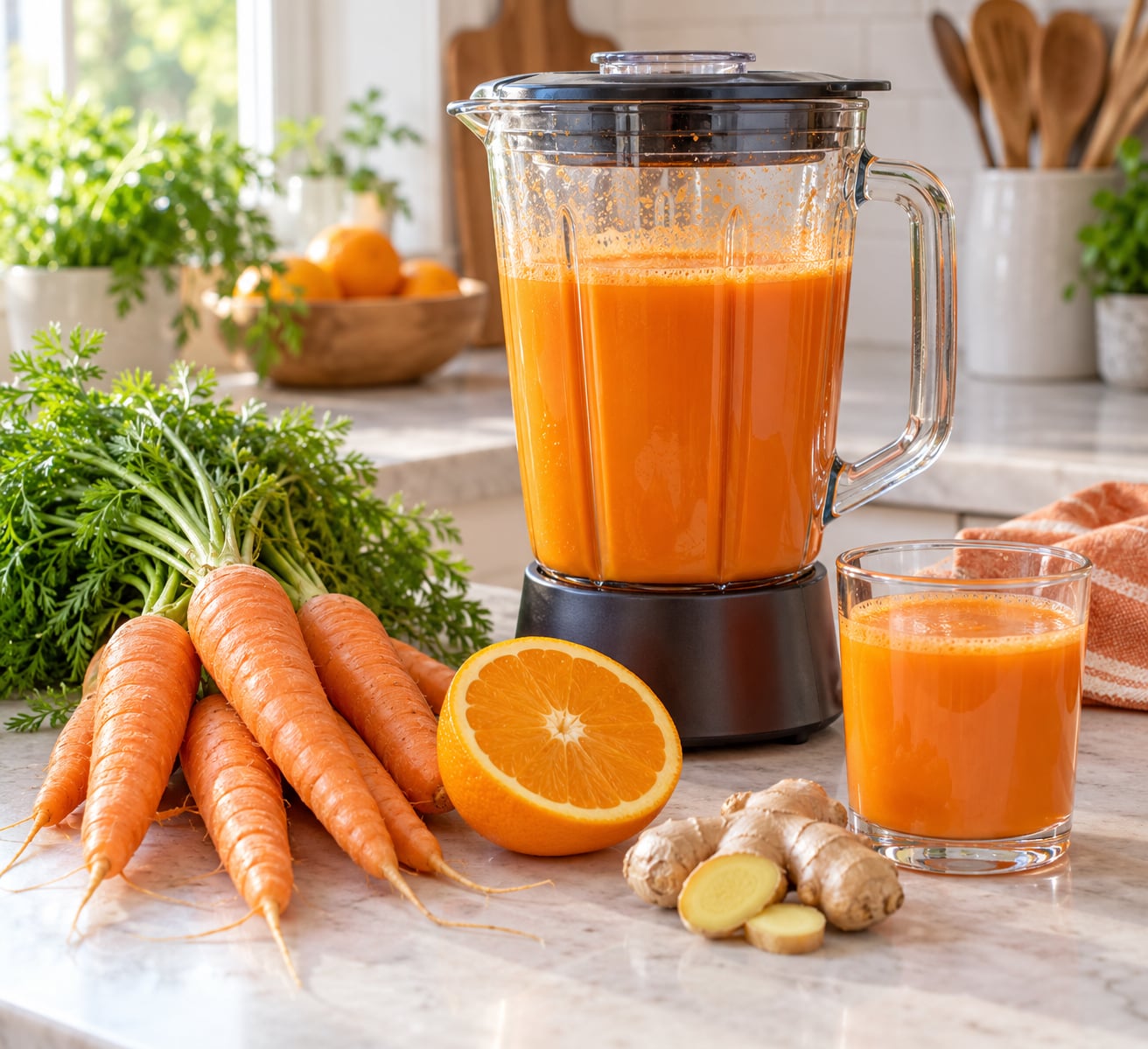
A standard blender plus a fine mesh strainer or a nut milk bag is all you need, and how to make carrot juice in a blender takes about five minutes from cutting board to glass. The one thing a blender will not do on its own is separate the juice from the fibre pulp, so straining is the step people skip and then wonder why the drink tastes like warm carrot soup.
Carrots are dry and high in fibre, which is why they need a splash of liquid before a blender can do anything useful with them. Once you understand that, the method is simple: chop small, add liquid sparingly, blend hot, strain firmly.
Here is the method I use, with the quantities, the straining options, and the fixes for the four problems that come up most often.
Table of Contents
- What You Need
- Step-by-Step: How to Make Carrot Juice in a Blender
- How to Prepare the Carrots
- How to Blend Carrot Juice
- How to Strain and Season the Juice
- How to Serve and Store Carrot Juice
- Common Mistakes
- The juice comes out watery
- The juice is too thick to strain
- The juice still tastes pulpy or fibrous
- Chunks of carrot jam under the blades
- The juice tastes cooked or dull
- Not sure whether you need a nut milk bag
- Frequently Asked Questions
- Can a blender blend raw carrots?
- What fruit can I mix with carrot juice?
- Is drinking carrot juice actually good for you?
- Can I use a nut milk bag instead of cheesecloth?
- How long does carrot juice last in the fridge?
- Can I make carrot juice in a mixer or mixer-grinder?
- Conclusion
What You Need
The list is short, and almost everything on it is already in your kitchen.
- A blender. A high-speed blender gives the smoothest result, but any blender with a pulse button works. A stick blender in a tall beaker is a decent substitute.
- 5 large carrots, about 300 g. Washed, tops snapped off, cut into 1-inch pieces.
- Liquid: 1/2 to 3/4 cup of cold filtered water, coconut water, or the juice of one peeled orange. Water gives the purest carrot flavour, orange gives sweetness, coconut water rounds it out.
- A strainer. A fine mesh strainer (40-mesh or finer), a nut milk bag, or two layers of cheesecloth draped over a bowl.
- Optional add-ins: a 1-inch knob of fresh ginger, 1 tablespoon of lemon juice, half a sweet apple with the core removed, a small handful of ice cubes, a pinch of salt or black salt.
- A wide bowl and a rubber spatula for pressing the pulp, plus a glass with ice.
A quick note on timing: prep is about 5 minutes, blending is 60 to 90 seconds, and the recipe serves 2 to 4 people depending on how much liquid you add. It is the fastest juice in my morning routine for that reason.
Step-by-Step: How to Make Carrot Juice in a Blender
How to Prepare the Carrots
Scrub the carrots under cold running water and trim off the leafy tops, which taste bitter. If the soil is stubborn, soak the carrots for 20 to 30 minutes in cold water with a splash of baking soda, then rinse again.
You do not need to peel them. Carrot skin is thin, it holds nutrients, and peeling five carrots adds several minutes to a five-minute recipe. Peel only if you are using old, woody carrots with thick rough skin.
Cut everything into pieces about 1 inch long. Uniform size is the whole trick here: small pieces liquefy evenly, while a mix of chunks and slivers leaves you blending long enough to cook the juice and still finding fibrous bits in the strainer.
Cut the core out of any large, thick carrot. It is woody and it is the single most common reason juice tastes stringy.
How to Blend Carrot Juice
Put the liquid in the blender jar first, then the carrots on top. Layering matters more than it sounds: soft ingredients such as peeled orange segments or apple go closest to the blades so they catch first and pull the harder carrots down into the blades.
Start on the lowest speed, then ramp up to high. Blend for 60 to 90 seconds, stopping once you lift the lid to check. Some recipes suggest adding ice cubes during blending, and that works: the cold slows the motor down and keeps the juice from heating.
If the mixture looks like thick paste with barely any movement, add 2 tablespoons of water and blend again. Add liquid a little at a time. Too much water is the most common failure in this recipe and it is hard to take back once it is in.
You will know the blend is done when it moves like thick smoothie batter and smells sweet rather than cooked. If the jar is warm to the touch, keep blending for another 15 seconds; warm juice tastes flat no matter what you add later.
If you have a juicer, you can skip the liquid entirely because a slow juicer extracts its own. That same machine cannot replace the blender method for a big batch without a second pass through a fine strainer.
How to Strain and Season the Juice
Set your strainer over a wide bowl, tip the puree in, and press the pulp down with the back of a spoon or a rubber spatula. Press firmly rather than skimming. Skimming gives you thin juice and a bowl of wet pulp; pressing gets you the yield and the smooth body you were after.
Here is how the three straining tools compare in practice.
| Tool | Smoothness | Effort | Good for |
|---|---|---|---|
| Fine mesh strainer | Some fibre stays in the glass | Low, about 3 minutes | Everyday use, and the cheapest option |
| Nut milk bag | Smoothest, almost no pulp | Higher, two hands and a slow squeeze | When you want a restaurant-finish texture |
| Two layers of cheesecloth | Smooth, close to a nut milk bag | Medium, and messy to clean | A one-off batch when you own no strainer |
A regular colander will not do this job. The holes are far too wide, so the juice runs through and you are left with pulp.
You can also skip straining entirely. If you drink your juice as a thick, spoonable smoothie, the pulp is not a problem at all, and you keep all of the fibre. That is a legitimate choice, not a shortcut.
Season after straining, while the juice is still cold. A tablespoon of lemon juice sharpens it, a pinch of salt cuts the earthiness, and ginger adds heat rather than sweetness. These are the add-ins that work reliably, with roughly these amounts per 2 cups of juice.
| Add-in | Amount | What it changes |
|---|---|---|
| Fresh ginger | 1-inch knob, peeled | Sharp heat; mellows a heavy carrot flavour |
| Lemon juice | 1 tablespoon | Brightness and a longer-lasting taste |
| Sweet apple | Half, cored | Rounds out the earthiness, adds body |
| Peeled orange | One, deseeded | Natural sweetness, replaces added water |
| Turmeric | 1/4 teaspoon | Warm colour, earthy note |
| Black salt | A small pinch | Deepens the flavour more than table salt |
| Celery or cucumber | 2 stalks or half a cucumber | Makes the drink lighter and milder |
Hold off on honey, maple syrup, and dates. Carrots are already sweet, and the moment you add sugar you are drinking a sweet vegetable drink instead of juice.
How to Serve and Store Carrot Juice
Serve it cold, straight off the blend, over ice in a tall glass. Ice keeps the temperature down and stops the juice from separating while it sits in front of you. A thin slice of orange or a sprig of mint is the only garnish it really needs.
Drink it within 24 to 48 hours for the best flavour. A clean sealed bottle keeps about three to four days in the refrigerator, but by day three the flavour flattens and the colour dulls.
Separation is normal, not a sign that something went wrong. The pulp settles at the bottom and the top turns darker as it oxidises. Give the bottle a shake and it comes back together.
For an easier morning, wash and chop a week’s worth of carrots, spread them on a tray, and freeze them flat. Frozen carrots go into the blender without thawing and skip the chopping entirely, though blend for a few seconds longer since the pieces are colder and harder.
Do not pour the pulp down the drain. Stir it into vegetable broth, drop it into carrot fritters or muffins, or mix it into granola and bake. Roughly a quarter of the carrot’s fibre ends up in that bowl.
Common Mistakes
Every one of these comes up repeatedly, and all six have the same cause: skipping a step rather than doing it badly.
The juice comes out watery
Too much liquid went into the jar, and straining cannot put it back. Start at 1/2 cup for 300 g of carrots and only add more if the blades stall. If you already over-diluted, blend a handful of ice cubes and a couple of carrot tops’ worth of extra carrot to tighten it up.
The juice is too thick to strain
Puree that sits like paste is the opposite problem, and it happens when there is not enough liquid for the blades to move the mass. Add 2 tablespoons of water or a handful of ice, blend 20 seconds, and try again.
The juice still tastes pulpy or fibrous
Two causes: pieces that were cut unevenly, or a blend that stopped too early. Cut everything to a consistent 1 inch, remove the woody core, and give it a full 90 seconds on high. If your blender struggles, a second pass through the same strainer catches what the first one missed.
Chunks of carrot jam under the blades
Dropping everything in at once puts heavy carrots straight against blades spinning below a pile of pulp. Add half the liquid first, then the carrots, then the remaining liquid, and start on low speed so the mixture circulates before the motor comes up to speed.
The juice tastes cooked or dull
Long blending generates heat, and heat kills the fresh taste. Add 4 or 5 ice cubes, keep it under 90 seconds, and drink it within minutes of straining. If it still tastes flat, a squeeze of lemon brings most of it back.
Not sure whether you need a nut milk bag
Skip it unless you are chasing a really silky finish. A fine mesh strainer is faster, washes in a few seconds, and the small amount of fibre it leaves behind is not a problem for most people.
Frequently Asked Questions
Can a blender blend raw carrots?
Yes, but only with liquid. Raw carrots are too dry and too fibrous to move on their own, so add between half a cup and three quarters of a cup of cold water, coconut water, or orange juice before you start. Cut the carrots into even one-inch pieces, use the pulse button or high speed, and give it 60 to 90 seconds. A high-speed blender gives the smoothest result, and a regular kitchen blender works fine as long as you stop and scrape down the sides if the mixture stalls.
What fruit can I mix with carrot juice?
Orange and apple are the two that work best. One peeled, deseeded orange replaces the added water and sweetens the drink naturally, while half a sweet apple rounds out the earthy flavour and gives the juice more body. Half a pineapple brightens it further, and a squeeze of lemon adds sharpness without any extra sugar. Avoid banana and mango, which make the blend thick and creamy rather than drinkable as juice.
Is drinking carrot juice actually good for you?
Carrots are rich in beta-carotene, which the body converts to vitamin A as needed, so juice does deliver a solid dose of that antioxidant. The honest caveat is that juicing removes most of the fibre and concentrates the natural sugars, which are absorbed more quickly than in a whole carrot. Most nutrition guidance recommends eating whole vegetables first and treating juice as an occasional addition. If you have a condition affecting blood sugar or vitamin A intake, ask your doctor or a registered dietitian first.
Can I use a nut milk bag instead of cheesecloth?
A nut milk bag works well and produces a smoother, silkier finish than a fine mesh strainer, so it is worth reaching for if texture is the priority. The trade-off is effort and cleanup: it takes two hands, a slow squeeze, and a good rinse afterwards, while a strainer takes about three minutes and one rinse. A bag also resists clogging on the small seeds and fibre that block mesh holes. If you already own one, skip the cheesecloth.
How long does carrot juice last in the fridge?
A clean, sealed bottle keeps carrot juice good for about three to four days in the refrigerator, but the flavour is best in the first 24 to 48 hours. After that the taste flattens and the colour dulls as the juice oxidises. It will separate and darken as it sits, which is normal, and a shake brings it back together. Drink it within minutes if you can, and keep the bottle full so less air sits against the juice.
Can I make carrot juice in a mixer or mixer-grinder?
Yes, with one adjustment. A mixer-grinder jar is small, so work in batches of about two carrots at a time and add liquid with each batch, otherwise the top of the jar stays dry. Since most grinders run at fixed high speed with fewer speed options, keep each batch under 45 seconds and scrape down the sides between pulses to avoid heating. Strain the pulp through a nut milk bag afterwards, since a grinder gives a coarser puree than a blender.
Conclusion
Start with five carrots cut into even one-inch pieces, half a cup of cold water, and 60 seconds on high. That is the whole foundation, and getting the liquid ratio right matters more than any other variable in this recipe.
Once that batch tastes right, adjust from there: a peeled orange instead of water for sweetness, a knob of ginger for heat, a nut milk bag if you want it silkier. Straining the pulp firmly and drinking it the same morning is what separates good carrot juice from a disappointing one, so if you make carrot juice in a blender for anything other than a smoothie, do not skip that step.