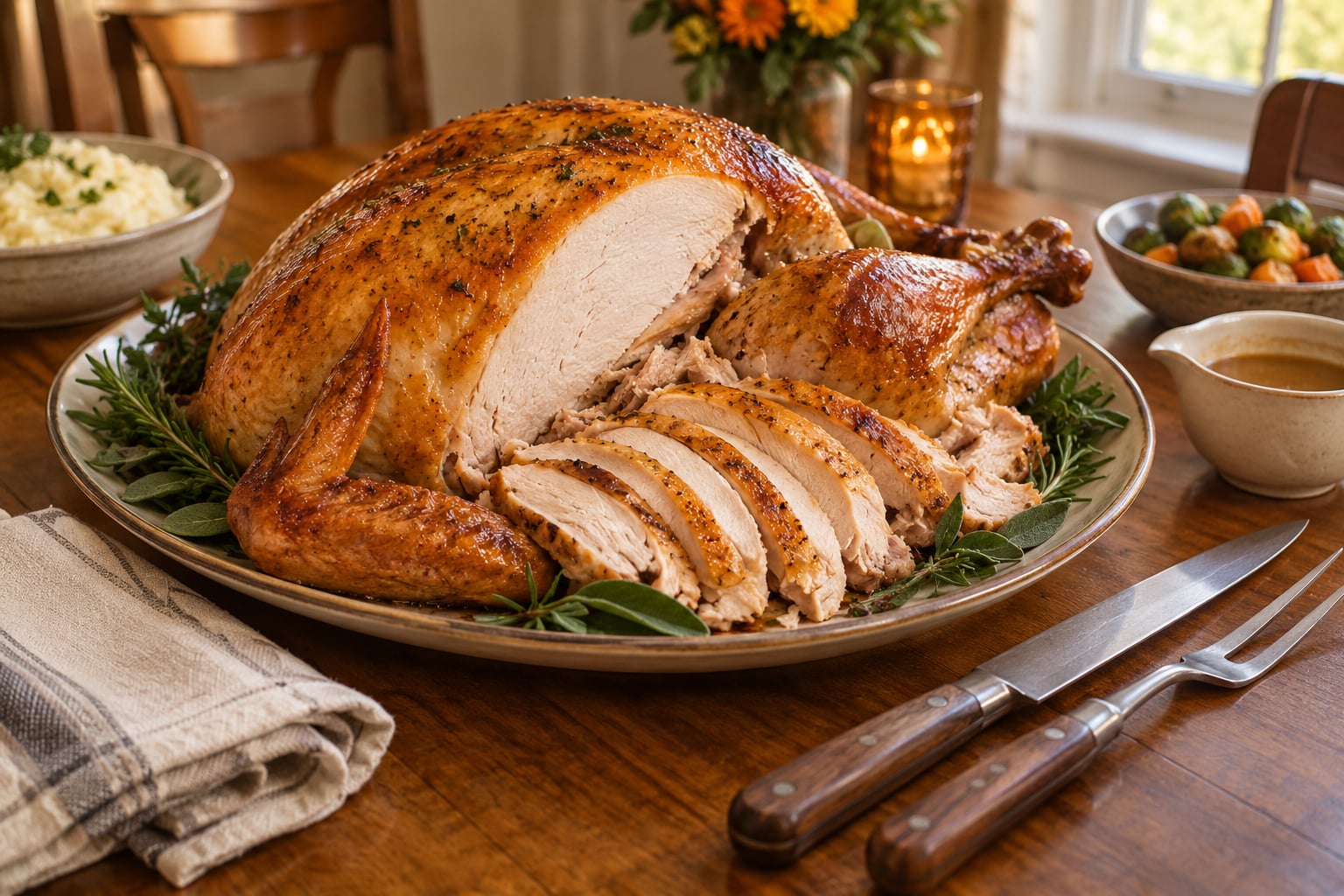
Carving a turkey at the table is mostly about order: take the legs and thighs off first, then the wings, then lift the whole breast off the bone and slice it across the grain. Rest the bird 30 to 60 minutes after it comes out of the oven, confirm it hit 165°F / 74°C in the thickest part of the breast, and the joints will give you the cut lines on their own. Ten minutes of work, most of it in finding the joints rather than fighting them.
The part that trips up first-timers is nerves, not skill. Nobody expects you to do surgery in front of twelve relatives, so the method below is written for someone who has never carved a bird before. You do the same cuts a restaurant cook does, just more slowly.
Table of Contents
- What You Need
- Should you carve at the table or in the kitchen?
- How to Carve a Turkey at the Table: Step by Step
- How to carve a turkey at the table: set up the bird
- Remove the legs and thighs
- Remove the wings
- Carve the breast into even slices
- Slice the thigh meat and drumsticks
- Arrange and serve the carved turkey
- Common Carving Mistakes and How to Fix Them
- Frequently Asked Questions
- Should I carve the turkey before guests sit down or at the table?
- Can you carve a turkey without a cutting board?
- How do I carve turkey breast without wasting meat?
- How long should a cooked turkey rest before carving?
- How do I store and reheat carved turkey leftovers safely?
- Conclusion
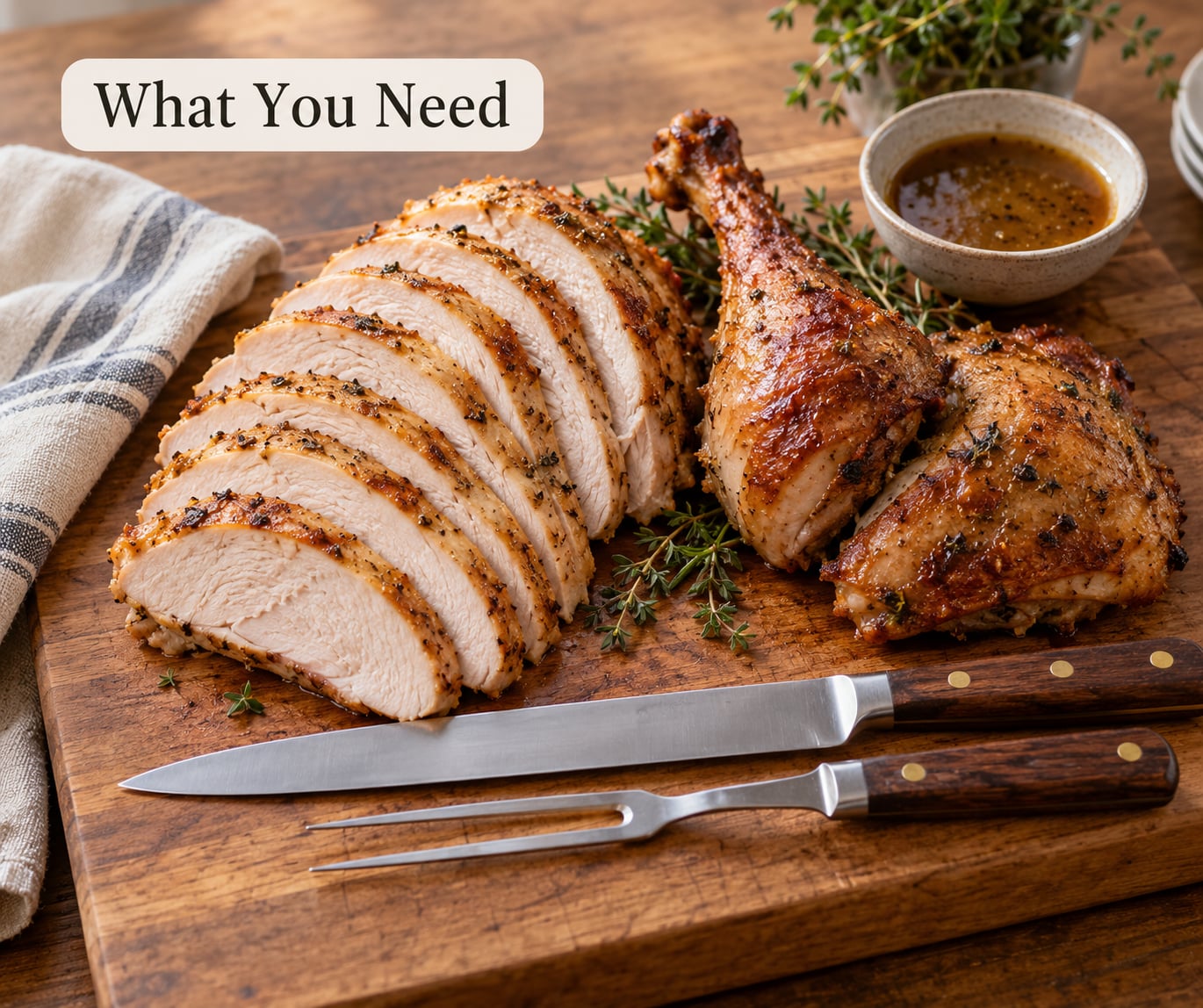
What You Need
Tools first, because the wrong knife is the single biggest reason a carve goes wrong. You need three things to cut with and four things to keep the bird and the counter under control.
- A long, thin carving knife. Eight to ten inches with a straight, flexible blade. It slides under skin and along bone without tearing either. A thick chef’s knife works in a pinch, but you will saw more than you slice.
- A small boning or paring knife. Useful for the joints, where a long blade has no room to maneuver.
- A carving fork. Not for the meat. You use the tines to pin the bird so the knife hand stays free.
- A grooved cutting board, ideally set over the sink. The groove catches the juices and drippings so they don’t run across your counter. Fork in a roasting pan over the sink does the same job if you own neither.
- A clean kitchen towel. Folded and draped over the bird, it gives your fingers purchase on a hot, slick surface. Non-negotiable for the wings.
- A platter warmed in the oven. A cold platter drops the temperature of the first slices you serve.
- An instant-read thermometer. The only way to know the bird is actually done rather than hopefully done.
Before the bird ever reaches your board, check that thickest part of the breast, right under the wing. Poultry needs to reach 165°F / 74°C internally, and a probe reading in the thigh or the deepest breast is the only proof. If you skip it, the risk is real rather than theoretical.
Resting matters just as much. Pull the bird from the oven, set it on a board or platter uncovered, and wait 30 to 60 minutes. Resting lets the juices redistribute instead of running out onto your board at the first cut, and the connective tissue inside the joints softens so the pieces separate cleanly. Covering the bird traps steam and softens the skin you worked hard to crisp, so leave it open.
One thing you can do hours earlier: cut the wishbone out before the turkey goes in the oven. It sits in a V right at the base of the breast, and once the bird is roasted it is welded to the meat by the same heat that cooked it. Pulling it out raw takes twenty seconds. Fighting it later leaves you tearing a strip of breast skin to get it.
Should you carve at the table or in the kitchen?
Both work. Tableside carving is the ceremony, and for a bird under about fourteen people it is genuinely the nicer choice because the meat gets to the table seconds after it is cut. Kitchen carving is faster, quieter, and far easier when you are cooking for a crowd or when the bird is large enough that you want both hands free.
The honest answer from people who host every year: carve in the kitchen, then do one dramatic slice of breast at the table if you want the moment. Guests also love watching, but they love not watching a host hunt for a joint while the gravy gets cold more. Whatever you pick, set your board over the sink or on a damp towel, because a wet board will not slide.
How to Carve a Turkey at the Table: Step by Step
How to carve a turkey at the table: set up the bird
Take the turkey out of the roasting pan, tip the juices into a container for gravy, and lay the bird breast side up with the legs pointing away from you. Tuck the wing tips under the bird and drape a folded kitchen towel over the breast and legs. Press down on it with your palm until it stops wobbling.
Now take a second and just look. The breast is the large flat section in the middle. The thighs are the big rounded pieces where the legs meet the body, the drumsticks are the two narrow ends pointing at you, and the wings are folded along the sides. The backbone is the raised ridge running down the center, which you can feel under your fingers when you press the breast. Knowing where each part is now saves you poking around with the knife later.
Remove the legs and thighs
Starting on one side, cut down through the skin and meat until you hit the joint where the drumstick meets the body. The skin here is loose and pulls away easily, so a shallow cut is enough to expose it.
Now wiggle the drumstick up and down. You are looking for the spot where the bone moves freely, usually a pale bit of cartilage. That is your cut line. Slice straight down through it in one confident motion, no sawing back and forth, and the whole leg and thigh should lift away in your hand as one piece.
If the joint resists, you are probably cutting into the socket instead of through the cartilage above it. Move your knife slightly toward the body and try again. Repeat on the other side.
Remove the wings
Cut through the skin at the top of the shoulder, push the wing away from the body, and cut through the joint where the wing meets the breast. The wing comes off in two sections: the drumette near the body and the flat, which is the part people eat.
The one mistake here is cutting close to the breastbone, which takes a piece of breast meat with the wing. Leave the joint room. Keep the wings on the bird until the very end and you can use them as handles to lift the breast off cleanly.
Carve the breast into even slices
Slide the knife blade along the top of the backbone and down the center, following the keel bone, cutting the breast meat off the rib cage from the inside. Work all the way down until the blade reaches the wishbone area, then repeat from the other side until the whole breast lifts off in one piece.
Lay the breast skin side up on your board. Look at the fibers: they run along the length of the breast. Make your first cut parallel to the breastbone and about a quarter inch deep, stopping when the knife touches bone. That top cut gives you a clean reference edge.
Now turn the knife ninety degrees and slice down across those fibers, cutting through to the board in one stroke. Each slice should be a half inch to three-quarter inch thick. Repeat, keeping the blade vertical so the slices stay the same thickness instead of tapering to wedges.
Near the top of the breast, where the muscle curves over the shoulder, the grain runs at an angle. Slow down there and follow what you see. Those slices turn chewy fast, and cutting with the grain is the number one reason table-side turkey disappoints people.
Slice the thigh meat and drumsticks
Set each thigh skin side down and cut straight down through the meat to the bone, running the blade along the bone from the tip to the joint. Turn the bone and pull it out. The thigh meat comes away in one piece and slices into thick rounds.
For drumsticks, cut between the two bones lengthwise so people can pull the meat off with a fork. There is also a small tender piece tucked above the hip joint, the oyster, that most people never eat. Find it on the back side of the thigh and eat it yourself. You earned it.
Arrange and serve the carved turkey
Warm your platter in the low oven while you carve, then fan the breast slices in the center with a slight overlap so the skin shows. Put the drumsticks on one side, the sliced thigh meat on the other, and put a wing on each end to frame the platter.
For a holiday dinner of more than about fifteen people, carve only what the table will eat in the first fifteen minutes and bring the bird out a second time. Loosely tenting foil keeps the meat from drying, but only do that if the platter is sitting more than twenty minutes. Turkey left at room temperature for more than two hours should go into the fridge or into hot water, not onto the table.
Common Carving Mistakes and How to Fix Them
Almost every bad carve comes down to one of the following. Each has a straightforward fix.
- Carving before the bird has rested. The juices flood out at the first cut and the meat tastes dry. Fix: rest it 30 to 60 minutes, uncovered.
- Slicing with the grain instead of across it. Long intact fibers chew instead of tenderizing. Fix: look at the meat before you cut and slice perpendicular to the direction the fibers run.
- Using a dull knife or the wrong knife. A dull blade tears skin and crushes meat. Fix: sharpen before the holiday, and use the long thin carving knife rather than a rock-solid chef’s knife.
- Pulling pieces away by force. Tugging on a drumstick usually tears skin off the breast and leaves meat on the bone. Fix: find the cartilage first and cut it, every time. If the joint does not release, your blade is in the wrong spot.
- Losing breast meat around the wing. Cutting too deep at the shoulder leaves a hole in the breast. Fix: cut at the joint with the blade held close to the wing, and leave the wings on as handles until the breast is off.
- Slicing too far from the breastbone. You end up with thin tail slices on one side and a thick uneven slab on the other. Fix: follow the keel bone all the way down and let the blade tell you where the meat ends.
- Crowding the platter. Stacking slices hides the crust and makes serving hard. Fix: fan in a single layer with a slight overlap.
Two handling notes. Wash your hands, board, and knife thoroughly before and after, and use a separate clean plate for the cooked meat you are serving rather than the board the raw bird sat on. And keep the carved platter either hot or cold, never lukewarm for hours: either put it over a pan of hot water or get it into a refrigerator within two hours.
Frequently Asked Questions
Should I carve the turkey before guests sit down or at the table?
For a bird under about fourteen people, carving at the table keeps the meat hot and makes a nice moment of the meal. For a large gathering, carve in the kitchen and serve platters, because a big bird takes real concentration and the gravy waits for nobody. A good middle ground is to carve most of the turkey in the kitchen, then take one slice of breast off at the table for the show.
Can you carve a turkey without a cutting board?
Yes, and it works fine. Set the bird directly in a roasting pan, a sink rack, or on a folded damp towel on the counter, which stops it sliding. A sturdy platter works too, though breast slices are harder to cut on a round surface. Whatever you use, protect the counter with a board, a cutting mat, or a layer of paper towels.
How do I carve turkey breast without wasting meat?
Keep the wings on the bird until the breast is removed, then use them as handles to lift the whole breast off. Slide the blade along the keel bone from the top down to the rib cage on both sides rather than cutting down into the meat blindly. That way you follow the bone the whole way and the slices come off with almost nothing left behind.
How long should a cooked turkey rest before carving?
Rest a whole turkey 30 to 60 minutes before carving, uncovered on a board or platter. Resting lets the juices redistribute through the meat instead of running out during the first cut, and it softens the connective tissue inside the joints so the legs and wings come away cleanly. Covering the bird during the rest traps steam and softens the skin, so leave it open.
How do I store and reheat carved turkey leftovers safely?
Get carved turkey into the refrigerator within two hours of serving, covered, and use it within three to four days. Reheat pieces to 165°F / 74°C, either in a microwave or in a pan with a splash of broth over low heat so the breast does not dry out. Keep the carcass in the freezer for stock rather than leaving it on the counter.
Conclusion
Rest the bird, check that it hit 165°F / 74°C, and lay your tools out before anyone sits down. Take the dark meat off first, then the wings, then lift the breast and slice across the grain with a sharp knife. Do those things in that order and a carved turkey looks like something you were born knowing how to do.