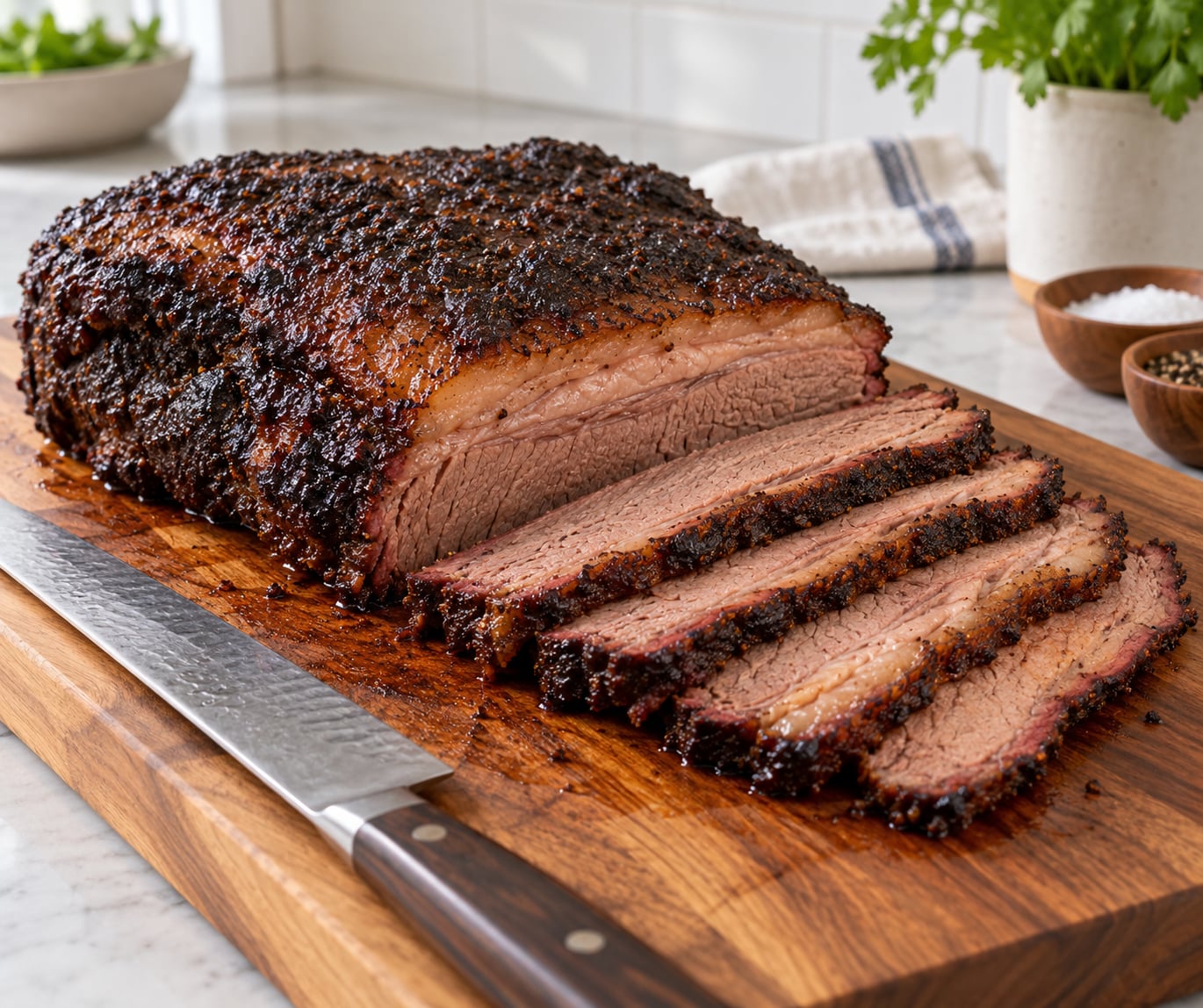
Slicing brisket against the grain means cutting across the muscle fibers rather than along them, and it is the single change that turns a good cook into slices that actually melt. Most texture problems people blame on the cook are slicing problems. A brisket taken to tenderness, rested properly, and cut perpendicular to the visible grain will shred under a fork. The same brisket cut parallel to the grain eats like rubber bands, no matter how long it sat in the cooker. The technique takes about five minutes once you know where the fibers run, and the whole job starts with finding that direction on the cut in front of you.
The tricky part is that a whole packer brisket is two muscles, not one. The lean flat and the marbled point have grain running in opposite directions, so the correct cutting angle flips as you move from one to the other. Get that flip right and the rest is just a sharp knife and a steady hand.
Table of Contents
- What You Need
- Step-by-Step: How to Slice Brisket Against the Grain
- 1. Let the Brisket Rest Before Slicing
- 2. Identify the Grain on the Cut
- 3. How to Slice Brisket Against the Grain: Choose the Correct Direction
- 4. Position the Brisket for Stable Cuts
- 5. Make the First Cut and Continue Evenly
- Common Mistakes
- Tips
- Frequently Asked Questions
- How can I tell which way the grain runs in brisket?
- Should I slice brisket with or against the grain?
- Does the grain run the same direction on flat and point brisket?
- How thick should I slice brisket against the grain?
- Should I slice brisket while it is hot or after it rests?
- What is the best knife for slicing a whole brisket?
- Conclusion
What You Need
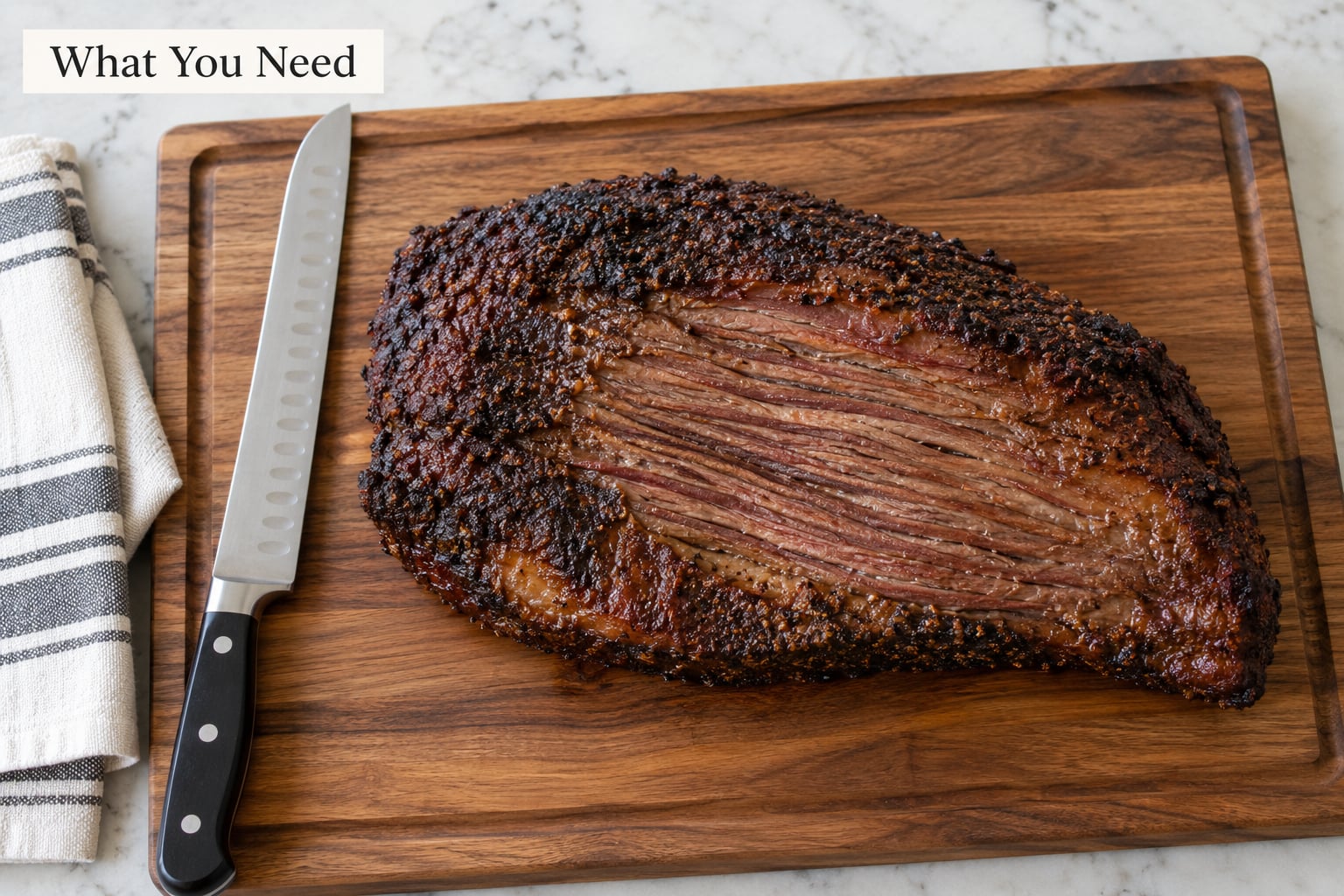
A long slicing knife between 10 and 14 inches is the tool that matters most. The length lets you cut through a whole flat in a single stroke without sawing back and forth, and a sawing motion is what tears bark and drags juice onto the board. A dull blade does the same thing, so sharpen before the cook, not after.
A cutting board with a groove or a damp towel underneath stops the brisket from sliding when you press down. This matters more than people expect: a brisket that moves halfway through a cut gives you a ragged, uneven slice.
Then there is the brisket itself, which needs one condition: it must be rested. Pull it out of the cooker, set it on a board or a platter, and leave it alone before the knife comes anywhere near it.
That is the whole kit. No special slicing gadget, no grain detector, no carving board gimmick. A chef’s knife will do the flat if it is at least 8 inches, but a dedicated slicing knife makes the job noticeably easier.
Step-by-Step: How to Slice Brisket Against the Grain
1. Let the Brisket Rest Before Slicing
Resting lets the muscle fibers relax and the juices redistribute instead of running out onto the board in the first cut. Cut straight out of the cooker and the brisket loses moisture exactly where you are trying to preserve it.
How long to wait depends on the style. Pull a whole packer brisket from a smoker or a 250 F oven and give it at least 30 to 60 minutes. A large cook often benefits from one to two hours. Competition cooks routinely hold a brisket for three to four hours in a closed towel-lined cooler and slice it cold the next day, which firms the muscle up and makes the cuts cleaner. Whatever window you have, the brisket should feel warm rather than scalding and the surface should stop weeping juice before you start.
The 4-2-10 rule is a reasonable backstop when you are planning a long cook: rest roughly four hours, or two hours per pound of raw brisket, on a hot brisket. It is a guideline, not a law, and a small flat is usually ready well before the two-hour mark.
2. Identify the Grain on the Cut
Brisket grain is far easier to read than grain on most other meat. Take the brisket to a window or a bright countertop and look at it from the top, the side, and each end. You are looking for faint parallel lines running through the muscle, the same direction as pencil lines or wood grain.
Start by finding the seam that runs lengthwise along the brisket. That seam is the boundary between the flat and the point, and it is usually visible as a line of fat. Once you find it, run a fingertip along each side of the seam and you will feel the fibers separately, changing direction as you cross from one muscle to the next. Each muscle has one grain direction of its own.
The bark will not help you here. Bark is a crust laid over the surface, so it can point any direction the pitmaster chose. Look at the cut faces instead, where the muscle fibers show as fine streaks, and check both the length and the height of the cut so you are not fooled by one view.
If you trimmed the brisket aggressively before cooking, that is normal. You are not trying to reconstruct the butcher’s original grain map, only the direction of the fibers in front of you now. A shallow notch scored into the meat before cooking gives you a reference point, and it is a habit some backyard cooks swear by.
3. How to Slice Brisket Against the Grain: Choose the Correct Direction
Cutting against the grain means every slice travels perpendicular, at a right angle, to the direction the fibers run. Here is where the two muscles split in terms and it is worth putting them side by side.
- Flat: grain runs left to right along the long length of the muscle. Cut down across the fibers, roughly a 90 degree angle from that length, at about 1/4 inch thick. This is the meat for plates and sandwiches.
- Point: grain runs the opposite way, front to back. Rotate the point about 90 degrees on the board, then cut across its fibers. Go slightly thicker here, about 1/4 to 3/8 inch, since the point carries more fat. It works well for soup meat, burnt ends, or the second half of a plate.
- Tip of the point: grain matches the rest of the point but narrows as the muscle tapers. Cross it the same way as you would the rest of the point. The tip is often dry, so trim and cube it rather than slicing it thin.
The flat is where beginners go wrong most often. It is tempting to slice down the length of the flat in neat even strips, and that is cutting parallel to the fibers. Look at the flat and cut from one long edge to the other, across the strands, so the cut face opens up into a wide slice.
Some pitmasters slice the flat on a slight diagonal instead of straight across, which lengthens each slice and catches more of the surface. Both work. A straight crosswise cut is easier to see and easier to keep consistent, and consistency matters more than style here.
Two established methods handle the point. Aaron Franklin’s approach treats the whole brisket together, cutting crosswise into sections and then slicing each section across its own grain. Jim Budros’ approach turns the point roughly 60 degrees on the board so the grain lines up with the flat’s cutting line. Both are correct. The only wrong answer is slicing the point in the same orientation as the flat and ignoring that the fibers turned.
4. Position the Brisket for Stable Cuts
Lay the flat on the board with its cut face level and the grain running left to right in front of you. If the piece rocks, put a folded damp towel under it or cut a thin flat side off the bottom so it sits flat. A brisket that wobbles is a brisket that will tear.
Think about where your knife will travel. If the fibers run left to right, the blade moves from front to back, cutting down and forward through the meat in one smooth stroke. Your non-knife hand rests on the top of the brisket with fingertips curled under and out of the way, guiding the blade rather than gripping the meat like a vice.
Keep the grain visible while you work. As slices come off, you can shift them to a second platter and keep the remaining piece angled so the fibers stay in view. Once you lose sight of the grain, you are guessing.
5. Make the First Cut and Continue Evenly
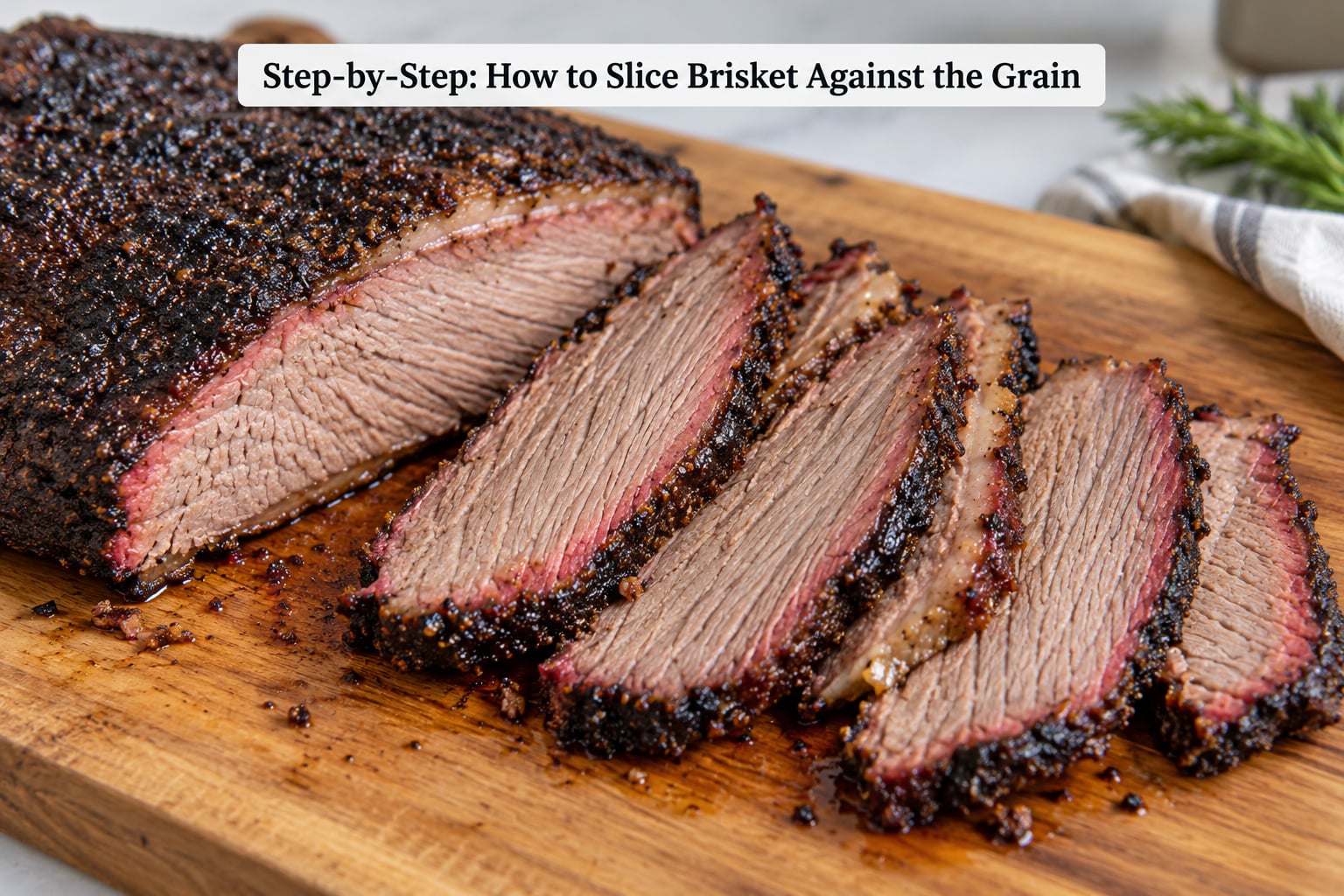
Start with a single confident slice about 1/4 inch thick, the width of a number two pencil. Hold the knife at a shallow angle and push it through with the full length of the blade, letting the edge do the work instead of your arm. No sawing, no rocking.
Set that first slice aside and look at it. The cut face should show the ends of the muscle fibers as tiny dots or flecks rather than long parallel strands. If you can see long strands running across the face of the slice, you were still cutting with the grain, so turn the meat and start again from that side.
Now continue down the flat at the same thickness, moving a finger-width each time. When you reach the seam, stop and move to the point. Rotate the point 90 degrees so its fibers run in the opposite direction, then repeat the same shallow, even strokes.
If the grain seems to change direction in the middle of a slice, look again rather than forcing it. Brisket is not a perfect rectangle and the fibers do curve around the heel of the point, where a slight diagonal will follow them better than a straight cut.
Common Mistakes
Slicing with the grain. The classic error, and it usually looks like neat, even strips cut down the length of the flat. The tell is a slice where you can see long strands running across the cut face. Fix: rotate the meat so the fibers run left to right, then cut from front to back. Remember that cutting with the grain is the same as serving a slice of rubber bands.
Cutting straight out of the cooker. The meat is hot, the fibers are tight, and the first slice loses all its juice to the board. Fix: rest at least 30 to 60 minutes, longer for a large packer.
Following fat seams instead of muscle fibers. A seam is a boundary between muscles, not an indicator of grain. Fix: read the fine parallel lines inside a single muscle and ignore the seams except as the place where you separate the flat from the point.
Slicing too thin. Paper-thin slices dry out on the platter and fall apart when you pick them up. Fix: aim for pencil width, about 1/4 inch, and err slightly thicker on the point.
Slicing too thick. Thick chops of brisket hide the effect of a good cut because the long fibers still run through the bite. Fix: if a slice is wider than about half an inch, thin it down.
Losing the grain around the point. The fibers change direction, and the heel curves. Fix: stop at the seam, rotate the point 90 degrees, and check the cut face of the first slice before continuing.
Using a dull or short knife. You end up sawing, which shreds bark and drags juice out. Fix: sharpen first, use a 10 to 14 inch blade, and cut in one stroke.
Tips
Slice only what you will serve in the next hour or two. Slices left sitting out dry out from the cut face, so bring the knife to the table or slice in smaller batches.
Store leftovers in a sealed container in the fridge and warm them gently in the oven rather than the microwave, which dries the edges out. Slice cold brisket straight from the fridge if you want maximum precision, then reheat the slices briefly.
Set the point slices with a little extra fat on top, or serve the bark-side slices first for the crunch and the moist slices after. Burnt ends come from cubing the point edges and returning them to the heat with sauce, which is a good use for any pieces too fatty or too irregular to slice cleanly.
If you bought a supermarket flat with no point muscle at all, do not let that stop you. Everything about identifying the grain and cutting perpendicular to it applies unchanged. You simply have one muscle instead of two, and the entire slab slices from one direction.
Frequently Asked Questions
How can I tell which way the grain runs in brisket?
Look at the cut faces of the meat, not the bark. Hold the brisket up to a window or bright light and look for faint parallel lines running through the muscle. Trace the seam that separates the lean flat from the marbled point, then check each side, because the fibers change direction across that line. If you can see long strands on a finished slice, you cut with the grain.
Should I slice brisket with or against the grain?
Always against the grain. Cutting perpendicular to the muscle fibers shortens them, so each slice is tender and easy to chew. Cutting parallel to the fibers leaves long strands running through the slice, which is why with-grain brisket feels stringy and tough even when the cook was perfect. One exception is brisket that was not cooked to tenderness, where slicing cannot rescue it.
Does the grain run the same direction on flat and point brisket?
No. The lean flat has fibers running along its long length, so you cut across that. The marbled point has fibers running the other way, so you rotate the point about 90 degrees before slicing it. This is the single most common slicing mistake: carrying the flat’s cutting angle straight into the point and producing stringy slices there.
How thick should I slice brisket against the grain?
About 1/4 inch, roughly the width of a number two pencil. On the flat, hold to that thickness for even bites that show off the cut. The point can run slightly thicker, around 1/4 to 3/8 inch, because it carries more fat. Anything under about an eighth of an inch dries out and falls apart, and anything over half an inch hides the effect of a good cut.
Should I slice brisket while it is hot or after it rests?
After it rests, never straight out of the cooker. Give a whole packer brisket at least 30 to 60 minutes, and up to two hours for a large one. Resting lets the fibers relax and the juices redistribute instead of running onto the board. Competition cooks often hold the brisket in a closed towel-lined cooler for several hours and slice it cold, which also gives the cleanest cuts.
What is the best knife for slicing a whole brisket?
A long slicing knife between 10 and 14 inches, kept sharp. The extra length lets you cut through a whole flat in a single stroke instead of sawing, which is what shreds bark and drags juice out onto the board. Use a push-and-draw motion with the full blade rather than a back-and-forth rock, and hold the meat steady with a damp towel under the board.
Conclusion
Find the fibers first, then turn the brisket so your knife crosses them instead of following them. Take one slice, check that the cut face shows flecks rather than long strands, and keep going at pencil width. That is the whole technique, and it works on a packer brisket, a supermarket flat, or an oven-roasted piece from any night of the week.