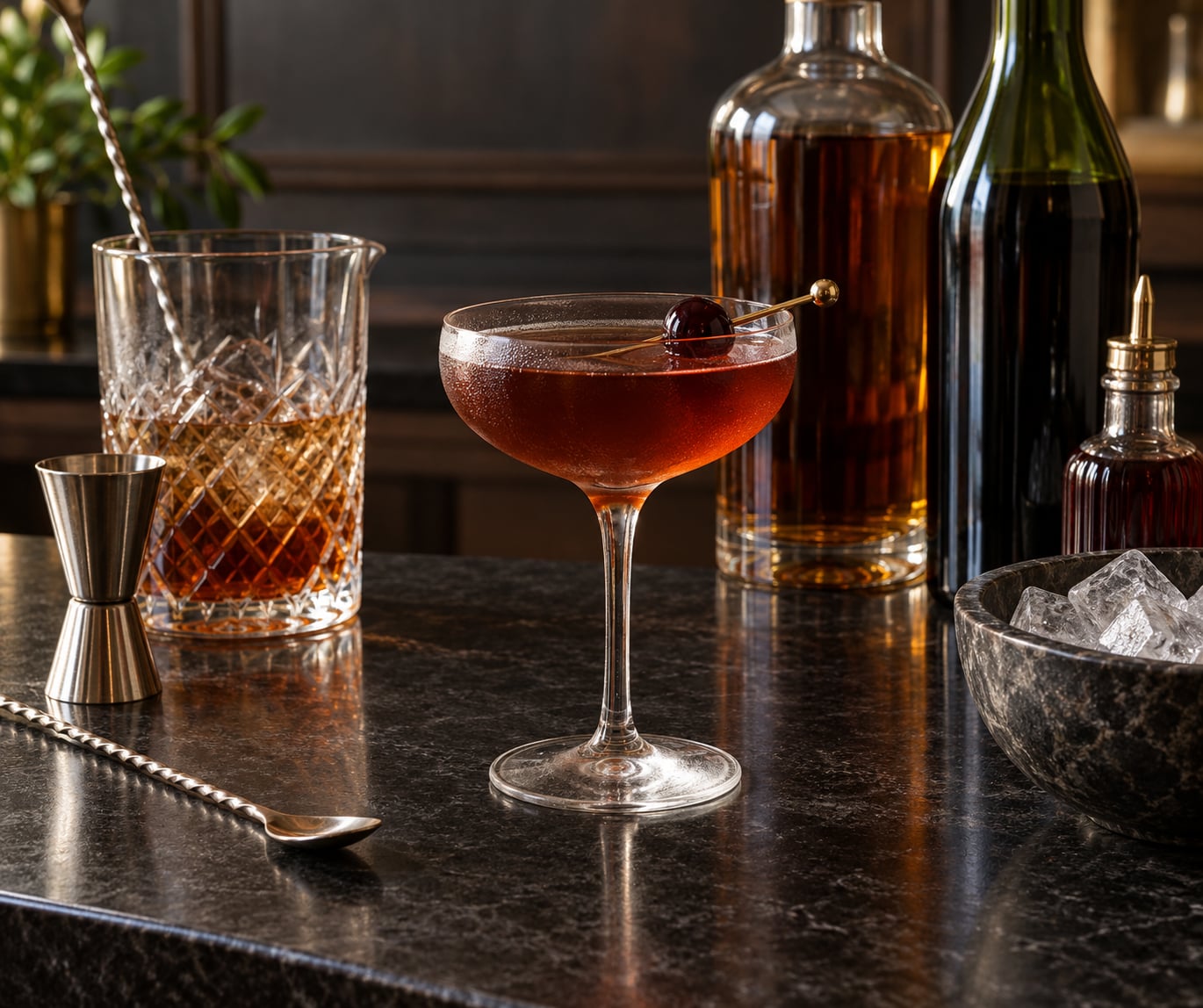
A Manhattan is three ingredients stirred with ice and strained into a cold glass: 2 ounces of whiskey, 1 ounce of sweet vermouth and 2 dashes of Angostura aromatic bitters. Learning how to make a Manhattan at home takes about five minutes, costs you nothing to practise, and needs no shaker.
The drink has nowhere to hide. There is no juice, soda or sugar to mask a bad ratio, which is why so many first attempts come out syrupy or warm. Get the measurements right, stir properly and the same three ingredients produce the cocktail that has barely changed since the 1880s.
Table of Contents
- What You Need
- Tools and Glassware
- Getting the Ratio Right When You Make a Manhattan at Home
- How to Make a Manhattan at Home: Step-by-Step
- 1. Chill the Glass and Measure the Ingredients
- 2. Combine the Manhattan Ingredients
- 3. Stir Until Properly Chilled
- 4. Strain, Garnish, and Serve
- Common Manhattan Mistakes and How to Fix Them
- Frequently Asked Questions
- What is the best whiskey for a Manhattan?
- Can I use dry vermouth instead of sweet vermouth?
- Should a Manhattan be shaken or stirred?
- How strong is a Manhattan compared with other cocktails?
- Can I make a Manhattan ahead of time?
- Conclusion
What You Need
The classic build is a 2:1 ratio of spirit to vermouth, plus bitters. That proportion comes from Harry Johnson’s 1882 bartenders manual, and it is still the standard most bars work from. Learn it there first, then adjust to taste.
- 2 oz (60 ml) rye whiskey — the spirit. It brings spice and structure.
- 1 oz (30 ml) sweet vermouth — a fortified, aromatized wine that brings body and sweetness.
- 2 dashes Angostura aromatic bitters — concentrated botanicals that tie the drink together. A dash is roughly 1/8 oz, poured freehand from the bottle spout.
- Ice — for stirring, plus a large cube or two if serving over rocks.
- A brandied cherry — Luxardo cherries are the standard. A plain maraschino cherry works in a pinch but leaves the drink thinner.
Vermouth is where beginners get stuck, because the shelf is full of options. Any sweet Italian or Spanish style works, and Carpano Antica, Cocchi Vermouth di Torino, Dolin Rouge and Punt e Mes are the bottles bartenders name most often. Sweet, not dry — dry vermouth is built for martinis and vermouth-laced drinks and tastes thin and sharp here.
Treat vermouth like wine once it is open. Store the bottle in the fridge with the cap on and use it within a couple of months; a warm kitchen bottle goes flat and oxidised, and that stale bottle is the number one reason a homemade Manhattan tastes wrong.
Tools and Glassware
You need a jigger, a mixing glass, a bar spoon and a strainer. Any strainer that holds ice back works; a Hawthorne strainer is the standard, but a julep strainer or even a slotted spoon in a pinch will do. No shaker, and no muddler — a Manhattan is never muddled.
For the glass, a chilled coupe or martini glass serves it up, and a rocks glass with one large cube serves it over ice. Chilling the glass first is not fussy detail; a room-temperature coupe can knock ten degrees off the drink before it reaches your mouth.
Getting the Ratio Right When You Make a Manhattan at Home
Two ounces to one ounce is the classic, but plenty of home bartenders go slightly stronger. Drinkers posting their specs on r/cocktails describe using anywhere from 2:1 up to 2.5:1 of rye to vermouth, and adding a few dashes of orange bitters alongside the Angostura. Once you know 2:1 cold, try 2.5:1 and see which one you prefer.
Measure with a jigger rather than by eye. Free-pouring is where most home drinks go wrong, and the difference between 1 and 1.5 ounces of vermouth is the difference between a drink and a dessert.
How to Make a Manhattan at Home: Step-by-Step
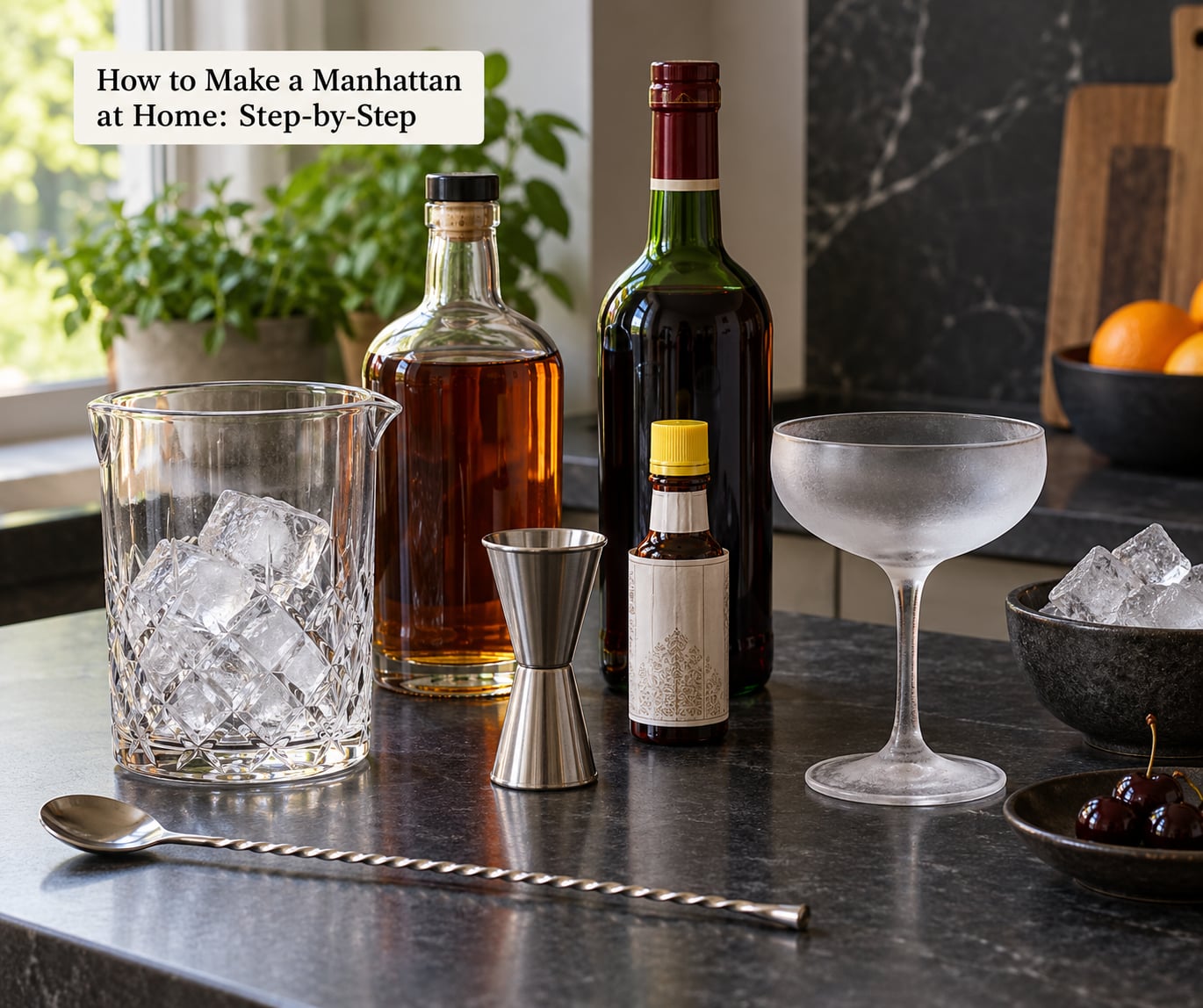
1. Chill the Glass and Measure the Ingredients
Put your serving glass in the freezer for five minutes, or fill it with ice and water and leave it while you work. Measure 2 oz of rye and 1 oz of sweet vermouth before you touch the mixing glass, so nothing sits and warms up while you hunt for the bitters.
2. Combine the Manhattan Ingredients
Fill the mixing glass halfway with cold ice. Add the whiskey, then the vermouth, then 2 dashes of Angostura over the top. Keep the order consistent; it matters less than the amounts, but it means every drink you make tastes like the last one.
3. Stir Until Properly Chilled
Stirring is the step that separates a good Manhattan from a warm one. Hold the spoon against the wall and rotate it briskly, keeping the ice moving as a column, and count about 30 stirs. Bar charts quoted by bartenders advise stirring a Manhattan roughly 30 percent less than you would a martini, aiming for a drink near 45F — properly cold, not slushy. Over-stir and the ice melts into a flat, watery drink.
4. Strain, Garnish, and Serve
Strain into the chilled glass, holding the spoon against the strainer so no ice chips follow the liquid. Add a brandied cherry, or express an orange peel over the surface and drop it in — rub the peel along the rim first and the oils wake up the nose. Serve immediately.
If you want the full bar-standard finish, use a bar spoon to slide a Luxardo cherry under the surface from the bottom. That detail is less about looks than keeping the cherry from floating and staining the glass.
Common Manhattan Mistakes and How to Fix Them
- Using dry vermouth. The drink comes out thin and harsh. Sweet vermouth is not optional in a classic Manhattan.
- Pouring too much vermouth. It reads as sweet rather than boozy. Measure it with a jigger and go back to 1 oz.
- Shaking instead of stirring. Shaking aerates the drink, dulling the aroma and making it feel thinner. Stir it.
- Serving it warm. Undiluted whiskey and room-temperature vermouth need a cold glass and a real stir. Chill both.
- Over-stirring. Thirty stirs is plenty. Going to sixty waters the drink down and flattens the whiskey.
- Skipped or stale vermouth. An open bottle left on the counter tastes sour and flat. Refrigerate it and replace it every couple of months.
- A cheap maraschino cherry. Standard cherries have no brandied fruit in them and dilute the glass. Use a brandied cherry.
- Too much garnish. A cherry plus a peel plus a mint sprig reads as decoration. Pick one.
On the same theme, if your drink tastes weak rather than sweet, the answer is usually dilution, not the whiskey. Under-stirring leaves the mix uneven and watery at the bottom of the glass. Stir steadily until the whole thing feels one temperature.
Frequently Asked Questions
What is the best whiskey for a Manhattan?
Rye is the traditional answer because its spicy, dry character cuts through the vermouth instead of adding to it. Rittenhouse, Bulleit Rye, Sazerac and Old Overholt are all reliable home-bar bottles. Bourbon works well too, and tastes a little rounder and sweeter, so many drinkers use a 2.5:1 ratio to compensate. Try both and pick the one you want to drink, not the one you think is correct.
Can I use dry vermouth instead of sweet vermouth?
You can, but it changes the drink into something closer to a Dry Manhattan, and the result is thin and sharp next to a classic. If dry vermouth is all you have, make it half sweet and half dry rather than swapping one for the other, and go a touch lighter on the vermouth. The sweet, fortified style is what gives the Manhattan its body and colour.
Should a Manhattan be shaken or stirred?
Stirred, always. Spirit-forward drinks with no citrus, egg white or sugar get stirred, because shaking whips air into the drink and dulls the aroma of the whiskey and vermouth. It also dilutes it faster than stirring does. About 30 stirs with cold ice gets you to the right temperature and dilution without losing the perfume.
How strong is a Manhattan compared with other cocktails?
It is a strong cocktail. Stirring with ice brings the finished drink to roughly 30 percent alcohol by volume, around twice the strength of most beer and a little less than a martini. Served in a coupe with plenty of food it is very manageable, but there is no juice or soda slowing it down, so pace yourself and skip the second pour immediately after the first.
Can I make a Manhattan ahead of time?
Yes, up to a few hours. Mix the whiskey, vermouth and bitters together without ice and keep it sealed in the fridge, then stir each serving with fresh ice right before pouring. That way the dilution happens at the last moment, which is what keeps it crisp. Do not mix it with ice and store it, and do not make it more than a few hours ahead.
Conclusion
Start with the measurement, because everything else follows from it: 2 ounces of rye, 1 ounce of sweet vermouth, 2 dashes of Angostura. Chill the glass, stir about 30 times with cold ice, strain and serve immediately with a brandied cherry. Once that drink tastes right, adjust the ratio and the whiskey until it is yours.