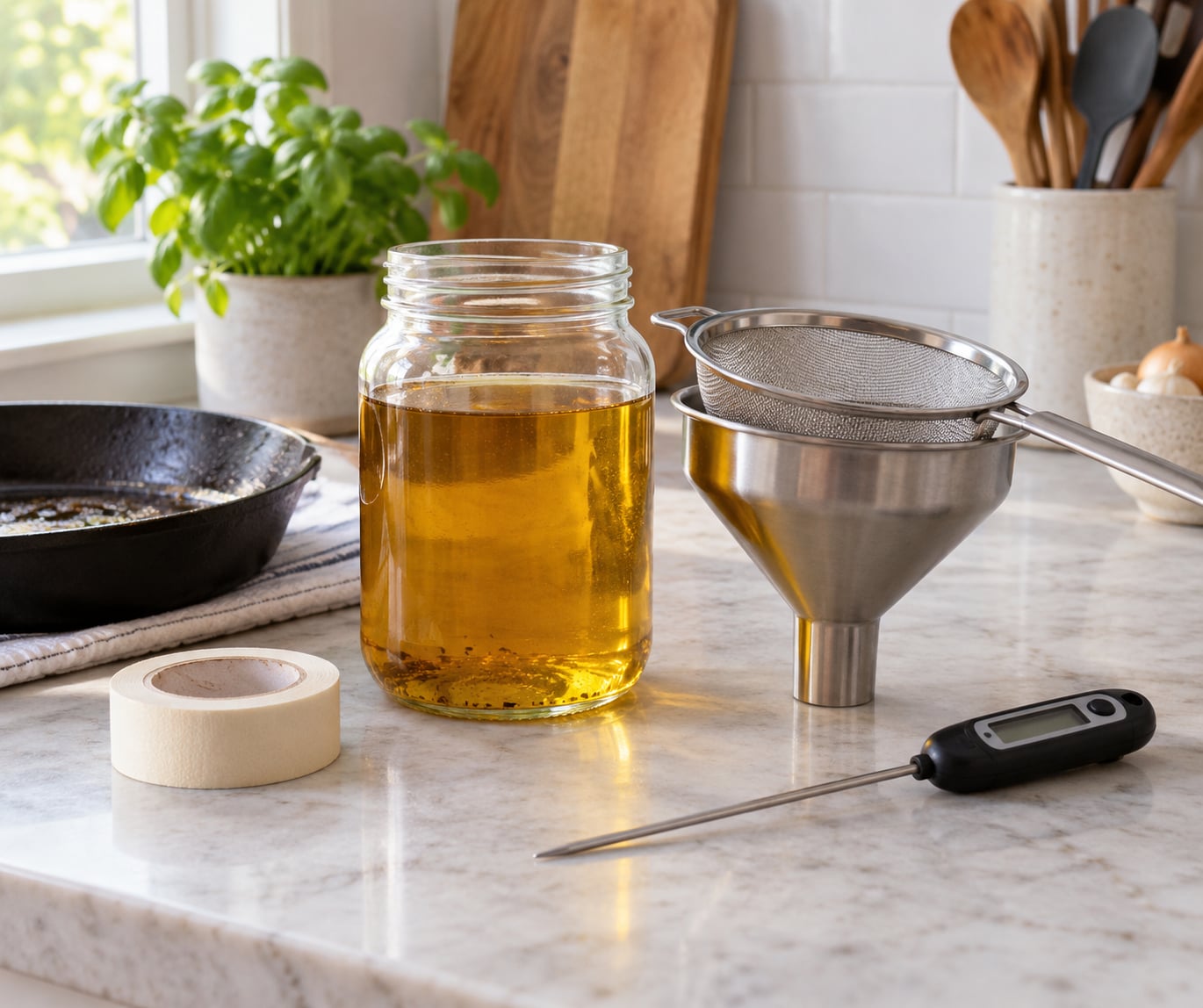
Yes, you can reuse frying oil, and most home batches survive two to five fry sessions if you handle them right. The method to reuse and filter frying oil safely is simple: let it cool completely, strain out every crumb, store it sealed in a cool dark place, and label the jar with the date and the number of uses. Skip the cooling or the labeling and the oil goes off far faster than the internet suggests.
The whole job takes about 15 minutes of hands-on time plus however long the oil needs to cool on the counter. The one rule that matters most is patience, because pouring hot oil into a jar or through a strainer is how people end up with a burned hand and a fried kitchen towel.
Last updated: October 2026
Table of Contents
What You Need
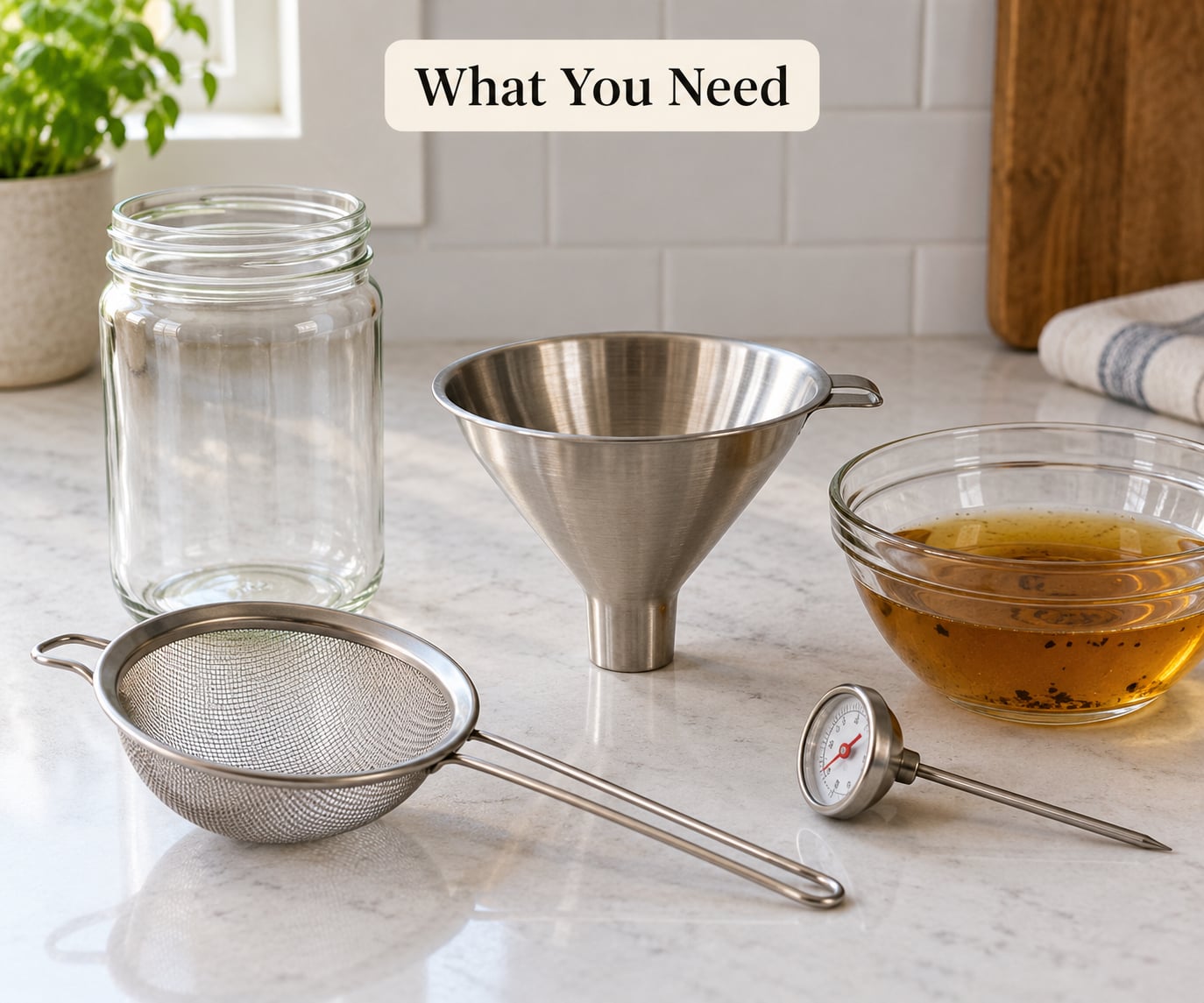
None of this is specialized gear, and most of it is already in your kitchen. The one piece worth buying is a proper fine-mesh strainer if you do not own one, because that is the tool that decides how much debris comes out.
- A heatproof storage container. A wide-mouth glass Mason jar is the classic choice, but any clean container rated for hot oil works. Skip thin plastic, and skip anything you would not pour hot coffee into.
- A fine-mesh strainer. Look for mesh small enough to hold a breadcrumb. A kitchen sieve with large holes catches almost nothing.
- Cheesecloth or filter paper to line the strainer, folded in a single layer so the weave stays open.
- A funnel that fits your container, or a strainer that rests on the jar rim without one.
- An instant-read thermometer. This is the one tool that turns guesswork into a number, both when cooling and when reheating.
- Masking tape and a pen for labeling the oil with its date, its last food and its use count.
- A spider or skimmer to lift crumbs out mid-fry, which matters more for oil life than any filter.
Which filter method should you use?
Cheesecloth works, paper towels work, and a coffee filter works in a pinch, but they are not interchangeable. This table compares the six common home methods on what each one actually catches, how fast it flows and where it earns its place.
| Method | What it catches | Speed | Best for |
|---|---|---|---|
| Fine-mesh strainer alone | Large crumbs, batter fragments | Fast | Quick jobs, a lot of oil |
| Fine-mesh strainer lined with cheesecloth | Crumbs plus fine sediment | Medium | The default home setup |
| Paper towel in a funnel | Crumbs, some fine particles | Slow | Small batches, no strainer |
| Fryer filter paper | Crumbs and fine sediment | Medium | Repeat fryers, closest to commercial |
| Stainless pour-over cone | Crumbs plus fine sediment | Medium | Coffee filter and mash users |
| Commercial filter pump | Everything, down to sediment | Fastest | Large volumes, small kitchens |
The decision rule is simple. If you fry a few times a year, the strainer lined with cheesecloth is plenty, and it costs almost nothing. If you deep-fry weekly with a countertop fryer, a stainless pour-over cone is the single upgrade most worth making, and it shows up in cooking groups constantly as the best home strainer. Commercial filter pumps belong to restaurant kitchens with far more oil than one meal needs.
One caution about the paper towel method: it is fast, cheap and fine in a pinch, but paper fibers left behind can smoke in the oil during the next fry. The first time you use it, run a small amount of the filtered oil through the strainer again to catch any stray fibers.
Step-by-Step: How to Reuse and Filter Frying Oil
1. Let the Oil Cool Completely
Turn off the burner and move the pan or fryer pot off the heat as soon as you are done. Let the oil drop to room temperature on a cool burner, which usually takes 30 to 60 minutes depending on how much oil and how deep the pot is.
You know it is cool enough when the container is comfortable to hold with a bare hand and the surface no longer sends up heat shimmer. If you want a number, aim for under 120F, and check with the thermometer rather than guessing from a wisp of steam.
Two things to avoid here. Do not pour oil that is still warm into a closed container, because a warm jar can crack and any water in the oil flashes into steam. And do not set a hot pot directly on a cold burner or cold countertop, which can warp the pan and, on some surfaces, crack the glass.
Hot oil is the single most dangerous part of this whole process. Water dripping in, steam pockets forming under a layer of oil, a strainer set on a wet counter, and a jar of hot oil on a slippery floor are all realistic ways to get burned. Work on a clear, dry stretch of counter, and keep kids and pets out of the kitchen while it cools.
2. Check the Oil Before You Reuse It
Cool oil is easier to judge than hot oil because you can pour a little into a clear glass and look at it in daylight. Smell it first, then look, then decide.
Signs the oil is still fine to use: it pours like a thin golden liquid, smells faintly nutty or neutral, and tastes clean on a spoon. A deeper amber color on its own is not a safety problem, it is a quality problem, and plenty of cooks fry with oil that has gone that far.
Signs to discard it: the oil is noticeably thicker and coats the side of the jar, it foams and will not settle, it throws a haze or smoke before it reaches frying temperature, it smells stale, musty, sour or paint-like, or there is bitter sediment on the bottom. That last smell is called rancid, and it is the clearest single signal that the oil has oxidized.
There is a practical test that beats any rule of thumb. If you would not be happy to pour fresh oil from the bottle into the same pan right now, this oil has reached the end of its useful life. The cooking forum crowd tends to use a similar visual rule, reusing oil until it looks really dark with burnt pieces floating in it, which is a fine starting point even though it runs a little past conservative for some oils.
One more check that costs nothing: sniff for fish. Oil that fried salmon or shrimp will smell faintly of fish for a while, and that flavor carries straight into the next food. It is perfectly safe, just wrong for doughnuts and sweets.
3. Filter the Oil Thoroughly
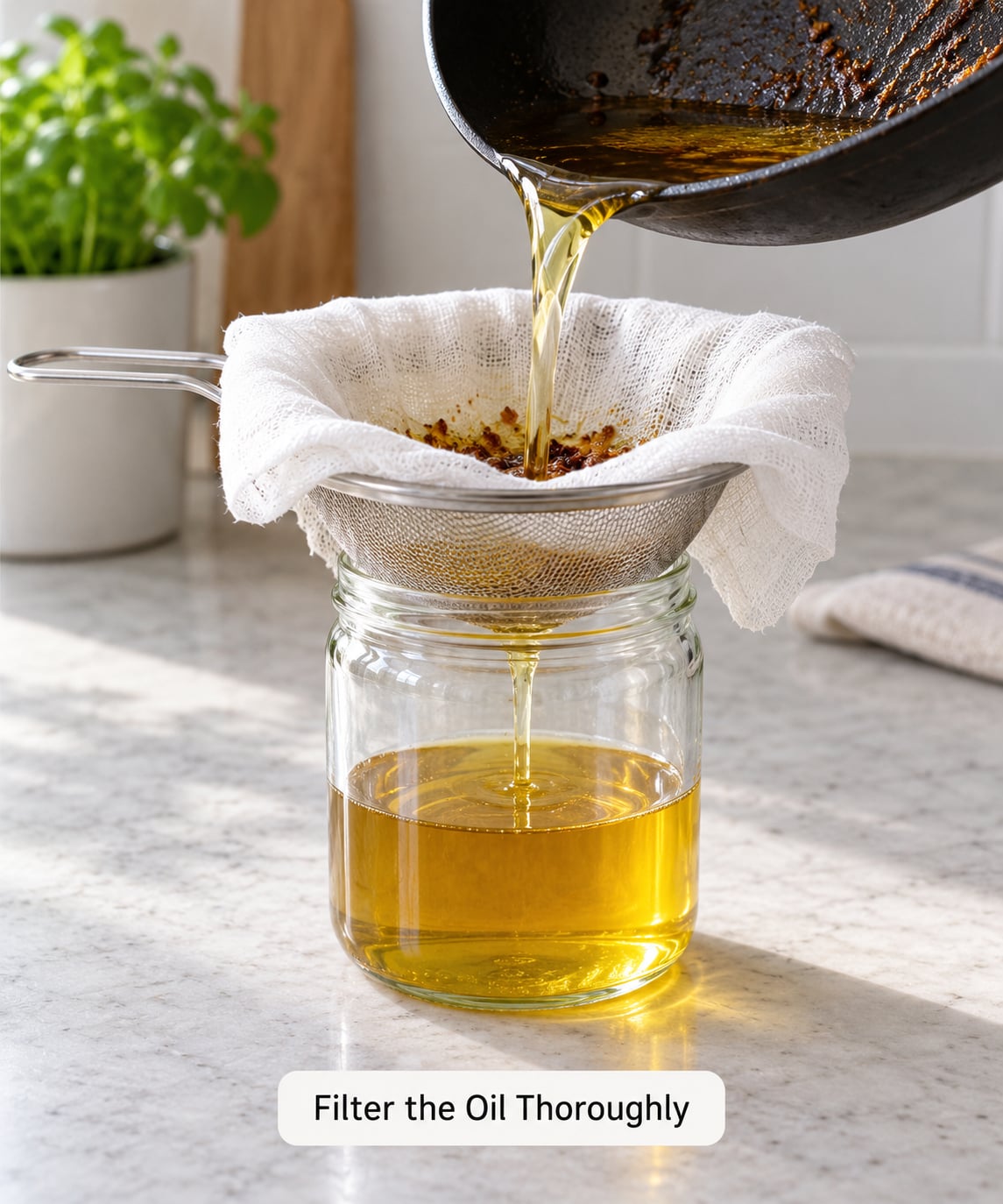
Warm oil filters faster than cold oil, so filter it once it is comfortably handleable but before it has gone completely cold. Set your fine-mesh strainer over a funnel or directly on the jar rim, and line the strainer with a single layer of cheesecloth or a sheet of fryer filter paper.
Pour slowly in one continuous stream and let it run through without pressing on the sediment. If you push the crumbs down into the jar, you have simply relocated the problem, and those crumbs are what scorch on the next fry and turn the oil bitter.
Sediment is where most of the damage hides. Water and food particles settle into the bottom layer, free fatty acids collect there, and that dark sludge is the fastest route to a ruined batch. Wipe the settled layer out of the container with a paper towel before you put the oil away.
Does oil pass through filter paper? Ordinary paper towel and coffee filters slow the flow dramatically and will clog on a large batch, but they do stop the particles, and for a cup or two of oil that tradeoff is fine. Dedicated fryer filter paper is thicker and designed for the job, and if you fry regularly it is the better buy. Ordinary coffee filters are the most likely to end up with a waxy papery taste in the oil, so I would not use them on anything you plan to fry in repeatedly.
You can tell it worked when the oil coming out of the strainer runs clear and light in color against a white background, and when the cheesecloth comes away holding dry crumbs rather than a wet paste. If the oil is still cloudy, run it through the strainer a second time.
4. Store It in the Right Conditions
Transfer the filtered oil into a clean, heatproof, airtight container and seal it. Opaque glass or a container kept inside a closed cupboard is better than a clear jar on open shelving, because light is one of the three things that drives oil breakdown, along with heat and air.
Keep it away from the stove. A cupboard a few feet away is fine, but a shelf directly above the range heats up every time you cook, and that is a warm spot you do not need. Heat and air are what turn oil rancid; cool and sealed is the whole storage brief.
Label the container with three things: the date, what it was last used for, and the number of uses. Masking tape and a Sharpie are perfect. This takes ten seconds and it solves the single most common problem home cooks report, which is a row of jars on the counter with no idea which one is which or how old they are.
4b. How long can you keep it that way?
| Where you store it | Roughly how long it stays good |
|---|---|
| Counter, sealed, in a cool kitchen | Several days, maybe a week |
| Cool dark cupboard | A couple of weeks |
| Refrigerator, sealed | A couple of months |
| Freezer, sealed in portions | Several months, longest life of all |
Refrigerating is the best answer for most people who fry more than once a month. Let the jar come to room temperature before you open it, because cold oil pulls moisture from the air into the jar the second you crack the seal, and that water is what makes oil foam and spit on the next fry.
Freezing works well if you portion the oil into containers with an inch or two of headroom, because oil expands as it freezes and will push a tight lid off. Thaw it in the refrigerator overnight, never on the counter.
And do not top up an old jar with fresh oil from the bottle. You are welcome to add new oil to the pan alongside old oil for one fry, which thins it and speeds things up, but mixing them in storage just gives the new oil a shortened life too.
5. Reuse It at the Right Temperature
Pour the oil back into your pan, set it over medium heat, and bring it up slowly to 350F for most foods. Rushing the heat is what produces the grey haze and acrid smell that people blame on the old oil when the old oil is actually fine.
If the oil smokes before you have food in it, turn the heat down and let the temperature come back. Repeatedly overheating oil drives off the compounds that give fried food its flavor and starts the breakdown that ends its usable life. Keeping the temperature steady between 325F and 375F is the single best habit for getting more fries out of one batch.
How many times can you reuse frying oil?
| What you fried | Reasonable number of uses |
|---|---|
| Fries, chips, tater tots | 3 to 5 |
| Battered food such as tempura | 2 to 3 |
| Breaded or battered food such as fried chicken | 1 to 2 |
| Well-handled neutral oil, filtered after every session | 8 or more |
The reason breaded and battered food gets the shortest run is the coating itself. Batter and breadcrumbs carry a lot of water into the oil, and water is what accelerates degradation, foaming and polymerization, the process where oil molecules link together and thicken.
Match the food to the oil as well as the number. Oil used for fried chicken is great for fries, for a second round of chicken, and for seasoning popcorn, which is the most popular tip in the cooking groups I read on this. The rule people over-worry about is direction: sweet then savory is fine, savory then sweet is not, because doughnuts and crullers should never be fried in oil that has seen fish or onion.
Two habits stretch the range. Pat food dry before it goes in, since surface water drops the temperature and makes the oil sputter, and keep the pan no more than two-thirds full so the temperature recovers fast.
Common Mistakes
Almost every problem with reused oil traces back to one of these. The fix is usually cheap and takes under a minute.
Filtering or storing oil while it is still hot. This is the burn and fire risk, and it is also the reason jars crack. Wait until the container is comfortable to hold and check under 120F with your thermometer if you are unsure.
Storing oil on the counter near the stove. Heat and light are the enemies. A closed cupboard in a cool kitchen is fine for a week or so, and the refrigerator is better for anything longer.
Forgetting to label the jar. You will absolutely not remember which one is the three-week-old chicken oil. Date, food, use count. Ten seconds now saves a wasted batch later.
Reusing oil that smoked heavily or caught fire. If oil smokes before it reaches frying temperature, or if it ever ignites, the high-heat breakdown products including acrolein are well past the level you want in food. That batch is finished, and the pan needs scrubbing too.
Forcing sediment through the filter or skipping filtration entirely. Debris in the pan burns, and burnt debris is the fastest route to a bitter batch. Skim crumbs with a spider during the fry, let the oil settle, then strain.
Overloading the pan. A crowded pot drops the oil temperature, which soaks oil into the food instead of sealing the crust, and the food you lift out comes out greasy. Two-thirds full is the working rule.
Pouring old oil down the drain. This is the most common expensive mistake in the whole topic. Oil congeals inside the pipe, mixes with the soap and wipes, and turns into a blockage that no plunger will move.
Confusing a dark color with a safety problem. Amber oil is usually just aged oil, and it will still fry food well. The things that mean discard are thickness, foam that will not settle, smoking early, and that stale or sour smell.
Two questions come up constantly in kitchen forums, so here is a straight answer for both. Can bacteria grow in used cooking oil? Oil itself is inhospitable to bacterial growth, but the water and protein left over from frying is not, and those particles are what you are filtering out, which is why the sediment at the bottom gets discarded rather than scraped back in. And can you reuse oil that sat out overnight? A few hours on a cool counter is fine, but oil that sat out on a counter all night or for days at room temperature should be discarded, especially if it was unfiltered, because the food particles in it had hours to warm up and grow. Bring the pot back into the kitchen in front of you, smell it, and make the call from there.
When oil really is finished, the disposal route takes five minutes. Mix in a spoonful of gelatin or an absorbent powder sold for this purpose and stir until the oil thickens and solidifies, seal it in a sturdy container or bag, and put it in the trash. Never pour it down the drain, and do not skip the sealing step, since liquid oil in the garbage is a mess for whoever collects it. Where recycling drop-offs for used cooking oil exist locally, they will take the clean oil directly, and a quick search of your city or county name plus cooking oil recycling will usually find one.
And do not waste good oil just because it is no longer deep-fry quality. Oil past its frying peak is perfectly good for sautéing vegetables, roasting potatoes, brushing onto bread, or making a vinaigrette.
Frequently Asked Questions
How long can used frying oil be stored before it needs to be discarded?
A few days sealed on a counter in a cool kitchen, a couple of weeks in a dark cupboard, a couple of months in the refrigerator, and several months in the freezer. Always label the jar with the date, the food and the use count, and smell it before each fry.
What is the best way to filter frying oil at home?
Pour the cooled oil through a fine-mesh strainer lined with a single layer of cheesecloth or fryer filter paper, and let it run without pressing on the sediment. Wipe out the settled sludge afterward. It is the single most useful habit for extending the life of the oil.
How many times can I reuse the same frying oil?
Three to five uses for fries and other light frying, two to three for battered food, and one to two for breaded or battered food such as fried chicken. Well-handled neutral oil that is filtered and stored cool after every session can go further, but the smell test decides it, not the count.
Can I reuse oil that smells slightly smoky?
A faint clean aroma is normal for any oil that has been fried in. A stale, musty, sour or acrid smell means the oil has oxidized and should be discarded. Smoke you can see in the pan is a different signal entirely, and it means turn the heat down before you cook in it.
Which oils are best for repeated frying?
High smoke point refined oils hold up best because they resist the heat that degrades them. Peanut oil smokes around 450F, sunflower around 440F, and canola and standard vegetable oil around 400F. Extra virgin olive oil has a lower smoke point and a stronger flavor, so it suits shallow frying better than repeated deep frying.
How should old frying oil be disposed of safely?
Never pour it down the drain, where it solidifies and blocks the pipe. Stir in gelatin or an absorbent oil solidifier until the oil thickens, seal it in a bag or container and put it in the trash, or take the clean oil to a local cooking oil recycling drop-off.
In Short
Let the oil cool completely before you touch it, and discard the batch if it has thickened, foams, smokes early or smells stale. Strain it through a fine-mesh strainer lined with cheesecloth, seal it in a heatproof container away from heat and light, and label it with the date and the use count. Then bring it back up to 350F slowly next time, and skim crumbs out during the fry. That is how to reuse and filter frying oil without wasting a drop or wrecking a meal.