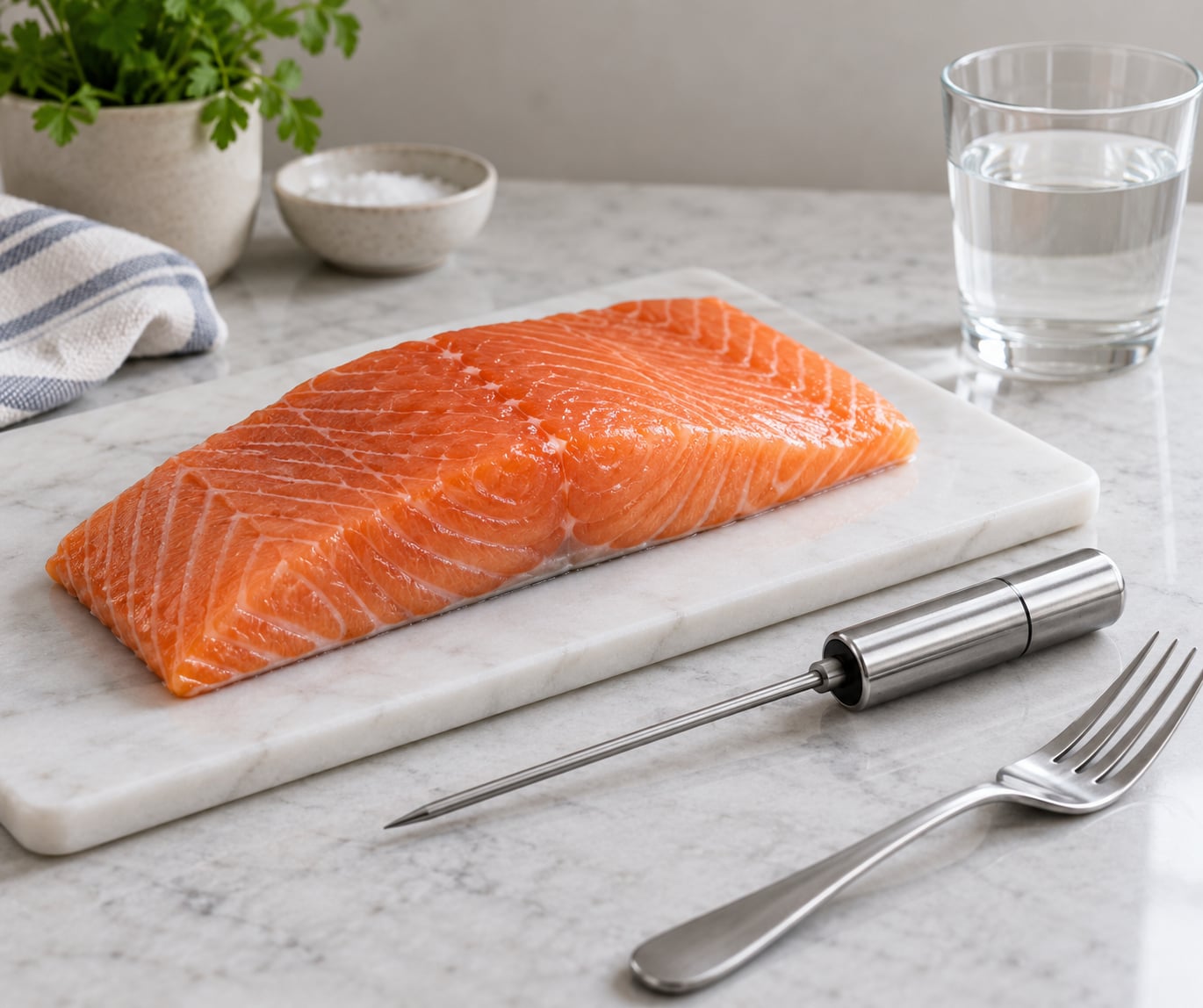
Salmon is done when the thickest part of the fillet reads 125 to 130°F (52 to 54°C) on an instant-read thermometer, or, without one, when the flesh turns from translucent dark pink to opaque light pink and a fork slides in and separates it into moist flakes. The USDA safe minimum for fish is 145°F (63°C). Updated for 2026.
That answer is the whole thing, but the gap between 130°F and 145°F is where a lot of home cooks lose good fish. Salmon is lean, so it has almost no window between raw and dry. It can go from perfect to overcooked in about two minutes at the tail of the cooking time.
This guide walks through four checks — temperature, appearance, texture, and flake — and then the mistakes that trip people up most. If you only remember one thing: start your cooking time short, then check early and often. The recipe time is a suggestion; the thermometer is the decision.
Table of Contents
- What You Need
- Step-by-Step: How to Tell When Salmon Is Done Cooking
- Common Mistakes
- Frequently Asked Questions
- What temperature should salmon reach when it is done?
- Is salmon supposed to be pink in the center?
- How can I tell if salmon is overcooked?
- Should I check the temperature of frozen or thawed salmon?
- Does the safe cooking temperature change by cooking method?
- Can I use a fork test instead of a thermometer?
- Conclusion
What You Need
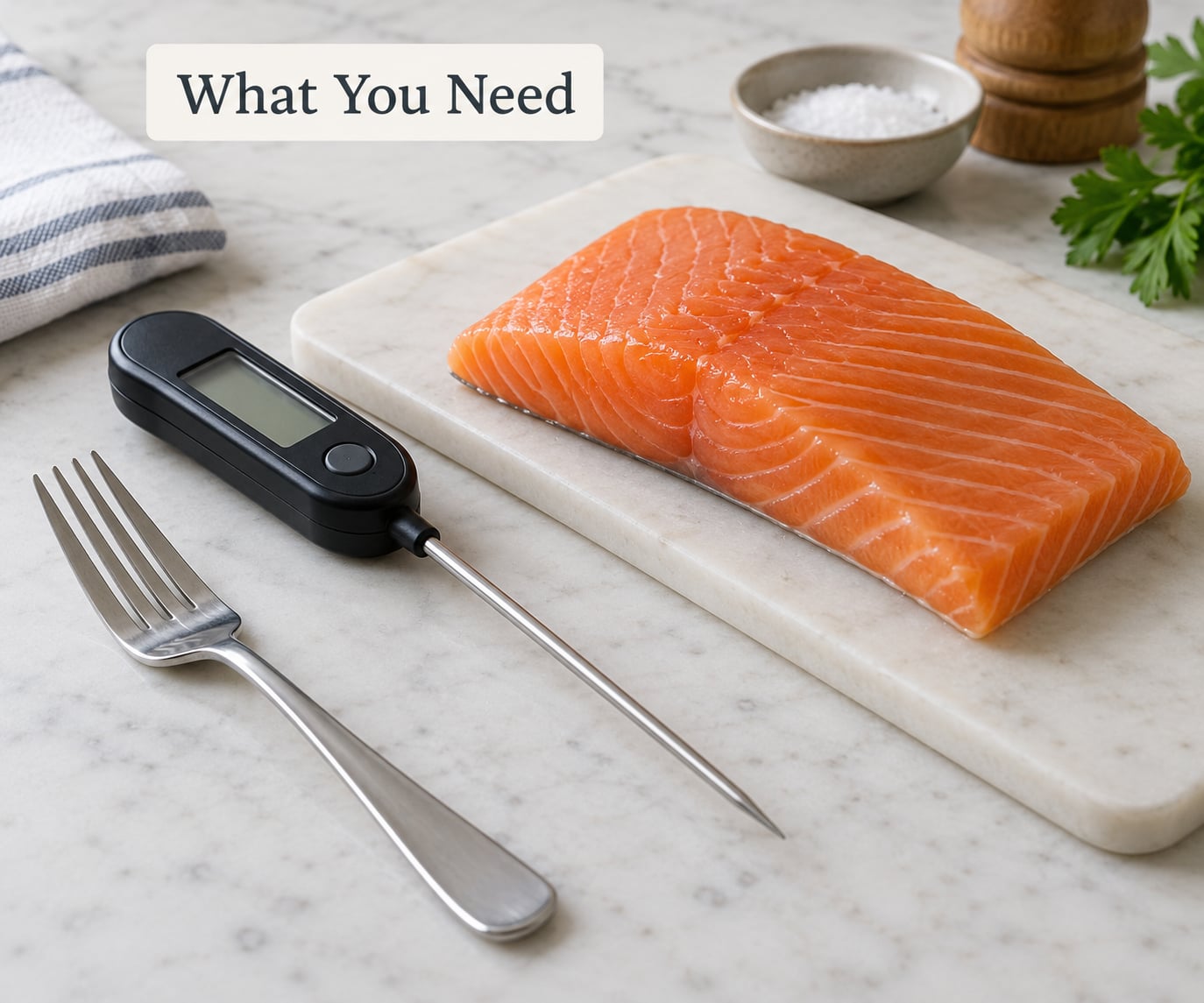
You do not need a pile of equipment, but you do need one thing most home cooks skip: an instant-read thermometer. Everything else on this list is optional or already in your kitchen.
- Instant-read thermometer with a thin probe. A thin probe reaches the center of the fillet without leaving a big hole, and an instant read lets you check without pulling the fish out of the oven. This is the single most useful tool for the job.
- A fork. The flake test is the best backup when you have no thermometer, and it is a good second opinion even when you do have one.
- A heat-safe board or plate. Resting the fish on a warm surface matters more than resting it on a cold cutting board, which pulls heat back out of the fish.
- Probe wipes or a glass of water. If you are checking several pieces of fish in a row, clean the probe between them so you are not carrying flavors or bacteria from one fillet to the next.
- Paper towels and foil. For the rest, and for blotting surface moisture before searing.
One optional tool deserves a warning. Infrared thermometers read the surface only, so they will tell you the temperature of the browned top of the fish, not the center. On a fillet they will read high, sometimes by 20°F or more. Use one for steak or a seared crust, never for deciding whether a fillet is done.
Step-by-Step: How to Tell When Salmon Is Done Cooking
1. Choose the Cut and Cooking Method
Cooking time follows thickness, not recipe slogans. A 1-inch tail-end fillet and a 1.75-inch center-cut steak can sit in the same 400°F oven, but the steak needs roughly twice as long to reach the center temperature the thin fillet hit long ago.
Species changes things too. Farm-raised Atlantic salmon carries more fat and stays moist through a wider window. Wild sockeye is lean and dense, and it moves from done to dry faster than anything else on the counter. Chinook and coho sit in between. When a recipe gives you a time, assume it means a standard 1 to 1.25-inch fillet unless it says otherwise.
Here is a starting point. Every method below assumes a 1 to 1.25-inch fillet, and every one of them ends the same way: check the temperature early rather than trusting the clock.
| Method | Heat | Starting time | First temperature check | Notes |
|---|---|---|---|---|
| Pan-sear, skin side down | Medium-high | 6 to 8 minutes skin down | At 5 minutes | Then 2 to 3 minutes on the flesh side |
| Oven | 400°F | 10 to 12 minutes | At 8 minutes | Conventional or convection; convection runs faster |
| Convection oven | 400°F | 8 to 10 minutes | At 6 minutes | Hot pan, short time |
| Grill | Medium-high, oiled grates | 4 minutes per side | After the first side | Move off the heat to check |
| Broil | High | 7 to 10 minutes | At 6 minutes | Pull at the first sign of opacity |
| Air fryer | 400°F | 8 to 10 minutes | At 7 minutes | Thicker cuts need 12 or more |
| Sous vide then torch | Water bath 120 to 125°F | 25 to 30 minutes | At 25 minutes | Torch or sear for surface only |
Thicker cuts take longer, but not in a straight line. A rough guide: add about 2 minutes per extra half inch of thickness for oven and pan methods, and check the center rather than the surface.
2. Check the Internal Temperature
Insert the probe into the thickest part of the fillet, about an inch in from the edge, and angle it slightly downward. Avoid bone, the skin, and the pan or rack, any of which will give you a false reading.
Wait for the number to stop moving. Most digital probes settle within a few seconds, and reading early on a thin fillet can cost you several degrees.
Here is where the two temperature numbers meet, and it is worth holding both at once:
- 125 to 130°F (52 to 54°C) is where salmon is moistest and most forgiving. Most cooks I know, including a lot of Alaska and Oregon fishers pulling their own catch, land here and rest the fish.
- 145°F (63°C) is the USDA safe minimum internal temperature for fish and shellfish. It is a safety floor, not a quality target.
- 135°F (57°C) sits in between and is perfectly safe; the fish is firmer and drier than at 130.
If you want both numbers satisfied, cook to 145°F and the fish will still be perfectly edible, just tighter and less moist than it needed to be. That is the trade most people would rather not make.
| Doneness | Internal temperature | Color | Fork and texture | Verdict |
|---|---|---|---|---|
| Raw | Below 115°F | Translucent dark pink to red | Firm, rubbery, springs back hard | Not ready |
| Medium-rare | 115 to 120°F | Mostly opaque at the edges, still translucent at the very center | Fork slides in, layers part but stay connected | Very moist, still soft in the middle |
| Medium | 125 to 130°F | Opaque light pink throughout | Fork separates into clean moist flakes along the white lines | The sweet spot for most cooks |
| Medium-well | 135 to 140°F | Pale pink to beige, firm looking | Resists slightly, then gives; flakes hold shape | Safe and noticeably drier |
| Well-done (USDA) | 145°F | Uniformly opaque, pale | Firm all the way through, flakes but tight | Safe minimum, least moist |
| Overcooked | Past 150°F | Chalky white, dry, white protein flecks on the surface | Falls apart, no spring, dry mouthfeel | Past saving |
Pull three to five degrees early and let the heat finish the job. That gap is called carryover cooking: the hot pan and the hot outer layers keep pushing heat toward the center after the fish leaves the heat. A fillet pulled at 125°F often lands near 130°F on the plate. If you pull at 145°F, expect closer to 150°F when it reaches the plate.
3. Look for the Right Appearance
Color is the weakest of the three signals, but it is a useful one when you know what to look for. Raw salmon is translucent and deep pink or red, and you can see light through the flesh near the thin edges. Cooked salmon is opaque, lighter pink, and you cannot see through it at all.
Undercooked fish still shows a translucent, glassy band right at the center of the thickest part, even though the outside looks cooked. That band is the single clearest visual sign that you need more time. If the center is glassy and slightly darker than the surrounding flesh, it is not done.
You may also see little white flecks or a white film on the surface of cooked salmon. Most people assume this is rendered fat. It is not. Those flecks are albumin, a clear liquid protein in the flesh that heat squeezes out and that turns white as it cooks. That distinction matters because the same squeeze-out happens to the moisture inside the fish, which is why overcooked salmon goes dry. The more flecks you see, the more moisture has left.
A pink center is not automatically a problem. Salmon varies a lot in natural color, and sockeye stays noticeably darker and pinker than Atlantic even fully cooked. Judge the center by opacity and texture, not by how pale it looks.
4. Test the Texture and Flaking
The fork test is the most reliable check when you have no thermometer, and it takes about five seconds. Press lightly on the thickest part with the flat of the fork first, then slide the tines in along the direction of the muscle and lift gently.
At doneness, the fork slides in with little resistance and the salmon separates into distinct, moist layers that follow the white muscle lines. The flesh gives a firm but yielding spring under pressure, then relaxes. If the salmon flakes apart on its own before you touch it, it has gone past where most people want it.
Watch for the flip side. Mushy texture that falls apart into wet shreds is not a sign of a delicate, well-cooked fish, even though beginners often read it that way. It is a sign of overcooking. Truly overcooked salmon goes dry, tight, and chalky, and it can squeeze out a lot of water when you cut it.
5. Rest, Serve, and Recheck If Needed
Rest the salmon five to ten minutes on a warm plate, loosely tented with foil. Resting does two things: it lets the carryover heat finish moving toward the center, and it lets the muscle fibers relax so the fish stops shedding moisture when you cut it.
If you checked early and the fish was not done, put it back for another minute or two and check again. Salmon reheats gently and a minute of oven time rarely ruins a piece that was close. If you already served it slightly under, a quick sear in a hot pan or a few seconds under the broiler fixes the surface without cooking the center further.
For leftovers, reheat to 165°F (74°C), the USDA recommendation for reheating cooked fish. Cover it loosely so it does not dry out while it heats.
Common Mistakes
Almost every overcooked fillet traces back to one of a handful of habits. These are the ones I see repeatedly.
Cooking to the recipe time instead of the temperature. Recipe times are written for an average fillet in an average oven. Start your timer, but check the fish two minutes before the stated time. If it is already at 130°F, you are done.
Reading the thin end of the fillet. The tail is always done before the thick part, so it will read done while the center is still raw. Push the probe into the thickest section, near the front third of the fillet.
Letting the probe touch bone, skin, or the pan. Bone and metal conduct heat and give false-high readings, which is how a well-done-looking fillet ends up dry. Angle the tip into the meat.
Trusting color alone. Salmon varies hugely in natural color, and a glazed or seasoned fillet can look pale on the outside while running cool in the middle. Opacity at the center plus the flake test is a better signal than any single hue.
Cutting into the fish to peek. Every cut lets juices run out, and on a lean fish like salmon that loss is permanent. Use a thermometer or the fork test instead. Both work through the surface without opening the flesh.
Using an infrared thermometer. It measures the browned surface, not the center, and on salmon it commonly reads well above the internal temperature. Fine for a seared crust, useless for doneness.
Confusing frozen and thawed thickness. Frozen fish takes longer to cook partly because it starts below refrigerator temperature. Check the temperature earlier than the recipe suggests, and thaw in the fridge overnight if you can.
Overcooking is the mistake that ruins salmon most often, and it is a habit rather than a lack of knowledge. Dryness, not pinkness, is what makes people quit a piece. If you pull a little early and rest the fish, you can always send it back for a minute; you cannot add moisture back once it is gone.
Frequently Asked Questions
What temperature should salmon reach when it is done?
For the best texture, pull salmon when the thickest part reads 125 to 130F (52 to 54C). The USDA safe minimum internal temperature for fish is 145F (63C). Because carryover cooking keeps raising the temperature after you pull the fish, many cooks take it out three to five degrees below their target and let it finish on the plate.
Is salmon supposed to be pink in the center?
A little pink is usually fine, especially with darker fish like sockeye, which stays pink even when fully cooked. What matters is opacity: cooked salmon no longer looks translucent or glassy. If the center is pale pink but fully opaque and it flakes into moist layers, it is done. A translucent, glassy center means it needs more heat.
How can I tell if salmon is overcooked?
Overcooked salmon turns pale, chalky, and dry, with white protein flecks on the surface and a tight texture that falls into shreds instead of clean flakes. It often squeezes out water when you cut it. Once the flesh has lost its spring and the flakes crumble rather than separate, you cannot fix it, so watch the temperature and pull early next time.
Should I check the temperature of frozen or thawed salmon?
Check it either way, but start earlier for frozen fish, since it begins well below refrigerator temperature and takes longer to heat through. A thawed fillet cooks closer to the stated recipe time. Note that cooking from frozen makes it very hard to hit a narrow window, so thawing in the fridge overnight gives you far better control of the final temperature.
Does the safe cooking temperature change by cooking method?
No. The target internal temperature is the same for pan-seared, baked, grilled, broiled, air-fried, and sous vide salmon, because what matters is the temperature in the thickest part. The methods differ only in how fast they get there. Hard, dry heat such as broiling pushes the surface past done quickly, which is why those pieces need an early check.
Can I use a fork test instead of a thermometer?
Yes, and it is the best check available without a thermometer. Slide a fork into the thickest part along the muscle and lift gently. Salmon is done when it slides in with little resistance and separates into moist layers along the white lines, with a firm but yielding feel. Color alone is not enough, because salmon varies naturally from pale to deep red.
Conclusion
Here is the whole sequence. Check the thickest part with an instant-read thermometer and pull at 125 to 130°F, keeping the USDA minimum of 145°F in mind if you want to be strictly conservative. Confirm the flesh is opaque and flakes into moist layers under a fork. Rest it five to ten minutes, loosely tented, and let carryover heat finish the center.
Most importantly, start your cooking time short and check early. Salmon goes from done to dry faster than any other fish on the counter, and the cooks who nail it every time are the ones who stopped trusting the clock.