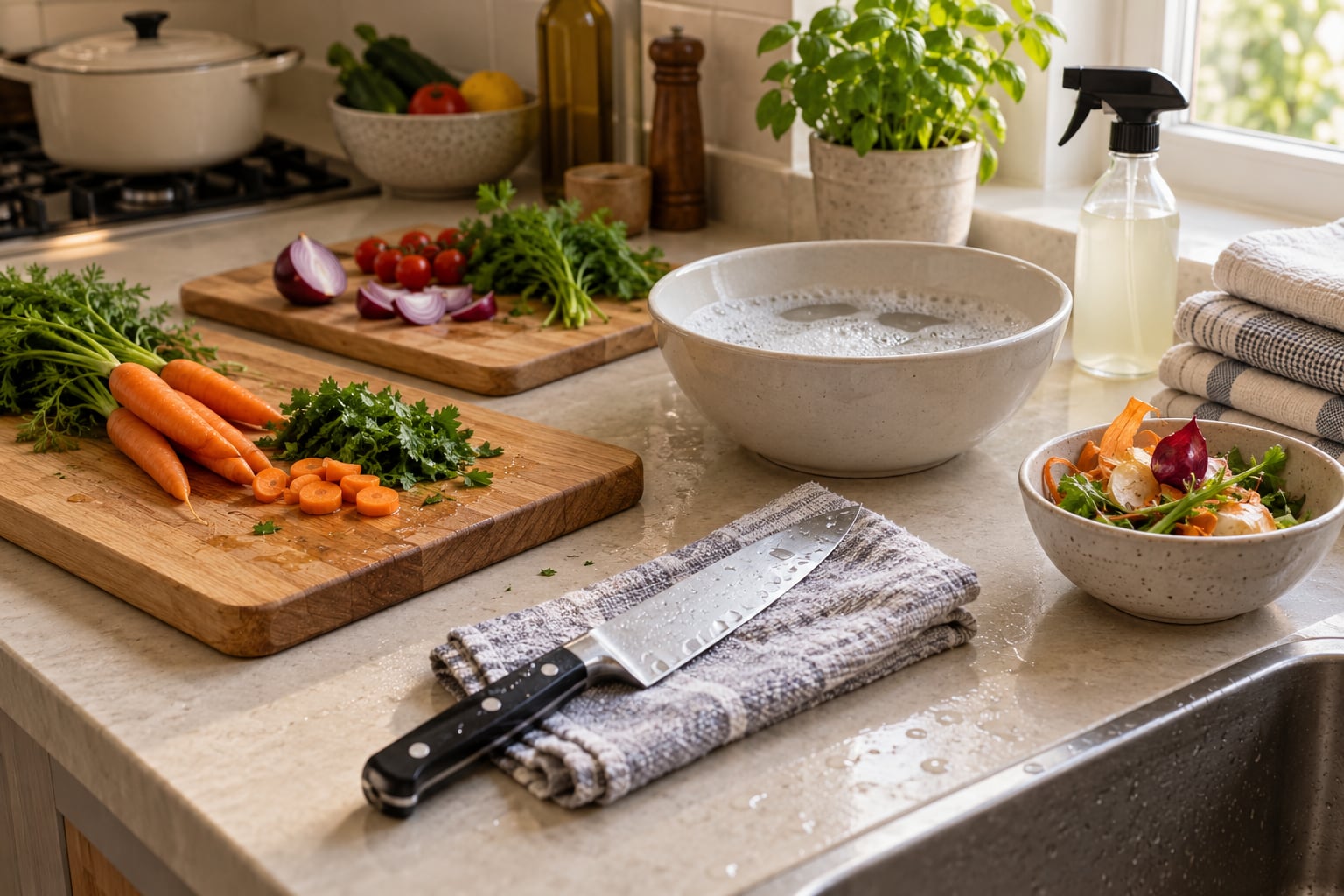
How to clean a kitchen as you cook comes down to one habit: reset your workspace in short bursts while the food is doing the slow work. While onions soften, while pasta water boils, while a roast rests, you wipe the counter, rinse the knife, and scrape the board. Set up a station first, clean between every task, and the after-dinner cleanup shrinks to about five minutes.
Beginners on r/cookingforbeginners describe the opposite experience. They stop to wash up, lose the thread of the recipe, and end up facing 30 to 60 minutes of cleanup that turns cooking into something they avoid. The fix is setup, not discipline, and that is what this guide walks through.
The French restaurant term behind the whole idea is mise en place, which means putting everything in its place before you begin. Chefs do it so nothing is fetched mid-service, and the empty spaces you create are the same spaces that make wiping down fast. In a home kitchen, the practice is smaller but identical in logic.
Table of Contents
- What You Need
- Step-by-Step: Clean as You Cook
- Common Mistakes
- Frequently Asked Questions
- Do I need to sanitize the kitchen after every task?
- What is the safest way to wash dishes while cooking a meal?
- Should I rinse raw chicken or poultry before cooking it?
- How do I stop my sink from becoming a mess while cooking?
- How often should I clean kitchen counters during meal prep?
- Can I leave cooked food on the counter while I finish cleaning?
- A Cleaner Kitchen Starts Before the Heat
What You Need
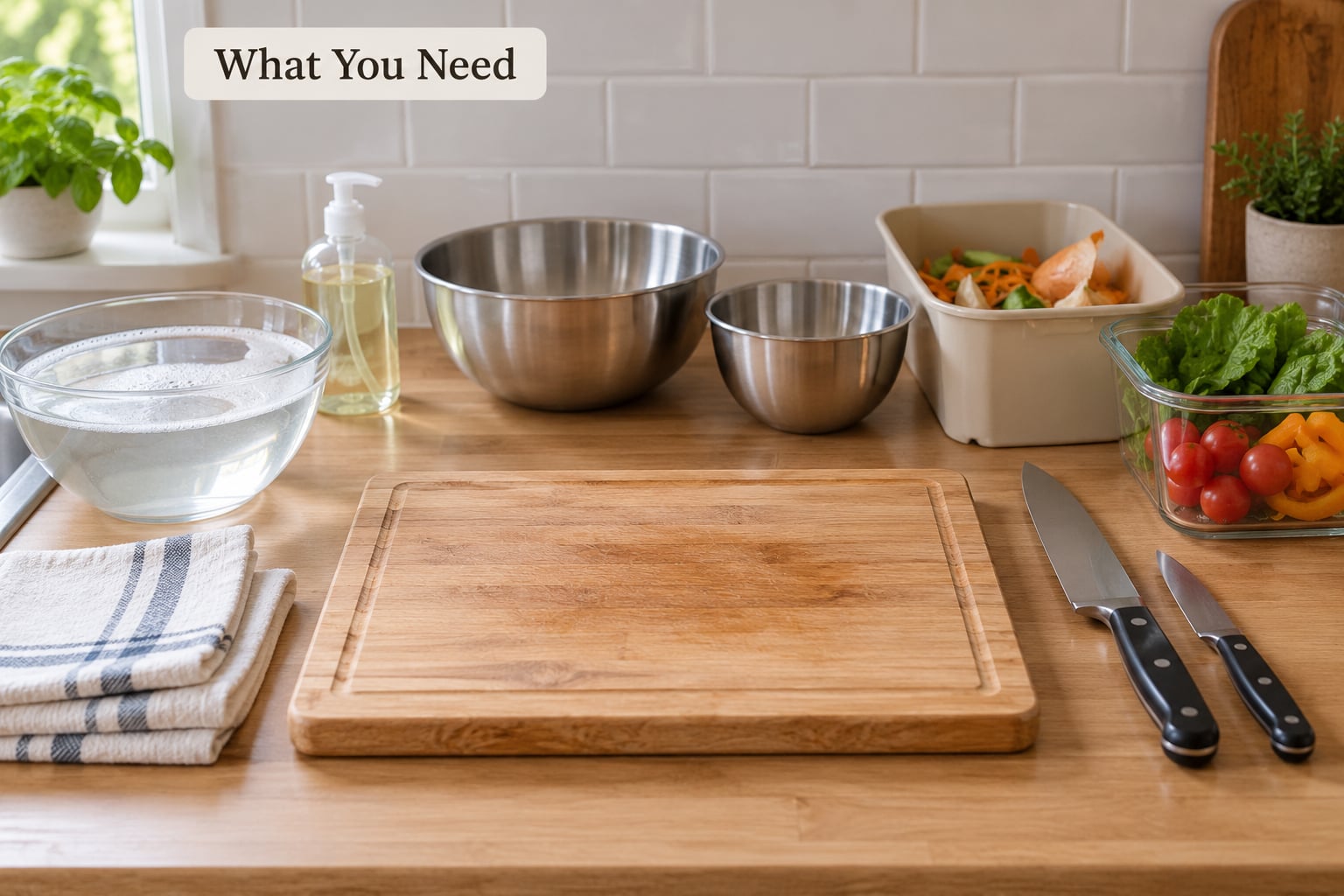
The tools are ordinary and mostly already in your kitchen. What matters is that each one has a fixed home within arm’s reach, so cleaning never requires a search.
- A clear worktop. Everything not in use goes back in the cupboard or the fridge before you turn on the hob.
- A washing-up bowl filled with hot, soapy water. This is the single most useful item in the whole system. Used knives and boards go in and soak, which kills most of the work.
- A countertop scrap bowl. An empty bowl, a small bin, or a sheet of parchment paper folded into a tray catches peelings, ends, and packaging as you go.
- Two cutting boards. One for raw meat, poultry and seafood, one for ready-to-eat food like bread, salad and cooked items. Colour-coding them is the easiest way to stop the mix-ups.
- A damp microfibre cloth, kept in the sink. Wring it out, wipe, wring it again. A cloth that has gone dry does nothing but smear.
- Dish soap and a food-safe sanitizer. Soap and hot water clean; sanitizer disinfects. You need both, in that order, on surfaces that touched raw food.
- Clean kitchen towels, and gloves if you prefer them. Keep separate towels for dishes and for wiping surfaces.
- Greaseproof liners or a silicone mat for the hob and oven floor, if you cook often enough for baked-on grease to be a problem.
You do not need vinegar sprays, degreasers or specialist wipes mid-cook. Plain hot soapy water handles almost everything, and a squirt of dish soap in a spray bottle of water is enough for a quick wipe between tasks.
Step-by-Step: Clean as You Cook
Six stages take a dinner from a cluttered counter to a clean kitchen, in the order that works best.
1. Set Up a Cleaning Station Before You Start
Clear the main work area, then wipe it. Fill the washing-up bowl with hot water and a squirt of soap, set out the scrap bowl beside the board, and drape the damp cloth in the sink where your hands already go.
Empty the dishwasher or run it, and clear the drainer. If a machine is mid-cycle, that is fine; you simply cook around it, but a free sink is worth waiting ten minutes for.
Put the raw ingredients in one place and the ready-to-eat ingredients in another, physically separated. How do you know the station is ready? You should be able to stand at the hob, reach the bowl, the cloth and the bin without turning around or stepping over anything.
2. Wash Hands and Prepare Ingredients in Stages
Prep everything before the heat goes on, the way the mise en place method demands. Wash hands with soap for at least 20 seconds, then again after handling raw meat, eggs, or unwashed produce, and after any trip to the bin.
Chop on the right board. Use the raw board for chicken, and when the chicken is in the pan, move it straight to the other board, or wash and sanitize the first one before it touches anything else.
Put unused ingredients away in small containers as soon as you have measured them. Oil does not need to go back in the cupboard, but chopped herbs, opened cans and part-used vegetables do, because that is how the counter fills up. The check is simple: your prep space holds only the ingredient you are working on right now.
3. Clean Tools and Surfaces Between Tasks
When you move from one food to the next, stop for 60 seconds. Scrape the board into the scrap bowl, rinse it, drop it in the soapy water, then wipe the area it sat on with the damp cloth and a drop of soap.
For surfaces that touched raw meat, wash first, then apply a food-safe sanitizer and leave it the contact time printed on the label before wiping it off. A cloth that has seen raw chicken goes into the laundry or the bin, not back on the counter.
You know the area is ready when the cloth comes away clean and the surface is dry to the touch. One more check: nothing raw is still sitting on the board you are about to use for something that gets eaten without cooking.
4. Manage Dishes, Water, and Waste While Cooking
Soak, do not queue. Anything used goes into the soapy bowl the moment it is finished, and anything in use gets rinsed and left in the sink. This is the compromise most home cooks land on, and it works: pans that will not be used again soak until the end, while boards and knives get washed immediately because you need them back.
Empty a pan of liquid rather than carrying it to the sink while full. Pour fat down the sink only in small amounts with plenty of hot water running, because fat congeals in cold pipework.
Consolidate scraps. Every few minutes, tip the countertop scrap bowl into the bin and reset it with fresh paper or a clean liner. For a typical 30-minute dinner, two trips to the bin is normal, and they happen while something simmers.
Watch the floor. Grease and water make the single biggest slip hazard in a home kitchen, and a 20-second sweep at the change of stage prevents a spill that spreads across three tiles.
5. Store Food and Cool Ingredients Safely
Perishable food does not wait for you. Put raw meat, cut vegetables, dairy and cooked food into the fridge or freezer within two hours, one hour in a hot room, and put the cold stuff back before you turn the hob off.
Hot food goes into shallow containers, uncovered or loosely covered until it stops steaming, then gets sealed and dated. Deep hot containers cool slowly in the middle, which is where bacteria like to grow.
Cook to the right temperature rather than to a timer you have a feeling about: 165°F (74°C) for poultry, 160°F (71°C) for ground meat, and 145°F (63°C) for whole cuts of meat and fish. A thermometer in the thickest part is the only real check, and the same guidance applies in 2026 as it did when the numbers were first published.
6. Finish With a Quick Kitchen Reset
Budget five minutes, and set a timer so it does not become twenty. Wash the cutting board by hand first, since boards hold the most bacteria.
Then wipe counters and the hob, stow every ingredient, empty the sink, run the dishwasher or stack the drying rack, and put leftovers away. Sweep the floor last, then dry it.
The result is a kitchen that is ready for tomorrow, not a kitchen that needs saving in the morning. That five minutes is the whole return on the habit.
Common Mistakes
Almost every struggle with clean-as-you-go comes down to timing or sequencing. These are the fixes that change the evening fastest.
- Cleaning too late. Fix: set a rule that any tool used for 60 seconds goes in the bowl immediately. A soaked knife does not need scrubbing, and dried-on food does.
- Using one board for raw and ready-to-eat food. Fix: two boards, one colour per food type, kept apart on the counter.
- Rinsing raw chicken or poultry. Fix: skip the rinse. It spreads droplets and bacteria around the sink without removing anything harmful, and chefs do not do it. Pat the meat dry, cook it, and wash and sanitize the surfaces it touched.
- Letting dishes pile up instead of soaking them. Fix: a filled soapy bowl is a holding area, not a mess to be dealt with later.
- Skipping sanitising between tasks. Fix: wash with soap and hot water first, then sanitise, then let it dry. A wiped-but-not-washed surface is not sanitised.
- Leaving perishable food out while you clean. Fix: fridge first, clean second. The habit is worth nothing if it costs you food safety.
One safety note worth reading twice. Never spray cleaner near a lit gas hob or an open flame, never mix vinegar with bleach or with any other cleaner, and never run cold water over a scorching glass or ceramic pan. Wipe those with a damp cloth after they cool, or deal with them at the end.
And if the energy is not there, do the two-minute version: bowl of scraps to the bin, cloth round the hob, board in the sink, counters wiped. That is a legitimate minimum viable clean, and a clean-enough kitchen beats a perfect one you never get to.
Frequently Asked Questions
Do I need to sanitize the kitchen after every task?
No. Sanitise the specific surfaces and tools that touched raw meat, poultry, seafood or eggs, after you have washed them with hot soapy water. Ordinary vegetable prep and wiping up crumbs do not need sanitizer, just soap and water. A daily wipe of the hob, handles and sink at the end of the day is enough for everything else. Sanitiser works best on a clean, dry surface and needs the contact time printed on the bottle.
What is the safest way to wash dishes while cooking a meal?
Fill a washing-up bowl or the sink with hot soapy water and drop used items in as you finish with them, rather than stacking them by the hob. Wash raw-meat items, boards, knives and bowls straight away, and let pans and other hot items soak until the meal is served. Hot water plus detergent removes grease and most bacteria, and soaking does the work of scrubbing without you lifting a hot pan.
Should I rinse raw chicken or poultry before cooking it?
No. Rinsing poultry spreads raw bacteria across the sink, the worktop and your clothes, and does not make the meat any safer. Pat it dry with kitchen paper, cook it straight away to 165u0026deg;F (74u0026deg;C) measured with a thermometer in the thickest part, then wash and sanitize the board, the worktop and anything the packaging touched. The same applies to raw beef and pork.
How do I stop my sink from becoming a mess while cooking?
Keep one bowl for soaking and one for washing, and empty the soak bowl into the dishwasher the moment it is free. Line the sink with a mesh cage or a plastic basin so scraps stay out of the plughole, and put a small bin beside the board rather than carrying every peel to the far side of the kitchen. Wipe the sink rim with a cloth whenever you pour something fat into it.
How often should I clean kitchen counters during meal prep?
Wipe between tasks, which usually means every five to ten minutes during a cook. The trigger is a change of food, not the clock: after raw meat goes in the pan, after chopping vegetables, after plating. A damp cloth with a drop of soap and 15 seconds of arm work is enough for a clean surface. Give the whole worktop a proper wash and dry once more at the end of the meal.
Can I leave cooked food on the counter while I finish cleaning?
Not for long. Cooked food is a perishable food, so get it covered and into the fridge within two hours, or one hour if the kitchen is hot. Put it in shallow containers rather than deep ones so it cools quickly, and leave the lids slightly ajar until the steam stops. If the cleanup is what is holding the food out, fill the basin first and get the food away before you start on the pans.
A Cleaner Kitchen Starts Before the Heat
Start with the counter, not the dishes. Clear the worktop, wash and sanitize it, fill a bowl with hot soapy water, and put a scrap container and a damp cloth where you can reach them without looking. Then clean briefly at every change of task, and give yourself five minutes at the end.
That is how to clean a kitchen as you cook, and it takes less attention than it sounds. The mess never gets the chance to become the thing you are avoiding.