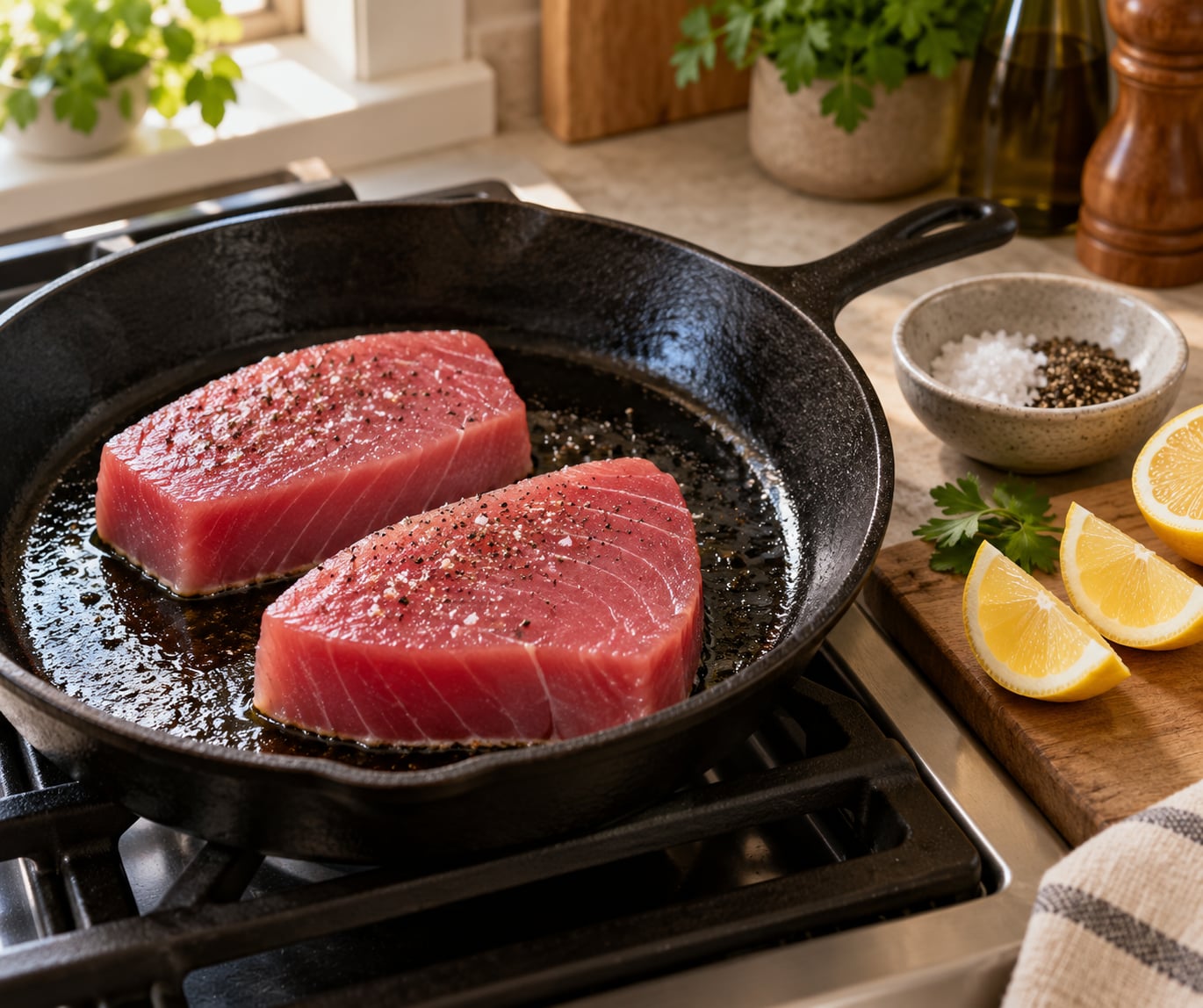
To cook yellowfin tuna steaks on the stove, sear them 45 to 90 seconds per side in a preheated heavy skillet over high heat, then rest them 3 to 5 minutes before slicing. That short, hot contact gives you a golden crust and a rare, buttery center, and the whole thing takes under 15 minutes start to finish.
Yellowfin and ahi are two names for the same fish (Thunnus albacares), so any recipe calling for one is calling for the other. The reason tuna rewards precision is that it has almost no connective tissue and very little fat, which means it cannot be slow-cooked politely. Every extra minute past rare turns the flesh pale grey, dry, and rubbery, and no amount of sauce hides that.
One bit of terminology first: “sushi grade” is a marketing label, not a regulated standard. Tuna sold for cooking is perfectly good for a skillet sear, and the cuts sold for sushi are often the same fish trimmed differently. Buy steaks that smell clean and ocean-fresh, look deep red rather than pale, and feel firm rather than mushy.
Table of Contents
What You Need
The equipment list for this method is short, but two items matter more than the rest: a heavy skillet that holds heat and an instant-read thermometer. The thermometer is what turns “cook until done” into a number you can trust, and it is the difference between a rare center and a rubbery disk.
The tuna and how to cut it
Aim for steaks 1 to 1.5 inches thick. Thinner than 3/4 inch and the center overcooks before the crust develops; thicker than 2 inches and the outside burns long before the middle comes up to temperature.
If your steaks are uneven, tap the thick end gently on the cutting board to bring it level, or cut the thick end off and cook it separately. Even thickness matters far more than the cut name. Ventresca, the fatty belly section, is the most forgiving because the fat keeps it moist, while a lean loin steak needs faster, cleaner heat.
Pans: which one to use
| Pan | Why it works | Watch out for |
|---|---|---|
| Cast iron skillet | Holds the most heat and gives the hardest sear | Needs more oil than you think; fish can stick if the surface is not properly oiled |
| Stainless steel skillet | Excellent crust, evenly heated, easy to find | Demanding: fish sticks if it is wet or the pan is cool |
| Nonstick skillet | Most forgiving for beginners; releases cleanly | Lower ceiling on sear temperature, so the crust is browner than shelled but less deep |
| Ridged grill pan | Gives cross-hatch marks and lifts the steaks off the surface | Steaks fall between the ridges unless they are thick enough |
Any of these will work. A heavy stainless or cast iron skillet heated until it is nearly smoking gives you the most restaurant-like result.
Cooking fat: pick by smoke point
High heat means the fat has to survive high heat. Oils that break down and smoke below the searing temperature will taste bitter and smoke up your kitchen.
| Fat | Approximate smoke point | Best use here |
|---|---|---|
| Avocado oil | Around 520°F (270°C) | Best neutral choice for a very hot sear |
| Refined olive oil | Around 470°F (245°C) | Good high-heat option with a mild flavor |
| Grapeseed oil | Around 420°F (220°C) | Neutral and easy to find |
| Canola or vegetable oil | Around 400°F (205°C) | Reliable and inexpensive |
| Extra virgin olive oil | Around 375°F (190°C) | Use only on medium-high heat; smoke if pushed harder |
| Butter | Around 350°F (175°C) | Add after the sear, off the heat, to baste |
Seasoning is a matter of taste. Kosher salt and coarsely ground black pepper on both sides is the classic, and marinating is optional rather than necessary. A 20-minute soak in soy sauce, ginger, and a little honey works well if you want a teriyaki-leaning crust, but plain salt and oil is what most cooks prefer for the purest result.
Step-by-Step
1. Prepare and Season the Tuna Steaks
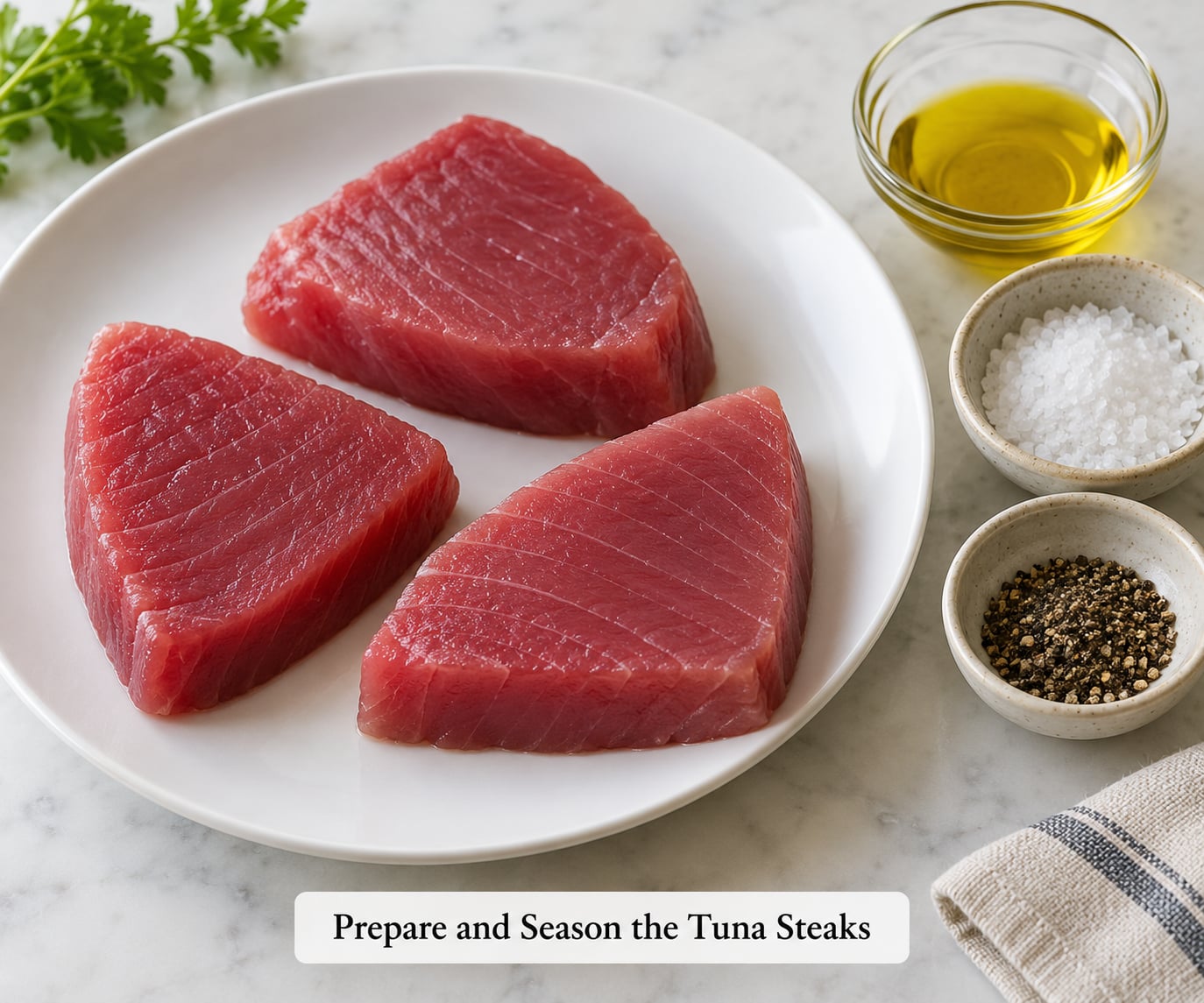
Pat every steak dry on both sides with paper towels. This is the least glamorous step and the one that most reliably prevents sticking, because surface moisture has to boil off before the fish can brown.
Season both sides generously with salt and pepper, roughly 1 teaspoon of kosher salt per steak. If the fat cap runs along one edge, score it lightly with a sharp knife so it renders instead of curling the steak upward in the pan.
Handle the fish once from the packaging to the board and once from the board to the pan. Every extra touch transfers moisture and tears the surface that you are trying to brown. Do not stack the steaks on top of each other to season them, and do not let them sit out for more than about 20 minutes before they hit the pan.
2. Heat the Skillet Until Very Hot
Set the burner to high and give the empty skillet 3 to 5 minutes to heat. The pan is ready when a drop of water sizzles and skitters across the surface and evaporates almost instantly, or when a flick of the handle sends a shimmer of heat distortion above the metal.
Do not rely on smoke as the only signal. Oil smokes long before a properly heated skillet is ready to receive fish, and a thin wisp of smoke usually means the pan is already past the useful heat you want.
Add 1 to 2 tablespoons of your oil and let it shimmer and flow like water across the pan. It should look wet, not smoking. Add a thin layer of butter if you want the flavor, but keep in mind that butter browns quickly, so it goes in after the tuna is nearly done.
3. Sear: How to Cook Yellowfin Tuna Steaks on the Stove
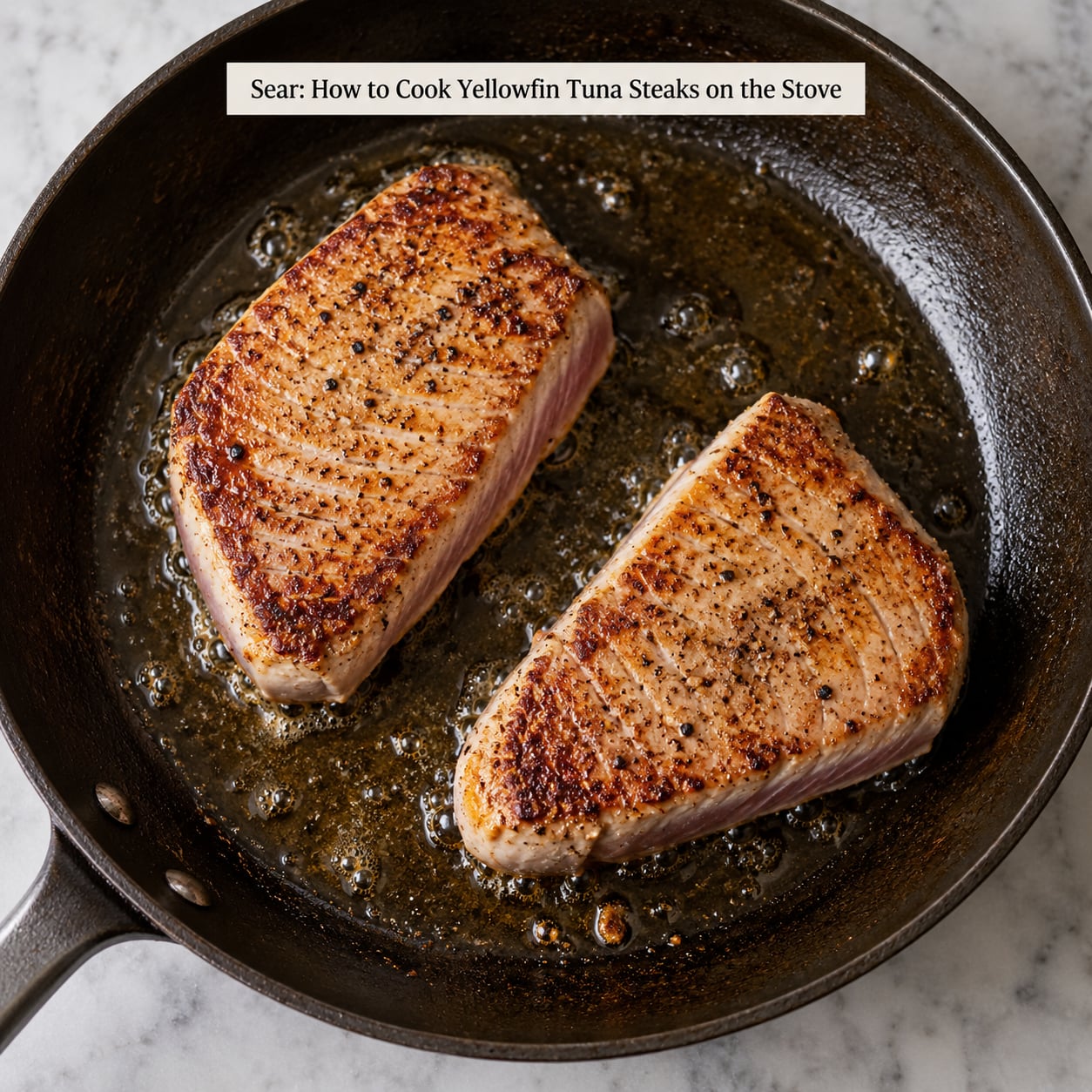
Lay the steaks into the pan away from you, away from the handle, one at a time and without dropping them from height. They should hiss loudly on contact. If they do not, the pan is not hot enough; take them out, raise the heat, and wait another minute.
Leave the heat at high for the first 20 to 30 seconds, then drop it to medium-high so the crust does not scorch before the center cooks. This is the step most recipes skip, and it is the difference between a browned crust and a black crust.
Timing scales with thickness. Use this as a starting point and adjust after your first steak.
| Steak thickness | First side | Second side | Result |
|---|---|---|---|
| 3/4 inch | 45-60 seconds | 30-45 seconds | Rare center, easiest to overcook |
| 1 inch | 60-75 seconds | 45-60 seconds | The reliable everyday steak |
| 1.5 inch | 90 seconds | 60-75 seconds | Best balance of crust and rare center |
| 2 inch | 2 minutes | 90 seconds | Rare or medium-rare, needs a firm hand |
Turn each steak once with a thin metal spatula or fish turner, working from the edge inward so you do not scrape across the crust. A quick 90-degree turn at the 30-second mark gives you cross-hatch marks without the risk of a second full flip.
A pale grey band around the outside of the steak is normal. It is a layer of proteins that denature under heat, and it is not a sign of undercooking. Judge the center, not the edge.
4. Check the Center, Rest, and Serve
Check the center with your thermometer before the steak leaves the heat. Make a small nick in the thickest part, insert the probe, and read it fast. Inserting a thermometer early lets heat escape, so only open the steak once.
| Doneness | Internal temperature | What the center looks like |
|---|---|---|
| Rare | 115-125°F (46-52°C) | Translucent deep red, very soft |
| Medium-rare | 125-135°F (52-57°C) | Pink and glossy, just set |
| Medium | 135-145°F (57-63°C) | Opaque pink-brown, firmer |
| Well-done | 145°F (63°C) and above | Firm, pale grey-brown throughout |
For food safety, the USDA recommends a minimum internal temperature of 145°F (63°C) for whole cuts of fish. Most cooks intentionally stop short of that because tuna is served rare, and a properly seared rare steak is what this recipe is built for. Anyone who prefers their fish cooked through can pull at 145°F (63°C) and accept the firmer texture.
Move the steaks to a plate and rest them 3 to 5 minutes. The internal temperature will climb several degrees during the rest as residual heat continues to cook the center, which is exactly why so much overcooked tuna comes from steaks that were simply left too long after leaving the pan.
Slice with a sharp serrated or long slicing knife, cutting straight down through the steak and against the grain rather than sawing back and forth, which drags the fibers apart. Finish with flaky salt, cracked pepper, and a squeeze of lemon. Serve with something acidic and green, such as a dressed arugula salad, cucumber ribbons with rice vinegar, or charred asparagus.
Common Mistakes
Nearly every disappointing tuna steak traces back to one of a handful of fixable habits.
Crowding the pan. Drop the temperature and steam the steaks instead of searing them, so you get a pale, grey exterior with no crust. Cook in batches of two steaks maximum in a 12-inch skillet, or use two pans.
A cold skillet. The fish sticks, tears, and turns chalky white where it tore. Heat the empty pan first and use the water test.
A smoking-hot skillet. The outside chars black before the center moves, and burnt oil makes the whole pan taste acrid. Back the heat down to medium-high once the fish is in.
Moving the fish too early. If a steak releases with a fight, it is not ready. Give it another 15 to 20 seconds; the crust that lets go easily is the crust that formed properly.
Leaving it on low heat. A gentle simmer cooks the tuna slowly through its entire doneness range and drives off moisture, which is how you get rubbery fish instead of a seared crust.
Poking at it mid-cook. Every probe or press breaks the crust and lets juice run out. Test once, at the end.
Resting too long, or not at all. A long rest walks the fish past rare; no rest at all means the juice runs across the board the moment you slice. Three to five minutes is the window.
Frequently Asked Questions
How thick should yellowfin tuna steaks be for cooking on the stove?
One to 1.5 inches is the sweet spot for a stove-top sear. That thickness gives the pan enough contact time to build a real crust while the center still comes off the heat rare. Anything under 3/4 inch overcooks in the middle before it browns, and anything over 2 inches burns outside before the middle catches up. If your steaks are uneven, gently tap the thick end level or trim it and cook the trim separately.
How long do you cook yellowfin tuna steaks on each side?
Plan on 45 to 90 seconds per side over high heat, depending on thickness. A 3/4-inch steak needs about 45 to 60 seconds a side; a 1-inch steak about 60 to 75 seconds; and a 1.5-inch steak about 90 seconds. Drop the burner to medium-high after the first 20 to 30 seconds so the crust browns instead of burning. Timing is only a starting point, so check the center with a thermometer.
Should I sear tuna on both sides?
Yes, but briefly. Sear the first side 60 to 90 seconds to build the crust, then turn once and give the second side a shorter sear, 30 to 60 seconds, because the heat has already carried into the fish. Flip more than twice only if you want cross-hatch grill marks, which take about 30 seconds of additional contact. The long cooks some recipes suggest are for thin-cut yellowfin slices, not thick steaks.
How do I know when yellowfin tuna is cooked through?
Use an instant-read thermometer and check the thickest part: rare is 115-125u0026deg;F (46-52u0026deg;C), medium-rare is 125-135u0026deg;F (52-57u0026deg;C), medium is 135-145u0026deg;F (57-63u0026deg;C), and 145u0026deg;F (63u0026deg;C) or above is cooked through, which is the USDA minimum for whole cuts of fish. Visually, a cooked-through steak is opaque and pale grey-brown all the way to the middle. A grey band at the edge is normal and does not mean undercooked.
Can I cook yellowfin tuna steaks from frozen?
You can, but thawing first gives you a much better result. Frozen steaks sear unevenly because the melting ice drops the pan temperature and the outside overcooks before the center thaws. Thaw them in the refrigerator overnight in a bowl, or in a sealed bag submerged in cold water for about 30 minutes, changing the water once. Once thawed, pat them very dry and follow the same timing. Never microwave them, which partially cooks the edges.
Start with steaks cut to an even 1 to 1.5 inches and a properly heated heavy skillet. Pat them dry, season both sides, sear 45 to 90 seconds per side, then check the center with a thermometer and rest for 3 to 5 minutes before slicing. That sequence is the whole technique; once you have the heat right, how to cook yellowfin tuna steaks on the stove becomes a ten-minute repeat rather than a gamble.