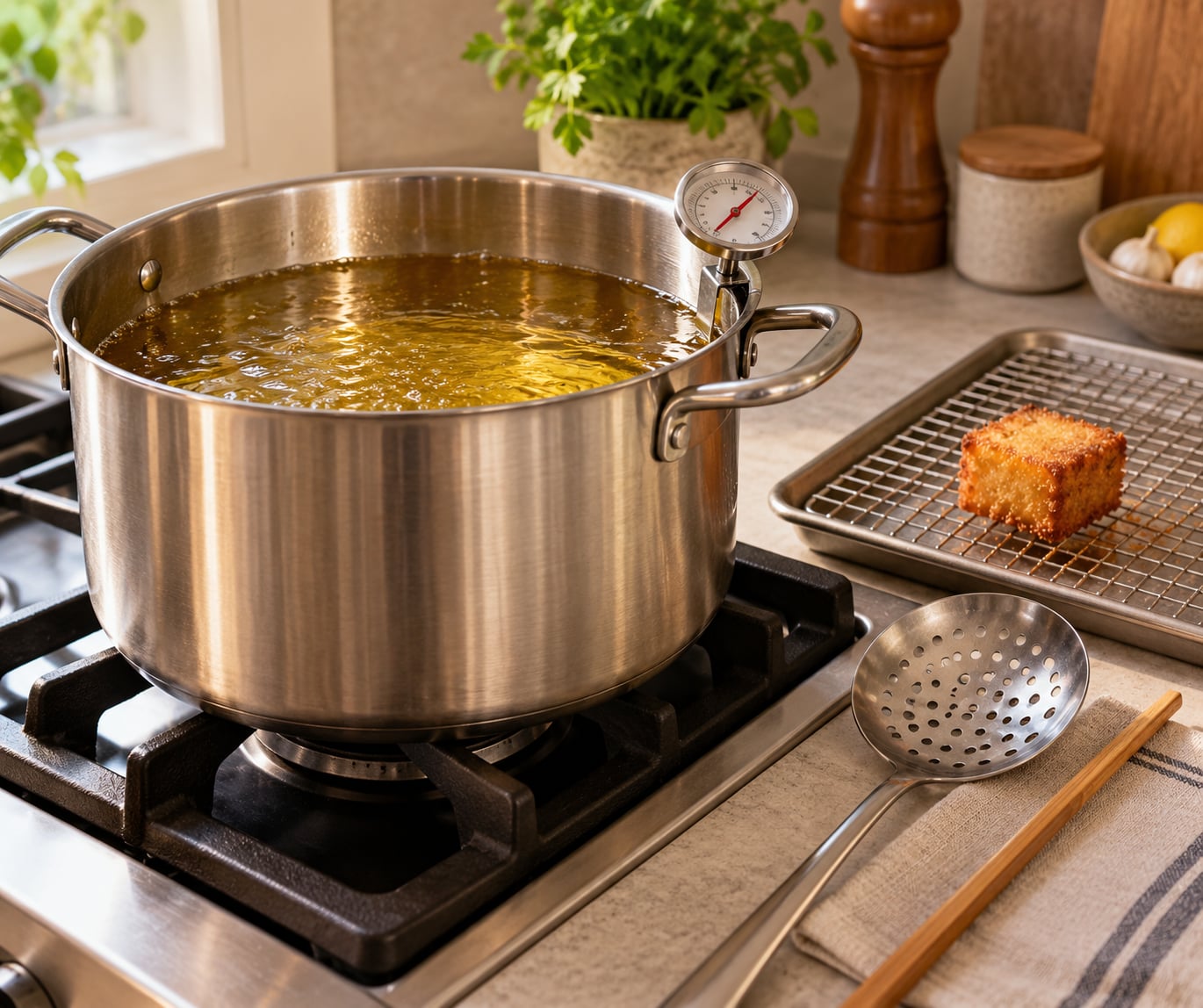
Most foods want oil at 350°F to 375°F (175°C to 190°C) before they go in, and there are only three honest ways to know you are there: read a thermometer, read the surface, or test it. If you have a clip-on fry thermometer or instant-read probe, clip it to the pot and wait for that number. Without one, you can still read the oil — it should shimmer and release steady streams of fine bubbles the moment a dry wooden spoon or a small piece of food touches it.
This whole guide takes about five minutes to read and saves you from the two classic home-frying failures: pale, greasy food that soaked up oil, and a blackened crust wrapped around a raw center.
Updated for October 2026, because a couple of the shortcuts floating around online are a good deal less reliable than they get passed around. The useful methods are below, along with the ones that quietly ruin your batch.
Table of Contents
What You Need
A thermometer is the only tool that gives you a real number. Everything else is inference, and useful inference at that.
- A clip-on deep-fry thermometer for the pot, so your hands stay free. A candy thermometer works for the same reason: it reads a wide range and clamps on.
- An instant-read probe thermometer if you prefer handheld. Touch the tip to the oil without letting the shaft touch the bottom or sides.
- A heavy pot or Dutch oven, ideally 6 to 8 inches deep with straight sides. Thick cast iron and stainless steel hold heat better than thin nonstick, so the temperature does not crater when food goes in.
- Enough oil to cover the food by half to two-thirds for deep frying, or a quarter inch for shallow frying.
- A dry wooden spoon or chopstick for the bubble test. Wet wood gives you a false positive.
- A small test piece, such as a torn cube of day-old bread, a stray potato chunk, or one piece of whatever you are about to cook.
Skip the infrared thermometer for this job. An IR gun reads the surface of the pot, not the oil, and the metal pan wall reads far cooler than the oil inside it. That single blind spot produces the exact confusion you see online about infrared thermometers being “wrong.”
Step-by-Step: How to Tell When Oil Is Hot Enough for Frying
Choose the Right Oil and Target Temperature
Set your target from the food, not from the recipe’s vague “medium-high.” Most savory frying lands at 350°F, fries and crisps want 375°F, and eggs and delicate batters sit lower.
| Food | Oil temperature | What it looks like |
|---|---|---|
| Eggs, frittata-style shallow fry | 320-340°F (160-170°C) | Bubbles but no smoke, loose edges |
| Fish fillets, shrimp | 350°F (175°C) | Steady fine bubbles |
| Chicken cutlets, thin bone-in pieces | 350-365°F (175-185°C) | Steady to brisk bubbles |
| French fries, potato wedges | 375°F (190°C) | Brisk, rolling bubbles |
| Doughnuts, onion rings, tempura batter | 350-360°F (175-182°C) | Steady bubbles |
| Vegetables, burgers, schnitzel | 350-375°F (175-190°C) | Steady to brisk bubbles |
The oil also has to survive the heat. Check the smoke point on the bottle and pick an oil rated above your target temperature. Canola, peanut, grapeseed, avocado, corn and vegetable oils are all neutral-flavored and handle 375°F without breaking down. Refined olive oil is fine; extra virgin loses its flavor at sustained high heat, and the smoke point is close to where you are working.
Check the Temperature With a Thermometer
Warm up at medium-high and let the reading climb slowly. Rushing on high heat gives you a hot bottom and a cool top, which is how you scorch oil before any food is in it.
Clip the thermometer to the pot wall so the tip sits in the oil without touching metal, or lower an instant-read probe into the middle of the pan. Watch the number rise and then hold steady for ten seconds before you add anything.
A reading that is climbing fast means the burner is outrunning the oil and your food will scorch. Back the heat down a notch until the temperature climbs slowly and even. If the number is still moving when you drop food in, the thermometer is working; if it has gone flat and cold, it is likely fogged by steam or has drifted and needs replacing.
Use Visual Cues and a Test Piece
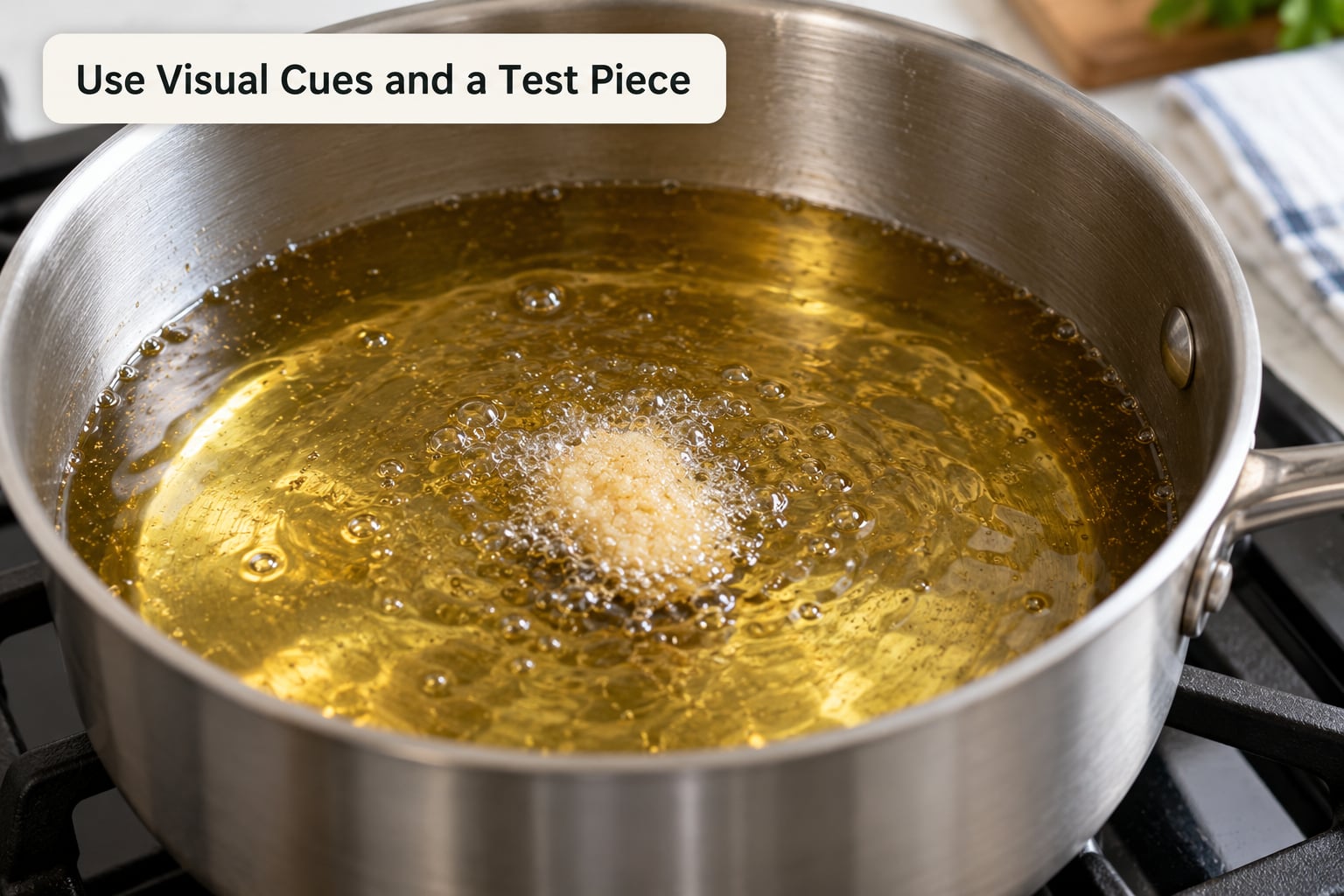
When the oil is close, it shimmers across the surface like a heat mirage and the whole pot gives off a faint waft of warmth. That shimmer tells you you are in the neighborhood, not that you have arrived.
The three traditional tests, best to least reliable:
- Wooden spoon or chopstick. Dip the dry tip into the oil. A few tiny champagne-style bubbles streaming off it means you are close. A steady stream of fine bubbles means it is ready. Vigorous, rolling, spitting bubbles means pull the heat down and wait. The science is simple: moisture trapped in the wood boils at that heat and escapes as steam.
- Bread cube. Drop a one-inch cube of bread and time it. Roughly 10 seconds to golden means about 374°F, 15 seconds about 356°F, 20 seconds about 338°F, and 30 seconds about 320°F. A fresh cube steams longer than a day-old one, which is why a stale piece gives a cleaner reading.
- Popcorn kernel. This one gets overhyped. Lifehacker tested it and found the first kernel popped at 278°F and the last at 283°F, well below the 350°F usually claimed. Kernels vary by moisture content and dead ones never pop at all. If you use it, drop three, not one, and treat the result as a rough “getting warm” signal.
Whichever test you use, read it against the table above rather than against a single magic number. Knowing how to tell when oil is hot enough for frying without a thermometer is really knowing which of those two failure zones you are in.
Add the Food and Keep the Temperature Stable
Lower food away from you with a slotted spoon or tongs, one piece at a time, and let each piece settle before adding the next. Close the temperature gap first: let meat and potatoes come closer to room temperature, and pat anything wet dry with paper towel. Water in the oil is what causes splatter and the drop.
Do not crowd the pot. More food means more thermal mass, a bigger temperature drop, and steam trapped under the pieces, which is the soggy crust you get from a crowded fryer.
Watch the thermometer after the food goes in. Oil that drops and never recovers means too much food or too little heat. Wait for it to climb back to target before adding anything else, and nudge the heat up if it will not get there.
For Celsius-only kitchens, here is the conversion you will actually use:
| Fahrenheit | Celsius | Typical use |
|---|---|---|
| 320°F | 160°C | Eggs, low-temperature batters |
| 340°F | 170°C | Upper end for eggs, soft batters |
| 350°F | 175°C | Chicken, fish, shrimp, general frying |
| 365°F | 185°C | Thick cutlets, bone-in chicken |
| 375°F | 190°C | Fries, crispy vegetables |
Shallow frying runs slightly cooler than deep frying, usually 330°F to 350°F (165°C to 175°C), because a shallow layer loses heat faster and the food sits close to the pan. If you only have an oven-safe shallow dish, keep the temperature toward the lower end and fry in two batches rather than one.
Common Mistakes
Nearly every disappointing fried batch traces back to one of these.
| Symptom | What went wrong | Fix |
|---|---|---|
| Food is pale, greasy, soggy | Oil was below 350°F, or too much food dropped at once | Let the oil climb back to target, then fry in smaller batches |
| Burnt outside, raw inside | Oil well above target, thick or frozen food | Lower the heat, let oil settle, thaw food first |
| Breading slides off into the oil | Oil not hot enough for the batter to set instantly | Wait for steady bubbles and check with a thermometer |
| Sticks together in a clump | Food added too fast or pot too full | Add pieces with space between them, use a wider pot |
| Heavy splatter | Food or utensils going in wet | Pat dry, lower food gently away from you |
| Oil smokes before food goes in | Heat too high, or oil past its smoke point | Take it off the burner and let it cool, then restart at medium-high |
Two habits cover most of the rest. Heat at medium-high and wait, because the pot is heating unevenly at a hard boil and the oil at the bottom is already degrading. And never walk away: keep the handle turned inward, keep a lid nearby, keep water away, and never add water to hot oil. If oil does catch fire, turn off the burner and slide a lid or metal sheet over the pot.
Smoke is never a readiness signal. It means the oil is past its smoke point and has started breaking down into bitter compounds and acrid smoke. That is a reason to cool the oil and start over, not a reason to add food quickly.
Frequently Asked Questions
What temperature should oil be for frying?
Aim for 350°F (175°C) for most foods, including chicken, fish and shrimp, and 375°F (190°C) for French fries, crispy vegetables and anything that needs a fast, hard crust. Eggs and delicate batters sit lower, around 320°F to 340°F. Match the oil’s smoke point to your target so it does not break down before the food is done.
Can I tell if frying oil is ready without a thermometer?
Yes. Dip a dry wooden spoon or chopstick into the oil. A few tiny bubbles means it is still heating, a steady stream of fine bubbles means it is ready, and vigorous rolling bubbles mean it is too hot. A torn cube of day-old bread dropped into the pot gives a second opinion: about 10 seconds to golden brown lands near 375°F.
Why is my oil not hot enough when it looks ready?
Shimmer looks hotter than it is. Oil shimmers before it reaches frying temperature, and a burner set too high creates a hot bottom and a cooler top, so the surface can look calm while the pan is far off target. Check with a thermometer, watch for steady bubbles at the spoon, and reduce the heat so the temperature climbs slowly and evenly.
Should I heat oil before adding wet food?
No, and dry food matters more than most people expect. Pat meat, vegetables and utensils thoroughly dry, and let food come closer to room temperature before it goes in. The water on the surface turns to steam, splatters, and drags the oil temperature down, which is why cold or wet food is the leading cause of greasy fried results.
What does it mean if oil smokes while frying?
Smoke means the oil has passed its smoke point and is breaking down, not that it is ready for food. The flavor turns bitter and acrid and the oil loses its ability to cook cleanly. Turn off the burner, let it cool, then restart at medium-high heat. If it smokes again at a lower setting, the oil is past its useful range and should be discarded.
How do I keep frying oil at the right temperature?
Fry in small batches, let the temperature climb back to target between batches, and adjust the burner as you go. Start the food at room temperature or close to it, keep pieces spaced apart so the oil can circulate, and use a heavy pot so the pan itself does not hold the heat back. The thermometer after the food goes in tells you when to wait or turn the heat up.
Conclusion
Pick the target for your food, hit it with a thermometer if you own one, and back it up with a dry wooden spoon until you can read steady bubbles on sight. Add food in small batches, keep it as close to room temperature and as dry as you can, and adjust the heat so the temperature holds from the first piece to the last.
Get those four things right and you have solved the whole problem: no thermometer needed once your eyes are calibrated.