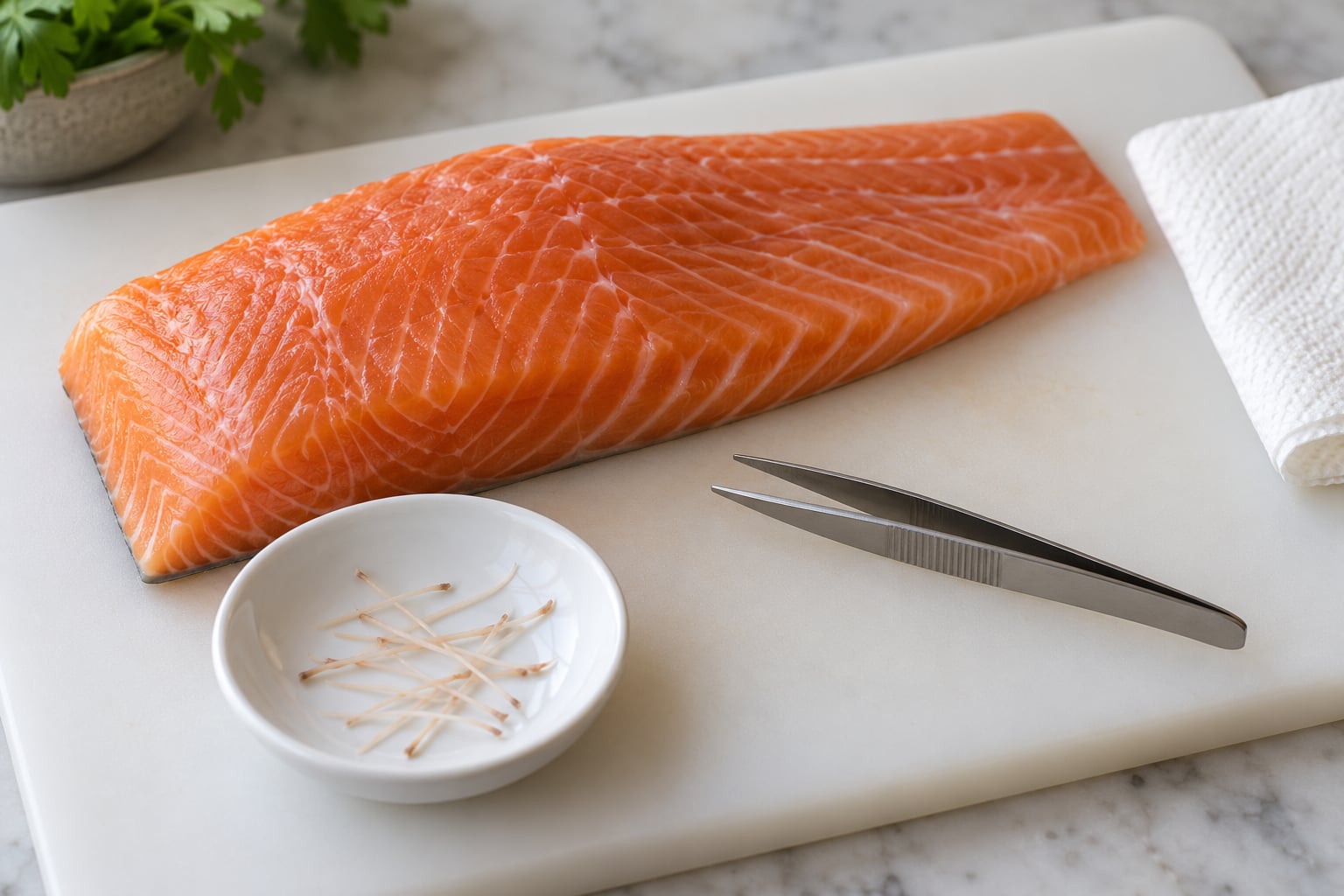
Removing pin bones from a fish fillet takes three to five minutes, a pair of needle-nose pliers or kitchen tweezers, and no cutting at all. Lay the fillet skin-side down, run a fingertip along the flesh to feel each raised bone tip, grip the bone, and pull it forward toward the head and slightly upward. That single motion is the whole method. Everything else on this page is about doing it without snapping a bone or shredding the meat.
Pin bones are a row of thin, slightly curved bones that branch off a fish’s ribcage and run outward toward the belly, sitting in the upper third of the fillet just under the flesh. They are not the backbone, not the rib bones, and not the belly flap. They are easy to miss because the tips barely rise above the surface.
Table of Contents
What You Need
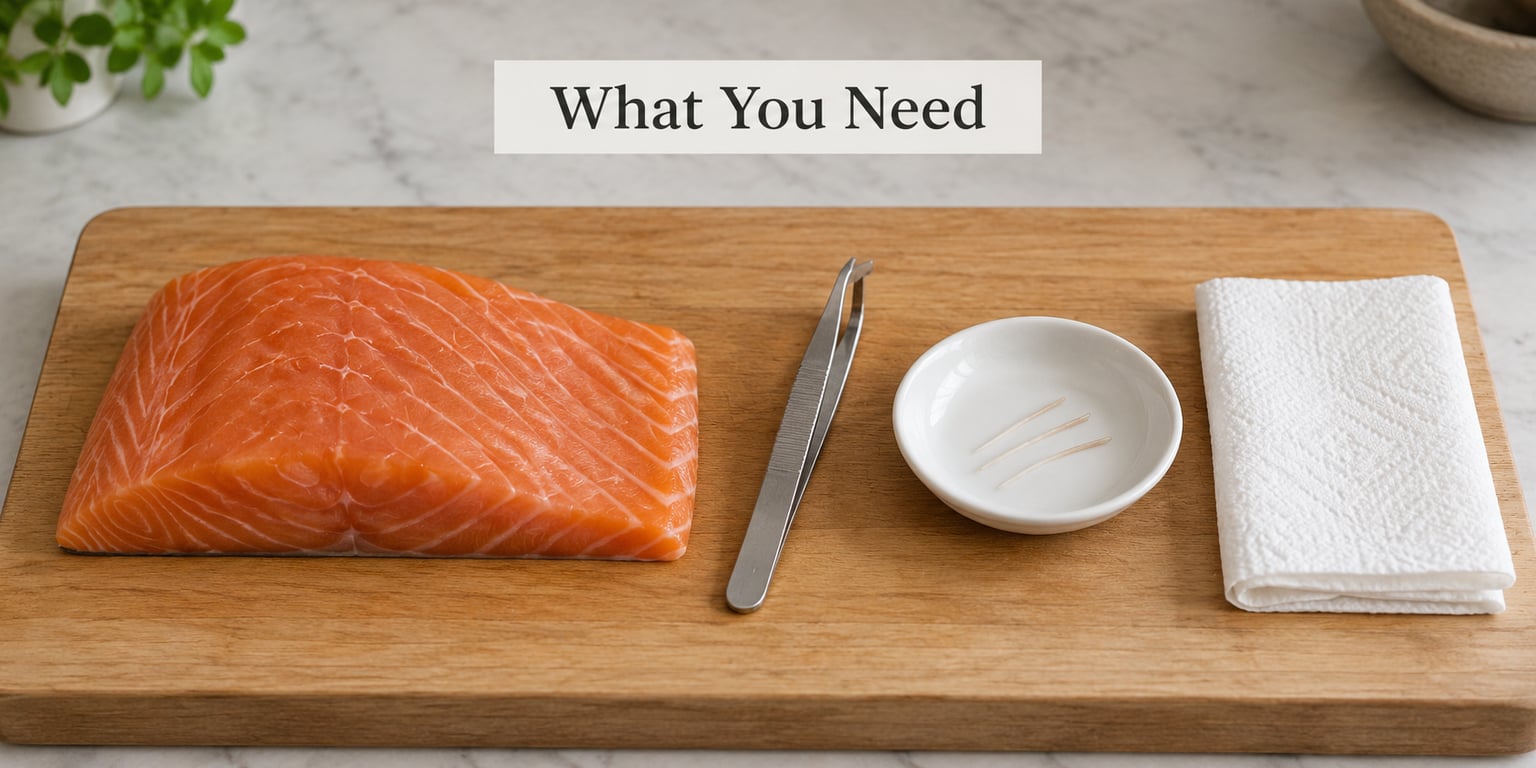
You need very little, and most people already have it.
- A pair of needle-nose pliers or long kitchen tweezers. Needle-nose pliers from a hardware store are the tool most experienced filleters actually reach for. They grip a thin bone without slicing through it, which is the failure mode of flat cosmetic tweezers.
- A shallow plate or bowl to drop extracted bones into, so you are not flicking fish flakes across the counter.
- Paper towels to pat the fillet dry. A wet fillet slides around and feels slippery under a fingertip.
- A flat board or plate big enough for the fillet to lie flat.
- Optional: a sharp fillet knife. Only for bone-heavy fish like pike and trout, where cutting the pin bone section out in one strip beats picking out thirty small bones.
Before you start, know which bones you are dealing with. The backbone runs the full length of the fillet and was usually removed when it was filleted. The rib bones are thin curved slivers attached near the belly. Pin bones sit between them, angled slightly toward the head, and they are firm enough to snap if you grip them in the wrong place.
Step-by-Step
Budget three to five minutes for a salmon or trout fillet. The whole job is a scan, a grab, a pull, and a second scan.
How to Find the Pin Bones
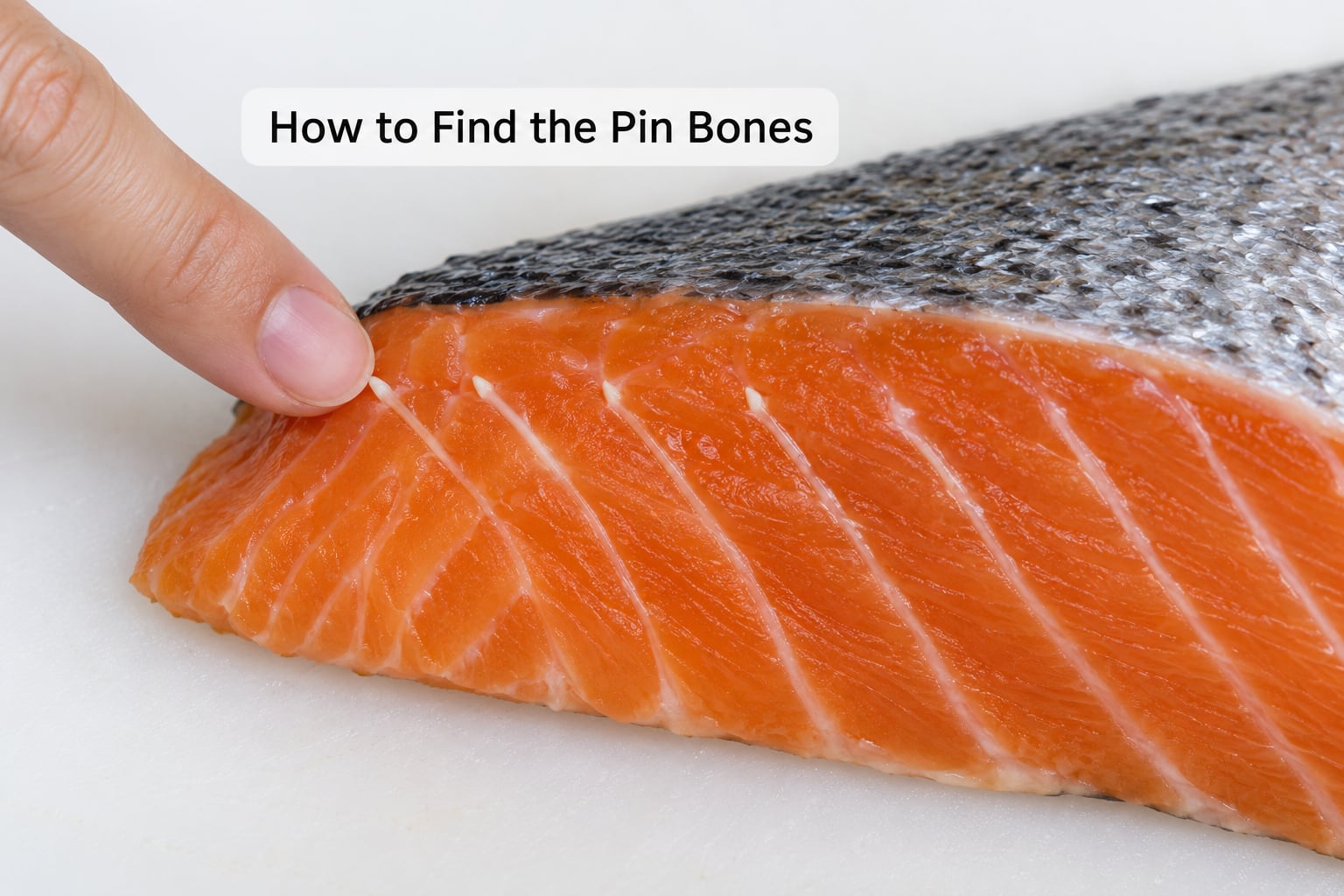
Find them by touch, not sight. Lay the fillet skin-side down, lay your non-tool hand flat on top of it to hold it still, and with the other hand run a fingertip lightly along the length of the flesh against the grain, starting at the neck end and moving toward the tail.
You are looking for a faint raised line and a small hard tip under the skin of the meat. Move slowly. A quick swipe misses half of them because you are reading texture rather than stopping on each one. The bones fan slightly, so trace each one from its tip back toward the ribcage to see which direction it runs.
You will feel them most easily in the thick part of the fillet near the head, and they get thinner and sparser toward the tail. If you cannot feel anything, run a fingertip against the grain in the other direction. One of the two passes will pick them up.
How to Remove Pin Bones with Tweezers
Grip the exposed tip, not the middle. Pliers clamped on the middle of a pin bone will cut it in half and leave you with a broken stub and a hole in the meat. Clamped on the bony tip just where it breaks the surface, the same tool slides it out whole.
Pull forward toward the head and slightly upward, following the angle the bone already points. Pulling straight back or sideways is what shears the bone and tears the flesh. The pull should be steady and firm rather than a yank, and it should take about the same effort as pulling a splinter.
Brace with your other hand. Put two fingers down on the fillet right next to the base of the bone and press gently as you pull, so the flesh is held down instead of lifting with the bone. That brace is the single biggest difference between a clean extraction and a ragged one.
Move down the row, one bone at a time. If your pliers are narrow enough, you can grab two or three tips at once, but only after you have done a few slow ones to learn the angle.
How to Remove Pin Bones with Your Fingers
You can do the whole job with your hands on smaller fish and on bones that already stand proud of the meat. Pinch the tip between a thumb and forefinger, press on the surrounding flesh with the other hand, and pull in the direction the bone points.
Wet fingers work better than dry ones, which is counterintuitive but true. A thin film of water gives your fingertips grip on a slippery surface. Dry a drop of water off the fillet, but do not soak the whole thing.
Fingers are most practical on trout, on smaller fish, and on the thick front half of a salmon fillet where the bone tips stand up clearly. They are hopeless on deep-set bones in a firm, cold fillet, and on pike or any fish with dozens of tiny pins. For those, use a tool.
If you are out of tools entirely, a spoon handle works surprisingly well. Rest the spoon on the fillet, hook a bone tip with the edge of the bowl, and lift. It is slower and you will miss more, but it does not tear meat the way a knife does.
How to Check the Fillet for Missed Bones
Run your fingertip over the fillet a second time, along the same line and against the grain. This second pass catches most of what the first one skipped. Then press the flesh down with a fingertip in a few spots: a bone that is buried and shallow will push up as a ridge when the meat compresses around it.
Look at the surface too, especially along the thickest part near the head and along the belly edge. A bone tip that is nearly flush shows as a faint pale line, particularly under good light.
If you break a bone, do not go in after the fragment with a knife. Finish cooking, then use a small fork to lift the piece of meat containing the stub away from the rest of the fillet, or use a coffee spoon to scoop it out with a small piece of flesh attached. Chasing a fragment with a knife tip only spreads it. Fishing the fragment out cold is also fine if you would rather not risk it, since pin bones stay firm through cooking.
Common Mistakes
Pulling straight up instead of forward. This is the most common failure. Pin bones point slightly toward the head, so pulling forward and a touch upward follows the line of the bone. Pulling straight up or straight back shears the bone at the tip or tears a strip of meat off the fillet.
Gripping the flesh instead of the bone. Pliers slide off wet meat. Shuffle the jaws until you feel the hard click of the bone tip between them before you pull. If you cannot feel that, the jaws are on flesh.
Using flat tweezers on a fresh fillet. Wide, flat cosmetic tweezers close like a clamp and snap the bone in two. Long, narrow tweezers or needle-nose pliers close progressively, which is exactly what you want.
Cutting around each bone with a knife. It works, but you trade a three-minute job for a ten-minute one and end up with ragged edges. The exception is pike and trout, where a full strip of bone-heavy section is faster to lift out with a knife than to pick clean bone by bone.
Assuming one pass is enough. Most people find three to four bones on the first scan and one or two more on the second. Some fillets slip through entirely, which is why a quick look at the plate before serving is worth the two seconds.
Pulling bones out of a stiff, half-thawed fillet. Fish that has been sitting in the refrigerator for a day or two, or that went into rigor quickly, has flesh that has started to release from the bone, and the pins come out far more cleanly. A fillet that is still stiff and icy in the middle is the hard case.
A couple of handling habits make everything easier. Keep the fillet skin-side down, since the skin anchors it and stops it sliding. Pat it dry first. Work at room temperature for ten minutes or so, because cold meat grips the pliers and breaks more bones. And once the fillet is cooked, let it rest to an internal temperature of 145°F, or 63°C, before serving.
Some people skip deboning altogether and just pull the pins out with their fingers mid-meal, which is a perfectly reasonable approach for three or four bones in a casual dinner. It is a worse plan for a child, an older guest, or anyone who chokes easily.
Frequently Asked Questions
Can I remove pin bones from a frozen fish fillet?
Yes, and a partly frozen fillet is often easier than a soft one. Cold, firm flesh grips the bone less, so pins tend to slide out instead of tearing off. Let the fillet sit at room temperature for 10 to 15 minutes so the surface is workable, then work from the tail end, where the bones are smallest.
Should I remove pin bones before or after cooking the fish?
Before, for most people. Once the flesh has firmed up from cooking, an overlooked bone is nearly impossible to see in the finished fish. A few people who smoke or cure fish pull the pins out afterward, because long cooking softens the surrounding meat enough that the bones lift out by hand. For a pan-seared or roasted fillet, debone first.
Are pin bones in salmon safe to eat?
In small quantities, yes. A pin bone that gets swallowed is usually swallowed whole and causes no problem, since these bones are thin and mostly cartilage. The real risk is a fragment catching in the throat, which matters more for children, older adults, and anyone with swallowing difficulty or dentures. Removing them yourself takes a few minutes and removes the question entirely.
What is the easiest way to find pin bones without cutting into the fillet?
Lay the fillet skin-side down and run a fingertip along the flesh against the grain, from the neck end toward the tail, moving slowly enough to stop on each raised tip. Press the meat down with a fingertip afterward, since a shallow buried bone pushes up as a ridge when the surrounding flesh compresses. Neither technique cuts anything.
What should I do if I break a pin bone while removing it?
Leave the fragment where it is rather than cutting after it with a knife. Cook the fish as planned, then lift the piece of meat holding the stub away with a fork, or scoop it out with a coffee spoon along with a little flesh. You can also pull the cooked flesh apart gently and pick it out. Broken fragments do not become dangerous from cooking.
Take three minutes before the fish hits the pan. Lay the fillet skin-side down, find the bones with a fingertip, and pull each one forward toward the head with needle-nose pliers or tweezers while a finger holds the flesh down beside it. Then sweep the fillet once more against the grain, because that second pass is what catches the bone you would have found mid-bite.