Pick the cooking method first, then match the oil to the heat. A rule of thumb most home cooks can live with: choose an oil whose smoke point sits at least 30 to 50 degrees above the temperature your pan will actually reach. That single habit covers about ninety percent of the decisions people get wrong, and it takes under a minute once you know the four steps below.
The rest of this guide fills in the details: what a smoke point really measures, a chart you can print, how refined and unrefined versions of the same oil differ, and how to keep the oil you bought in good shape. No equipment required beyond a pan and, if you want precision, a cheap thermometer.
Table of Contents
- What You Need
- Step-by-Step
- Step 1: Identify the Heat You Will Use
- Step 2: Check the Oil’s Smoke Point
- Step 3: Choose for the Food and Method
- Step 4: Store and Use the Oil Safely
- Common Mistakes
- Frequently Asked Questions
- What smoke point should I choose for frying?
- Is a higher smoke point always better for cooking oil?
- Which cooking oil is best for sauteing vegetables?
- Does the type of oil change how it tastes in food?
- Can I use an oil labeled for lower heat in a hot pan?
- How should I tell when cooking oil has gone bad?
- Conclusion
What You Need
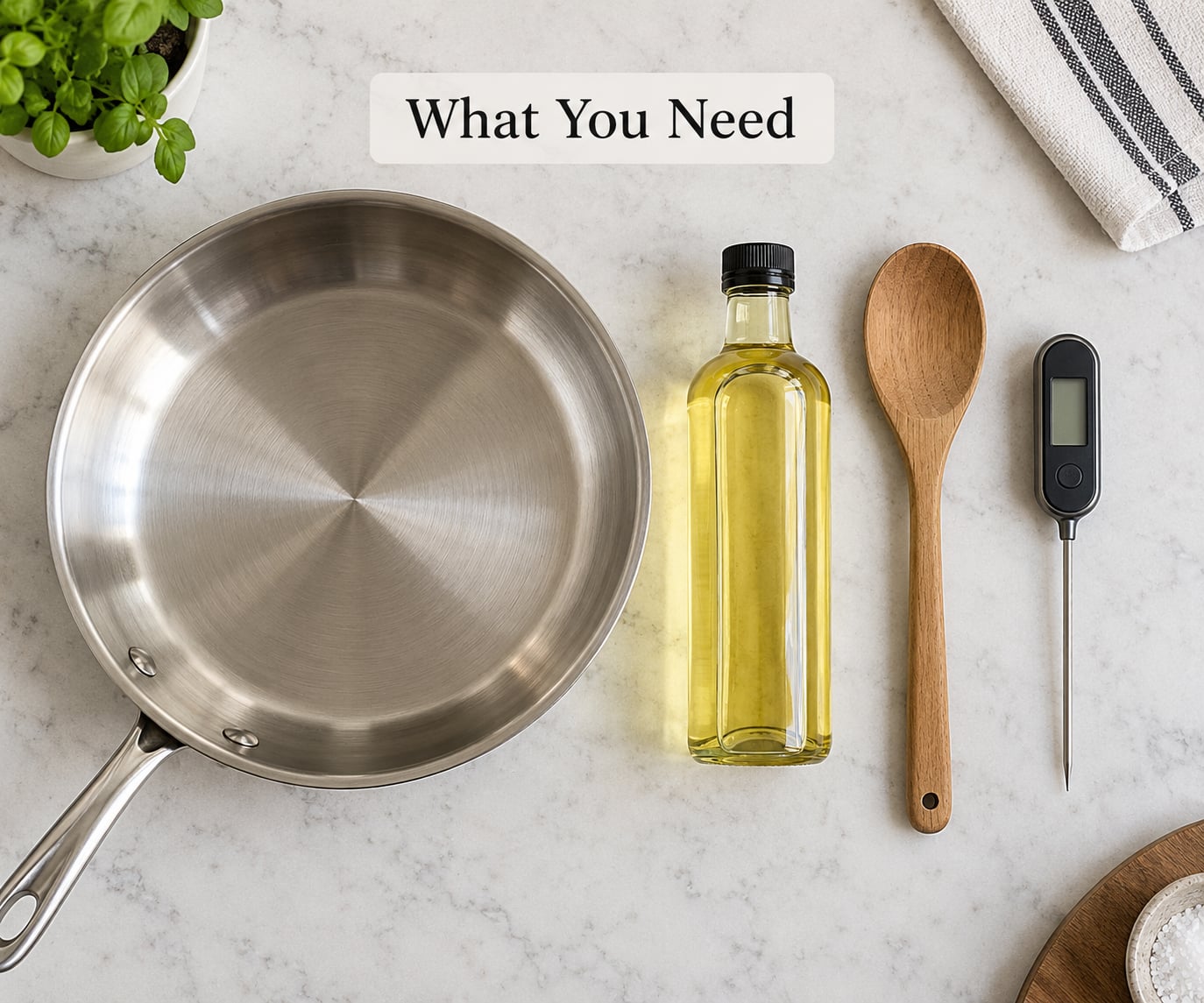
Almost everything you need is information rather than gear. Before you open the cabinet, work out these five things:
- The cooking method. Frying, searing, roasting, baking, sauteing and finishing are different jobs, and each one has a typical temperature range.
- The target temperature. If you do not know it, a pan thermometer costs less than a takeout order and removes all guesswork.
- The food. Delicate fish and cut vegetables punish a strong-flavored oil; bread and popcorn want a neutral one.
- The smoke point on the label or from the manufacturer. Refined and unrefined versions of the same oil can differ by more than a hundred degrees.
- Any allergies in the room. Peanut and tree nut oils are worth ruling out before anything else.
A dry stainless or cast iron skillet and a wooden spoon cover almost every case. A thermometer is optional but it is the single thing that stops the most common mistake, which is cooking well past the heat you planned for.
Step-by-Step
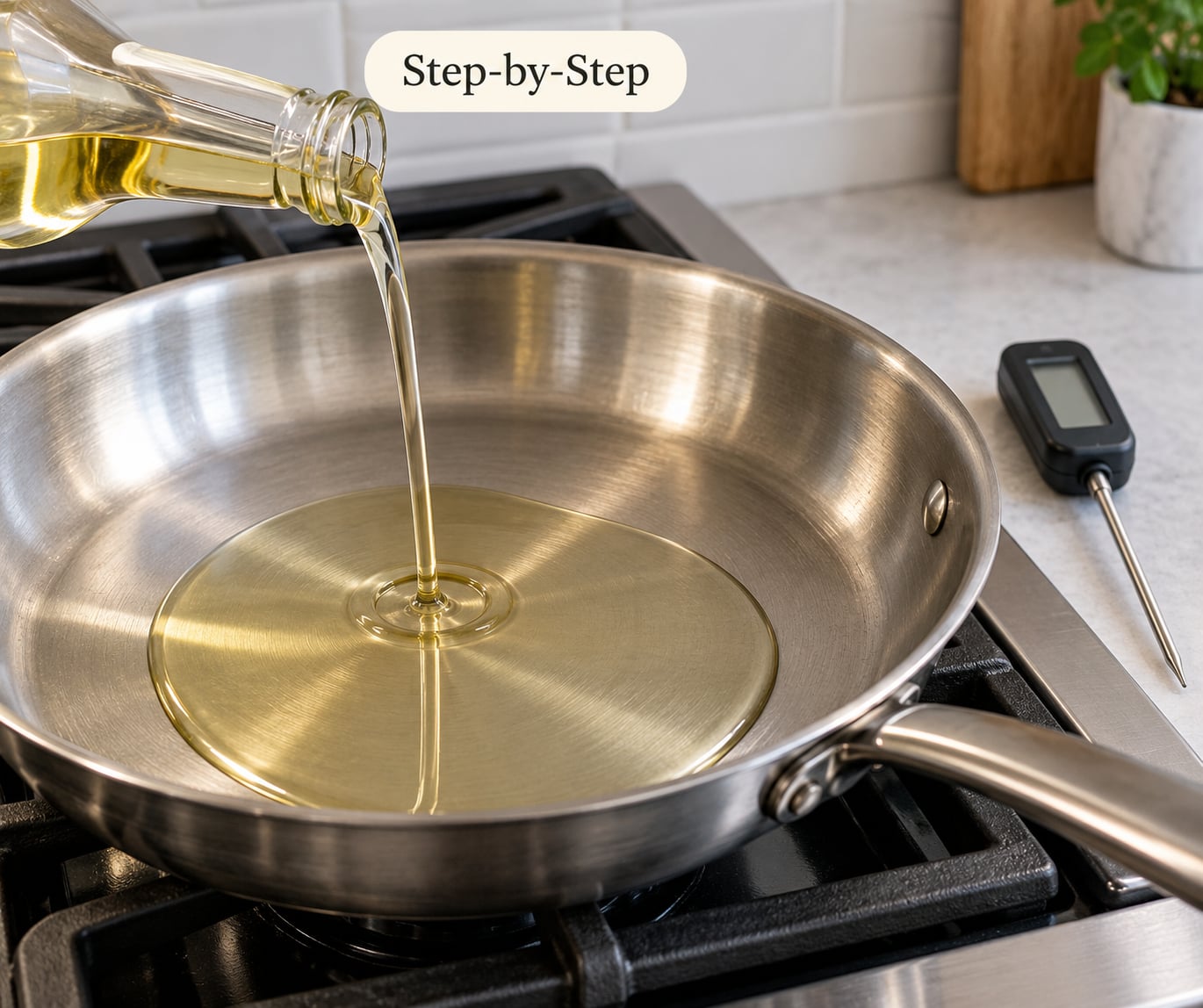
Step 1: Identify the Heat You Will Use
Start with the temperature your food will actually see, not the number on the dial’s highest setting. Here are the ranges that matter for home cooking:
| Method | Typical temperature | What you need from the oil |
|---|---|---|
| Salad dressing, drizzle, finishing | Room temperature | Flavor. Smoke point is irrelevant. |
| Gentle sauteing, soft eggs, delicate fish | 250 to 300 F | Low smoke point, mild flavor |
| Medium sauteing, pan-frying, baking | 325 to 375 F | Medium smoke point, neutral flavor |
| Roasting vegetables, bread, casseroles | 375 to 425 F | Medium-high smoke point |
| Stir-frying, wok cooking | 400 to 450 F | High smoke point, neutral to light flavor |
| Searing, grilling, deep frying | 450 to 500 F | Very high smoke point with real margin |
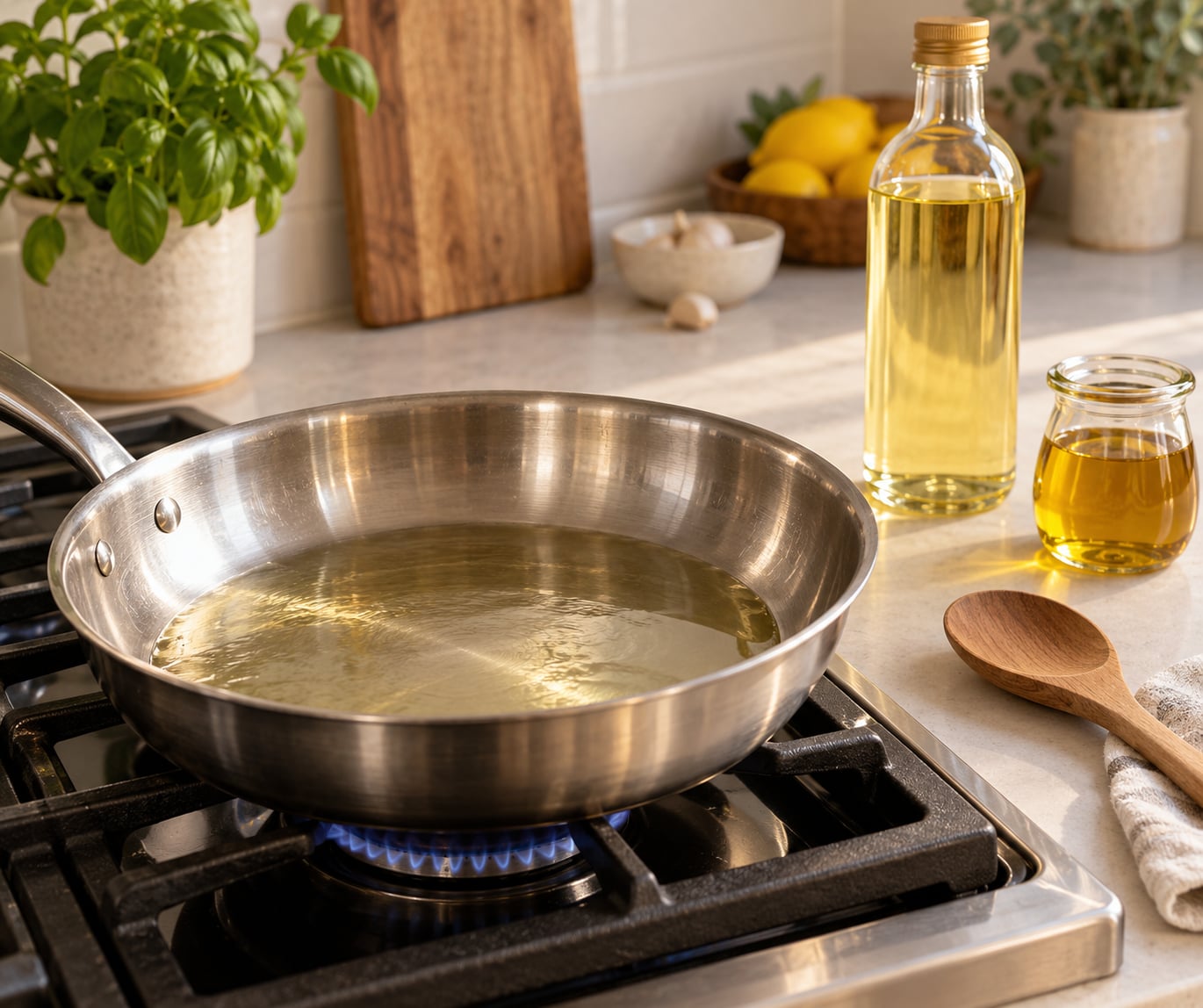
How you can tell you are in the right range without a thermometer: oil shimmering means it is hot enough for sauteing, faint smoke from the food dropping in means the pan is near searing temperature, and a fully smoking pan means you have gone too far. If oil is visibly smoking before the food goes in, turn the heat down and let it settle.
Step 2: Check the Oil’s Smoke Point
A smoke point is the temperature at which an oil begins to break down and produce visible smoke. The triglycerides split into free fatty acids and glycerol, the glycerol breaks down further into acrolein, which is what makes overheated oil smell sharp and unpleasant, and the oxidation process generates aldehydes and other compounds that transfer into the food.
Two things worth knowing before you compare numbers. First, smoke point is a measure of refinement more than anything else. Second, it is measured with the Cleveland Open Cup method under American Oil Chemists Society standard Cc 9a-48, and the cup, the oil sample and the heating rate all shift the result. That is why ten websites list ten different numbers for the same bottle. Treat every figure as a range, not a promise.
| Oil | Smoke point, refined | Smoke point, unrefined | Best for |
|---|---|---|---|
| Refined avocado | 480 to 520 F | Not usually sold unrefined for cooking | Searing, high heat, neutral flavor |
| Refined olive | 460 to 480 F | Extra virgin: 375 to 405 F | Frying; extra virgin for roasting and sauteing |
| Refined canola | 400 to 450 F | Not applicable | Everyday high-heat cooking |
| Refined peanut | 440 to 460 F | 350 to 375 F | Deep frying, especially poultry |
| Refined sunflower (high oleic) | 440 to 460 F | Not applicable | Frying, air frying, wok cooking |
| Refined safflower | 450 to 480 F | Unrefined: about 390 to 400 F | High heat, light flavor |
| Refined grapeseed | 420 to 440 F | Not applicable | High heat, light flavor |
| Refined sesame | 440 to 470 F | Not applicable | Stir-frying, deep frying |
| Refined coconut | 400 to 450 F | Unrefined (virgin): about 350 to 390 F | Baking, high heat, popcorn |
| Extra virgin olive | Not refined | 375 to 405 F | Sauteing, roasting, finishing, low to medium heat |
| Ghee (clarified butter) | Not applicable | 440 to 480 F | Searing, frying, flatbreads |
| Butter | Not applicable | About 300 F before browning | Sauteing, baking, sauces |
| Toasted sesame oil | Not applicable | About 350 to 410 F | Finishing, dressings, low heat |
| Corn, soybean, sunflower (standard) | 400 to 440 F | About 320 to 360 F | Budget baking and sauteing |
| Vegetable or canola blend | 400 to 450 F | Not applicable | Everyday cooking, baking, frying |
Now do the subtraction. If your pan will hit 425 F for roasting vegetables, anything rated 400 F is too close for comfort; look for 440 F or above. If you are searing at 480 F, refined avocado and ghee are the two names that show up in nearly every list. This margin rule is the whole decision, and it takes one subtraction.
Step 3: Choose for the Food and Method
Smoke point gets you into the right range; flavor decides whether the dish is good. Three families cover almost everything:
Neutral oils like refined avocado, refined canola, refined sunflower, grapeseed and vegetable blends let the food taste like food. They are the right call for frying, searing, stir-frying, baking and anything with a sauce. They are also the easiest choice for beginners because the flavor cannot get in the way.
Mild but characterful oils like extra virgin olive oil, refined olive and toasted sesame carry aroma and flavor that belongs on top of or alongside the food. Extra virgin olive at 375 to 405 F handles sauteing, roasting vegetables at moderate heat and finishing beautifully. It can also take higher heat than its reputation suggests, as peer-reviewed stability work from De Montfort University and studies reviewed in Acta Scientific Nutritional Health found olive oil holds up well under sustained heat.
Single-origin and specialty oils like unrefined sesame, expeller-pressed nut oils and flavored or infused oils are finishing products. Herbs and aromatics do not raise a smoke point, and infusions add water content that makes them spoil faster, so pour them over food after cooking rather than heating them.
A few pairings worth trying: high oleic sunflower for turkey or potatoes, peanut for fried chicken, refined canola for shrimp tempura, extra virgin olive for roasted tomatoes and bruschetta, ghee for flatbreads and scallions, refined avocado for steak. For cast iron seasoning, the debate is about whether the oil should smoke at all. Staying just under the smoke point and wiping off the excess gives you a polymerized, non-stick surface without the acrid smell, which is why most seasoning veterans keep the heat moderate.
On fat type, beyond smoke point: monounsaturated oils such as olive and avocado are the everyday default, polyunsaturated oils such as corn, soybean and standard sunflower are fine but oxidize faster because of their higher polyunsaturated content, and coconut and palm are high in saturated fat. Plant omega-3s from flax, chia and hemp belong on food, not in the pan, since they break down quickly under heat. If you want an authority-checked framework, the American Heart Association recommends replacing saturated fats like butter and coconut oil with unsaturated vegetable oils whenever you can.
Step 4: Store and Use the Oil Safely
Selecting well is half the job. Four habits keep oil working for months instead of weeks:
- Keep it cool, dark and sealed. A cabinet away from the stove beats one next to it. Light and heat are the two things that drive oxidation.
- Buy the size you will use. Nobody finishes a liter bottle of oil before it turns.
- Refrigerate nut oils and anything expensive. Cold slows rancidity, and a cloudy layer that solidifies at the back of the fridge is normal, not a defect.
- Watch for the smell. Fresh oil smells faintly of the nut, seed or grass. The moment it turns crayon-like, paint-like or stale, toss it. Do not smell-test hot oil, since the smoke is itself the warning.
When frying, do not crowd the pan. More food means more moisture, the temperature drops, and the oil absorbs and holds onto the burnt compounds longer. When you do cool frying oil for reuse, strain it through a fine sieve into a container, keep it in the fridge, and use it within a few weeks for the same food. Cooler oil darkens over time, which is normal; a foamy texture or a bitter smell means it is done.
For deep-fried poultry, cook to an internal temperature of 165 F, and for whole cuts of meat or fish, 145 F, as recommended by the USDA.
Common Mistakes
Chasing the highest smoke point on the shelf. A 500 F oil is not automatically better than a 450 F oil; it is only useful if you are cooking above 420 F. For sauces, dressings and finishing, flavor matters and the number does not. Pick the smallest margin that safely covers your heat, and nothing more.
Treating refined and unrefined as interchangeable. They are the same oil at different processing stages. Refining bleaches out the flavor and the free fatty acids that make an unrefined oil smoke earlier and taste stronger, which is why refined extra virgin olive would be a contradiction and why refined canola has no unrefined counterpart in most kitchens. Check which version you are holding, not just the oil name on the front.
Using one oil for everything. It is tempting to buy one bottle and never think about it again. In practice a single oil means either a flavor that fights your food or a neutral oil that leaves bread and vegetables a little flat. Two bottles solve it: a neutral high-smoke oil for heat, and a finishing oil for flavor.
Heating the pan to max before the oil goes in. The pan is what holds the heat, so it keeps climbing after the oil hits it. Heat the pan, add oil, let the oil reach temperature, and only then add food.
Assuming a smoke point figure is exact. Avocado oil gets reported as smoking well below its label figure, usually because the bottle is a virgin or less-refined version, or because the pan was far hotter than the recipe needed. Keep the heat moderate when you are new to an oil, and buy from a seller who states the processing method.
Ignoring allergies and cross-contact. Highly refined peanut oil is processed in a way that removes nearly all of the protein that triggers reactions, and the FDA treats it as exempt from major peanut allergen labeling, but that is not the same as safe for everyone. Highly sensitive individuals and anyone with a doctor-advised avoidance should treat all peanut oil as off the table.
Frequently Asked Questions
What smoke point should I choose for frying?
For home deep frying and searing at 450 to 500 F, choose an oil rated at 440 F or higher: refined avocado, refined peanut, ghee, refined high-oleic sunflower, refined safflower or refined sesame. Keep a margin of at least 30 to 50 degrees above your target heat, and heat the oil with the food nearby so it does not sit overheated.
Is a higher smoke point always better for cooking oil?
No. A higher smoke point only matters when you are cooking above about 400 F. For sauteing, baking, dressings and finishing, flavor and odor matter more, so an extra virgin olive oil at roughly 375 to 405 F is often the better choice than a neutral 480 F oil that adds nothing but heat tolerance.
Which cooking oil is best for sauteing vegetables?
A refined, neutral oil with a smoke point above 350 F works well: refined canola, refined avocado or refined grapeseed. For softer vegetables or a richer flavor, use extra virgin olive oil at medium heat. Avoid strong oils such as toasted sesame or unrefined nut oils here, since their flavor can overpower delicate greens.
Does the type of oil change how it tastes in food?
Very much so. Refined oils are processed to strip flavor and odor, so the food leads. Extra virgin olive, toasted sesame, peanut and unrefined oils carry their own aroma and taste, which works when it complements the dish and fails when it takes over. Match a strong oil to strong flavors like fried chicken or roasted garlic.
Can I use an oil labeled for lower heat in a hot pan?
You can, but it costs you quality. Heating an oil past its smoke point makes it break down into free fatty acids and acrolein, which gives food a bitter, acrid taste and leaves the oil less pleasant the next time you use it. If that is your only option, lower the heat, add food sooner, and replace the oil after the meal.
How should I tell when cooking oil has gone bad?
Smell it first. Fresh oil smells faintly of its source, while rancid oil turns crayon-like, waxy or stale. In the pan, an oil that foams heavily, spits, or turns dark and thick after cooking has probably degraded. Storage is the real fix: keep oil sealed, cool and away from light, and buy bottle sizes you will finish.
Conclusion
Name the method before you name the oil. Work out the temperature your pan will reach, pick an oil rated 30 to 50 degrees above it, and let the food decide between a neutral and a flavorful option. Refined canola or avocado covers most everyday heat, extra virgin olive covers roasting, sauteing and finishing, and ghee or refined peanut handles the hottest pans.
That is the whole process. Everything else on a cooking oil label, including how to choose a cooking oil by smoke point ratings that come with a margin, is detail that follows from those three decisions.