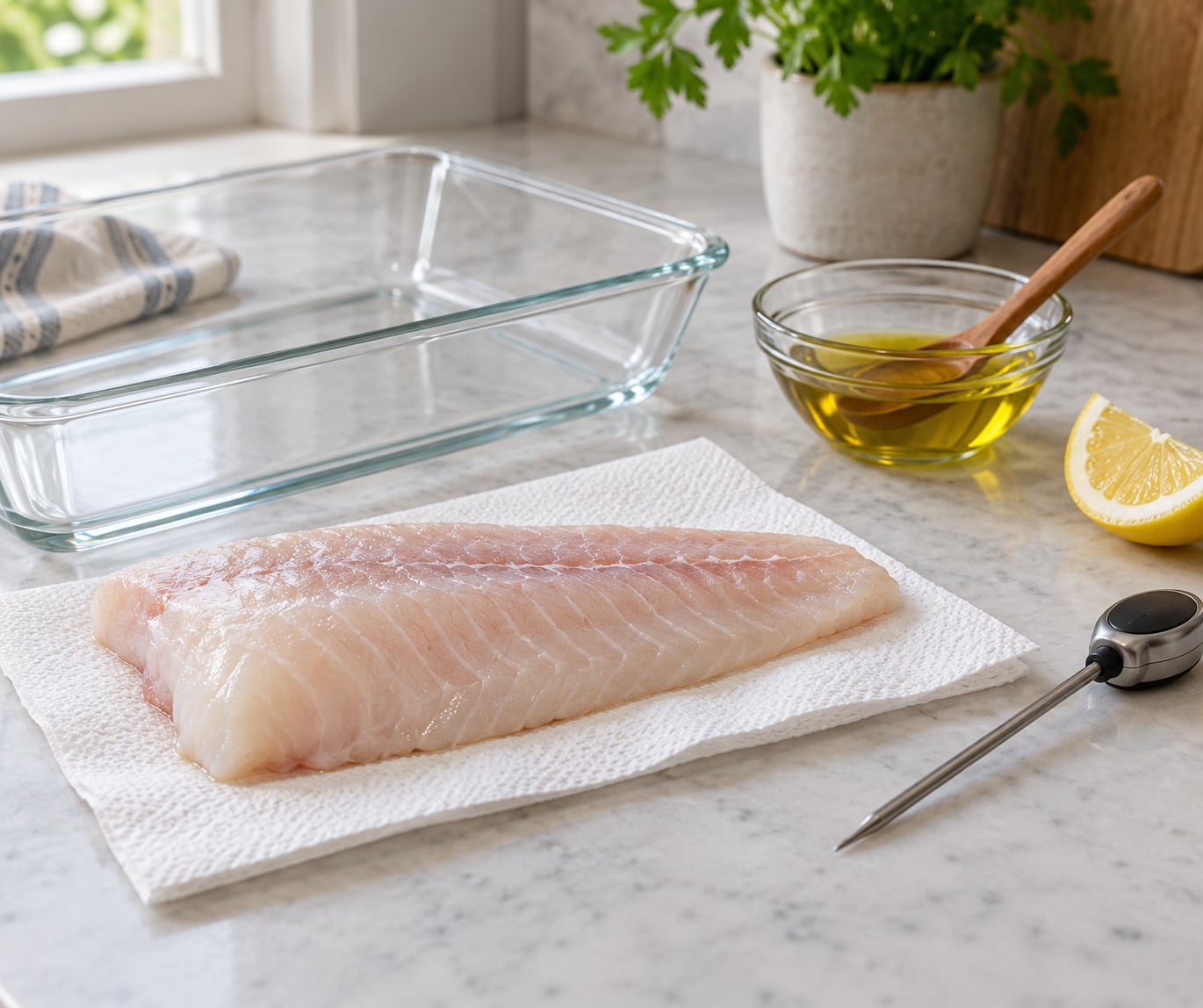
If you have ever pulled a frozen fillet out of the freezer and ended up with a pale, soft, slightly slimy piece of fish sitting in a puddle of cloudy liquid, the water was already gone before the pan ever got hot. Freezing ruptures the muscle cells, and thawing pushes that moisture out. Here is how to cook frozen fish without it getting watery: thaw it gently, blot it completely dry, and cook it fast in a hot pan or hot oven until it hits 145F / 63C inside.
It takes about five minutes of prep and twenty minutes of cooking for thin fillets, and the technique is forgiving enough that a beginner can get a good result on the first try. The mistakes that ruin fish, though, are all easy to make on a rushed weeknight.
Updated for 2026.
Table of Contents
- What You Need
- Step-by-Step
- How to thaw frozen fish safely
- How to get the water out of frozen fish before it hits the pan
- How to season frozen fish without making it watery
- How to cook frozen fish in a pan
- How to cook frozen fish in the oven
- How to cook frozen fish in an air fryer
- How to fix frozen fish when the water still pools
- How to tell when frozen fish is done
- Common Mistakes
- Frequently Asked Questions
- Conclusion
What You Need
The tool list for this job is short, and most kitchens already have every item.
- Paper towels, several dry ones. This is the single most important item on the list.
- A shallow dish or plate that fits in your refrigerator, for thawing in the fridge so nothing drips onto a shelf.
- An instant-read thermometer with a thin probe. Guessing doneness by color is how fish gets overcooked.
- A fish spatula or a thin, flexible metal spatula. A regular slotted turner is wide and often tears a fillet.
- A heavy skillet with a lid, ideally cast iron or stainless. Heavy metal holds heat better than a thin nonstick pan when you want a real sear.
- A sheet pan and a wire cooling rack. The rack lifts the fish off the pan so liquid drains instead of sitting underneath.
- A neutral oil such as avocado, canola or grapeseed, plus kosher salt for a dry brine.
- Heavy aluminum foil and parchment for oven cooking.
Optional: a squeeze of lemon, fresh dill or parsley, and a shallow container of cold milk if your frozen fish has a strong smell.
Step-by-Step
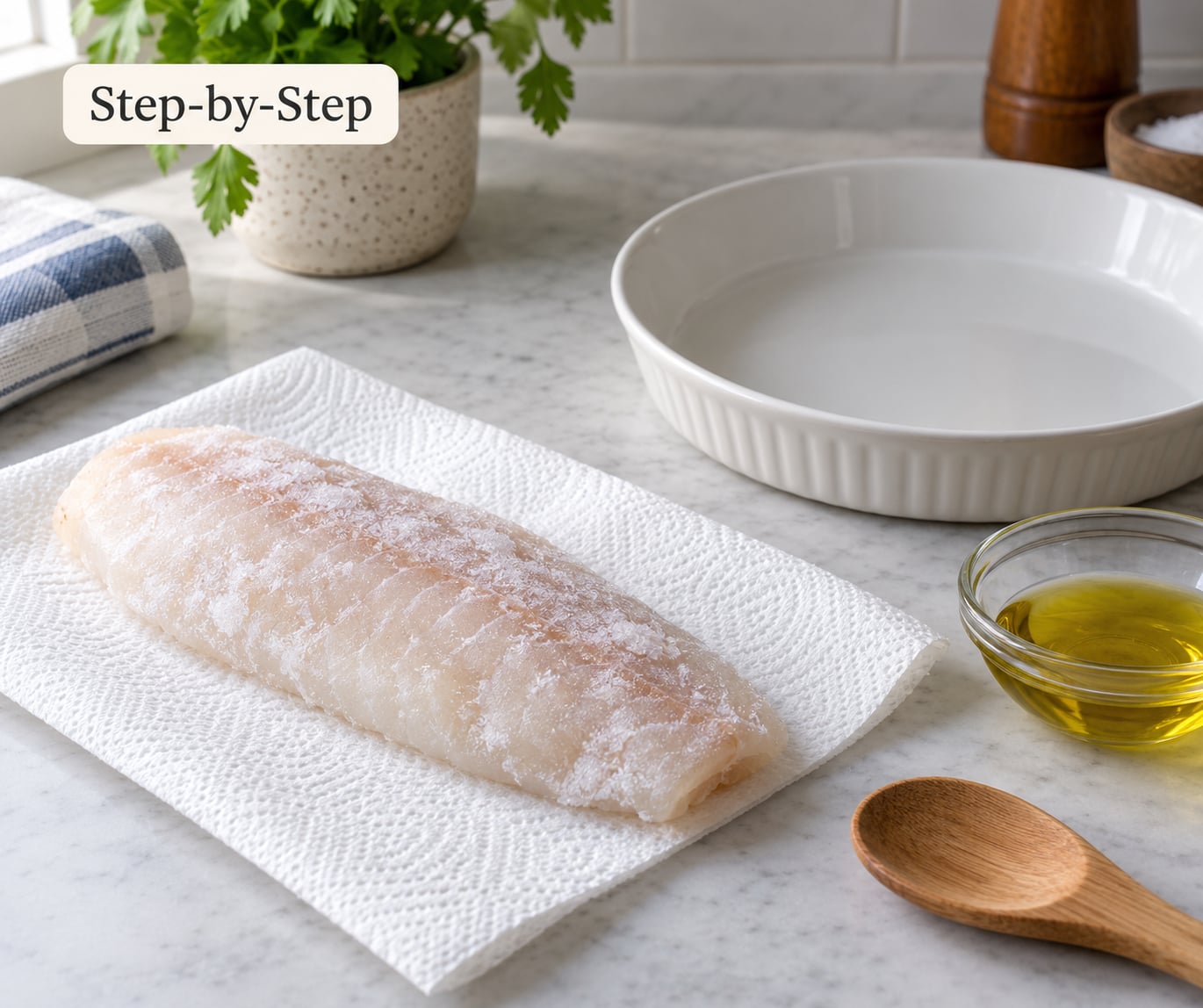
How to thaw frozen fish safely
The refrigerator method is the one to use when you have time. Put the sealed fillets or unopened bag in a shallow dish, set it in the coldest part of your fridge, and leave them for several hours or overnight.
Cold water is the fastest safe method. Keep the fish sealed in a plastic bag, submerge it in cold tap water, and change the water every 30 minutes. It is safer and cleaner than running the fillet under a tap, which warms unpredictably and spreads bacteria across the surface.
| Fillet thickness | Refrigerator | Cold water |
|---|---|---|
| 1/2 inch / 1.3 cm | 4 to 6 hours | 30 to 45 minutes |
| 1 inch / 2.5 cm | 8 to 12 hours | 1 to 1.5 hours |
| 2 inch / 5 cm steak | 18 to 24 hours | 2 to 3 hours |
Two methods to skip: hot water, which cooks the outside while the center stays frozen, and the microwave, which heats the edges first and leaves a raw cold core. Nobody should leave fish on the counter overnight either. The 40F to 140F / 4C to 60C range is where bacteria multiply fastest, and a countertop thaw on a warm kitchen sits there for hours.
How to get the water out of frozen fish before it hits the pan
Blot the thawed fish dry with paper towels, pressing firmly on every surface until the towels come away without a damp mark. Do not rinse the fillet under running water, since wet flesh absorbs water and turns soggy. If ice crystals are heavy, one quick dip in cold water followed by thorough drying is fine. Pat, do not rub, or you will tear the surface you are trying to crisp.
How to season frozen fish without making it watery
Salt pulls a little liquid out of the flesh on purpose. A dry brine, which is salt scattered over the fish and over the pan 15 to 30 minutes before cooking, seasons it deeper and leaves the surface drier, which is exactly what you want.
Once the fish is dry, add a thin film of oil. Oil needs a dry surface to spread instead of beading, and dry flesh is what lets a crust form. Save the lemon for the last minute of cooking, since acid early on makes the surface tacky and slow to brown.
How to cook frozen fish in a pan
Heat a heavy skillet until an oil drop shimmers, then add a thin layer of oil and the fillet in a single layer with space around it. Crowding drops the pan temperature, and a cool pan is the same as a low pan: the fish sits in its own liquid and poaches instead of searing.
Cook without touching it for the first three to four minutes. The fillet will tell you when it is ready to move, because it releases from the pan on its own. If you need a spatula to get under it, it is not ready yet.
Turn once, cook the second side, then finish with the lid on for one or two minutes so the center catches up with the crust. Slide a probe into the thickest part and confirm 145F / 63C. Pull it off the heat at that point, because residual heat keeps cooking.
How to cook frozen fish in the oven
The oven is the hands-off option for thick pieces. Preheat to 400F / 200C, line a sheet pan with parchment, set a wire rack on top, and lay the fillets on the rack in a single layer. Lightly spray or brush with oil and season with the dry brine.
Cover loosely with foil for the first half of the cooking time, then uncover it so moisture can evaporate and the surface can brown. That foil and uncover pattern does more to prevent watery fish than almost anything else in the oven method.
Cooking straight from frozen takes roughly 50 percent longer than cooking thawed fish. Use these as starting points and check the temperature before you trust the clock.
| Method from frozen | Temperature | 1 inch / 2.5 cm fillet | 2 inch / 5 cm steak | Water released |
|---|---|---|---|---|
| Oven, parchment and rack | 400F / 200C | 25 to 30 minutes | 40 to 50 minutes | Low |
| Air fryer | 400F / 200C | 10 to 14 minutes | 18 to 24 minutes | Low |
| Grill | Medium-high | 5 to 7 minutes a side | 9 to 12 minutes a side | Medium |
| Pan-seared, partly thawed | Medium-high | 4 to 6 minutes a side | 6 to 8 minutes a side | Medium |
| Steamed | Steaming, 212F / 100C | 6 to 8 minutes | 10 to 12 minutes | None |
| Microwave, 50 percent power | Medium setting | 4 to 6 minutes | 7 to 10 minutes | Medium |
How to cook frozen fish in an air fryer
Yes, and it is one of the best methods for avoiding watery fish. The fan moves hot air fast, so surface moisture evaporates instead of pooling. Set the air fryer to 400F / 200C, spray the fillet with oil, and use a light coating so nothing sticks to the basket.
Keep the pieces in a single layer with a little space, and check the thickest part a few minutes before the listed time. Air fryer baskets run hot, and fish that looked pale at nine minutes can go dry by twelve.
How to fix frozen fish when the water still pools
Sometimes liquid appears anyway, especially with breaded or previously frozen fillets. Set the fish on a wire rack over a sheet pan for a minute so it drains, blot the top, and serve it right away with a sauce that has its own liquid, such as a lemon butter or a salsa.
You can also stop fighting the liquid and cook with it. Dropping frozen fillets into soup, stock or coconut milk is the standard advice over on r/Cooking, and a frozen salmon fillet cooked in a can of coconut milk stays tender for that reason. When liquid is the cooking medium rather than a by-product, it stops being a problem.
One clarification that trips people up: the cloudy white liquid in the pan is mostly protein called albumin squeezing out of the flesh, not a sign of spoilage. It is safe to eat.
How to tell when frozen fish is done
Use an instant-read thermometer in the thickest part of the fillet, away from the bone. 145F / 63C is the safe minimum internal temperature for fish, and it is a minimum rather than a target, since more cooking only dries it out.
Visual cues support the thermometer rather than replace it. Cooked flesh turns opaque and separates into flakes when you lift it with a fork, and it springs back when pressed. If the flesh stays translucent, gives easily, or splits into ragged pieces, it has gone past done into overcooked territory, and that dry, chalky texture is what people usually call mushy.
The old 10-minute rule, which assumes a fillet cooks in 10 minutes per inch, was written for thawed fish and a hot pan. Cooking from frozen roughly adds half again to that, which is why the clock alone is not enough. Take the pan out of the heat once you have your reading.
Common Mistakes
Almost every watery fillet has one of these causes.
- Thawing in hot water. The outside turns to mush before the center softens. Use cold water and change it every 30 minutes instead.
- Rinsing the fillet under the tap. Wet flesh absorbs water and steams itself. Pat dry and skip the rinse.
- Skipping the drying step. Paper towels on both sides for 30 seconds removes more water than most people expect, and it is what lets a crust form.
- Crowding the pan. Too many fillets drop the temperature and create a steam bath. Cook in batches.
- Cooking at excessive heat. Very high heat burns the outside while the center stays raw, and the trapped moisture then makes it dry out and turn chalky. Medium-high is enough.
- Moving the fish too early. If it sticks, it is not browning yet. Wait for the natural release.
- Letting it overcook. Fish does not improve past 145F / 63C. Take the thermometer reading and stop.
- Thawing on the counter overnight. The outer layer enters the danger zone long before the center is thawed.
A few extras worth knowing. If your fish tastes too fishy, a short soak in cold milk with a spoonful of lemon, or a splash of vinegar in the cooking liquid, softens the smell. A squeeze of lemon and fresh herbs at the end does the same job without a soak.
Quality shows up in the freezer aisle. Individually quick-frozen fillets form smaller ice crystals than block-frozen blocks, so they lose less water. A heavily frosted or ice-glazed piece, or one that has thawed and refrozen, will weep no matter how carefully you cook it. Prefer fillets that look bright and only lightly frosted.
Finally, keep the cooking surface hot, and serve the fish immediately. Fish that sits on a plate for ten minutes gives its own moisture right back to the plate.
Frequently Asked Questions
Can I cook frozen fish straight from the freezer?
Yes. Cooking fish from frozen works well in an oven, air fryer or grill because dry heat drives moisture off instead of trapping it. Add about 50 percent to the usual cooking time, keep the pieces in a single layer, and check the thickest part with an instant-read thermometer. It reaches 145F / 63C safely, and the crust usually turns out better than a fish that sat in its own thawing liquid.
Should I rinse frozen fish before cooking it?
No. Running water rinses away nothing useful on the surface and soaks the flesh, which makes it more likely to turn soggy and to lose moisture during cooking. If the fillet is covered in loose ice crystals, a quick dip in cold water followed by thorough drying with paper towels is fine. Otherwise, pat the fish dry and move straight on to seasoning.
What is the fastest safe way to thaw frozen fish?
Cold water is the fastest safe method. Keep the fish sealed in a plastic bag, submerge it in cold tap water, and change the water every 30 minutes until it is flexible. A 1 inch / 2.5 cm fillet takes 1 to 1.5 hours, while a 2 inch / 5 cm steak needs 2 to 3 hours. The microwave is faster still but heats unevenly and leaves a cold core.
Why does my frozen fish release so much liquid in the pan?
Ice crystals formed while freezing rupture the muscle cells, so moisture escapes during thawing and again at the start of cooking. Slow cooking, a crowded pan or a pan that is not hot enough lets that liquid pool, and the fillet ends up gently steamed in its own water instead of searing. Blot the fish dry and use a hot pan with space around each piece to prevent it.
Can I cook frozen fish in an air fryer?
Yes, and it is one of the more reliable methods for avoiding watery results because the fan cooks from every side and evaporates surface moisture fast. Cook at 400F / 200C, spray the fillet with a little oil, and keep it in a single layer. Start checking at about 10 minutes for a 1 inch / 2.5 cm fillet and take it out once the thickest part reads 145F / 63C.
How do I know when frozen fish is fully cooked?
Push an instant-read thermometer into the thickest part, away from any bone, and wait for 145F / 63C, the safe minimum for fish. Look for the flesh turning opaque and flaking apart when lifted with a fork. Appearance alone is not enough, because a frozen fillet looks underdone while the center is still cold, and warm color can also mean the outside is cooked while the middle is not.
Conclusion
The fix is not complicated. Thaw frozen fish under refrigeration or in cold water, never on the counter and never in hot water. Blot it dry, give it room in a hot pan or a 400F / 200C oven, and take it off the heat once the thickest part reads 145F / 63C.