Learning how to make jam without pectin comes down to three things: enough fruit, enough sugar, and enough cooking time. Combine about 2 to 3 pounds of prepared fruit with 1 to 2 pounds of granulated sugar and 1 to 3 tablespoons of lemon juice, then simmer until the mixture reaches 220F (104C). The fruit’s own pectin does the setting once the sugar draws out the water and the acid lets those pectin molecules bond.
That is the whole trick, and it is slower than a boxed-pectin recipe. Anyone with a heavy pot, a plate and a thermometer can do it in about 45 minutes of actual cooking, plus prep. This guide covers the method, how to test for a set, and what to do when the jam stays runny.
Table of Contents
- What You Need
- Choosing Fruit by Natural Pectin
- Optional Flavourings
- What Sugar, Acid and Heat Actually Do
- Step-by-Step: How to Make Jam Without Pectin
- Step 1: Prepare the Fruit and Equipment
- Step 2: Cook the Fruit with Sugar and Lemon
- Step 3: Test Whether the Jam Has Set
- Step 4: Fill, Seal, and Store the Jam
- Why Jam Without Pectin Might Not Set
- How to Rescue a Batch That Failed
- Frequently Asked Questions
- Do I need pectin to make jam at home?
- Which fruits make the best jam without added pectin?
- Why is my jam without pectin still runny?
- Can I reduce the sugar in jam made without pectin?
- How long does homemade jam without pectin keep?
- Can pectin-free jam be frozen?
- Conclusion
What You Need
The base ratio for most fruits is 2 to 3 pounds prepared fruit, 1 to 2 pounds sugar, and 1 to 3 tablespoons fresh lemon juice. Pectin-free jam leans on sugar more heavily than a pectin recipe does, because sugar is what releases the fruit’s natural pectin from the water around it.
A wide, heavy-bottomed preserving pan or Dutch oven works better than a tall stockpot. You want the surface area to keep the boil from scorching the bottom while the water cooks off.
Beyond the pan, the useful tools are a kitchen thermometer that reads to at least 220F (104C), a jar funnel, a small ladle, a pinch of salt, and two or three saucers or plates you can run under the freezer for the plate test. Clean half-pint or pint jars with screw bands if you plan to refrigerate or freeze; proper canning jars with two-piece lids if you want it shelf stable.
Choosing Fruit by Natural Pectin
Not every fruit sets the same way. The pectin lives mostly in the skins, cores and seeds, so unpeeled apples and tart little berries do far better than peeled mango. This table tells you how much extra cooking each one needs.
| Fruit | Natural pectin | What to expect |
|---|---|---|
| Quince, lemon, gooseberry, cranberry, green apple, red currant | High | Sets on its own with normal sugar. A short cook, usually 20 to 30 minutes. |
| Raspberry, blackberry, plum, apricot, fig, sweet apple | Medium | Sets reliably if you cook it a full 30 to 40 minutes. Remove the stones from plums for a cleaner texture. |
| Strawberry, blueberry, peach, rhubarb, pineapple | Low | Needs the full sugar ratio and patience. Expect 35 to 45 minutes and a soft set. |
| Mango, banana, papaya, blueberry in late-season soft batches | Negligible | Never set on their own. Pair with a high-pectin fruit or use freezer jam, which is uncooked. |
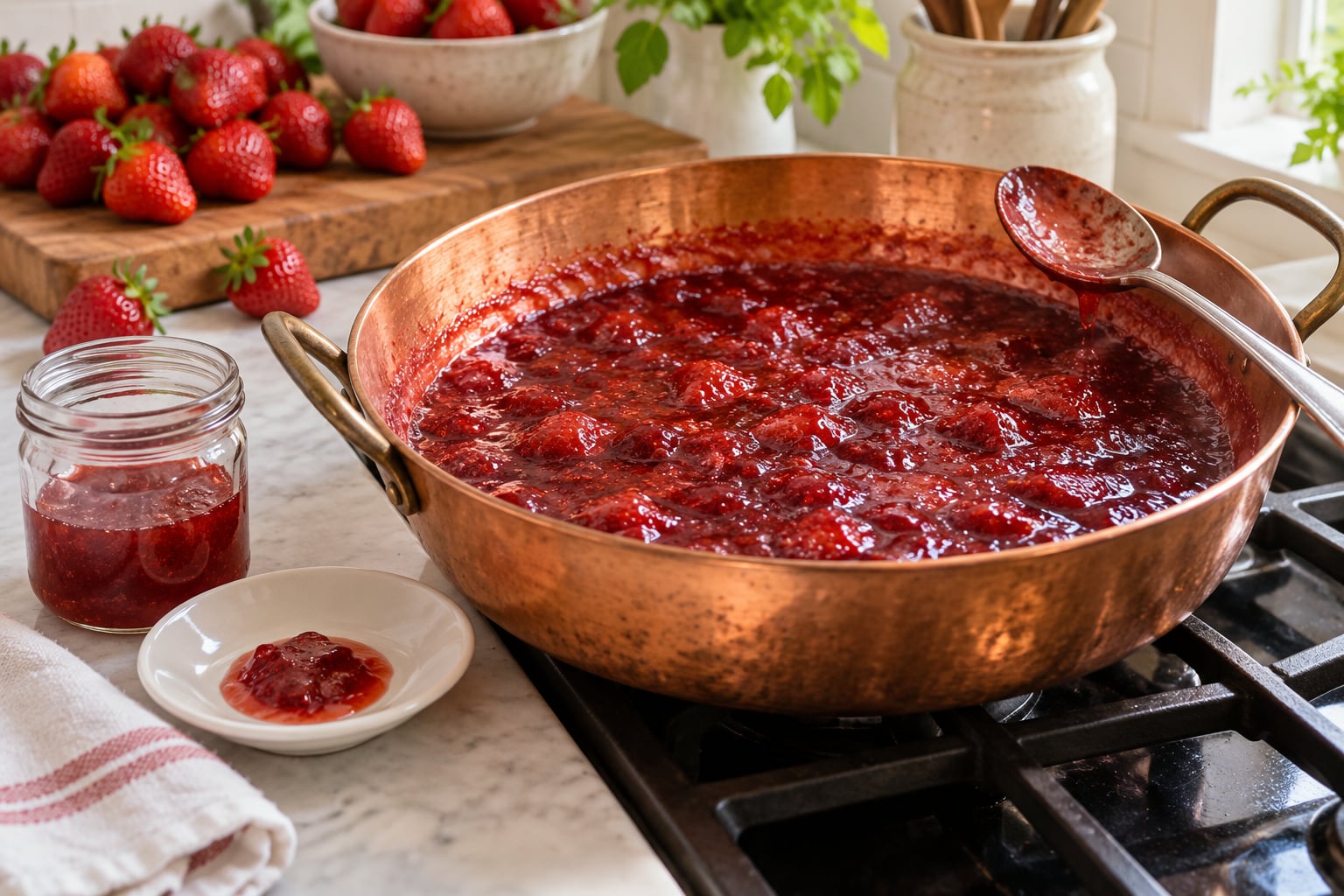
Strawberry jam without pectin lands in the low-pectin row, so it wants the top of the sugar range and the acid at the upper end. A mixed batch is often the easiest way out: put a Granny Smith in with the strawberries and the whole pot sets more reliably.
Optional Flavourings
A pinch of salt sharpens the fruit and cuts the sweetness without changing the set. Lemon zest, a split vanilla pod, a cinnamon stick, or a few mint leaves can go in with the sugar and infuse during the boil, then get fished out before jarring.
What Sugar, Acid and Heat Actually Do
It helps to know why the three ingredients are all necessary, because it explains most of the failures later. Pectin is a long molecule that lives in the fruit’s cell walls, and it is useless while it is suspended in water. Sugar grabs onto that water, which frees the pectin molecules to move around and link up into chains. The acid, usually citric acid from lemon juice, changes the charge on those molecules so the chains can bond to each other instead of drifting apart.
Heat is the third piece. Until enough water has boiled away, the chains stay too crowded to touch. Cooking the mixture down to roughly 65 percent sugar, which is what 220F (104C) corresponds to, brings the chains close enough to lock together. Once they do, the jam holds its shape on a cold plate.
One consequence worth remembering: too much acid reverses the process and splits the chains again, which is the reason for adding lemon juice at the start of the cook rather than after a batch fails to set.
Step-by-Step: How to Make Jam Without Pectin
Step 1: Prepare the Fruit and Equipment
Wash the fruit and give it a quick soak in plain water if you are nervous about residues. Hull strawberries, stone the plums and apricots, and core the apples. Leave the skins on wherever you can, because that is where most of the pectin lives.
Cut everything roughly the same size, or crush soft berries, so the fruit cooks at an even rate. You want the pieces soft enough to crush with a spoon but not so pulpy that the jam turns into purée.
Heat the fruit on its own first for 10 to 15 minutes with a splash of water to soften. Meanwhile, if you are canning, wash your jars and keep them warm. If you are only refrigerating, run the jars through a dishwasher and let them dry, or wash them in soapy water and rinse well.
How do you know the fruit is ready? It should slump easily when you press a piece with the back of a spoon, and the juices run freely without any hard edges left.
Step 2: Cook the Fruit with Sugar and Lemon
Measure your sugar and have it ready next to the pot, because you want it in all at once and quickly. Stir the warm fruit, add the sugar, and add 1 to 3 tablespoons of lemon juice depending on the fruit’s own acidity. A Granny Smith batch needs closer to a tablespoon; a bland strawberry batch wants the full 3.
Stir until the sugar has completely dissolved, then bring the mixture to a boil. Once it boils, drop the heat to a steady simmer that keeps a bubble breaking the surface every second or two. Do not crank the heat to force it down faster. A hard boil drives off aroma, scorches the base of the pan and, on soft fruit, roughens the texture into a grainy paste.
Skim the grey foam off the top with a spoon during the first ten minutes. Let the jam cook for 30 to 45 minutes depending on the fruit, stirring often enough that the bottom does not catch. As water leaves, the mixture will start to look glossy and drag a spoon trail behind it.
A word on batch size: keep it under about 8 cups of prepared fruit per pot. A larger heap in a wider pan will take forever to reduce and will not cook evenly, which is one of the most common reasons a batch ends up thin.
Step 3: Test Whether the Jam Has Set
Start testing in the last 10 minutes of cooking rather than trusting the clock. There are three checks and the cold plate test is the one that matters most.
Put a saucer in the freezer for at least 10 minutes while you cook. Take a spoonful of jam and drop it onto the cold plate. Wait 30 seconds, then run your fingertip across the edge of the blob. If it wrinkles as you push, it is ready. If it runs flat and pools like water, give it another five minutes. Cookers on forums describe the finished test as jam that sheets very slowly off the plate and barely drips, and that slow sheet is exactly what you are looking for.
The thermometer reads the sugar concentration rather than the texture. 220F (104C) is the standard set point at sea level. If you are cooking high in the mountains, water boils lower, so drop the target a few degrees for every 1,000 feet you are up. Cookers who live up high generally agree that dropping the target by 5F to 10F and extending the simmer works better than chasing a thermometer that never arrives.
What about jam that’s overdone? If it turns dark, smells scorched or pulls into a stiff paste, you can often loosen it: put the jar in the microwave for 15 seconds and stir, repeating in short bursts. That is a rescue for a few seconds of too much heat, not a fix for a ruined pan.
Expect a soft set. Without commercial pectin, no-pectin jam lands somewhere between a firm jelly and a spoonable preserve. Home canners who prefer a sliceable result usually cook the fruit further, but pushing much past 220F starts trading flavour for firmness.
Step 4: Fill, Seal, and Store the Jam
Take the pot off the heat and let it sit for five minutes. Skim any last foam, then fill your hot jars. Leave the recommended headspace, generally a quarter inch for refrigerator and freezer jam and half an inch for jars you plan to water-bath process.
Wipe each rim with a damp paper towel before screwing the band on. Any sticky jam left on the thread will stop the lid from sealing properly, and this is the single most common reason a jar fails to seal. Run a clean cloth around the rim as a final check.
Then choose your storage method, because it decides whether the batch lasts two weeks or a year and a half.
| Storage | How long it keeps | What to know |
|---|---|---|
| Refrigerator, sealed jars | 3 to 4 weeks, about a month once opened | The safe default for an untested home recipe. Refrigerate promptly and use it first. |
| Freezer, headspace left | Up to 6 months | Leave half an inch of headspace because jam expands as it freezes. Thaw in the fridge overnight. |
| Water-bath canned, tested recipe | 12 to 18 months in a dark pantry | Only use a recipe developed and tested for canning, or a formula from a university extension service such as NCHFP. |
If your jars went through a water bath, leave them undisturbed on a towel for 12 to 24 hours before checking the seals. Press the centre of each flat lid: no give means it sealed. Refrigerate anything that flexes, and take the seal test a few days later before you trust a shelf-stable batch.
There is a real distinction here worth being blunt about. A jam recipe that was never formulated for canning is not shelf stable, no matter how good it looks. NCHFP and USDA guidance treat untested refrigerator jams as refrigerated products, not preserves. If you want jars that live in a cupboard, use a tested recipe or a pectin product that comes with validated processing times.
Label each jar with the fruit, the date and the storage method. Six months later, a sticky shelf of unlabelled jars is a guessing game.
Why Jam Without Pectin Might Not Set
Runny jam is the most common failure, and it almost always comes down to five causes. Work through them in order.
It was not cooked long enough. This one accounts for most of it. The clock on a recipe is an estimate, and the real endpoint is 220F (104C) plus a passing plate test. Many canners have found they have to cook the fruit far longer than the recipe implies before it sheets off the plate.
The sugar ratio was cut. Sugar is not just sweetness. It binds the water in the fruit, which is what frees the natural pectin to form chains. Cut it by a quarter and the jam may never reach a gel no matter how long you boil it.
The acid balance was off. Too little acid and the pectin chains never bond. Too much lemon juice has the opposite problem: so much acid breaks the chains down, which is why doubling the lemon juice after a failed set often makes the jam worse. Add acid at the start, in the quantity the fruit calls for.
The pot was too full. More than about 8 cups of fruit will not reduce evenly, and the undercooked edges give you a thin jam even when the rest is right.
You used almost-ripe or frozen-thawed fruit. Overripe fruit can have already broken down its pectin. Frozen fruit actually works well for freezer jam, but cooking it takes longer than fresh.
How to Rescue a Batch That Failed
If a jar is runny the next morning, don’t throw it out. Pour the jam back into the pot, heat it to a boil again and cook it back to 220F (104C), testing on the cold plate as you go. This works well for a batch that was only slightly underdone and takes 10 to 15 minutes. Some canners simply boil the thin batch down hard again until it thickens, which is exactly the right instinct.
If re-cooking a thin jam makes you nervous about scorch or scorching the fruit, switch it to freezer jam instead. Pour it into jars with headspace, cool, and freeze it. Uncooked jam is runnier by nature, and it keeps fine that way.
Third option, and often the best one: stop trying to make it jam. Thin jam is an excellent sauce over ice cream, a filling for thumbprint cookies, a glaze for a tart, or a swirled-through yoghurt. Nothing wasted.
And if a batch is very sour or bitter, the cause is usually underripe fruit or skins left on for a long cook. Peel the fruit, use ripe berries, and shorten the boil. Sugar cannot fix a fruit that was picked green.
Frequently Asked Questions
Do I need pectin to make jam at home?
No. You can make jam without pectin by relying on the pectin already in the fruit, plus sugar to draw out water and lemon juice to help those pectin chains bond. Expect a softer, more spreadable set and a 30 to 45 minute cook rather than the 10 minutes a boxed-pectin recipe takes.
Which fruits make the best jam without added pectin?
Apples, quinces, gooseberries, cranberries and lemon are high in natural pectin and set easily on their own. Raspberries, blackberries, plums and apricots sit in the middle. Strawberries, blueberries and peaches are low and need the full sugar ratio, a squeeze of lemon and the longest cook. Mango and banana have almost none.
Why is my jam without pectin still runny?
The usual reasons are undercooking, not enough sugar, too little or too much acid, or a pot that was too full to reduce evenly. The fix is to heat the jam back to 220F (104C) and retest with the cold plate method. If you cut the sugar, a shorter cook will not be enough to save the batch.
Can I reduce the sugar in jam made without pectin?
You can lower it by about a quarter cup per batch and keep a set, but going further gives a syrup instead of a jam. Sugar is the mechanism that frees natural pectin, so less sugar means less pectin activity, a softer set and a shorter safe life in the fridge. Non-sugar sweeteners will not set this type of jam.
How long does homemade jam without pectin keep?
In sealed jars in the fridge it keeps 3 to 4 weeks, and about a month after opening. Frozen with headspace, it holds up to 6 months. Only a recipe tested for water-bath canning will keep on a pantry shelf, and those keep 12 to 18 months in a cool dark cupboard.
Can pectin-free jam be frozen?
Yes, and it is the safest storage for any batch that is not shelf stable. Fill jars leaving half an inch of headspace so the jam has room to expand, cool before lidding, then freeze. Thaw in the fridge overnight rather than on the counter, and use it within the freezer window.
Conclusion
Start with the fruit. Pick something naturally high in pectin, or go low and commit to the full sugar ratio plus the longest cook. Have your jars and your freezer plate ready before the sugar goes in, then trust the plate test rather than the timer, and pull the jam at 220F (104C).
One more thing worth knowing: if the batch stays runny, reheat it and cook it back to temperature. Most thin jam is undercooked, not broken.