Yes, you can freeze most vegetables without blanching them, and skipping the blanch is not a food-safety risk. The trade-off is quality. Raw-frozen vegetables stay perfectly safe in a freezer at 0°F, but their color, flavor and texture degrade faster than blanched vegetables do. Blanching exists to switch off enzymes, not to kill bacteria.
That distinction matters because blanching is the step most people hate. It means boiling a pot, fishing out sad limp green beans, and cooling them in ice water while six pounds of garden surplus waits on the counter. If you have a weekend and a big freezer, that is worth it. If you have a Tuesday evening and a bag of peppers, it is not.
So the honest answer to how to freeze vegetables without blanching is: wash them very well, dry them completely, cut them, tray-freeze them in a single layer, and package them airtight. This guide tells you which vegetables handle that fine, which ones turn to mush or go grey, and how long you actually have to eat them.
Table of Contents
- What You Need
- Step-by-Step: How to Freeze Vegetables Without Blanching
- Choose Vegetables That Freeze Well Without Blanching
- Wash, Cut and Dry Before You Freeze Vegetables Without Blanching
- Season or Coat Vegetables for Better Texture
- Freeze in a Single Layer, Then Package
- How Long Unblanched Frozen Vegetables Keep
- Common Mistakes
- Frequently Asked Questions
- Can you freeze vegetables without blanching them?
- Which vegetables are best for freezing without blanching?
- How long do unblanched frozen vegetables last?
- Should I wash vegetables before freezing them?
- Can I freeze vegetables with oil or butter instead of blanching?
- How should frozen vegetables be thawed without becoming mushy?
What You Need
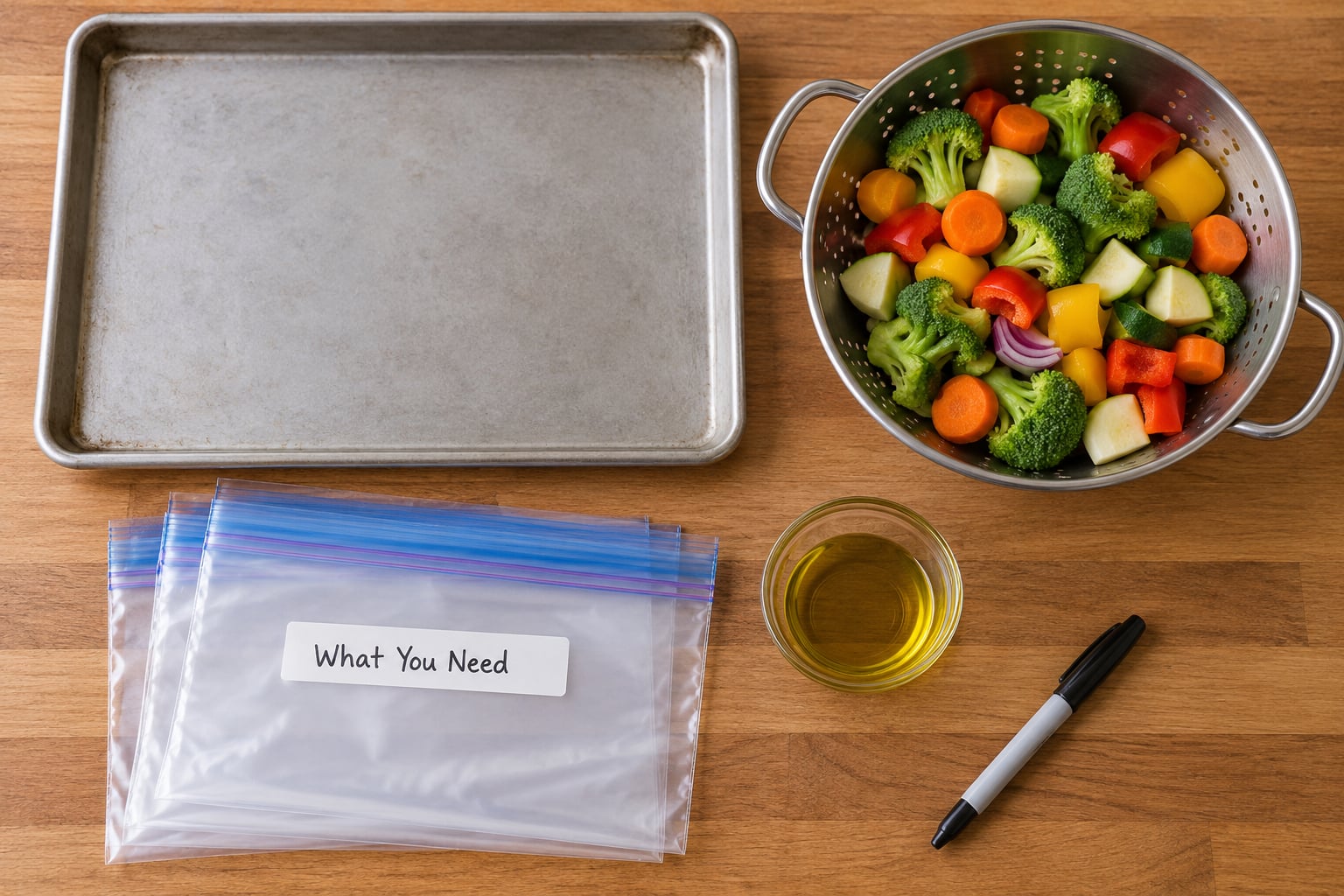
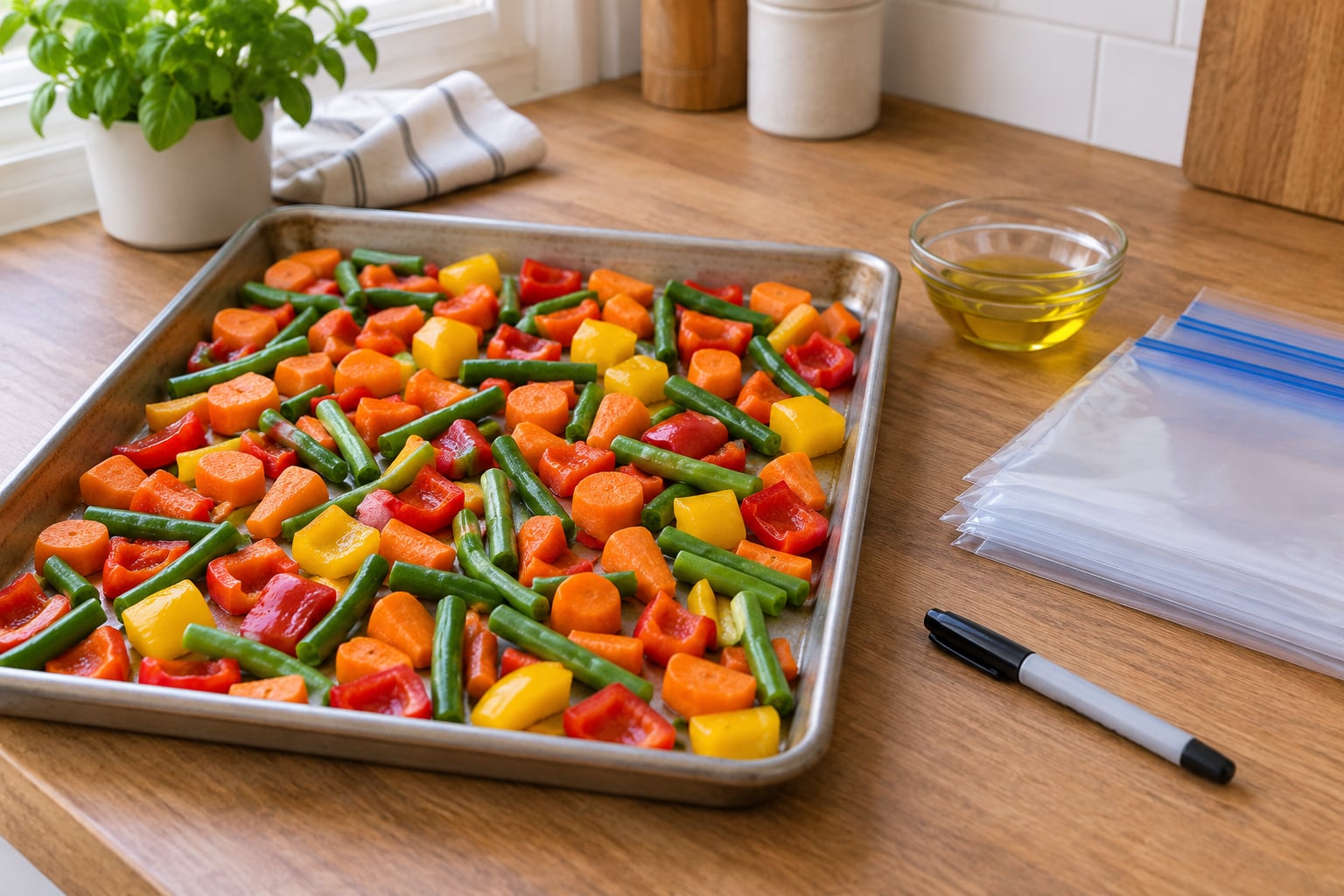
None of this is special equipment. If you own a cookie sheet, some freezer bags and a marker, you can do it tonight.
- A rimmed baking sheet or cookie sheet — you need something flat that fits your freezer so pieces freeze separately instead of into one solid block.
- Freezer-safe bags or rigid containers — press-to-seal bags with a write-on strip are easiest. Heavy-duty bags or vacuum-sealed pouches hold quality longer because they keep more air out.
- A marker or masking tape and a pen — for the vegetable name and the date. This is the one step people skip and regret in February.
- A colander and a clean towel or salad spinner — for washing and getting vegetables properly dry.
- Olive oil, melted butter or salt — optional, but a thin coat before freezing buys you real texture later.
- Ice cube trays — for herbs and for small diced vegetables you want in fixed portions.
Step-by-Step: How to Freeze Vegetables Without Blanching
The whole process takes about 20 minutes of prep plus an hour or two of freezer time. Set it up in this order and it runs without interruptions.
Choose Vegetables That Freeze Well Without Blanching
Start with vegetables that are dense, low in water and low in delicate cell structure. Those are the ones that come out of the freezer tasting like themselves.
| Vegetable | How to prep it | Best use after thawing |
|---|---|---|
| Bell peppers | Dice or slice, seeds and pith out | Sauces, stir fries, casseroles, roasting |
| Onions and shallots | Dice or slice | Cooked dishes only, soups, sauces |
| Carrots | Slice thin or dice | Soups, stews, roasted, snack sticks |
| Sweet potatoes | Cut into chunks or 1/2 inch rounds | Fries, roasted, baked casseroles |
| Green and yellow beans | Trim, cut or leave whole | Cooked dishes, not as a plain side |
| Winter squash and pumpkin | Cook first, then puree or cube | Soup, pie filling, bread |
| Tomatoes | Whole, halved or chopped | Cooked dishes only, sauce, soup |
| Berries | Hull and rinse, dry fully | Thawed in baking dishes, smoothies |
| Herbs | Chop and freeze in ice cube trays with oil or water | Finish, sauces, pesto cubes |
| Jalapenos and hot peppers | Freeze whole or sliced | Salsas, chili, curries, frozen margaritas |
| Cabbage | Shredded or wedges | Slaw, soups, stir fries |
| Radishes | Sliced or whole | Salads, quick pickling |
Green beans are the vegetable readers ask about most, and the answers split. A BackYard Chickens thread on freezing produce had members report unblanched beans that were safe but “a little tough at times,” and others freezing them raw successfully for cooked dishes rather than as a side. That matches what the texture rules predict: beans survive raw freezing, but blanching is what stops them turning rubbery after three months.
Some vegetables are simply not worth the freezer space. Freezing does not fix them, because their problem is water and delicate structure rather than enzyme activity.
| Vegetable | Why it fails |
|---|---|
| Cucumbers and pickles | High water content turns to mush and releases liquid |
| Lettuce and salad greens | Cells collapse into a watery limp mass |
| Celery | Loses all crunch and goes rubbery |
| Potatoes | Texture turns gluey and grey |
| Eggplant and zucchini | Spongy and watery once thawed |
| Asparagus | Turns limp and brown very quickly |
| Raw or cooked beans in their pods | Cottony texture and strong flavor |
| Dairy or mayonnaise-based salad | Emulsifies and separates badly |
Wash, Cut and Dry Before You Freeze Vegetables Without Blanching
Drying is the step that decides whether this works. Water that freezes into ice crystals punctures cell walls, and that is what produces mushy texture and the grey, papery freezer burn you get later. If you only remember one instruction from this article, make it this one.
Rinse vegetables under cool running water and scrub anything with dirt on it, like carrots and beets. Do not soak them, and never use soap.
If you are picking straight from a garden, do not skip washing. Vegetables can carry soil, insects and garden bacteria, and freezing does not sterilize anything. Let field heat go before you pack them, because warm vegetables arriving in the freezer start forming ice immediately and thaw out unevenly.
Trim away bruises, soft spots and anything fibrous or bitter. Cut into pieces sized for how you actually cook — a single slice off a frozen block does not equal a nice even dice, and uneven cuts thaw unevenly too. Then dry thoroughly: spread on a towel, or spin in a salad spinner, until nothing feels slick.
Get to the freezer within an hour of cutting. The shorter the gap between cutting and freezing, the less time enzymes have to work at freezing temperatures.
Season or Coat Vegetables for Better Texture
A thin coat of oil or melted butter before freezing slows moisture loss, which is what makes frozen vegetables go dry and leathery. You do not need much — a light toss is plenty.
Salt does something different. A light sprinkle draws a little moisture to the surface, which is helpful for roasting but can make vegetables wetter and more prone to sticking if you then cook them straight from frozen. If you plan to roast, salt after you thaw.
For texture-critical cooks, roasting works better than blanching and this is the question that comes up constantly on Cooking StackExchange: blanching leaves vegetables too soft to roast crisp, and roasting concentrates flavor instead of washing it out. Roast your vegetables at a high oven until caramelized, cool them completely on a tray, then freeze. From thawed they go back into a hot oven fine. This works particularly well for peppers, onions, squash and green beans, and it is the answer to “can I roast vegetables before freezing instead of blanching.”
Herbs are their own case. Chop parsley, cilantro, basil or chives, pack them into ice cube trays with a splash of olive oil or water, and freeze. The cubes drop straight into soups, sauces and finishes.
Freeze in a Single Layer, Then Package
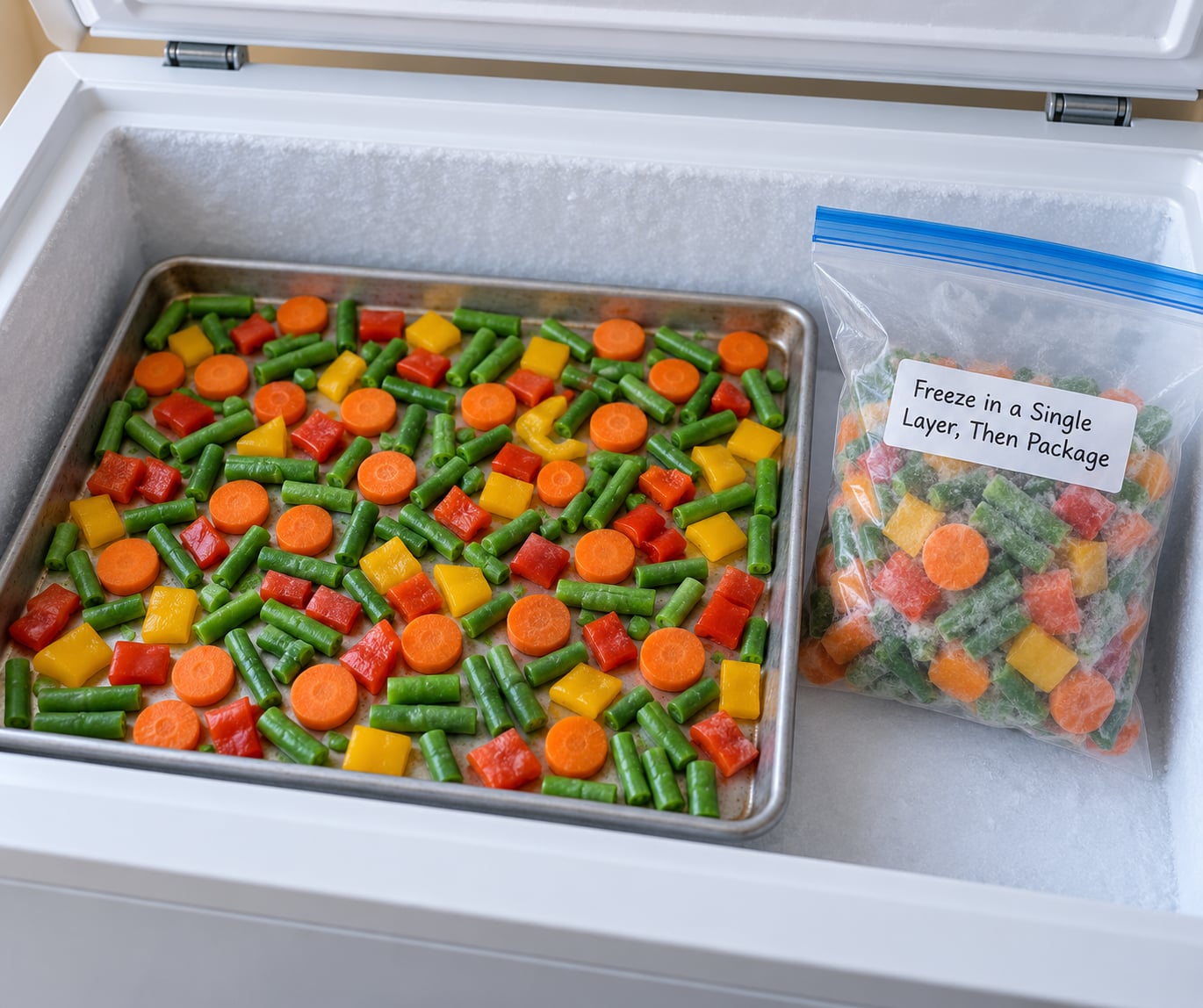
Spread the dried vegetables across a baking sheet in one loose layer with no pieces touching. Set the sheet in the freezer for one to two hours, until the pieces are solid.
That pre-freeze, often called flash freezing or tray freezing, is the single most-repeated practical tip across freezing threads, and it is what prevents the frozen brick problem. Green beans that touch each other on the sheet come out as one solid clump no matter how good your bag is.
Tip the frozen pieces into bags or containers. Press out the air as much as you can — for a zip bag, run your hands down the seal from one end to the other. If you do not have a vacuum sealer, a drinking straw through a small hole in the corner of the bag works surprisingly well for removing air from a bag of diced vegetables.
Label every package with the vegetable and the date, then freeze the bags flat in a single layer rather than standing them on end. Flat packs freeze faster and thaw faster. Leave a little room in rigid containers, because liquid expands when it freezes and a completely full tub will crack or pop its lid.
Keep your freezer at 0°F. Colder is better for quality, but a home freezer thermometer matters more than the dial you think is set correctly.
How Long Unblanched Frozen Vegetables Keep
Blanched vegetables are usually stored for 8 to 12 months. Unblanched vegetables keep just as safely, but you should plan to eat them much sooner because quality starts slipping well before safety does. This table is the part most guides leave out.
| Category | Unblanched, use within | If blanched first |
|---|---|---|
| Dense vegetables (carrots, sweet potato, beets) | 4 to 6 months | 8 to 12 months |
| Peppers and onions | 4 to 6 months | 8 to 12 months |
| Green beans, peas, corn | 2 to 3 months | 8 to 12 months |
| Tomatoes, whole or chopped | 3 to 4 months | Not typically blanched |
| Berries | 3 to 6 months | Not typically blanched |
| Herbs in ice cube trays | 3 to 4 months | Not applicable |
Corn and peas sit in the middle ground. They can be frozen raw if you plan to use them relatively soon, and quality drops faster than with dense vegetables. One BackYard Chickens member who froze corn cut off the cob without blanching reported it came out rubbery and tasteless — exactly the enzyme and texture failure the tables predict.
That is the honest framing for the whole topic. Skipping blanching does not put anyone at risk. It buys you back prep time and costs you texture on a predictable schedule.
Common Mistakes
Freezing vegetables that are still wet. This is the number one cause of mush and ice crystals. Dry them completely, and never pack vegetables that have been sitting in water.
Not removing air from bags. Air is what causes freezer burn. Press bags flat, use a straw for stubborn ones, or drop the straw in the bag and seal it with the trapped air partly evacuated. Fill rigid containers to about 1 inch below the lid.
Overfilling packages. A big block of vegetables freezes slowly in the middle, which keeps enzymes working and means you break off a chunk every time. Freeze small portions in a single layer and leave headspace in containers.
Skipping labels. Unblanched frozen peppers and unblanched frozen tomatoes look identical when they are half-frosted on the counter. Write it down.
Freezing unsuitable vegetables. Cucumber, lettuce, celery and potato will disappoint you no matter what technique you use. Use those fresh.
Thawing slowly in the fridge. For vegetables destined for a cooked dish, cook from frozen instead. Thaw in the fridge overnight only when you need the raw texture, such as peppers for a salad.
If you do decide to blanch, do not underblanch. The National Center for Home Food Preservation, drawing on University of Georgia Cooperative Extension guidance, warns that underblanched vegetables can be worse than unblanched ones, because partial heating can stimulate the very enzymes you were trying to stop. Use about one gallon of boiling water per pound of vegetables, blanch only until the vegetable is heated through, and cool in an ice bath for the same length of time as the blanch.
| Vegetable | Blanching time in boiling water |
|---|---|
| Green beans | 3 minutes |
| Carrots, sliced | 3 minutes |
| Broccoli florets | 3 minutes |
| Cauliflower | 3 minutes |
| Cabbage, shredded | 1.5 minutes |
| Collards and other greens | 3 minutes |
| Sugar snap or snow peas | 1.5 minutes |
| Potatoes, whole | 3 to 5 minutes, then finish cooking |
| Summer squash, sliced | 3 minutes |
One more note on blanching: NCHFP discourages microwave blanching because it heats unevenly and leaves some enzyme activity intact, which is the underblanching problem again. Steam blanching works well, but takes roughly 1.5 times longer than water blanching.
Frequently Asked Questions
Can you freeze vegetables without blanching them?
Yes. Freezing vegetables raw is not a food-safety risk, and skipping blanching only costs you quality. Blanching exists to deactivate enzymes that break down flavor, color and texture over time. Vegetables frozen without it stay perfectly safe at 0°F, but they fade, soften or turn bitter sooner than blanched ones do.
Which vegetables are best for freezing without blanching?
Dense, low-water vegetables handle raw freezing best: bell peppers, onions, carrots, sweet potatoes, winter squash, cabbage, radishes, berries, hot peppers and herbs in ice cube trays. Green beans, peas and corn work raw but lose texture faster, so plan to use them within a couple of months. Skip cucumber, lettuce, celery and potato, which turn to mush no matter what technique you use.
How long do unblanched frozen vegetables last?
Plan on months rather than the 8 to 12 months that blanched vegetables keep. Dense vegetables such as carrots, peppers and onions hold decent quality for 4 to 6 months unblanched. Green beans, peas and corn are at their best within 2 to 3 months. They remain safe to eat longer, but flavor and texture decline well before the safety window ends.
Should I wash vegetables before freezing them?
Yes, and dry them thoroughly afterward. Garden and store-bought vegetables can carry soil, insects and bacteria, and freezing does not sterilize them. Rinse under cool running water, avoid soaking and never use soap. Drying matters just as much as washing, because moisture that freezes into ice crystals is what makes vegetables mushy and prone to freezer burn.
Can I freeze vegetables with oil or butter instead of blanching?
Yes, and it helps. Tossing vegetables in a light coating of olive oil or melted butter before freezing slows moisture loss, which is what makes frozen vegetables dry and leathery. Use a thin coating rather than drowning them. For the same texture benefit, herbs and small diced vegetables freeze well in ice cube trays with a little oil or water.
How should frozen vegetables be thawed without becoming mushy?
For anything going into a cooked dish, skip thawing entirely and cook from frozen, adding a couple of extra minutes. Thaw in the fridge overnight only when you need raw texture, such as peppers for a salad or berries for baking. Avoid thawing on the counter or in warm water, which warms the outer layers and softens them before the center even loosens.
Start tonight rather than waiting for a glut. Pick your firmest vegetables, wash and dry them properly, tray-freeze them in a single layer, and label every bag with the date. That gets peppers, onions, carrots, squash and tomatoes safely into the freezer with no pot of boiling water in sight. If you also have greens or beans to put away, blanch those properly in a separate batch, because they are the ones where the texture loss shows.