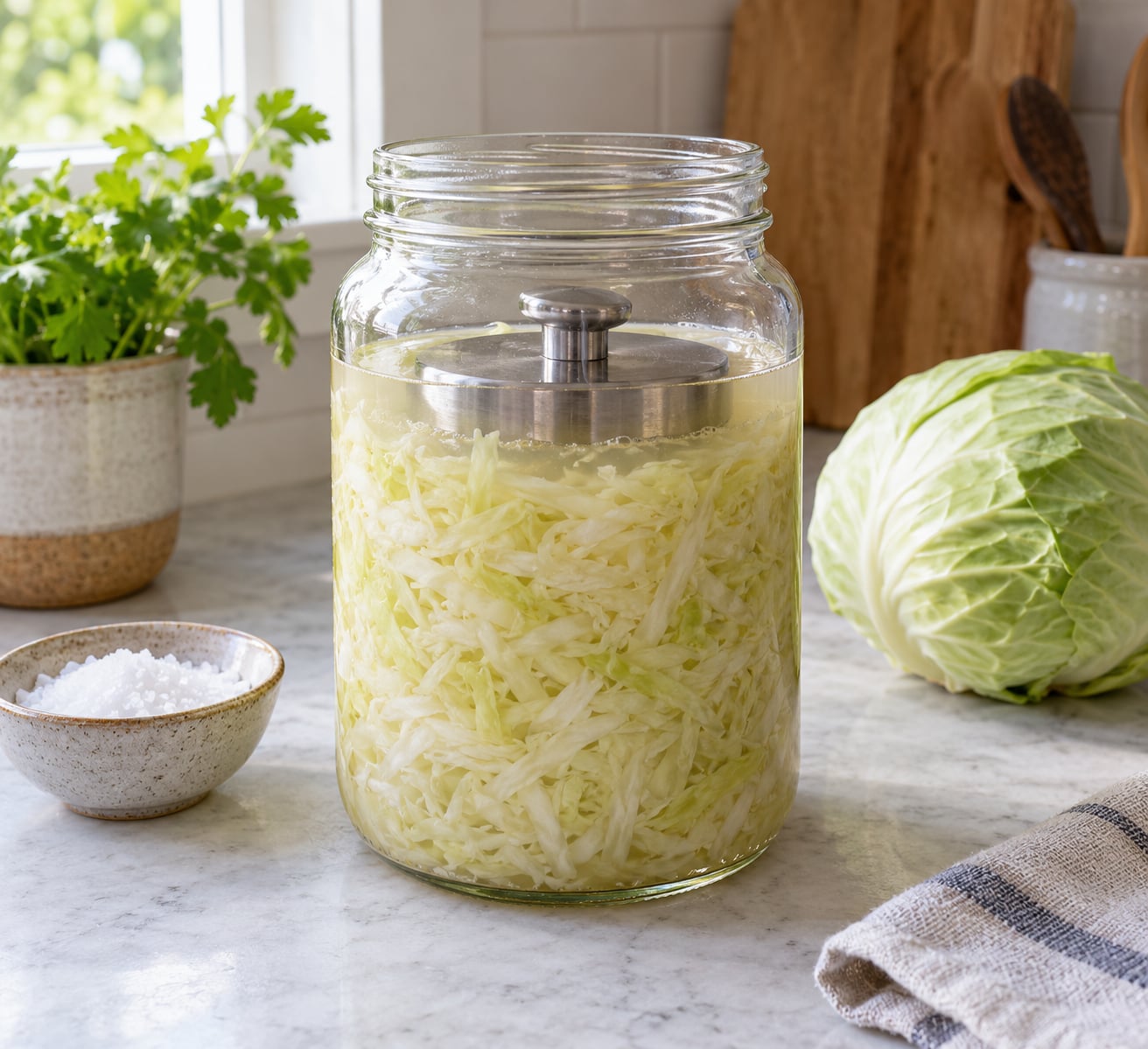
How to ferment sauerkraut in a jar comes down to three things: shredded cabbage, non-iodized salt, and a clean glass jar. Most of the work is ten minutes of chopping and pressing, then waiting while the cabbage turns itself sour in its own brine.
Two details decide whether the batch turns out well. The first is salinity: 2% salt by weight, measured with a scale, not guessed with a spoon. The second is submersion: every shred of cabbage has to sit under the brine for the whole ferment, held there by a weight.
Get those two right and the rest is mostly patience. A quart jar on a kitchen counter typically tastes good in five to ten days and keeps getting sharper for several weeks. Here is the whole method, including what to do when something goes wrong.
Table of Contents
- What You Need
- Step-by-Step: How to Ferment Sauerkraut in a Jar
- How to Ferment Sauerkraut in a Jar: Make the Brine
- Cut and Salt the Cabbage
- Pack the Jar and Keep the Cabbage Submerged
- Ferment at the Right Temperature
- Check Bubbles, Foam, and Sourness
- Refrigerate and Store the Sauerkraut
- Common Mistakes
- Salted by volume instead of by weight
- Cabbage floating above the brine
- Loose or undersized weights
- Trapped air inside the packed cabbage
- Sealing the jar airtight
- A jar that sits somewhere too warm
- Impatience with the timeline
- Mold, kahm yeast, or neither
- Brine loss and a shrinking level
- Sauerkraut that is too salty, or too bland
- Mushy instead of crunchy
- Frequently Asked Questions
- How much salt do I need for sauerkraut in a jar?
- How long does sauerkraut need to ferment at room temperature?
- Why is my sauerkraut not producing bubbles?
- Is it normal for sauerkraut brine to fall below the cabbage?
- How do I know when sauerkraut has gone bad?
- Conclusion
What You Need
For one quart jar, you need roughly 900 g of shredded cabbage, which is about one medium head after you trim the core and outer leaves. Buy a little extra, because a head that weighs closer to 1.4 kg will fill two jars.
Measure these before you start:
- Cabbage: green or white cabbage, medium to firm. Late-season winter and stonehead varieties hold up best, and any cabbage that has been through a couple of frosts tends to be sweeter and crunchier.
- Salt: non-iodized pickling salt, canning salt, or plain kosher or sea salt with no anti-caking additives. Table salt works, but it is denser, so the volume numbers below are different.
- Jar: a wide-mouth quart canning jar, plus a second jar or a small container to catch overflow.
- Fermentation weight: a glass fermentation weight, a small jar filled with brine and closed with a lid, two or three clean dry stones, or a folded cabbage leaf.
- Scale: a kitchen scale that reads grams. This is the one tool that genuinely matters.
- Slicing gear: a mandoline, a food processor with the slicing disc, or a sharp knife and a steady hand.
- Loose cover: a plastic lid set on loosely, a rubber band and a clean cloth, or a one-piece airlock lid that vents carbon dioxide without letting oxygen in.
- Optional flavorings: caraway seeds, juniper berries, fennel seed, a few cloves of garlic, a small apple, or shredded carrot. Keep added vegetables under a quarter of the total cabbage by weight, or the kraut turns soft.
Two things to skip: vinegar, which belongs to quick pickling and not to lacto-fermentation, and iodine, which can interfere with the bacteria you are trying to encourage.
Here is the salt you need for the amount of cabbage you are likely to have. The first column is the honest measurement; the others are approximations for convenience.
| Shredded cabbage | Salt at 2% | Table salt (tsp) | Coarse kosher or Diamond Crystal (tbsp) |
|---|---|---|---|
| 450 g (about half a small head) | 9 g | 1.5 | 1 |
| 900 g (one medium head) | 18 g | 3 | 2 |
| 1.4 kg (two quarts shredded) | 28 g | 4.5 | 3 |
| 2.3 kg (a five pound batch) | 46 g | 8 | 5 |
One last piece of gear worth adding: a baking sheet. Active fermentation pushes liquid upward hard, and a sheet under the jars saves the countertop.
Step-by-Step: How to Ferment Sauerkraut in a Jar
How to Ferment Sauerkraut in a Jar: Make the Brine
A 2% brine, which is 2 g of salt for every 100 g of water, gives you a reserve of liquid for topping the jar up as the cabbage drinks it down. For 500 ml of water, that is 10 g of salt, a little over a teaspoon of table salt or a scant tablespoon of coarse kosher salt.
Warm the water slightly, stir in the salt until it disappears completely, then let it cool to room temperature before it touches cabbage. Hot brine kills the bacteria you want. If you skip the brine entirely and salt the cabbage dry, the kraut comes out crunchier and the risk is lower, which is why many experienced fermenters never bother.
If you need to scale the brine up or down, keep the same 2% figure and use the volume of water that matches your jar. A quart jar needs about 500 ml, and a half gallon jar needs roughly 1.2 liters. Scale the brine for the weight of cabbage you are packing, not for the size of the glass.
Cut and Salt the Cabbage
Set aside the dirty outer leaves and the woody core, since both carry soil and make the kraut taste bitter. Rinse the rest, then shred it as fine as you can manage, about 2 to 3 mm, or use the slicing blade on a food processor and let the shreds rub against each other as they spin.
Weigh the shredded cabbage, calculate your salt at 2% of that number, and sprinkle it over in three or four additions so it distributes evenly. Then knead with clean hands for two or three minutes, squeezing and releasing, until the cabbage feels limp and glossy and a little brine already appears in the bottom of the bowl.
Let it rest in a non-reactive bowl for 20 minutes to an hour, up to a few hours if you want maximum brining. Watch the clock rather than the calendar: the cabbage is ready when the brine reaches the top of the mound and the shreds have gone soft and translucent at the edges. Taste a shred at that point. It should be pleasantly salty, not aggressively so, and it should not taste raw.
Use a glass or plastic bowl, a plastic cutting board, and wooden or plastic utensils. Wood boards and metal spoons carry mold spores and, worse, off flavors.
Pack the Jar and Keep the Cabbage Submerged
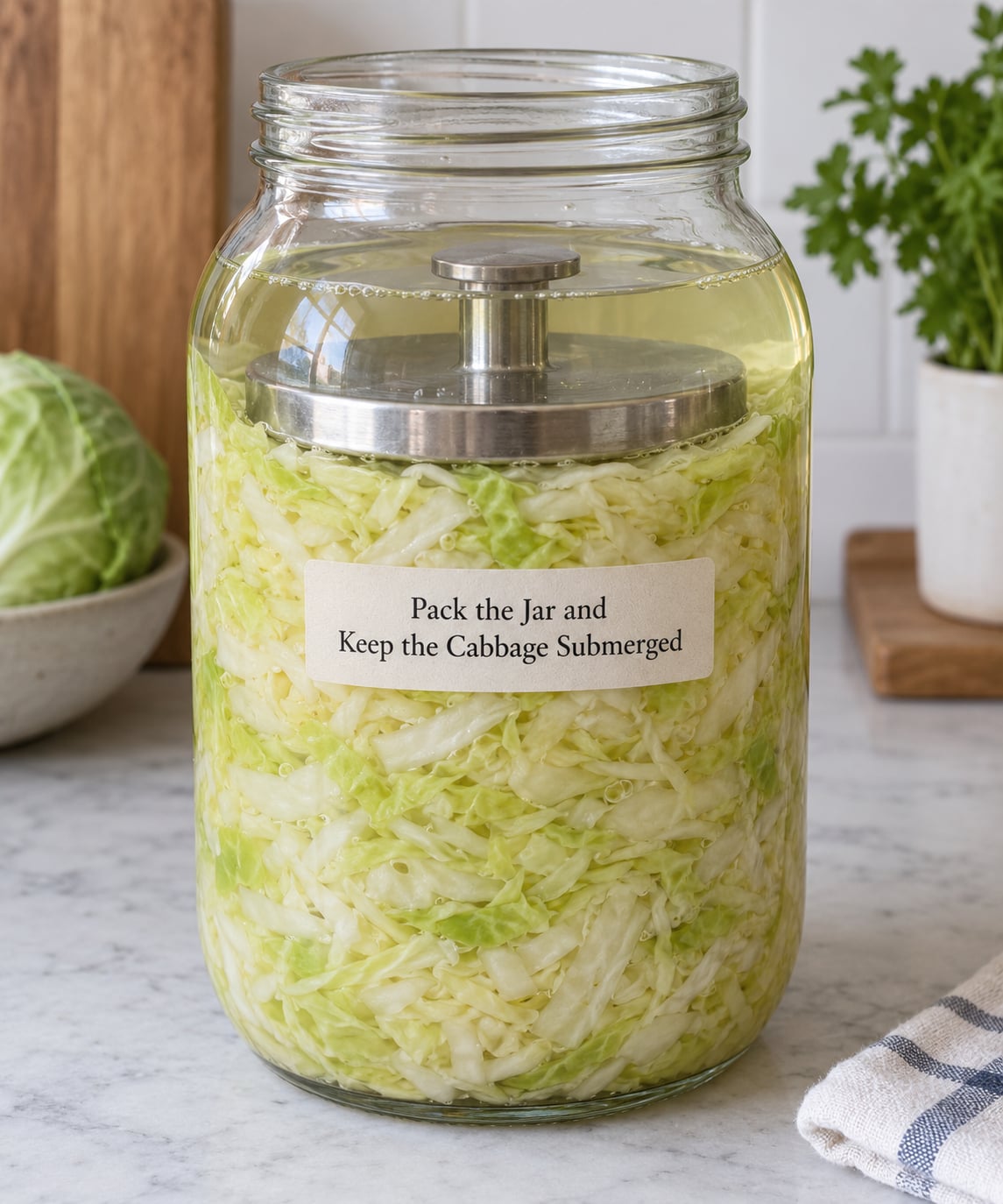
Scoop the cabbage into the jar a handful at a time and press down hard with a clean fist or the back of a spoon after each one. Pack it as tightly as you can. The goal is very little trapped air, because air pockets are where mold starts and where cabbage floats instead of fermenting.
Once the jar is full, pour in your cooled brine until the cabbage is covered by about an inch. Add the brine last so the shreds are pressed down rather than floated apart. Then set your weight on top and push once more until the cabbage compacts and the liquid level rises.
Leave two to three inches of headspace above the liquid. Fermenting cabbage releases carbon dioxide, and a jar filled to the rim will either spray brine across the counter when opened or blow its lid off overnight. This is the single most common rookie mess, and it is entirely avoidable.
Fermentation weights vary in how well they work. A glass weight sized for your jar is the cleanest option. A small jar filled with brine and closed with a tight lid works nearly as well, and clean stones in a mesh bag are the old-fashioned answer. A folded cabbage leaf is fine for a small batch, though it shrinks as it absorbs brine and needs a push-down a day later.
If your jar is only half full, keep going. Home fermenters ask about this constantly and the answer is consistent: a partly filled jar is perfectly fine as long as the cabbage is fully submerged and there is room above for the liquid to rise. Fill the empty space with brine, use a weight sized to the smaller cabbage mass, and you will get a smaller jar of kraut rather than a failed one.
Ferment at the Right Temperature
Sauerkraut ferments fastest somewhere between 65 and 75°F, which is 18 to 24°C. A typical kitchen counter sits in that band for most of the year, which is why the jar method is so popular with beginners.
Cooler is slower, not worse. At 60°F a ferment can take three weeks instead of one, and the flavor comes out milder and smoother. Below about 55°F the bacteria slow to a crawl and you may see no visible activity at all for days, which worries beginners who should not worry.
Warm is where problems start. Above 80°F the ferment runs hot, the cabbage softens faster, and the chance of mold and off flavors climbs sharply. Keep jars off a sunny windowsill, away from the oven and the dishwasher, and out of direct sun. Do not try to speed things up on top of the fridge.
Cover the jar loosely. One-piece airlock lids are the tidiest solution because they let gas escape while keeping air out, but a lid set slightly ajar or a clean cloth held with a rubber band works just as well. What you must not do is seal the jar airtight, because the pressure has to go somewhere.
Check Bubbles, Foam, and Sourness
Bubbling is the visible proof of life, and it comes in a predictable wave. Days one to three are the loudest: bubbles rise through the brine, a white foam gathers at the surface, and the liquid may creep up the glass. From around day four the activity drops as the cabbage uses up its available sugars. A quiet jar on day six is normal, not a failure.
Do not judge this by bubbles alone. Taste it. From day four, dip a clean spoon in, take a small piece of cabbage, and notice how sour it is. It should taste clean and pleasantly tangy. Salt comes through first, then sourness, then a deeper fermented complexity in the second and third weeks.
Here is roughly what a cool-to-moderate kitchen counter produces:
- Day 1: brining, packing, brine climbing the glass, occasional small bubbles.
- Day 2 to 3: steady bubbling under the weight, foam at the surface, brine near the top of the jar.
- Day 4: first taste. Still mild, clearly salty, barely sour.
- Day 5 to 10: the classic window. Tangy, crunchy, clean. Most first batches finish here.
- Day 14 to 28: sharper and more complex, noticeably more acidic, still good if you like sour food.
Two adjustments worth knowing. If your kraut tastes flat, a spoonful of the brine stirred in at the table usually wakes it up, and a pinch of caraway or juniper helps too. If it tastes harsh, cold storage mutes the acidity quickly, so chill it and reassess the next day rather than adding anything.
On flavorings: Germans typically pair sauerkraut with caraway, juniper, dill, and a little sweetness, so grated apple or a spoon of honey in the mix is traditional rather than a shortcut. Bay leaf, fennel seed, garlic cloves, and turmeric all work well, and turmeric gives the bright orange color people often think of as sauerkraut. Keep any added vegetable to under a quarter of the total weight or the texture turns soft.
Refrigerate and Store the Sauerkraut
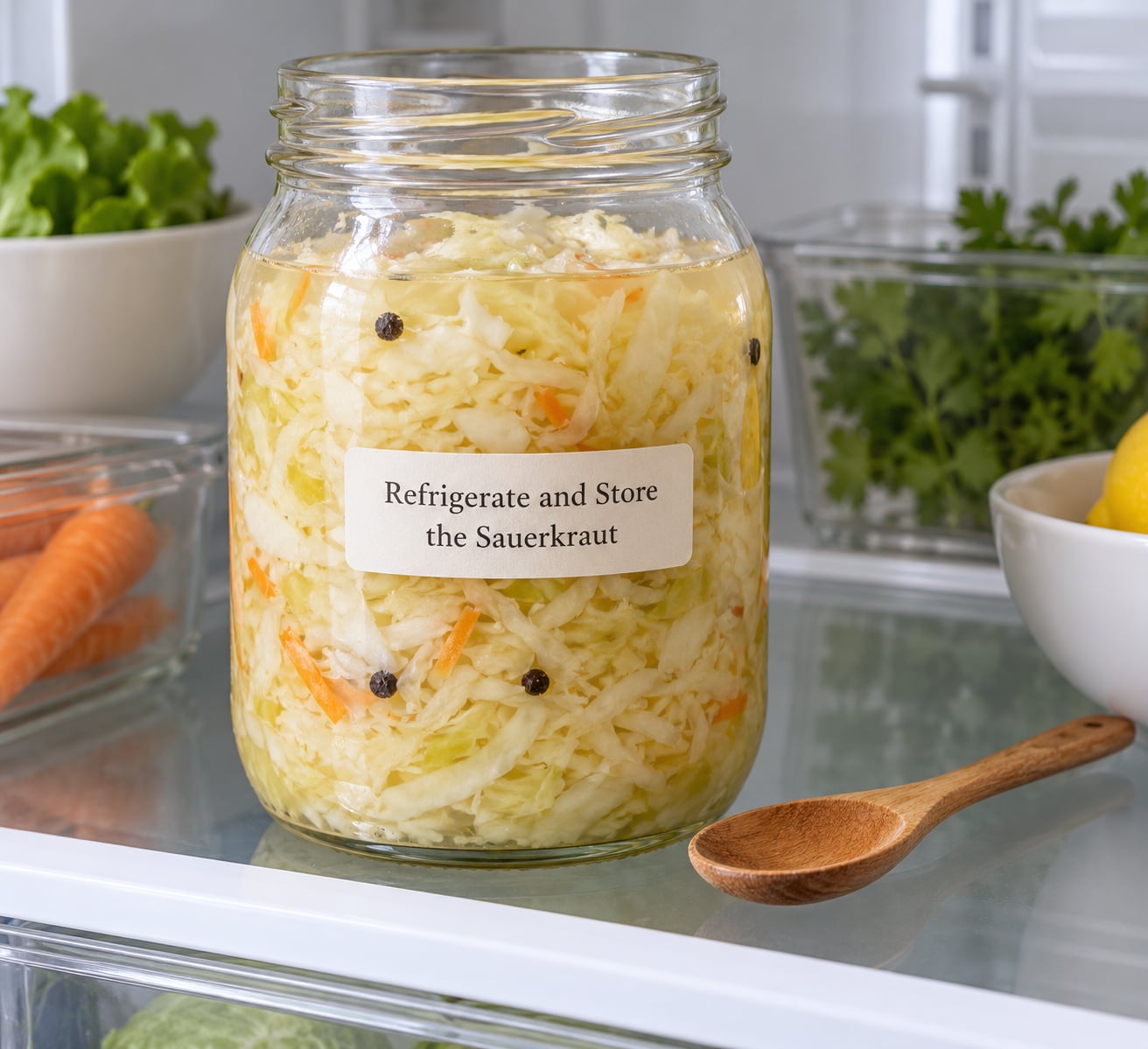
Cold is how you stop fermentation. Once the taste is where you want it, tighten the lid and move the jar to a refrigerator at 40°F or below. Cold does not spoil the kraut; it just slows the bacteria down so the flavor stops moving.
A useful trick is to taste cold before you commit. Spoon a serving into a small jar, refrigerate it overnight, and eat it the next day. Cold food tastes less sour than warm food, so a batch that seemed slightly sharp on the counter usually lands perfectly once chilled.
For storage, keep the cabbage under its brine and always use a clean fork. If the brine level drops, top up with plain unsalted water or with fresh 2% brine. Most batches keep well for two to three months in the refrigerator, often longer, and the flavor softens gradually as it ages, which is not a fault.
Before every opening, check three things: is the cabbage still under the liquid, is the brine clear rather than cloudy and thick, and does the jar still smell like clean sour cabbage? Lift the weight slowly and tilt the lid, because a fermenting jar can release a puff of gas that sends brine over the rim if you open it straight up.
If you want sauerkraut that keeps for months without a refrigerator, that is a different project: fully fermented kraut packed into sealed jars and processed in a water bath canner. Beginners should refrigerate first and can that later if the bug bites.
Common Mistakes
Almost every failed jar comes down to one of a handful of things. Here is how to spot them and what to change.
Salted by volume instead of by weight
Kosher salt varies wildly in density, so a tablespoon that equals 7 g in one brand can be close to 11 g in another. Guessing gives you kraut that is either bland or so salty you cannot eat it. Weigh the cabbage, then weigh the salt, and the problem disappears.
Cabbage floating above the brine
Anything above the liquid is exposed to air and can grow mold instead of fermenting. Push it under and put the weight back on. If the cabbage keeps climbing, your headspace is too tight or your weight is too light.
Loose or undersized weights
A weight that rocks or that sits on only part of the surface leaves corners uncovered. A weight that fits loosely in a narrow jar will often tip over. Match the weight to the width of the jar, and if nothing fits, a small brine-filled jar with a tight lid does the job.
Trapped air inside the packed cabbage
Packing loosely lets oxygen hide in pockets where it should not be. Press firmly after every handful and top the jar up with brine so the shreds compress as they settle. Crunchy kraut comes from tight packing and adequate salt.
Sealing the jar airtight
Carbon dioxide builds behind a sealed lid and something has to give, usually at 2 a.m. over your counter. Vent it with a loose lid, a cloth, or an airlock, and always leave two to three inches of headspace.
A jar that sits somewhere too warm
On a sunny sill or beside the oven, kraut ferments fast and turns soft, and mold risk goes up with the heat. A cool corner of the counter or a pantry shelf is better.
Impatience with the timeline
Small jars ferment in five to ten days, while a stoneware crock can take four to six weeks. Judge by smell and taste, not by a date in a recipe, and keep tasting from day four onward.
Mold, kahm yeast, or neither
This is where beginners panic, so here is the difference in plain terms. Kahm yeast is a harmless surface film that appears around day three or four. Mold is fuzzy, raised, and colored. When in doubt, throw it out; nobody is missing one jar.
| What you see | Kahm yeast (harmless) | Mold (discard) |
|---|---|---|
| Texture | Flat, thin, matte film that wrinkles when you touch it | Fuzzy, raised, spongy or dry |
| Color | White to off-white | Black, green, blue, pink, or mixed |
| Smell | Sour, sometimes yeasty or a bit sharp | Musty, rotten, fruity, or chemical |
| What to do | Skim it off and keep the kraut | Compost the whole jar, do not scrape and continue |
Brine loss and a shrinking level
Cabbage drinks water out of its own cells during the first day, so the level drops as the ferment starts. Top up with brine at the same 2% strength. If the level drops because the lid sat too close, increase your headspace next time.
Sauerkraut that is too salty, or too bland
Too salty usually means the measurement was off. Mix in a spoonful of unsalted fresh cabbage juice or dilute with a little cold water. Too bland usually means under-salting or a cool room. Add a little salt at the table in small increments and move the next batch to a warmer spot.
Mushy instead of crunchy
Soft texture comes from under-salting, heat, loose packing, or too many added vegetables. It is not dangerous, just disappointing. Push each of those four levers next time and the snap usually comes back.
Frequently Asked Questions
How much salt do I need for sauerkraut in a jar?
Use 2% of the cabbage weight measured in grams. For a 900 g head that is 18 g of salt, about 3 teaspoons of table salt or 2 tablespoons of coarse kosher salt. Weighing beats measuring by volume because salt density varies by brand. Skip iodized salt and any salt containing anti-caking additives, since both can interfere with the ferment.
How long does sauerkraut need to ferment at room temperature?
A quart jar on a kitchen counter usually needs 5 to 10 days to reach a pleasant tang, and 2 to 4 weeks to become sharper and more complex. Small jars ferment faster than crocks. Temperature drives the clock: near 70°F finishes quickest, while a 60°F basement stretches it out to several weeks. Start tasting at day four and stop when the flavor suits you.
Why is my sauerkraut not producing bubbles?
Most of the time nothing is wrong. Bubbling peaks during the first two or three days and slows once the cabbage turns sour, so a quiet jar on day six is normal. Check three things: the cabbage is still under the brine, the jar sits near 65 to 75°F, and the salt measured 2% by weight. Under-salting, a cold kitchen, or cabbage left above the liquid all slow the ferment.
Is it normal for sauerkraut brine to fall below the cabbage?
Yes, and it is easy to fix. Cabbage keeps drawing water out of its cells as the salt works, so the level can drop within a day. Press the cabbage back under the liquid and top up with brine at the same 2% strength. If exposed shreds have already turned dull or brown, remove those pieces, since that is where a ferment stalls and mold begins.
How do I know when sauerkraut has gone bad?
Trust your nose. Sour is fine, and a sharp vinegar edge is fine too. Trouble smells like rotten eggs, cheese, or nail polish remover, and fuzzy colored growth on the surface means composting the jar rather than scraping it clean. A flat, wrinkled white film is harmless kahm yeast that you can skim off. When the smell is uncertain, throw it out; one jar is not worth the gamble.
Conclusion
If you only remember three things, remember these: weigh the salt at 2% of the shredded cabbage, keep every shred under the brine for the entire ferment, and taste from day four until the sourness is where you like it.
Active fermentation looks like bubbles, a little foam, and brine slowly climbing the glass in the first few days. A flat white film you can skim is kahm yeast and nothing more. Anything fuzzy or colored is mold, and the jar goes in the compost.
Once the flavor lands, seal the jar and refrigerate it, keeping the cabbage submerged and using a clean fork every time. Most batches last two to three months that way, getting milder as they age.