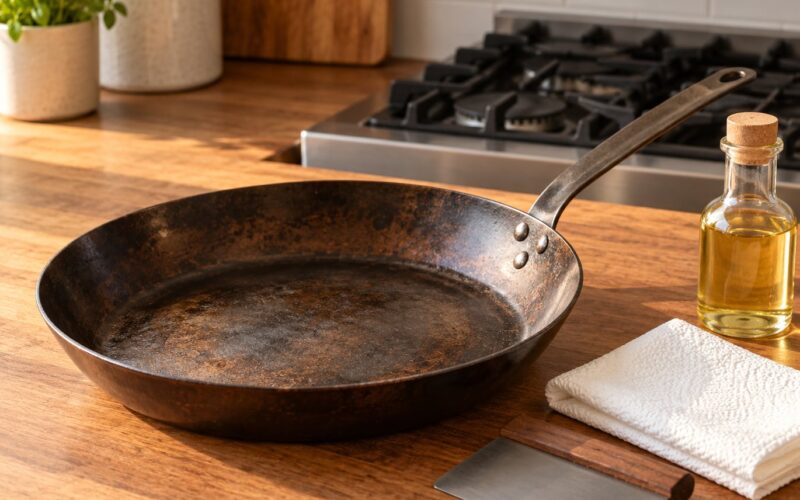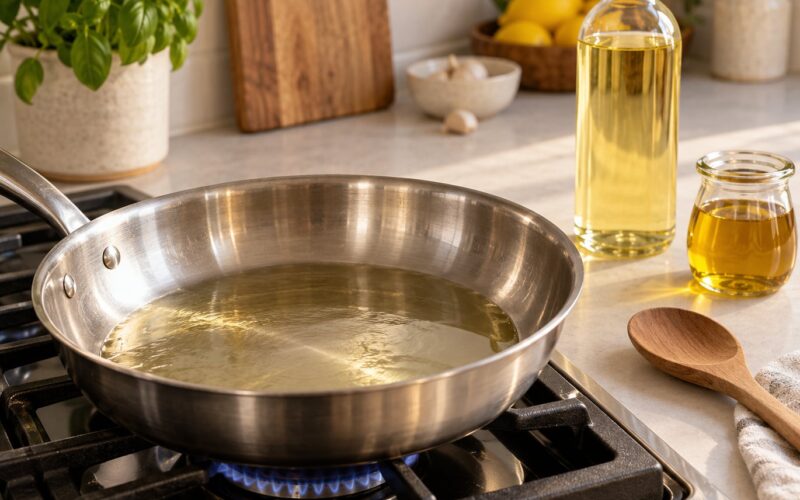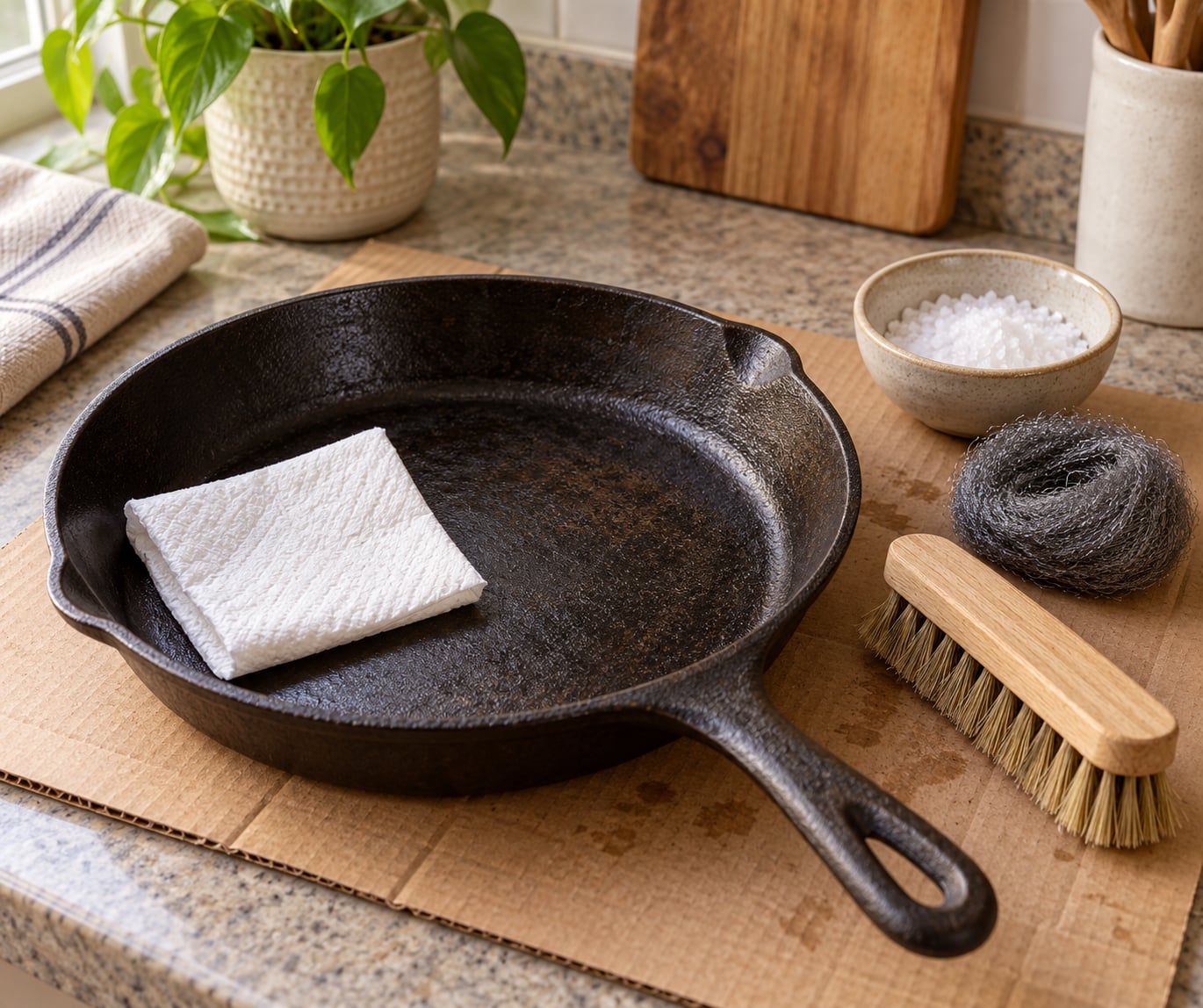
To strip and reseason rusty cast iron, scrub the corrosion off down to bright bare metal, wash the pan with warm soapy water, dry it completely, wipe on a paper-thin coat of high-smoke-point oil, then bake it upside down at 450-500°F for one hour and cool it in the oven. Repeat the oil-and-bake cycle two or three times, and the pan is back in service. Budget a few hours of active time spread over a day or two — it is not a 20-minute job, and that is where most people go wrong.
Good news first: rust is not a death sentence for cast iron. It is iron oxide, a loose crumbly coating sitting on top of the metal, which means it can be scrubbed off and the surface rebuilt from scratch. Lodge Cast Iron’s own care guidance is blunt about this — a rusty skillet is a project, not a trash item.
I’m not writing from theory here. The method below is the one that keeps showing up in the forums I read, from r/castiron threads to old threads on r/Cooking, and it matches what Kent Rollins and the Serious Eats test kitchen describe. The difference between a pan that seasons beautifully and a pan that stays blotchy and sticky is almost always technique, not product.
Table of Contents
- What You Need
- Step-by-Step: How to Strip and Reseason Rusty Cast Iron
- 1. Decide Whether the Pan Really Needs Stripping
- 2. Prepare a Safe Workspace
- 3. How to Strip Rust and Flaky Seasoning Off Rusty Cast Iron
- 4. Wash Away Residues and Dry Completely
- 5. Apply the Thinnest Possible Oil Layer
- 6. Bake the Seasoning Into the Iron
- 7. Test the Finish and Build Stronger Layers
- Common Mistakes
- Sticky, flaky or grey seasoning
- Frequently Asked Questions
- Is it dangerous to cook with a lightly rusty cast iron pan?
- Does vinegar remove rust better than salt or a chainmail scrubber?
- What is the best oil for reseasoning cast iron?
- Can I use an oven-cleaner strip on cast iron?
- Why does my cast iron seasoning look blotchy after baking?
- How should I care for newly seasoned cast iron?
- Conclusion: Start With the Least Aggressive Method
What You Need
You do not need a dedicated restoration kit. Everything on this list is a hardware store or pantry item, and most of it you already own.
- Workspace protection: a folded piece of cardboard, a sheet of newspaper, or a baking sheet. Rust dust and old seasoning flakes are messy and they stain counters.
- Mechanical scrapers: a stiff-bristled nylon brush, a plastic or metal pan scraper, a chainmail scrubber, and either 0000 or 000 steel wool, or a rust eraser. Coarse salt in a paper towel works as a mild abrasive too.
- Acid for heavy rust: white distilled vinegar. Just acetic acid, water, and time — no lye, no chemical stripper.
- Wash and dry supplies: mild dish soap, a soft sponge, a clean towel, and a stovetop or oven for low heat.
- Seasoning oil: a neutral oil with a high smoke point. Grapeseed and canola both work. Avocado works too. Avoid olive oil, butter, and anything with a low smoke point.
- Oven setup: a rack in the lower third of the oven, a cookie sheet or aluminum foil beneath the pan to catch drips, and enough headroom above for a large skillet upside down.
When you can skip the full strip: if the rust is a few orange freckles on the outside of an otherwise smooth, dark, well-seasoned pan, you do not need to strip the whole thing. Scrub the rust spot, rinse, dry, and put a thin coat of oil on the whole pan. Save the full strip for widespread rust, flaking seasoning, or a pan that has been sitting in a damp garage all winter.
Step-by-Step: How to Strip and Reseason Rusty Cast Iron
1. Decide Whether the Pan Really Needs Stripping
Sort out what you are actually looking at before you start scrubbing, because the treatment changes a lot depending on the damage. There are four distinct categories and people mix them up constantly.
Temporary rust stains are orange-brown smears that wipe or scrub off the surface. These come from a wet pan air-drying, or from a dishwasher cycle. A quick scrub and a fresh coat of oil is the whole fix.
Loose surface rust is flaky, orange, and comes off under a fingernail or a stiff brush. This is common and responds well to a vinegar soak followed by scrubbing.
Widespread pitting with heavy scale means thick rust that has eaten into the metal, leaving craters. Scrubbing alone will not clear it, and vinegar soaks help, but expect to repeat the cycle. Pitting is usually pre-existing or caused by long acid storage, not by your restoration — plenty of first-time owners discover it mid-strip and assume they ruined the pan.
Enamel damage is chipped, cracked, or flaking porcelain. Stop. Enameled cast iron cannot be reseasoned like bare iron. If the enamel is compromised, the pan is a display piece, not a cooking pan.
While you have it in your hands, check for cracks through the wall and for a flat base. A warped pan rocks on your counter no matter what you do to the surface. Kent Rollins puts lead testing first on anything from a fire or an unknown history, and that is worth following if the pan came out of a fire-damaged building.
2. Prepare a Safe Workspace
Set up outside or in a well-ventilated spot if you can. Open a window before you start scrubbing, because fine rust dust and old seasoning particles are an irritant, and wear gloves and a dust mask if the rust is heavy.
Put your cardboard down, position a sink or bucket for rinse water, and clear a drying area. Fill the bottom of the oven with a cookie sheet or crumpled foil so any oil that runs off the inverted handle does not burn onto the oven floor. That burnt drip smell is hard to get rid of.
One thing you can skip entirely: chemical oven cleaner or hardware-store paint stripper. They are unnecessary, they leave a residue that has to be scrubbed off again, and they can attack the seasoning on pieces you want to keep. The oven’s own self-cleaning cycle does the same job with heat you already have. If you go that route, protect the rack with foil and know that the cycle is hard on older, thin iron.
3. How to Strip Rust and Flaky Seasoning Off Rusty Cast Iron
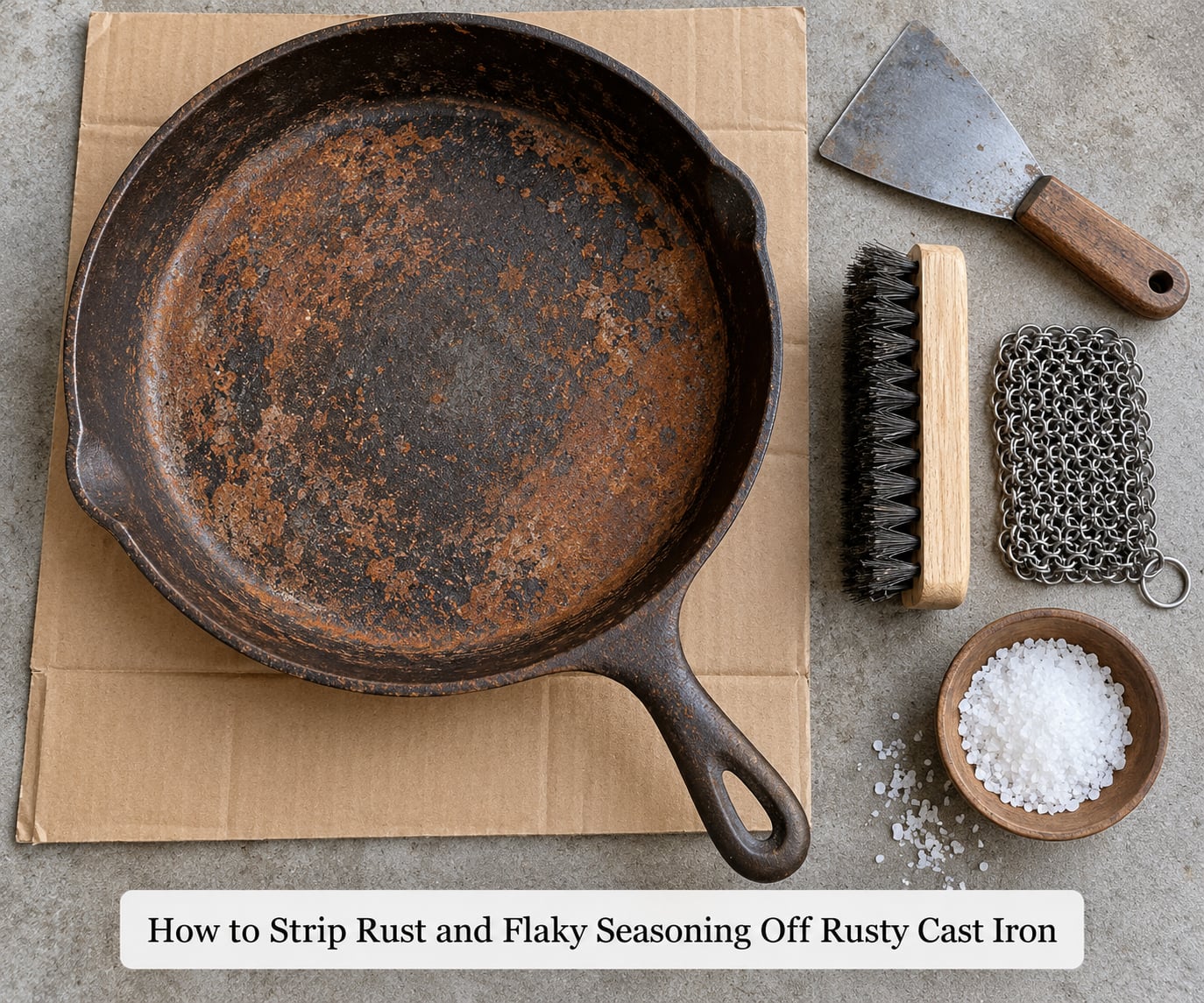
Work from the gentlest method that will do the job, and escalate only if you need to.
Start with the vinegar soak. Fill the pan with equal parts water and white distilled vinegar and set it on the counter for 30 to 60 minutes. Acid loosens the oxide so your scrubber has something soft to catch. The limit matters: vinegar is also strong enough to eat seasoning you wanted to keep, so do not leave it overnight. If you only have light surface rust, skip this entirely.
Scrub mechanically. Empty the pan, take a stiff nylon brush or a scraper to the rusty areas and knock the loosened scale into the cardboard. Then move to a chainmail scrubber or 0000 steel wool for the stubborn patches. Steel wool is not the first choice and should not be used on enameled or lightly seasoned surfaces, since it takes the seasoning with it. A rust eraser, which is a fine abrasive block sold for exactly this job, is a good middle step.
Use salt as a gentle abrasive. Coarse kosher salt with a few drops of oil, worked in with a paper towel, will lift light rust without touching the seasoning underneath. It is slower than steel wool and much kinder to the surface.
Escalate only for real scale. For thick, hard rust, 200-grit sandpaper, then a right-angle grinder with a wire wheel attachment, then a paddle wheel polisher. That is the ladder Kent Rollins uses, and each rung removes more metal than the last. If you find yourself on the grinder step, you are restoring a neglected piece, not cleaning a pan.
You know the rust is gone when the metal looks bright silver and slightly shiny, and when you run a fingertip across it, it feels smooth rather than gritty. That check matters more than anything else on this page: seasoning bare, rusty metal just seals the rust in and guarantees it comes back.
4. Wash Away Residues and Dry Completely
Wash the pan with warm water and a small amount of mild dish soap. Soap is safe here. The old rule about never using soap existed to protect a thin seasoning layer you were keeping, and here you have deliberately removed that layer, so use the soap and get every last flake of rust dust and abrasive grit out of the grooves. Scrub with a soft sponge or brush, rinse under warm water, and wipe out any grey slurry left behind.
Avoid the dishwasher here and going forward. The detergent is harsh, the soak is long, and the drying cycle is warm and wet — that combination is the number one cause of the rust spots people find on the outside of their pans.
Now dry it. Towel-dry first while the pan is still warm, then set it on the stovetop over low heat for a couple of minutes, or in a warm oven for five to ten minutes. Water hiding in the casting pores is what turns a thin oil coat into a patchy, blotchy one. Let the pan cool to room temperature before you oil it.
5. Apply the Thinnest Possible Oil Layer
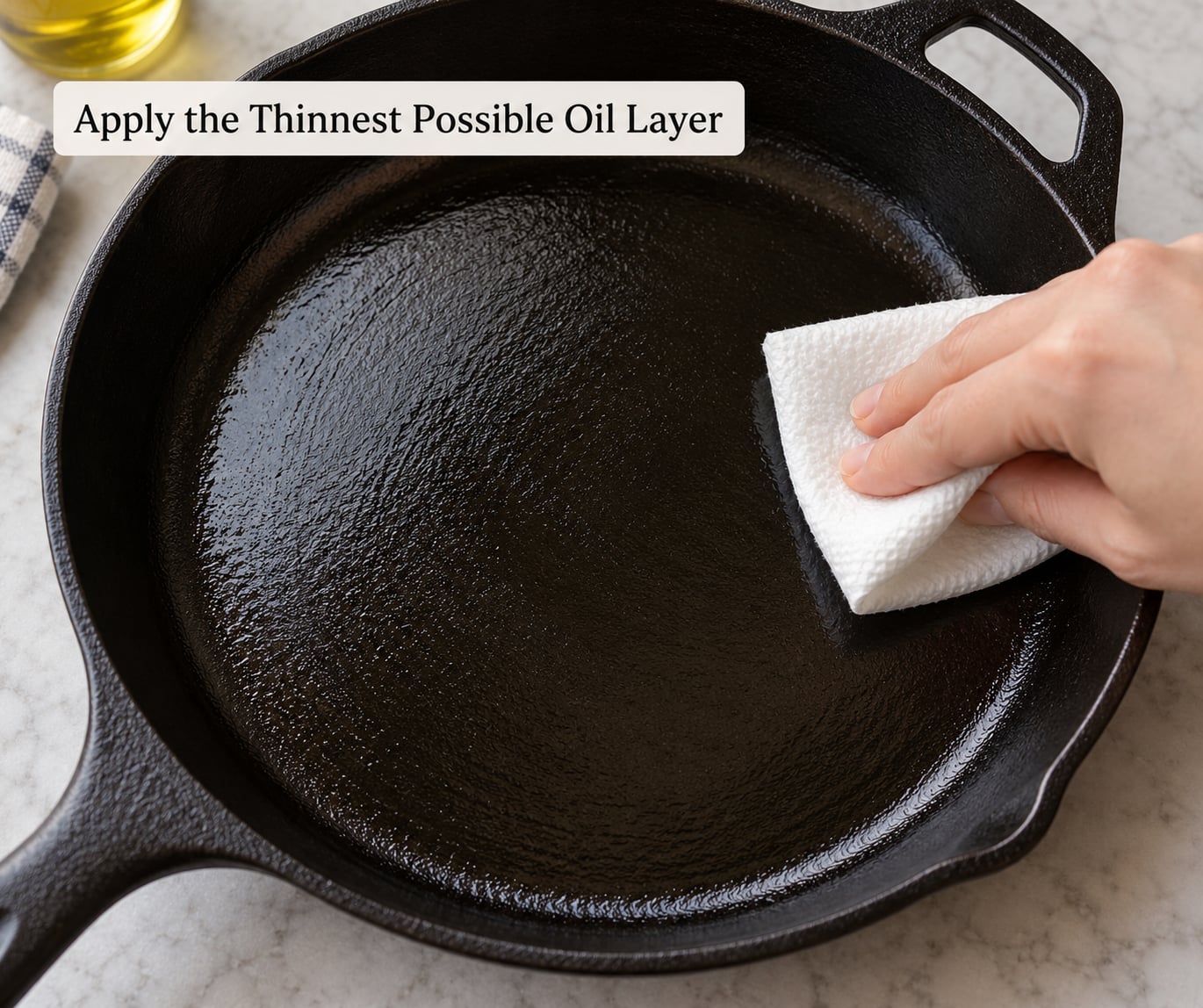
Put a small amount of oil in the pan — a teaspoon is plenty for a 12-inch skillet — then wipe it out with a folded paper towel until the surface looks almost dry. You are after a film you cannot really see, not a gloss. The pan should look exactly as it did before you started.
Go over it again with a clean, dry section of the towel, paying attention to the base, the walls, the handle and the pour spouts, which are the spots where excess oil collects and bakes into flakes.
If you see any shiny, wet-looking patches, wipe those harder until they match the rest. Sticky seasoning is almost always too much oil, and it cannot be fixed by baking it longer — it has to be stripped and started again.
On oil choice: the rule is a high smoke point, because the oil has to survive the oven without smoking or breaking down into bitter residue. Grapeseed oil is the classic pick, and canola and refined avocado oil work just as well. Flaxseed oil cures fast and hard, but it goes off, so buy a small bottle. Skip olive oil, butter, and unrefined oils — they smoke below baking temperature and taste bitter once polymerized.
6. Bake the Seasoning Into the Iron
Put the pan upside down on the lower oven rack so the handle has clearance and any oil runs to the base rather than pooling in the cooking surface. Preheat the oven first — a cold oven that slowly climbs leaves a thin, patchy film instead of an even cure.
Bake at 450 to 500°F for one hour. The oil polymerizes into a hard carbonized layer bonded to the iron, and that is what gives cast iron its natural non-stick surface and its resistance to rust. Do not crank the oven to 600°F hoping to save time; the extra heat just risks scorching the oil and warping the pan.
Turn the oven off and leave the door shut. Let the pan cool to room temperature inside the oven, which takes another 30 to 60 minutes. Pulling it out hot and hitting it with cold air or water is the fastest way to craze a fresh layer.
For thick, heavy rust, a short self-cleaning oven cycle (around 500°F with the door cracked, roughly an hour, with the pan foil-wrapped and a cookie sheet underneath) burns off loose rust before you start oiling. It also strips any seasoning you had, which is why it belongs before step 5, not after.
7. Test the Finish and Build Stronger Layers
A properly seasoned pan is dark brown to black, matte, and slightly even in tone. Streaky brown-and-silver patches mean the surface was not fully stripped or the oil coat was uneven. Go over those areas with 0000 steel wool, wipe them clean, and run another oil-and-bake cycle.
Two or three cycles is the normal range. You do not need a dozen. After each bake, cook something fatty and acidic-adjacent — bacon, fries, a piece of toast with butter — and the seasoning builds faster and more evenly than oven baking alone can manage it.
Then care for it: rinse while warm, scrub with a nonabrasive brush or chainmail if stuck, towel-dry, and put it back on low heat to finish drying. A thin coat of oil before storing it protects the surface through months of humidity, and storing it with the lid off or uncovered lets moisture escape.
Common Mistakes
Soaking bare iron in water. Long soaks let water sink into the casting and start fresh rust where you cannot see it. A few minutes under the tap is fine; a pan sitting in the sink overnight is how most people end up back at square one.
Letting detergent dry in the pan. The rinse-and-set-it-in-the-sink habit leaves a film that becomes part of your next seasoning layer. Towel-dry and heat-dry every time.
Using too much oil. This is the single most common reason a freshly seasoned pan feels sticky or tacky. Wipe until the pan looks dry. If it looks wet, it is too much.
Overheating the oven. The cure happens comfortably below the temperature that burns oil or warps iron. If your oven runs hot, use an oven thermometer and bake at the low end.
Stripping a healthy factory-seasoned pan. A smooth, dark, even pan does not need to be taken to bare metal. You would be removing a good layer to replace it with a worse one, and the strip-and-reseason cycle is a lot of oven time to spend on a pan that was already fine.
Treating enameled cast iron like bare iron. Steel wool, salt scrubbing, self-clean cycles, and oven baking at 500°F will damage porcelain enamel. Enameled pans are cleaned with nonabrasive methods and never reseasoned.
Seasoning over bare, unstripped rust. If you skipped the bright-silver check, you have sealed corrosion under a polymer layer and it will blister through into your food.
Sticky, flaky or grey seasoning
If the pan is sticky or gummy, it almost always had too much oil or too short a bake. Strip it back with steel wool or a chainmail scrubber, wash, dry, and redo with a thinner coat and a full hour.
Flakes that peel off in sheets point to oil pooled in one spot, usually where the oil was applied thick or where it collected at the base. The fix is the same: back to bare metal in the flaking area, thinner coat, and cook a few fatty meals after baking to bond the layer.
A uniformly grey, dusty surface means the seasoning never cured. Give it another hour in the oven at temperature.
Frequently Asked Questions
Is it dangerous to cook with a lightly rusty cast iron pan?
Rust itself is not toxic and it does not make you sick, so a few orange spots will not hurt you. The real concern is that rust is porous and crumbly: it destroys seasoning, flakes into food, and harbors bacteria when it sits under burnt food. Scrub off light surface rust, reseason, and cook normally. For anything beyond light surface rust, strip and reseason the pan properly first.
Does vinegar remove rust better than salt or a chainmail scrubber?
They do different jobs. Vinegar is chemistry: a 30 to 60 minute soak in equal parts water and white vinegar loosens rust so it lifts off easily. Salt and a chainmail scrubber are mechanical: salt is gentle enough to preserve seasoning, while a chainmail scrubber removes loosened rust fast but will also take off seasoning you wanted to keep. Use vinegar first, chainmail second, salt for light rust.
What is the best oil for reseasoning cast iron?
Any neutral oil with a high smoke point works, because the oil has to survive an hour at 450 to 500 degrees without smoking. Grapeseed oil is the most commonly recommended, and canola and refined avocado oil are equally good. Flaxseed oil cures hard and fast but goes off quickly. Avoid olive oil, butter, and low-smoke-point oils, which smoke in the oven and turn bitter.
Can I use an oven-cleaner strip on cast iron?
You do not need to. Chemical oven cleaner is unnecessary, leaves a residue you have to scrub off again, and can attack seasoning on pieces you want to keep. The oven self-cleaning cycle does the same job with heat alone: foil-wrap the pan, set it on a cookie sheet on the lower rack, and run a cycle around 500 degrees. It is hard on older, thin iron, so skip it on a vintage piece with fragile seasoning.
Why does my cast iron seasoning look blotchy after baking?
Blotching almost always means the oil coat was uneven or the pan was not bone dry before you oiled it. Water trapped in the casting pockets steams and pushes the oil into patches. Fix it by scrubbing the uneven areas with 0000 steel wool, wiping the pan completely clean, drying it over low heat, and running another thin coat through a full hour of baking. Uneven color alone is cosmetic; roughness is not.
How should I care for newly seasoned cast iron?
Rinse the pan while it is still warm, scrub stuck food with a nonabrasive brush or chainmail, and never put cast iron in the dishwasher. Dry it on the stovetop over low heat for a couple of minutes, wipe on a paper-thin coat of oil, and store it uncovered or with the lid ajar so humidity can escape. Cook fatty foods often, since those build seasoning faster than oven baking.
Conclusion: Start With the Least Aggressive Method
Put a paper towel on your rust spot and see whether it comes away orange. If it does, you have light surface rust: scrub it, rinse, dry, and add a thin coat of oil. If the rust is thick, flaking, or covering most of the pan, soak it in vinegar for 30 to 60 minutes, scrub to bright bare metal with chainmail or fine steel wool, and confirm the surface looks silver and feels smooth before anything else happens.
Then dry it properly, wipe on the thinnest oil coat you can manage, and bake at 450-500°F for an hour, cooling inside the oven. Two or three cycles and a few fatty meals later, you have a pan that will outlast the person who found it in the garage sale.