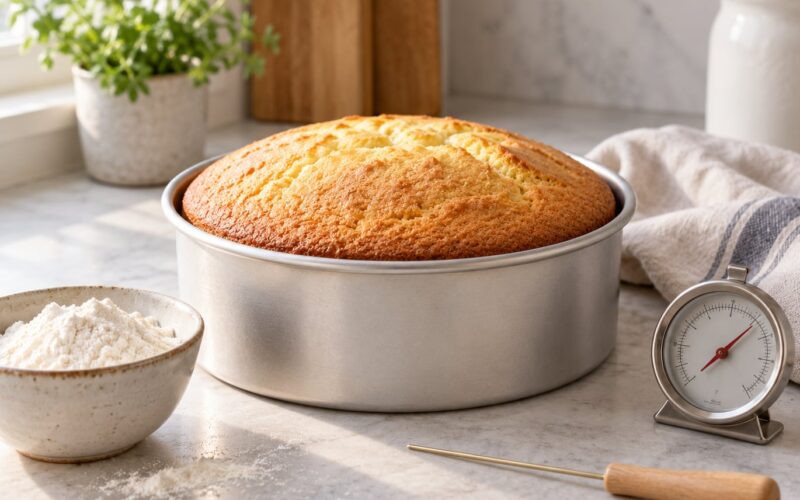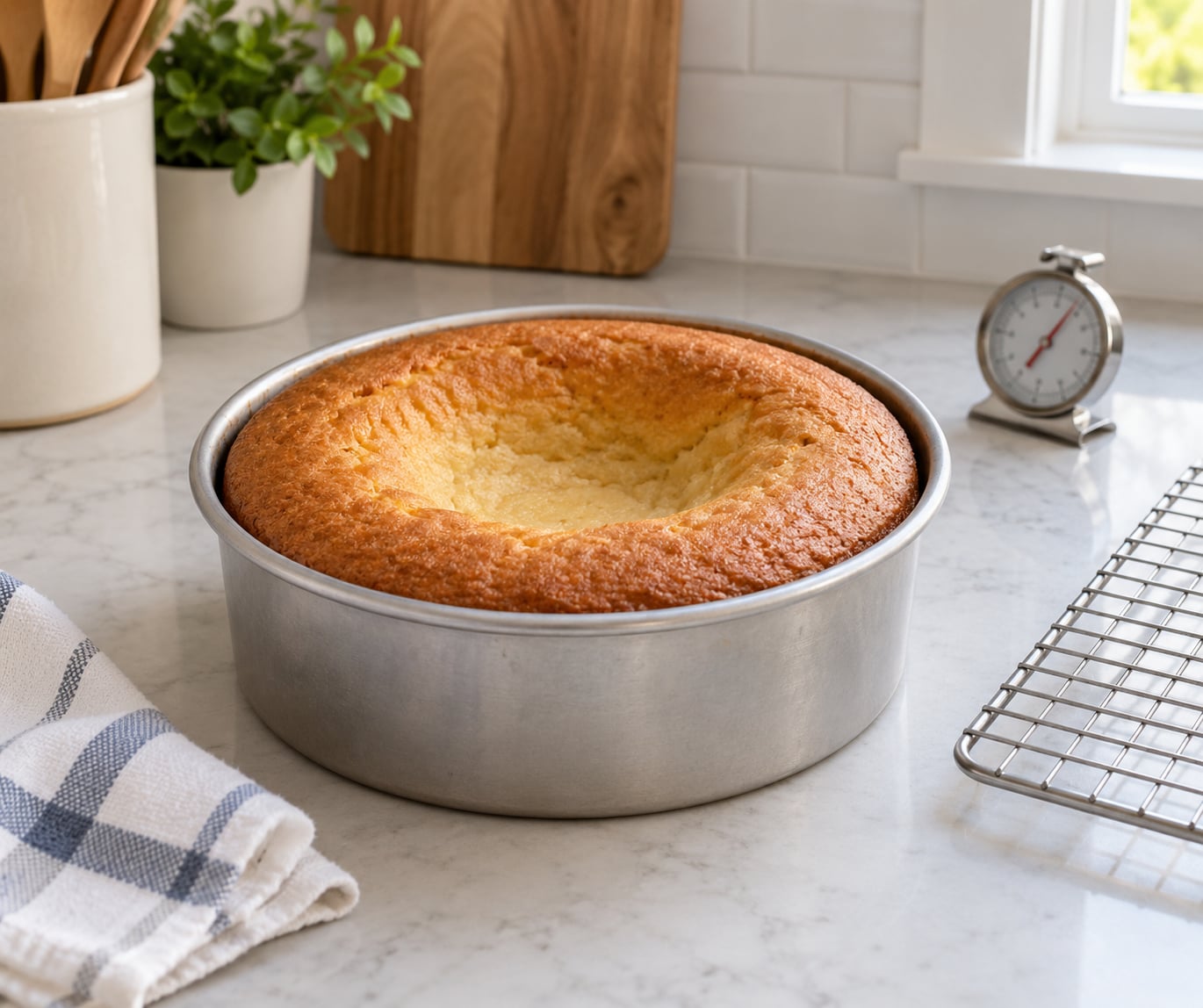
Cakes sink in the middle because the center of the batter was still wet and unset when the cake came out of the oven, so it could not hold up the risen top and collapsed inward as steam escaped. Almost every sunken cake traces back to one of seven things: oven temperature, underbaking, opening the door too early, leavening, pan size, mixing, or a careless cool-down. Fix the matching cause and the crater usually disappears for good.
That last part matters more than it sounds. Most bakers respond to a crater by rewriting the recipe, when the recipe was fine and the oven was running 30 degrees hot. Change the wrong thing and the same collapsed center shows up on the next three bakes.
Table of Contents
- What Causes a Cake to Sink in the Middle?
- The 7 Reasons Cakes Collapse in the Center
- Why Does an Oven Temperature Matter?
- How to Tell Whether the Cake Was Underbaked
- Why Can Opening the Oven Make a Cake Sink?
- What Batter Problems Lead to a Sunken Center?
- Why Does the Pan Matter When a Cake Rises?
- How to Prevent a Cake From Sinking in the Middle
- How to Fix a Cake That Has Already Sinked
- Frequently Asked Questions
- Why does my cake sink in the middle?
- How do I know if my cake is fully baked in the center?
- Should I use an oven thermometer when baking cakes?
- Can I fix a cake that sinks in the middle?
- Why does my cake collapse after I take it out of the oven?
- Does baking altitude make cakes sink?
- Start With the Oven and the Center
What Causes a Cake to Sink in the Middle?
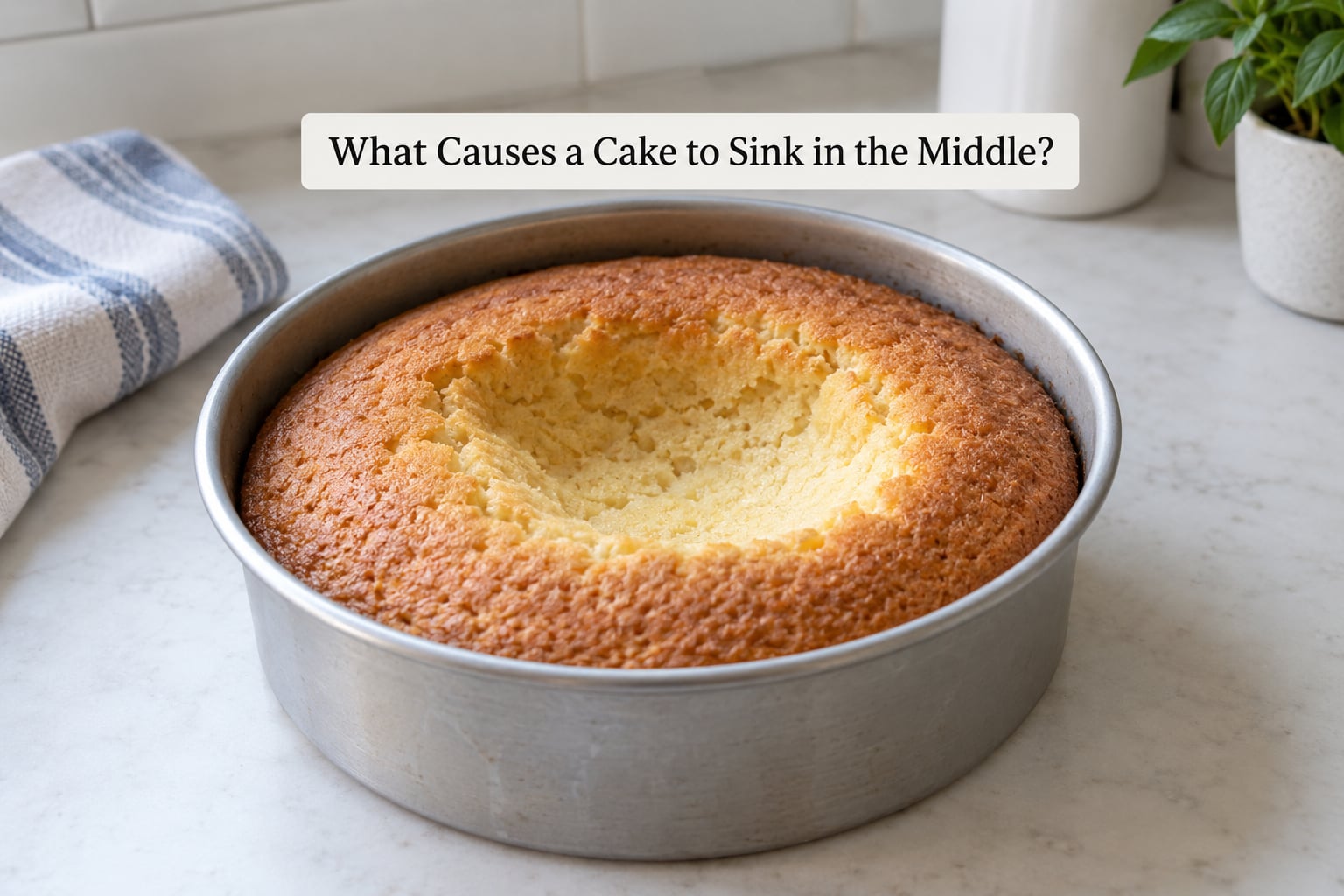
Heat reaches a cake from the outside in. The edges and the base of the pan cook first, and the center is always last, simply because it is the farthest point from any heat source. Two things have to happen before that center can support itself: egg proteins coagulate, and the flour’s starches gelatinize into a set gel. Both run fastest at the edges and slowest in the middle.
So the collapse itself is a timing failure. If the cake leaves the oven before its center has set, that middle is still soft batter, and the weight of the cake on top of it plus the steam escaping drives it down as it cools. The dent you see twenty minutes later was decided ten minutes before you opened the door.
Here is how the usual symptoms map to the usual causes. Find the row that matches your cake and you have your diagnosis.
| What you see | Likely cause | What to change |
|---|---|---|
| Deep crater right in the center, edges fine | Underbaked middle | Bake 3 to 5 minutes longer, test in the deepest point with a toothpick |
| Cake falls within 15 minutes of leaving the oven | Structure still unset, or oven door opened early | Do not open the door for the first 20 minutes of baking |
| Risen high then dropped all the way down | Too much baking powder or baking soda | Level the measuring spoon, cut the leavening by a quarter |
| Barely rose at all, dense and flat | Expired leavening | Test the baking powder with warm water or vinegar |
| Crispy dark edges with a pale sunken middle | Oven running hot | Check with an oven thermometer, drop the dial 25 degrees |
| Rise happened fast and pale, cake gummy underneath | Oven running cool or not fully preheated | Preheat 15 minutes longer, add 25 degrees |
| Dome with an even ring of sunken edge | Pan overfilled or too small | Fill to two-thirds, scale down for a bigger pan |
| Rough, tight, chewy crumb | Overmixed batter | Stop mixing the moment dry ingredients disappear |
| Fine, even layer cake that sinks on batch two only | Oven and pan have not returned to temperature | Let the oven recover 20 minutes between trays |
Read the crater before you read the recipe. One row usually tells you more than an hour of guessing.
The 7 Reasons Cakes Collapse in the Center
Why Does an Oven Temperature Matter?
An oven that runs hot browns the outside long before the middle sets, which produces exactly the shape home bakers describe as crispy edges and a wet center. An oven that runs cool does something sneakier: the whole cake finishes pale and under-set, and the collapse happens on the counter rather than in the oven.
The bigger mistake is preheating. Cakes go into a fully preheated oven, not one that has been on for five minutes. That initial blast sets the outer structure and drives oven spring, the rapid rise in the first 10 to 15 minutes. Without it, the cake spends its rise slowly while the center is still wet, and there is nothing holding the top up.
An oven thermometer costs less than a failed cake and takes the guesswork out entirely. Put it on the middle rack where the cake will sit. Many home ovens run 25 degrees or more off the dial, and the direction varies from oven to oven, so the only reliable answer is to measure yours.
Two adjustments worth knowing. With a convection oven, drop the recipe temperature by about 25 degrees, since moving air browns the surface faster. Above 3000 feet, add 15 to 25 degrees, because thin mountain air lets moisture and heat escape faster than at sea level.
Rack position matters too. Bake on the center rack. Put it too low and the bottom sets hard and dark before the middle catches up, and put it too high and the top browns ahead of the center.
How to Tell Whether the Cake Was Underbaked
Underbaking is the single most common reason cakes sink in the middle, and it is also the easiest to confirm after the fact. Cut the cooled cake and look at the very center. A properly baked crumb is even and slightly springy all the way through. An underbaked one shows a wet, dense, compressed line right down the middle, often with raw batter smeared against the base.
Next time, test in the deepest point of the cake, not the middle of the top surface. A toothpick or thin skewer goes straight down into the deepest part of the center, which is the last area to finish. A few moist crumbs clinging to the wood means done. Wet batter, glossy streaks, or a clean toothpick both mean it needs more time, and a clean toothpick in the center is the more common of the two misses.
Use a second signal alongside the toothpick. Press the center gently with a fingertip. It should spring back and leave only a very slight dent. If the dent stays, the crumb underneath is still setting.
Skewers beat toothpicks on tall cakes because they are thin enough to leave almost no hole. Test in two or three spots around the deepest part of the center, not just one.
Why Can Opening the Oven Make a Cake Sink?
Opening the door drops the oven’s internal temperature fast, and that shock hits a cake that is in the middle of oven spring, when the structure is expanding but not yet strong. The batter has lifted but has not finished coagulating and gelatinizing, so a sudden chill stops the rise and leaves a top layer with nothing under it.
That is why the door matters far more at the start than at the end. The rule of thumb is to leave the door shut for the first 20 minutes of a standard layer cake, and even longer for a tall sponge or pound cake. After that point, structure has set enough to handle a brief check.
Opening the door once, briefly, in the last third of baking costs you very little. The damage comes from repeated or early peeking. If you need to check early, turn on the oven light and look through the glass instead of pulling the door open.
What Batter Problems Lead to a Sunken Center?
Overmixing is the quiet one. Once flour is added, mixing develops gluten, the protein network that gives cake its structure. Beat too long or too hard and that network tightens into a chewy, dense mass that cannot rise properly, so the cake pokes up early and then sags in the middle as the excess gluten pulls downward during cooling.
Stop mixing the moment the last streak of flour disappears. If the recipe calls for the creaming method, cream the butter and sugar first, fold the dry ingredients in just until combined, and add any milk in two or three additions with a light hand between them. Undermixing is the opposite problem, and less common: patches of dry flour stay suspended, break up the structure in spots, and leave holes and weak areas in the crumb.
Too much liquid thins the batter so the flour cannot support the rise, and too much sugar does similar damage because sugar absorbs moisture and competes with flour proteins for it. Cold ingredients are the most common avoidable error. Eggs and dairy straight from the fridge will not emulsify into the fat properly, and butter straight from the fridge will not cream with sugar into air. Let them sit out 30 to 45 minutes.
Leavening has two separate failure modes. Too much and the cake rises fast and tall, then the structure cannot hold the volume and the middle drops, often within minutes of baking. Too little or expired and the cake barely rises at all, leaving a heavy, dense middle that sinks as it cools.
These ratios are the ballpark most reliable cakes are built on, and the measuring spoon is level every time.
| Leavening | Typical amount per cup of flour | Needs an acidic partner |
|---|---|---|
| Baking powder | 1 to 1.5 teaspoons | No, it is self-acidifying |
| Baking soda | About 0.5 teaspoon | Yes, buttermilk, yogurt, brown sugar, or vinegar |
| Self-rising flour | Already includes baking powder and salt | No |
Baking soda without its acidic partner does nothing but sit there as extra alkalinity. Baking powder left open in a humid cupboard loses potency long before the printed date suggests.
The freshness test takes a minute. Stir a spoonful of baking powder into a third of a cup of hot water. Vigorous fizzing means it is still active. Sparse bubbles or nothing means replace it. Baking soda should foam when it hits a splash of vinegar or lemon juice. Baking powder is double-acting, so most cakes want the double acting kind, where the label lists both monocalcium phosphate and sodium acid pyrophosphate.
Why Does the Pan Matter When a Cake Rises?
A cake needs an even pan with no warping, and a warped pan is a quiet cause that gets missed. If your oven has a hot spot, or the pan came out of the dishwasher bent, one side sets faster than the other and the cake pulls to the middle. Anything with a crack, a dark ring, or a dent will do the same thing, worse.
Size matters just as much. Batter needs room to rise. Fill a pan about two-thirds full, and if your recipe was written for a smaller pan than the one in the cupboard, scale it down rather than pouring it all in. A deeper batter in the same pan takes far longer to set in the center, which is the same problem as underbaking wearing a different hat.
Convert by volume rather than by pan size, since two 9-inch pans from different brands rarely hold the same. Approximate batter volumes for the everyday pans:
| Round pan | Approximate batter volume |
|---|---|
| 8 inch round, 2 inch deep | 6 to 7 cups |
| 9 inch round, 2 inch deep | 8 to 9 cups |
| 10 inch round, 2 inch deep | 11 to 12 cups |
| 9 by 13 inch pan | 14 to 15 cups |
| 8 inch square, 2 inch deep | 8 cups |
Material changes how fast the batter sets. Light-colored aluminum is the standard and bakes gently. Dark metal and nonstick absorb more heat and brown the sides and bottom faster, so drop the temperature about 25 degrees if you swap. Glass holds heat well and gives an evenly browned crust, but it takes longer to preheat and needs a few minutes of cooling before it goes near cold water, since thermal shock will crack it.
Prepare the pan and the cake will have one less thing going wrong. Grease and line the base with parchment, and if the recipe calls for it, the sides too. Then set the pan on the center rack. For a second batch, let the oven recover to temperature for about 20 minutes and use a pan that has cooled to room temperature, which is where a lot of repeat-bake sinking starts.
How to Prevent a Cake From Sinking in the Middle
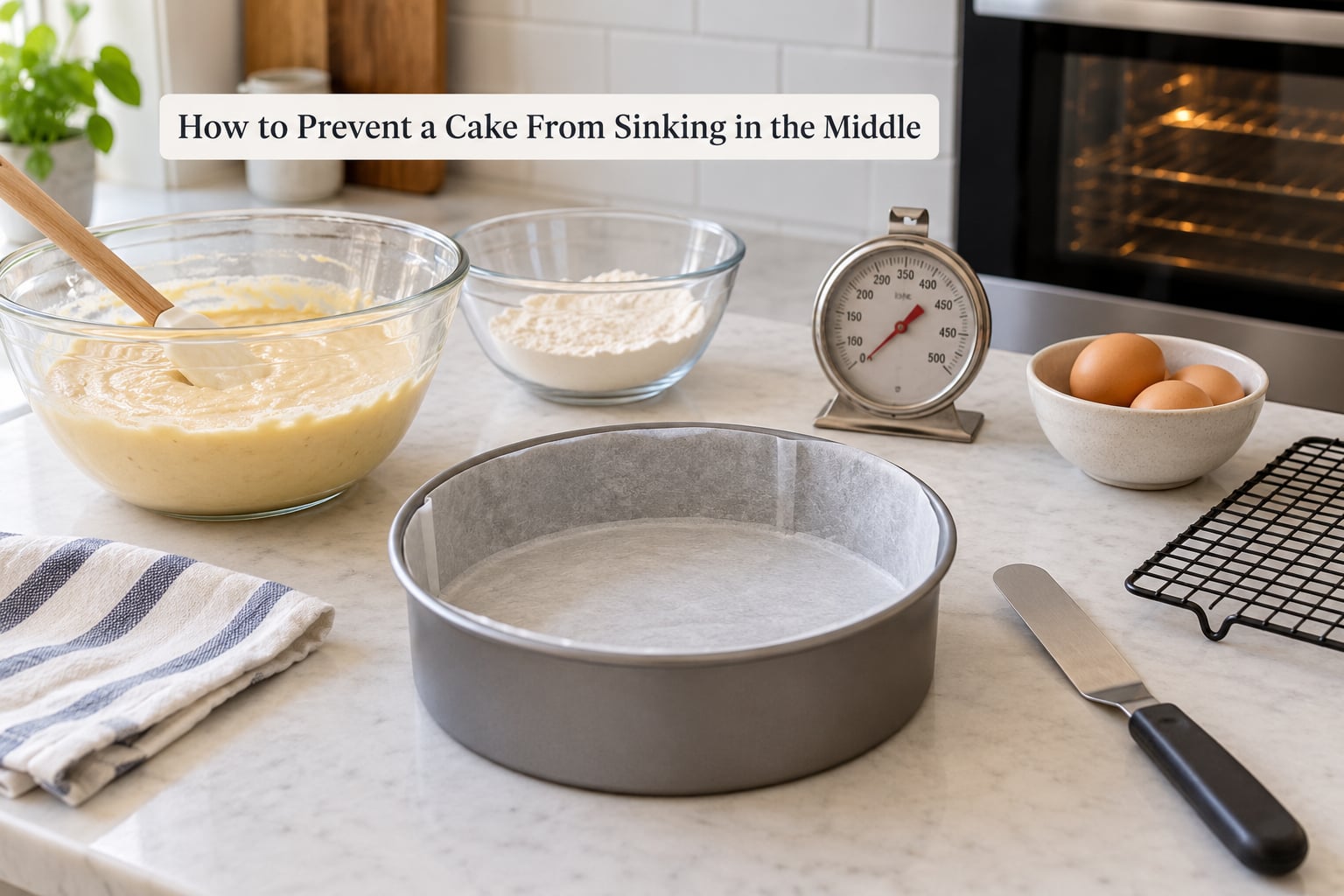
Here is the whole checklist in the order that catches the most problems.
Before you bake: preheat the oven a full 15 minutes and confirm it with an oven thermometer, check that the leavening is fresh with the water or vinegar test, level the measuring spoons, bring eggs, butter, and dairy to room temperature for 30 to 45 minutes, and weigh the flour if you own a scale, since a packed cup can carry 20 percent more flour than a spooned one.
Preparing the batter: stop mixing flour the instant it disappears, cream fat and sugar until light, and use the pan and fill level the recipe was written for. Fill to two-thirds and no more.
During the bake: keep the door shut for the first 20 minutes of a layer cake, and longer for tall cakes. Bake on the center rack. If baking two pans at once, stagger them front to back rather than side by side on the same rack, and expect the second pan to need a few extra minutes.
Testing doneness: poke the deepest part of the center with a toothpick or thin skewer, look for moist crumbs rather than wet batter or a clean stick, and add the fingertip spring-back check.
Cooling: set the pan on a wire rack and leave it for 10 minutes. Then turn the cake out and cool it completely on the rack, in the room it was baked in. Carrying a hot cake into a cooler living room is a real trigger, and bakers on r/AskBaking have reported seeing the collapse begin the moment they did it.
Altitude, above 3000 feet: reduce baking powder by about a quarter, add extra liquid, and raise the oven temperature by 15 to 25 degrees.
Cake-specific notes: tall sponge, chiffon, and pound cakes are the most prone because the batter is tall and light with little structure to spare, so test them with a skewer and expect a longer bake. Red velvet is an oil-based cake with cocoa, which slows setting, and one baker on r/AskCulinary got an identical central crater on two attempts at the same recipe before changing pans. Cupcakes made with cake flour sink and spill over the liners repeatedly for some readers on r/AskCulinary, since cake flour has less protein to hold the rise.
| Elevation | Baking powder | Liquid | Oven temperature |
|---|---|---|---|
| Under 1000 feet | No change | No change | Recipe temperature |
| 1000 to 3000 feet | Reduce by 10 to 15 percent | Add a little more | Recipe temperature, or 10 degrees higher |
| Above 3000 feet | Reduce by 20 to 25 percent | Add extra | Add 15 to 25 degrees |
One more pattern worth naming, because it drives people crazy: the first cake of the day caves and later ones come out flat and even. That is the oven and the pan holding heat from the previous bake. Let both return to temperature between batches and the pattern usually disappears.
How to Fix a Cake That Has Already Sinked
First, is it safe to eat? Yes, in almost every case. A sunken cake is a structural problem, not a food safety one, and plenty of HelpMeBake regulars have baked cakes with a collapsed middle for decades and eaten them without concern. The exceptions are cakes whose center is still wet raw batter, which should go back in the oven until a toothpick comes out with only moist crumbs, and any cake left at room temperature for more than a couple of days.
Now the repair. Chill the cake first, which firms the crumb and makes a clean cut far easier. Slice off the top with a serrated knife and take the level down to the lowest point of the crater, working around the cake rather than straight across, so the cuts stay hidden.
That disc makes excellent cake pops, or you can cube the trimmed cake for a trifle, a bread pudding, or a crumb-coated cake ball. It is the standard rescue path in the HelpMeBake community.
If the cake only has a shallow dip, you can usually skip the cutting. Fill the crater with a thin layer of buttercream or ganache and let the top of the icing set, and nobody will see the dent. A cake with a deep crater is better off as a trifle than as a frosted layer cake that will tilt on the first slice.
Whatever the outcome, slice before you serve. A sunken cake that looked fine on top will slice into a wedge with one very thin side, and that is the part that gets remembered.
Frequently Asked Questions
Why does my cake sink in the middle?
The center of the batter was still wet and unset when the cake left the oven, so it could not support the risen top and collapsed inward as steam escaped. The usual triggers are an oven that is not fully preheated or runs too cool, taking the cake out before the center had set, opening the door during oven spring, too much leavening, overfilling the pan, or overmixing the batter.
How do I know if my cake is fully baked in the center?
Test the deepest part of the center, not the top. A toothpick or thin skewer should come out with a few moist crumbs. Wet batter, glossy streaks, or a completely clean toothpick both mean it needs more time, and the clean toothpick is the more common miss. Press the center gently with a fingertip as a second check, since a properly baked center springs back and leaves only a very slight dent.
Should I use an oven thermometer when baking cakes?
Yes. It is the single most-recommended tool in baking forums, because many home ovens run 25 degrees or more off the dial and the direction varies from oven to oven. Place the thermometer on the middle rack where the cake will sit and use the reading to adjust every time. An oven running hot gives you crispy edges and a wet middle, while one running cool gives you a pale cake that collapses on the counter.
Can I fix a cake that sinks in the middle?
Yes, in most cases. Chill the cake, then trim the top level with the bottom using a serrated knife. A shallow dip can be covered with buttercream or ganache. A deep crater is better repurposed into cake pops, a trifle, or bread pudding. Cakes with raw batter in the center should go back in the oven until a toothpick shows only moist crumbs.
Why does my cake collapse after I take it out of the oven?
Structure was still setting when the cake came out, and the drop in temperature plus escaping steam pushed the soft middle down. Leave the cake in the pan on a wire rack for about 10 minutes before turning it out, and cool it in the same room where it was baked. Moving a hot cake into a cooler room is a common trigger readers on r/AskBaking have described seeing the collapse start immediately.
Does baking altitude make cakes sink?
Yes, above roughly 3000 feet the pressure is lower, so gas expands faster and moisture leaves faster. Reduce the baking powder by 20 to 25 percent, add a little extra liquid, and raise the oven temperature by 15 to 25 degrees. Between 1000 and 3000 feet, a reduction of 10 to 15 percent in leavening is usually enough.
Start With the Oven and the Center
If you only check three things after your next crater, check these. Preheat the oven fully and confirm it with a thermometer. Bake until a toothpick in the deepest part of the center shows moist crumbs, not wet batter. Leave the door shut for the first 20 minutes and cool the cake in the pan, in the same room.
Once you know which of those three it was, the fix holds on every cake after it. That is the whole answer to why cakes sink in the middle: heat reaches the center last, and anything that interrupts the set there shows up as a dent twenty minutes later.
What kind of cake did you make, and how long did it bake? The details usually narrow it to one cause fast.