To plan a dinner party menu that cooks itself, build the meal around one dish that needs no attention after it goes into the oven, two components you make a day ahead, and a cold course that never needs reheating. The oven and a slow cooker do the work while you pour drinks and talk to your guests, which is the whole point of a self-cooking menu.
It takes maybe fifteen minutes of planning plus a weekend of prepping. The hard part is not cooking. It is deciding what you are not going to make, then working backward from the minute you want to sit down.
Table of Contents
- What You Need to Plan a Dinner Party Menu That Cooks Itself
- Step-by-Step: Six Stages of a Self-Cooking Dinner
- 1. Choose a menu with one active recipe
- 2. Work backward from serving time
- 3. Make two components the day before
- 4. Set the oven dishes in sequence so the menu cooks itself
- 5. Keep the final 30 minutes calm
- 6. Use a simple cleanup plan
- Common Mistakes and the Fix for Each
- Frequently Asked Questions
- What does a self-cooking dinner party menu mean?
- How far in advance can I prepare a dinner party menu?
- How do I cook two oven dishes at the same time?
- What can I make ahead and reheat without becoming soggy?
- How do I keep food at a safe temperature while guests arrive?
- What is the easiest dinner menu for first-time hosts?
- Conclusion
What You Need to Plan a Dinner Party Menu That Cooks Itself
A menu that cooks itself means at most one dish needs attention in the final hour. Everything else is either chilled, made ahead, or finished by an appliance you do not have to watch.
Before you pick recipes, check what you already own. The method you can execute with your own cookware is the one that will save you on party day.
| Method | Equipment | Unattended time | Best for | Watch out for |
|---|---|---|---|---|
| Oven braise | Heavy pot with lid, oven-safe | 2 to 3.5 hours at 300 to 325 F | Short ribs, chicken thighs, braised short ribs, pork shoulder | Needs a real oven, and one rack |
| Slow cooker | 5- to 6-quart crockpot | 6 to 8 hours on low, 3 to 4 on high | Pulled pork, shredded beef, chili, oatmeal | Little browning first, so sear the meat separately |
| Sheet pan roast | Half sheet pan | 30 to 45 minutes at 400 to 425 F | Roast chicken thighs, salmon, root vegetables | Crowding the pan steams instead of roasts |
| One-pot | Wide braiser or deep skillet | 25 to 40 minutes at a single heat | Pasta, rice, braised greens, curry | Liquid ratio is not adjustable once it starts |
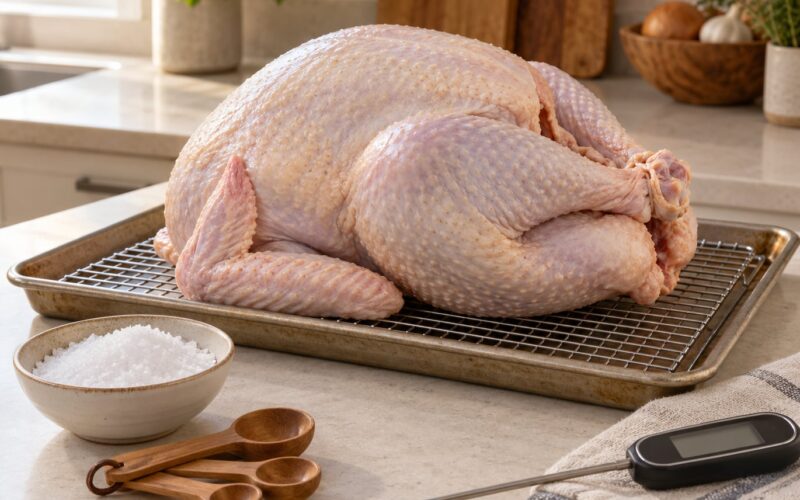
You also need a rimmed sheet pan for the vegetables, a couple of shallow serving dishes so everything goes out family-style, a digital thermometer, and a written timeline with real clock times on it.
One last tool matters more than people expect: an instant-read thermometer. Guessing at doneness is what turns a calm dinner into a stressful one.
Step-by-Step: Six Stages of a Self-Cooking Dinner
1. Choose a menu with one active recipe
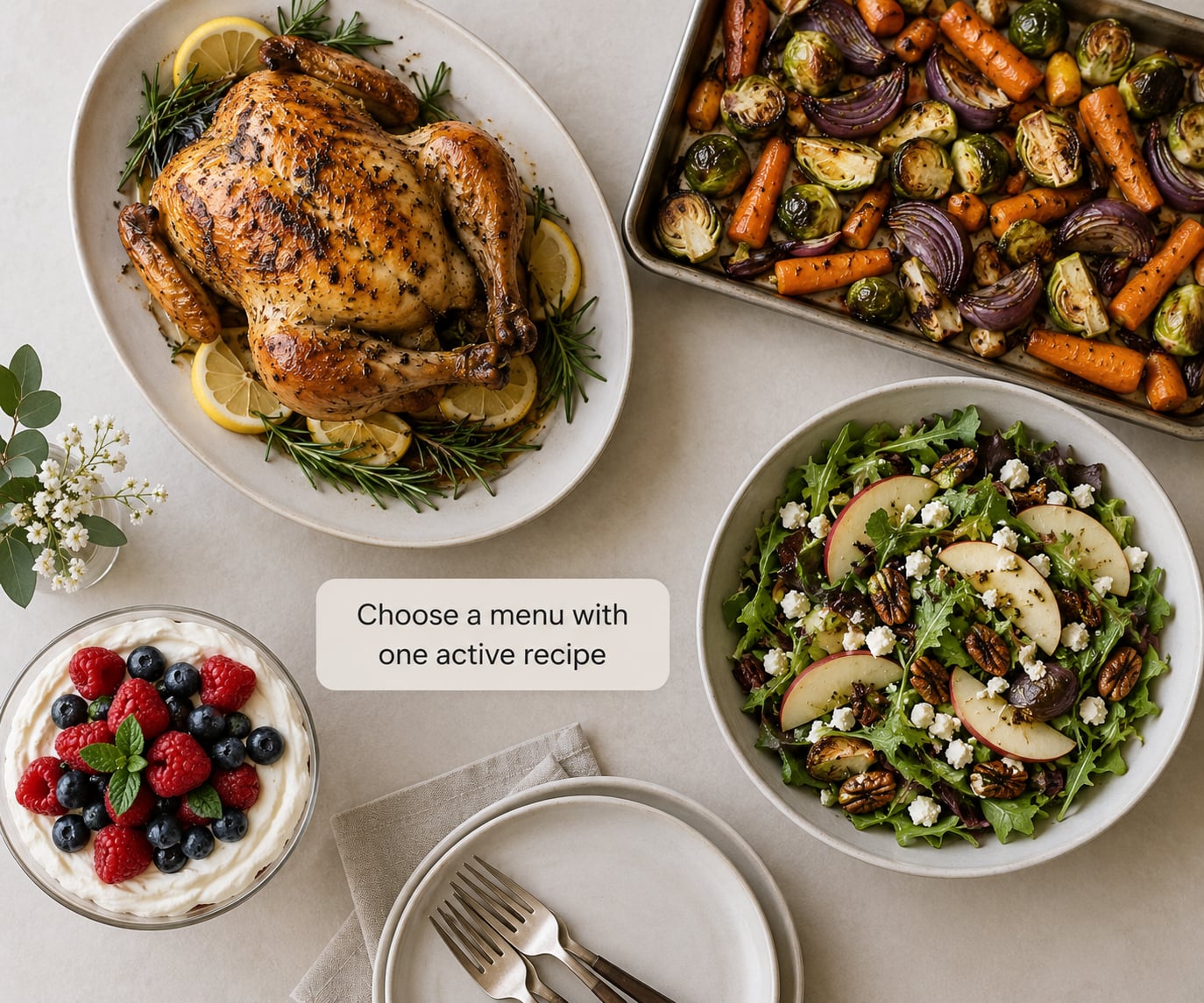
Choose the main first, because everything else has to fit around it. A good centerpiece for this style of cooking is one that is either fully unattended for over two hours or needs only a single stir.
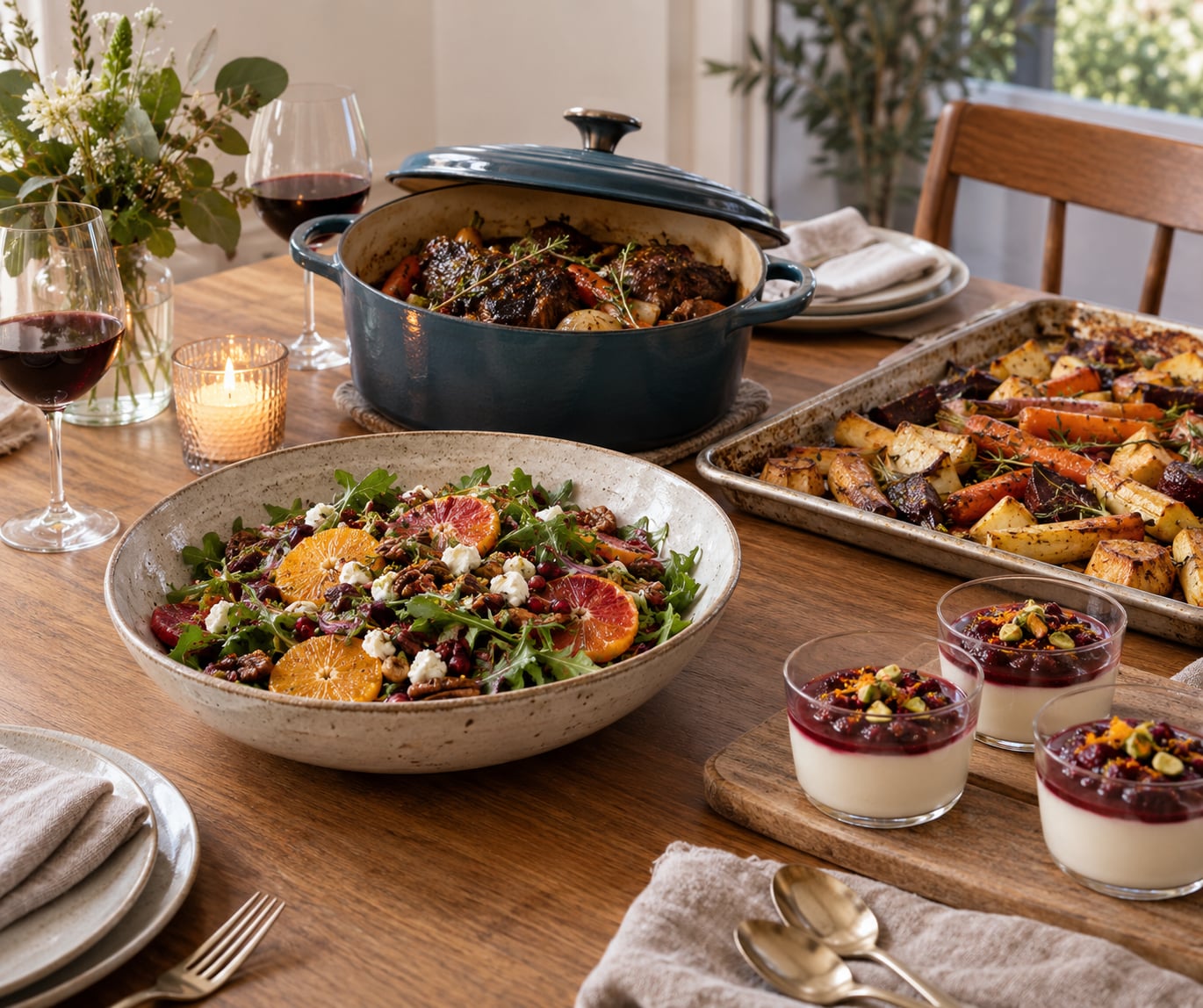
Balance it with a cold or room-temperature starter, a vegetable side that is already done when you sit down, and a dessert that is made entirely in advance. Here is a complete four-course example for six people:
- Arrival: sparkling wine and a bowl of salted Marcona almonds, set out before anyone rings the bell.
- Starter: a composed salad of shaved fennel, blood orange and toasted almonds with a lemon vinaigrette made the night before.
- Main: red wine braised short ribs at 325 F for two and a half to three hours, started before anyone arrives.
- Sides: root vegetables roasted the day before and reheated, plus creamy polenta made in the slow cooker that morning.
- Dessert: panna cotta set in the fridge for two days, served with a warm berry compote.
Notice what is missing. No second hot dish, no last-minute sear, no timed side that starts while the ribs are resting.
Honest limits matter here. Risotto needs stirring, grilled proteins need a hot start and fast service, and thin-crust pizzas need a stone and a very hot oven. Those are all good food. They just do not belong in a menu built around doing nothing for three hours.
2. Work backward from serving time
Decide the minute you want to sit down with a plate, then subtract. Pick 7:30 pm, and everything else falls into place.
| Clock time | Task | Why |
|---|---|---|
| 4:45 pm | Start the braise at 325 F | Two and a half to three hours unattended, and the pot holds heat for 20 once it is done |
| 6:45 pm | Pull the ribs out, skim the fat, rest them | Resting redistributes the juices; skimming is the only real work |
| 7:10 pm | Reheat the vegetables at 350 F | Lower heat keeps them from drying out |
| 7:20 pm | Spoon the polenta onto a warmed platter | Made earlier, held warm, finished with butter |
| 7:30 pm | Carry everything out | Nothing left to cook |
Bake in a 10 to 15 minute buffer. Carryover cooking means a roast continues to rise after it leaves the oven, and pulling it at exactly the stated minute usually lands you on the dry side of done.
For temperatures, use the food safety targets, not the recipe number. Poultry reaches 165 F (74 C) in the thickest part, ground meat 160 F (71 C), and whole cuts of beef, pork and fish 145 F (63 C) with a three minute rest.
3. Make two components the day before
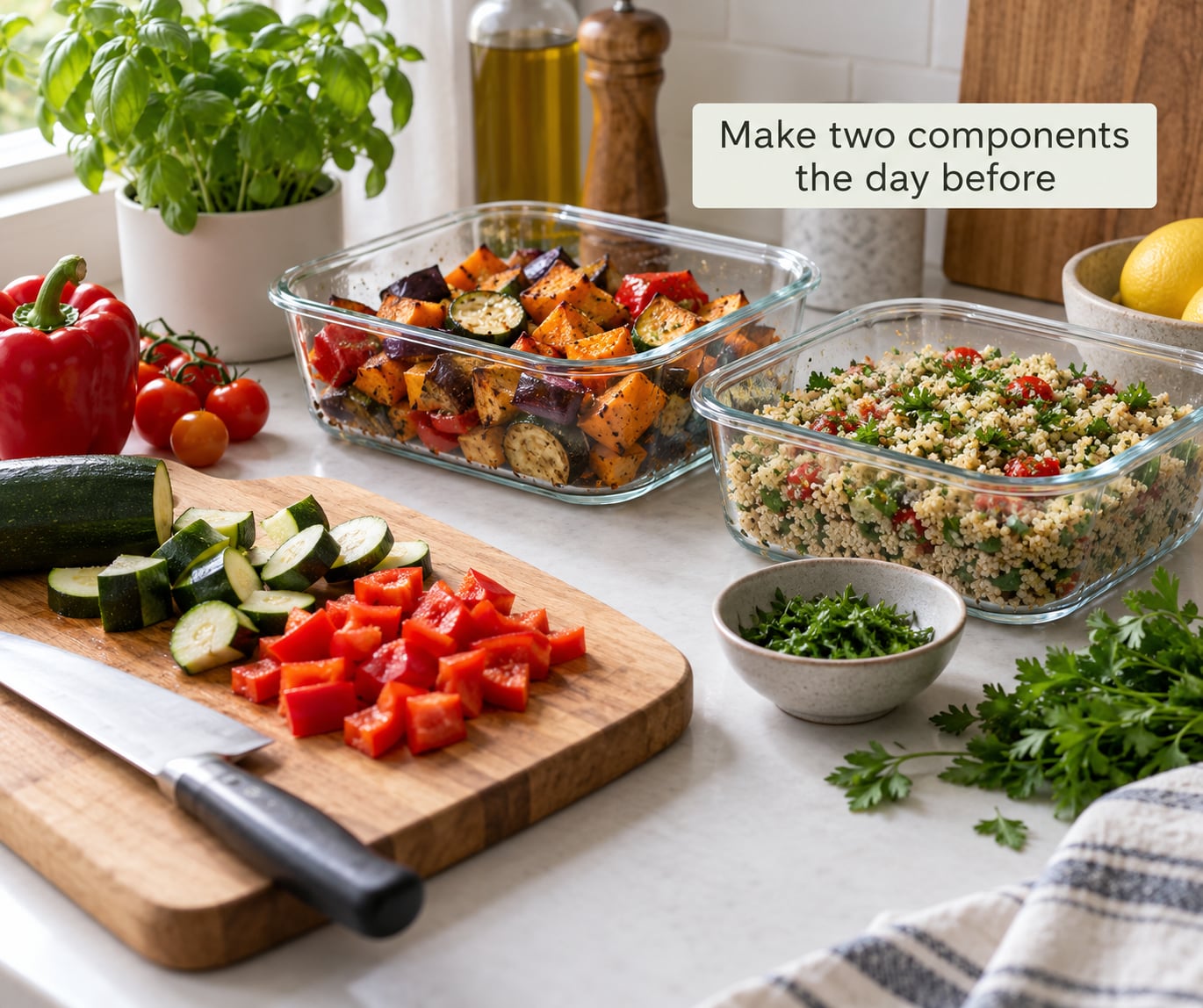
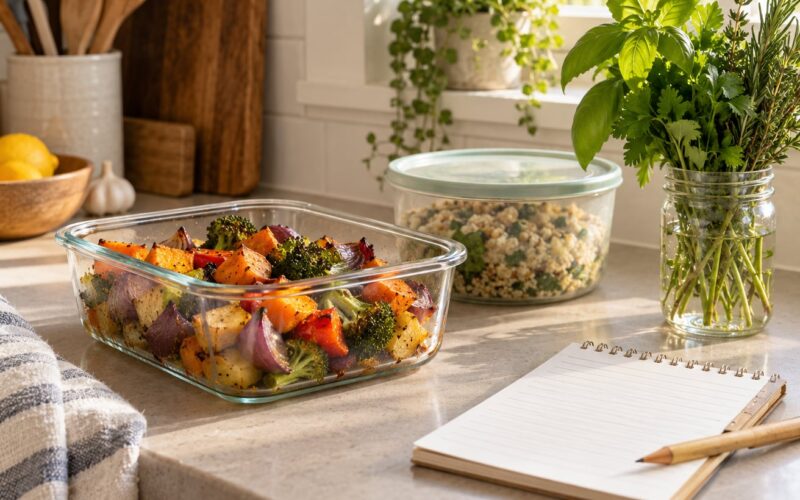
Pick two things that genuinely get better with a day in the fridge. Braises, soups and stews are the obvious ones. So are vinaigrettes, cured pickles, roasted vegetables and anything custard-based.
Cooked foods go into shallow containers, not deep tubs, so they cool fast. Cool them within two hours, and refrigerate most cooked dishes within three to four days. Desserts like panna cotta or a chilled chocolate tart can be built three days out with no problem at all.
Reheat in the oven or a skillet rather than a microwave whenever you can. A 350 F oven for 15 minutes brings a braise back to steaming without wrecking the texture. Add a splash of stock or water to sauces that have thickened overnight and cover them loosely.
The soggy-food list is short and worth memorizing: rice goes dry and hard, salad greens wilt, crisp breadcrumbs go soft, and pastry bottoms turn flaky-to-sad. Make those fresh, on the day.
4. Set the oven dishes in sequence so the menu cooks itself
Most home ovens have two working racks plus a broiler element and sometimes a third rack. That is enough for a main and a side, but only if the temperatures cooperate.
- Top rack, closer to the heat: roasting vegetables, anything that needs browning or crisping.
- Middle rack: the braise in its lidded pot, which needs gentle, even heat.
- Bottom rack: a sheet of something catching drips, or a dish that must stay crisp so it stays away from the wet heat.
The temperature conflict rule: if two dishes need different temperatures, run the hotter one first at its full heat, then drop the oven for the second. A roast chicken at 425 F for 25 minutes followed by a 325 F braise for two hours works fine. The reverse does not, because the braise will overcook waiting for the oven to come up.
Start the braise at T minus the total cook time minus the rest time. Start the vegetable tray near the end of the braise, not at the beginning, or you will be reheating something crisp that turned soft an hour ago.
If you own a slow cooker, use it to remove one dish from the oven equation entirely. That is the single easiest upgrade to this system.
5. Keep the final 30 minutes calm
Everything before this is prep. This part is service, and it runs on a list you write in advance and tape inside a cabinet door.
- Turn on the oven to 350 F and put the vegetable tray in, if it needs reheating.
- Take the cold starter out of the fridge 15 minutes ahead so it is not fridge-cold on the table.
- Put the polenta or potatoes back into the warm oven or covered pot.
- Check the braise with the thermometer. Skim the fat off the top and reduce the sauce if it is loose.
- Rest the main, then carve or spoon it into the warmed serving dish.
- Warm the plates in the switched-off oven for the last five minutes.
Serving family-style is what makes this work. Plating six individual meals while guests are at the door is how self-cooking menus turn into juggling acts, and it makes serving yourself feel generous rather than lazy.
For safe holding, keep anything hot above 140 F (60 C) in a chafing dish, a warmed slow cooker on low, or an oven turned down to its lowest setting with a pan covered in foil. Cold items stay out, on ice if they are creamy.
6. Use a simple cleanup plan
Cleanup is decided when you write the menu, not after the guests leave. Every extra pan on the list is a decision to wash something at midnight.
Count your pans when you plan. Most self-cooking menus for six work with one lidded braising pot, one sheet pan, a small saucepan for sauce, and a bowl you are not cooking in. The salad is a no-cook item and the dessert is already in the fridge.
Choose main dishes where the pan is oven-to-table, so there is no transfer and no foil-lined sheet to scrub. Roasted vegetables on the same sheet pan as the chicken thighs count as one pan, not two, as long as you give the vegetables enough space and cut them small enough to finish at the same time.
Two habits help. Put leftovers into containers within two hours of serving, before the table comes down, and set out a bus tub at the door so nobody offers to help while you are mid-dish.
Common Mistakes and the Fix for Each
Cooking three impressive dishes. Every extra hot dish adds a start time to track. Cut to one main, one make-ahead side and one cold dish. The food will taste more considered, not less.
Two oven dishes with conflicting temperatures. This is the most common self-cooking failure. Run the hotter dish first, then lower the oven for the longer braise, and start timing from when the door closes.
A side dish that finishes after the main. Reheat the side while the main rests. Resting is free time you should be spending on the oven at 350 F, not on a skillet at full heat.
Leaving cooked food out while you greet people. Two hours at room temperature is the limit, and it includes everyone’s conversations. Anything sitting out goes back into the fridge or onto a warmer before you sit down.
Cooking something for the first time on party day. Do a trial run of the main a week ahead at half scale. Cook for two instead of for eight and learn exactly where the recipe fails. You want surprises on the weekend, not on a Tuesday.
Ignoring the dietary question. Ask when you send the invitation, not at the door. And build the accommodation into the menu rather than bolting on a side dish, which means making the braise vegetarian-friendly from the start if you know one guest is coming.
A few hosting details are worth the ten minutes. Set the table before the oven goes on. Put a candle out and something cold to drink within the first two minutes of arrival, because guests who are drinking are guests you are not cooking for. And build one interactive element in, like a bruschetta board or a bowl of tomatoes everyone can salt at the table.
Frequently Asked Questions
What does a self-cooking dinner party menu mean?
It means a menu with at most one dish that needs attention in the final hour. The centerpiece is usually an oven braise, slow cooker dish, sheet pan roast or one-pot meal that runs unattended for two to four hours. Everything else is a make-ahead component or a cold course that is already finished when guests sit down, so the host is pouring drinks instead of watching a stove.
How far in advance can I prepare a dinner party menu?
Most braises, soups and stews can be cooked one to two days ahead and they usually taste better for it. Cold desserts like panna cotta, chilled custard and most cookies can be built two to three days ahead. Roasted vegetables, vinaigrettes and pickles also travel well for a day. Reserve the fresh components, meaning salad leaves, breadcrumbs and pastry, for the day itself.
How do I cook two oven dishes at the same time?
Use rack position and timing together. Put the dish that needs high heat and crisping on the top rack, and the gentle braise on the middle rack. If the temperatures differ, cook the hotter dish first for 20 to 30 minutes, then drop the oven to the lower temperature for the longer braise. Avoid crowding, because a full pan steams rather than roasts.
What can I make ahead and reheat without becoming soggy?
Braises, stews, soups, curries, macaroni and cheese, and roasted vegetables all reheat well. Cover them when reheating in a 350 F oven so steam keeps them moist, and add a splash of liquid to anything that thickened overnight. Leave out rice, salad greens, crisp toppings and pastry, which are best made fresh on the day.
How do I keep food at a safe temperature while guests arrive?
Keep hot dishes above 140 F, which means a warmed slow cooker on low, a chafing dish, or your oven turned to its lowest setting with the dish covered in foil. Cold items can sit out in shallow bowls and can be set over ice if they are creamy. Whatever is left over goes into the fridge within two hours of being served.
What is the easiest dinner menu for first-time hosts?
A slow cooker main, a make-ahead grain or potato side, and a dressed salad is about as close to foolproof as it gets. Pick a recipe you have made at least once before, or trial it a week early at half scale. Put out drinks and snacks the moment guests arrive so nobody is standing in your kitchen asking when dinner is.
Conclusion
Planning a dinner party menu that cooks itself comes down to a single decision: pick one long, unattended centerpiece and let every other course be finished before the guests sit down. A braise, a slow cooker dish or a sheet pan roast handles the heat. A composed salad and a dessert from the fridge handle everything else.
Then write the timeline backward from your serving time, and treat the thermometer as the authority rather than the recipe clock.
Start tonight by choosing one make-ahead side you are confident cooking, and put the serving time on paper. Everything after that is arithmetic.