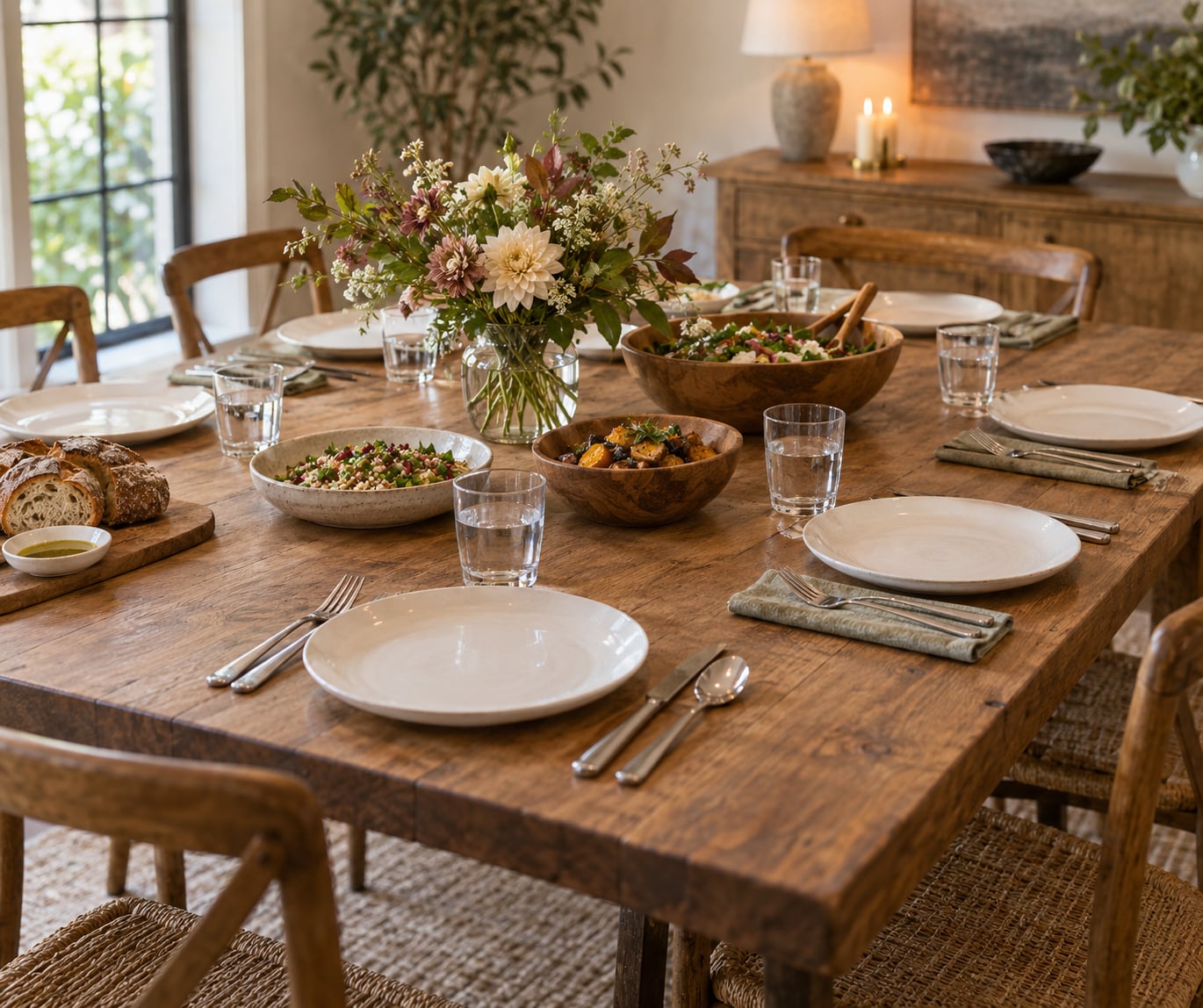
A good casual table setting is short: a dinner plate centered at each seat, a fork on the left, a knife and spoon on the right with the blade facing the plate, a napkin, a water glass above the knife, and one low centerpiece in the middle. Set only the utensils you will actually use, and you can do the whole thing in about 20 minutes.
There is no wrong version of this. Guests read the table, not a rulebook, and they will happily reach for the serving spoon you put on the wrong side. The point of setting a table for a casual dinner party is to give everyone a place to sit, something to eat off, and a clear path to the shared dishes — not to impress anybody.
What follows is the order I use every time, the placement rules that actually matter, and the mistakes that trip people up most.
Table of Contents
- What You Need for a Casual Table
- How to Set a Table for a Casual Dinner Party Step by Step
- How to Choose a Simple Place Setting
- How to Arrange Food and Drinks for Sharing
- How to Make the Table Feel Welcoming
- Common Table Setting Mistakes to Avoid
- Frequently Asked Questions
- Do I need a tablecloth for a casual dinner party?
- Where do the water glass and napkin go on a casual setting?
- How far apart should plates be when setting a table?
- How tall should a dinner party centerpiece be?
- Can I set the table the night before guests arrive?
- What serving utensils do I need for a family-style dinner?
- Conclusion
What You Need for a Casual Table
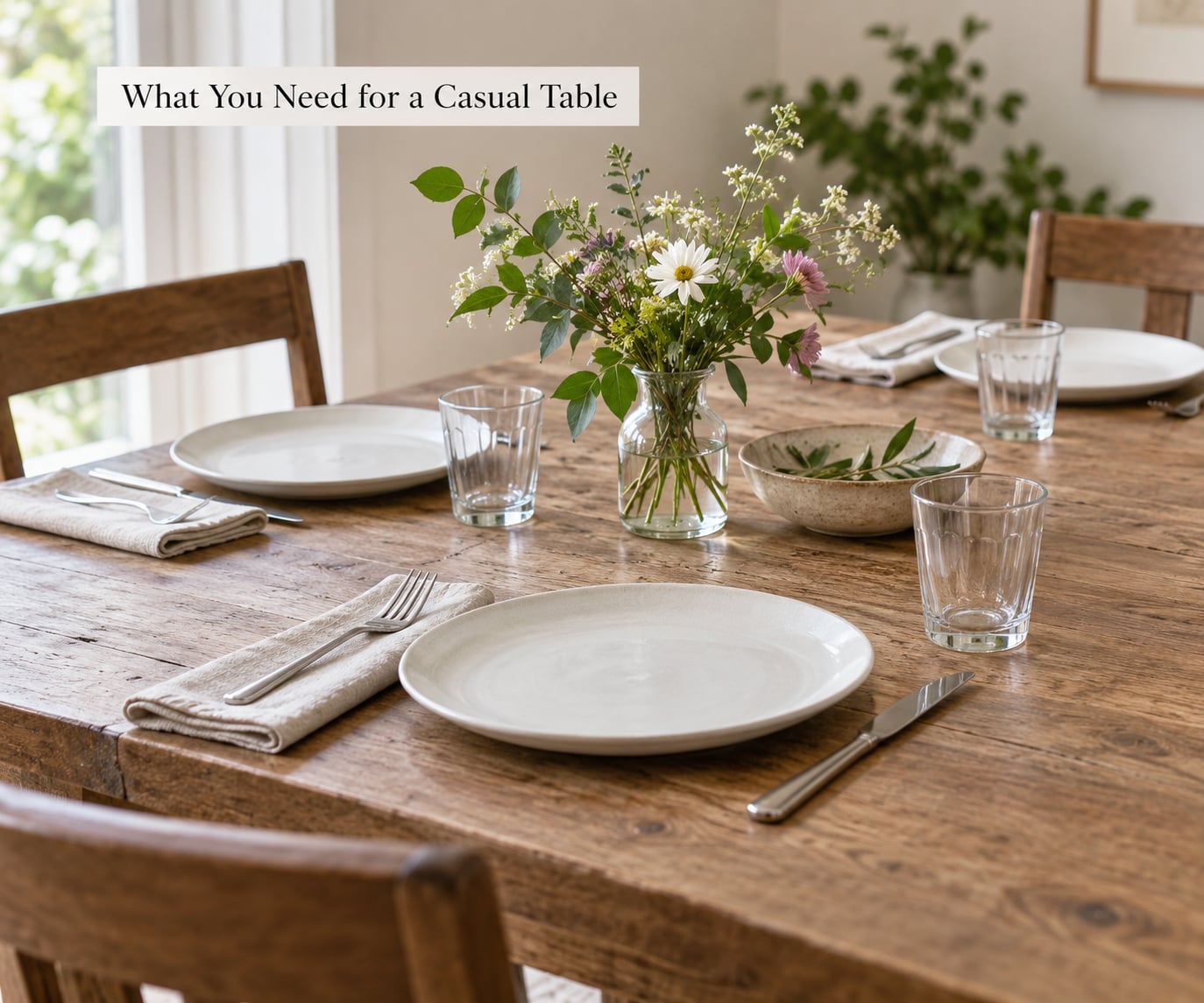
Most of this you probably already own. A full place setting for a casual dinner is a dinner plate, a fork, a knife, a spoon, a napkin and one water glass. If you are serving a salad, add a smaller fork above or beside the dinner fork. Skip everything else until the menu demands it.
Beyond the per-guest settings you need:
- Base layer — a tablecloth, a runner, or bare wood with placemats. All three are fine. Placemats should sit about an inch in from the table edge.
- Shared serving pieces — one bowl or platter per dish, plus a serving utensil for each one. A big salad needs two spoons so two people can serve at once.
- Extra flatware — one full set of forks, knives and spoons in a stack near the serving dishes, for anyone who drops a fork mid-meal.
- Serving boards and trivets — a wooden board for bread, a small mat under a hot dish if you want to protect the wood.
- One low centerpiece — a small vase, a bowl of fruit, or a few candles. Under 12 inches tall, ideally.
- A side table — for drinks, extra flatware, and bread. Very useful if your dining table is small.
You do not need a matching set. Mismatched stoneware reads as relaxed and collected; nobody will notice that the salad bowls came from a different house than the plates.
How to Set a Table for a Casual Dinner Party Step by Step
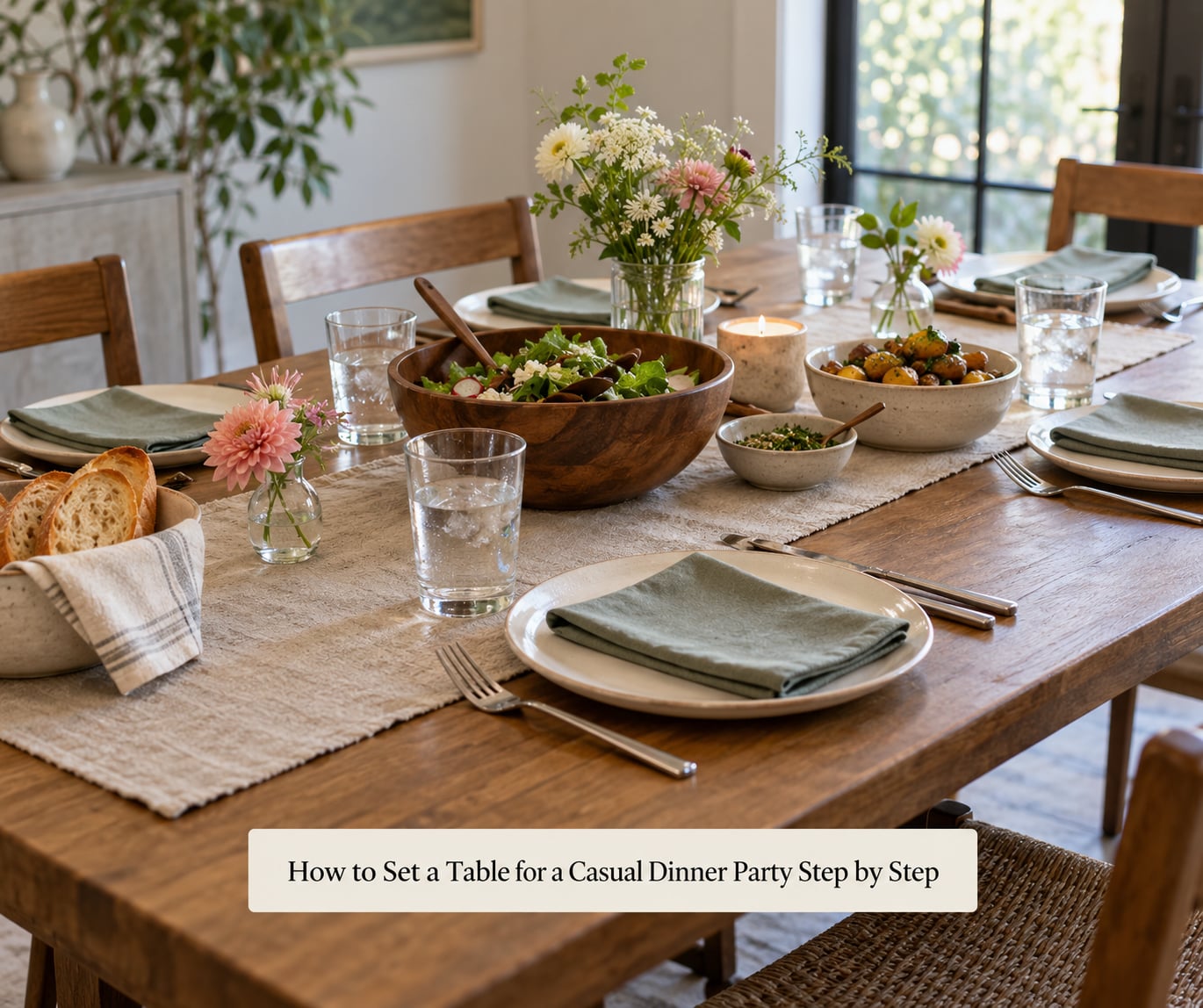
Work in this order and the table builds itself from the bottom up: base layer, dinnerware, flatware, napkins, glassware, shared food, then the centerpiece. Start at one end of the table and move down it rather than jumping around — you will keep the spacing consistent, which is the thing your eye notices when a table looks off.
Give each guest 18 to 24 inches of table width. With less than that, plates crowd and elbows fight, and the whole table feels cramped no matter how nice the dishes are.
How to Choose a Simple Place Setting
Center the dinner plate — 10 or 11 inches across is the standard range — about an inch in from the table edge, with the chair pulled out slightly. Fork to the left, closest to the plate. Knife to the right, blade facing inward toward the plate. Spoon to the right of the knife, or on the outside if you serve dessert with a spoon.
Add a salad fork only if a salad is part of the meal, placed above the dinner fork or just inside it. Add a dessert fork and spoon now only if you are plating dessert at each seat; most casual hosts bring them out with the course instead.
You will know the place setting is right if you can pick up the fork, use the knife, drink the water, and set the whole thing down without looking at your hands.
How to Arrange Food and Drinks for Sharing
Put the shared dishes in the middle, starting with the plate or bowl people will reach for most, and work outward. Space them a few inches apart so two hands can fit. Put the utensil for each dish beside or across that dish, not in a pile in the center — a slotted spoon for vegetables, a ladle for soup, a carving set for a roast, a cake server for dessert.
Drinks go where everyone can reach them without standing. A water glass at each place setting is simplest, and a carafe on the table refills it. If the table is tight, move drinks to a side table and let guests pour their own — that is a small sign of hospitality, not an inconvenience.
Keep the extra flatware, extra napkins and the bread within easy reach but off the eating surface. If a dish is a spill risk, put it on a trivet or folded towel.
One note on the menu: one-dish, shareable food keeps a casual table uncluttered. A table set beautifully and then buried under six serving dishes is just a serving table with plates around it.
How to Make the Table Feel Welcoming
Three restrained touches are plenty. Cut flowers or a small fruit bowl in the middle, kept low enough that people can see each other across the table. A few unscented taper candles or tealights — unscented, so nobody has to smell them through the roast. And name cards at each place, which is the one truly formal touch that still feels friendly.
A runner down the center of the table gives the surface some structure without committing you to a full cloth. Mismatched everyday dishes with a shared color in the napkins or glasses tie a loose set together more cheaply than buying anything.
Dim the overhead light. A warm lamp or a few candles do more for a casual table than any amount of matching stemware.
Common Table Setting Mistakes to Avoid
Overcrowding the table. The most common one by a distance. If plates are touching or the serving dishes are landing on top of water glasses, the table is too full — cut a course, or move the drinks to a side table.
A tall centerpiece. Anything over 12 inches turns dinner into a shouting match across the table. Keep it low, or put flowers on a console table instead.
Setting knives blade-out. Blades face inward toward the plate. It looks careless and it catches sleeves.
Adding formal pieces you will not use. A fish fork for a lasagna, a wine glass for a pitcher of lemonade, a charger plate under everything. Set what the meal requires and nothing more — this is the rule that makes casual setting simple.
Placing shared dishes badly. Put the dish people will want first nearest the empty seats, and never let a platter sit so close to an edge that a passing elbow sends it off. Family-style service has no fixed rule, so put the food where hands naturally go.
No plan for clearing between courses. Decide now where dirty plates go — usually a bus tub or the counter — so nobody stacks a used plate on an empty chair.
Forgetting the drinks. A table set perfectly with nowhere to pour a glass is the classic beginner error. Put the carafe or pitcher on the table before guests arrive.
Waiting for guests to tell them where to sit. With a small group, simply say “sit anywhere” and let them choose. With a larger table or one with a guest who has mobility limits, place them first and seat them where leaving is easy.
Frequently Asked Questions
Do I need a tablecloth for a casual dinner party?
No. A bare wood table, a runner, or placemats all work for a casual dinner. A full cloth adds ceremony you probably do not want, and it hides the wood that makes a home table feel warm. If you are using a cloth, still lay placemats or at least a runner so the plates have something to sit on, and keep the base layer neutral so your plates and food stay the focus.
Where do the water glass and napkin go on a casual setting?
Put the water glass above the knife blade, near what hosts call the 1 o’clock position relative to the plate. A wine glass, if you are serving wine, goes to the right of the water glass and slightly back. For the napkin, lay it on the left of the fork, or fold it loosely and rest it on the dinner plate. On a casual table, any of those three is accepted.
How far apart should plates be when setting a table?
Leave 18 to 24 inches of table width per guest, measured edge to edge. That is enough room for plates, elbows and a couple of shared dishes in the center. In practice it means your dinner plates should not touch and there should be a clear hand-width between neighbors. If you are under that, move the drinks and bread to a side table rather than squeezing everyone in.
How tall should a dinner party centerpiece be?
Keep it under 12 inches, and lower is better for a seated dinner. A guest should be able to see the person across the table without leaning. Small vases, a shallow bowl of fruit, a cluster of tealights, or a low bunch of flowers all work. If you have tall flowers, arrange them in the kitchen or on a side table instead of the middle.
Can I set the table the night before guests arrive?
Mostly yes. The base layer, placemats, plates, flatware and glasses can all be set the night before if your kitchen is cool and the glasses are dust-free. Add the centerpiece, candles and flowers the day of, and fill the water glasses right before guests sit so they are not warm. Refrigerated food on the table is the only thing worth waiting on.
What serving utensils do I need for a family-style dinner?
One utensil per shared dish: a slotted spoon for vegetables, a large spoon for casseroles and potatoes, a ladle for soup, a carving set for a roast, a cake server for dessert, and a separate spoon for anything with dressing. Put a couple of extra spoons in with the salad, since a single spoon guarantees a queue at the bowl.
Conclusion
Start with the table surface. Set one complete place setting — plate, fork, knife, spoon, napkin, water glass — and then repeat it down the table, leaving 18 to 24 inches per guest.
Next put the shared dishes in the middle with a serving utensil beside each one, and make sure drinks are reachable from every seat. Only then add flowers, candles and name cards, keeping the centerpiece low.
That is the whole job. Everything past it is decoration, and decoration is the part you get to change every time.