You do not have to stir risotto constantly. Add all the hot broth at once, cover the pot, let it simmer untouched for 15 to 18 minutes, stir twice, then stir for 3 to 5 minutes at the end to pull the starch together and finish the sauce.
Hands-on time drops from about twenty-five minutes of near-constant spoon work to roughly five. I teach this to people who thought risotto was a job for the whole dinner, and it has not failed me yet. The honest trade-off: fully stirred risotto is a touch silkier, so a no-stir batch lands slightly looser and a hair more toothy.
For most of the last decade the advice was the opposite. Cooks on kitchen forums called constant stirring overkill and completely unnecessary, and home cooks reported dumping nearly all the liquid in at once with the lid on and getting an equally good result. Carnaroli rice gets recommended by experienced cooks specifically because it asks so little of you.
Here is the method as I actually do it at home, with the timings written down so you can follow it once and then stop looking at a clock.
Table of Contents
- What You Need
- Step-by-Step
- How to Make Risotto Without Stirring Constantly
- Toast the Rice Without Burning It
- Add Warm Broth in Small Batches
- Stir Less, but Keep the Pan Moving Occasionally
- Finish Off the Heat
- Common Mistakes
- Frequently Asked Questions
- Do you really need to stir risotto constantly?
- Why does risotto need to be stirred at all?
- How long does no-stir risotto need to simmer?
- Should you stir risotto or not?
- Can I make risotto with regular long-grain rice?
- Is oven-baked risotto as good as stovetop risotto?
- Conclusion
What You Need
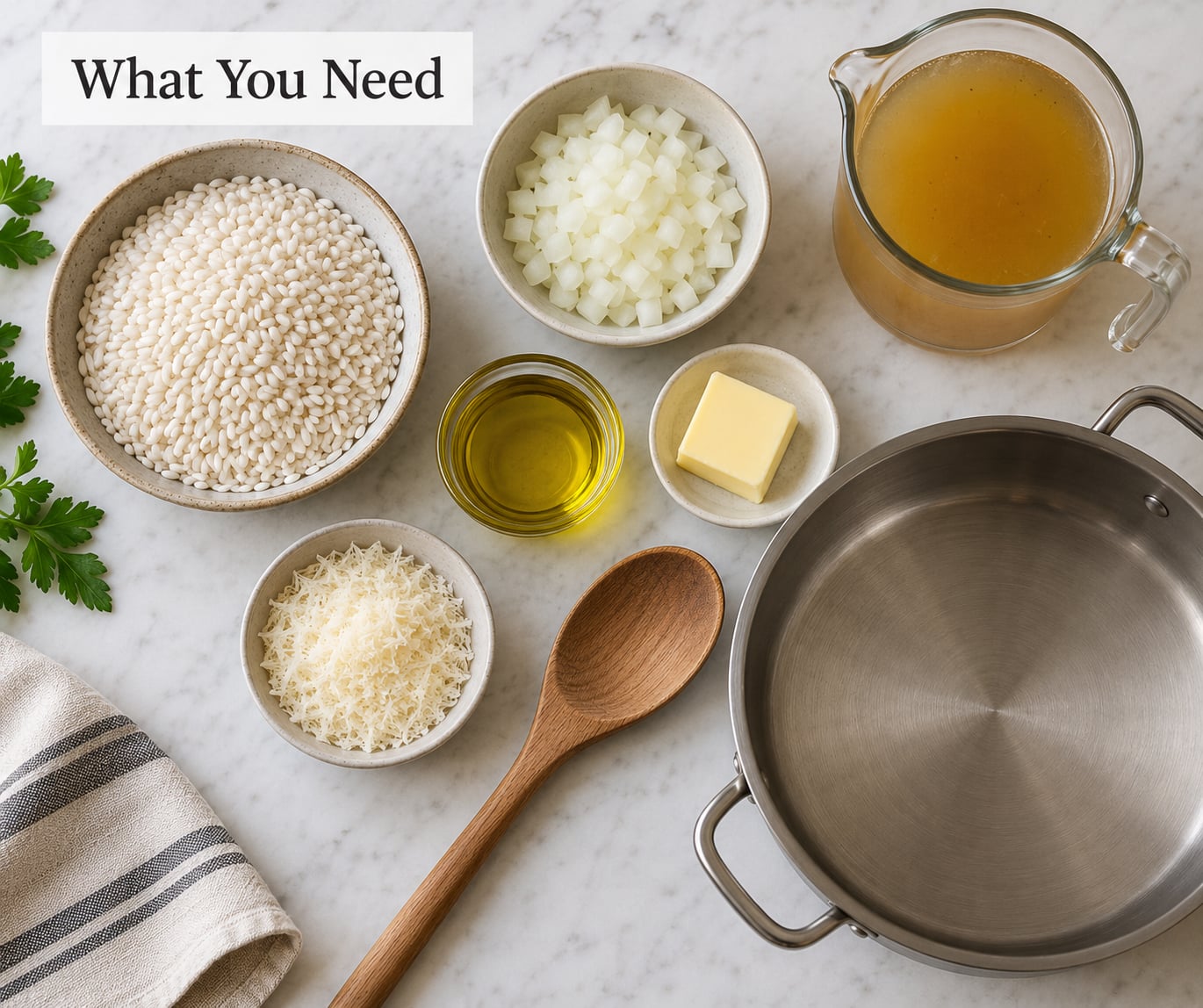
The equipment list is short, and the only item that genuinely changes the outcome is a pot with a tight-fitting lid. Everything else is a supporting role.
- Rice: 1.5 cups (about 300 g) short-grain risotto rice. Carnaroli first choice, arborio fine.
- Broth: 5 cups (about 1.2 L) homemade or store-bought, kept at a bare simmer. Hold back a cup to finish.
- Fat: 2 tablespoons olive oil or butter for the pan, plus 4 tablespoons cold butter cubed for the finish.
- Aromatic: 1 small onion or 2 shallots, finely diced (about 100 g).
- Wine: 1/2 cup dry white wine.
- Cheese: 3/4 cup grated Parmigiano Reggiano, plus more at the table.
- Seasoning: salt, black pepper, and a small splash of good olive oil to finish.
- Optional: saffron threads bloomed in warm broth, sliced porcini, lemon zest, a knob of butter with herbs.
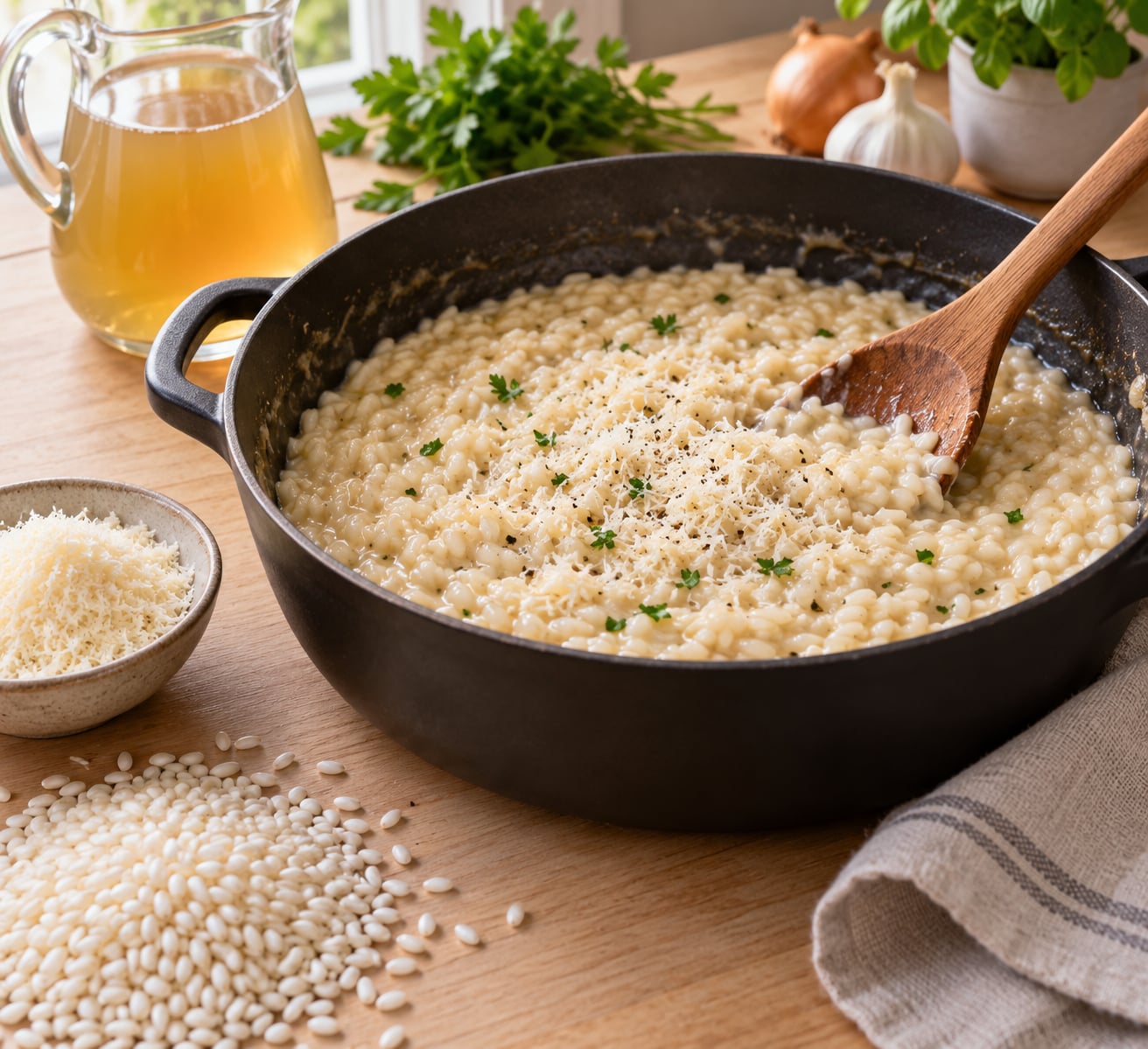
You also need a Dutch oven or heavy 4 to 6 quart pot with a lid that actually seals, a wooden spoon, and a ladle. A second pan to hold the broth at a simmer is useful, though a kettle of hot water plus a bouillon cube works just as well if you would rather not wash one more dish.
Rice choice matters more here than in the traditional method, because the no-stir method leans on starch rather than on your spoon to release it. Carnaroli has more surface starch and holds a firmer centre than arborio, which is why experienced cooks recommend it for hands-off cooking. Arborio works, but expect a slightly softer, creamier result and shorten the covered simmer by two minutes.
Long-grain rice is a different food. The kernels stay separate and release almost no starch, so you get well-cooked rice sitting in broth rather than risotto. If that is all you have, make rice and spoon broth over it instead.
Before you pick a method, it helps to see them next to each other. Hands-on time is what you actually spend at the stove with a spoon; total time runs from pan to plate.
| Method | Hands-on time | Total time | Texture | Best for |
|---|---|---|---|---|
| Dutch oven, covered on the stove | About 5 minutes | About 30 minutes | Creamy with a slight bite | A weeknight dinner you still want to call risotto |
| Oven-baked at 400F, covered | About 5 minutes | About 55 minutes | Soft, looser, forgiving | Cooking for a crowd or guests in the room |
| Multicooker at high pressure | About 3 minutes | About 15 minutes | Softest and creamiest | The fastest route to a creamy bowl |
| Wide skillet, covered | About 6 minutes | About 25 minutes | Looser, good for small batches | Two portions and one pan to wash |
| Ladle method, traditional | 20 to 25 minutes | About 30 minutes | Silkiest | When you want the closest match to restaurant texture |
Step-by-Step
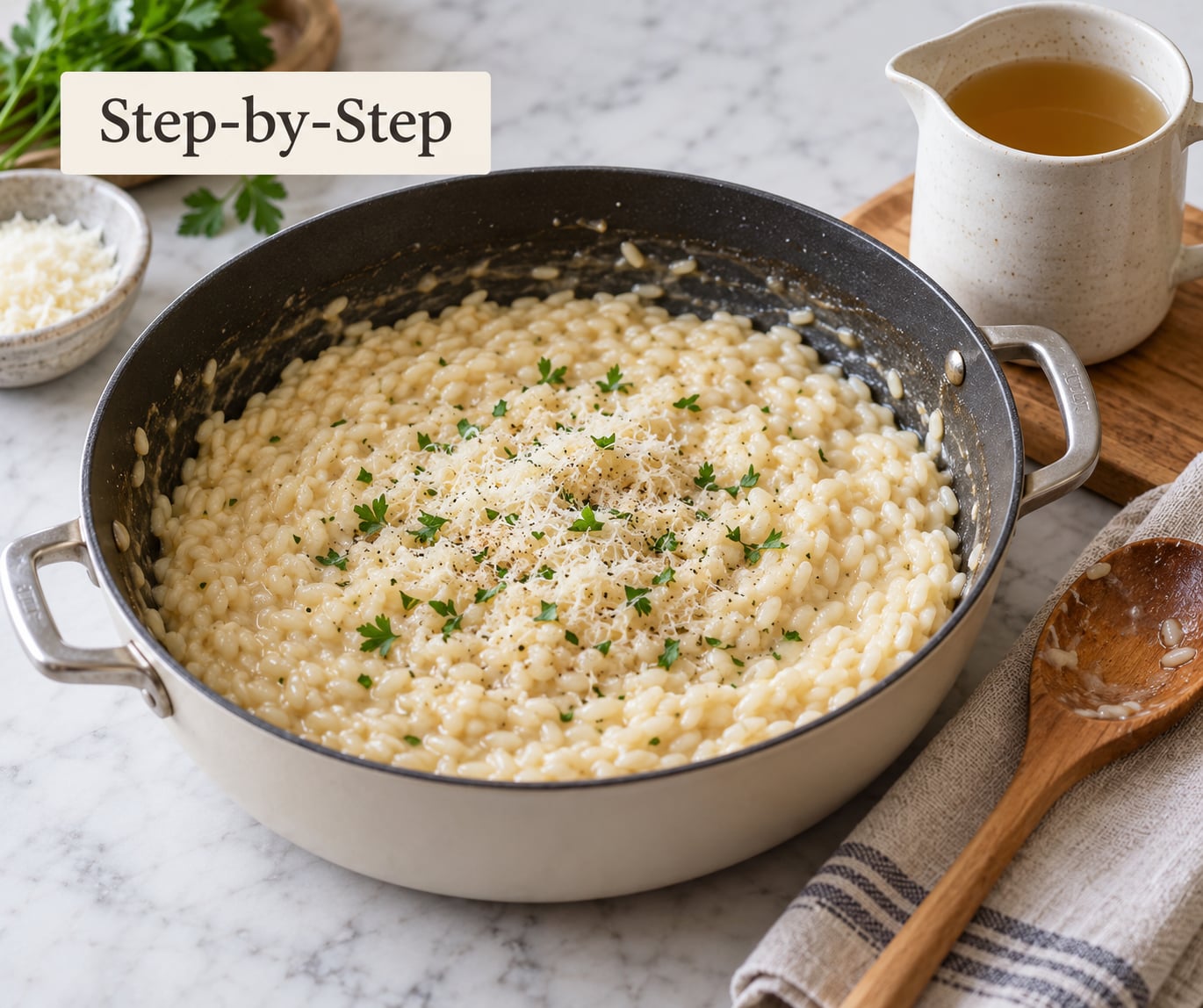
The whole method rests on four moves: toast the rice, add the hot broth in one go, keep the lid on while it simmers, and do the real stirring only at the end.
How to Make Risotto Without Stirring Constantly
Start with the broth at a bare simmer, toast the rice until the edges turn translucent, pour in every cup of hot broth at once, and cover. Two stirs during the covered simmer plus three to five minutes of steady stirring at the end is the whole schedule.
- Warm the broth. Bring 4 cups to a bare simmer in a second pan and keep it there. Cold broth drops the temperature of the pan, the rice stalls, then the liquid catches up and boils hard, which is the single biggest cause of gummy centres.
- Soften the aromatics. Heat 2 tablespoons of oil or butter in a heavy pot over medium heat. Cook the onion with a pinch of salt for 3 to 4 minutes until soft and translucent, not browned.
- Toast the rice. Add the rice and stir for about 2 minutes until the grains look chalky white in the centre with a clear, glassy edge. This step builds flavour and creates an even coating for starch.
- Deglaze. Pour in the wine and scrape whatever caught on the bottom. Let it cook away almost completely, about 2 to 3 minutes, so the pan is not suddenly swimming in alcohol.
- Add all the broth and cover. Pour in the 4 cups of simmering broth at once, stir once to level the rice, cover tightly, and bring back to a bare simmer. Drop the heat to the lowest setting so you see a bubble every second or two.
- Stir twice while covered. At the 8 minute mark, lift the lid and stir, scraping the base where a thin starchy layer forms. Cover again. At 16 minutes, stir a second time and look at the rice. Total covered time runs 15 to 18 minutes.
- Uncover and finish for 3 to 5 minutes. Take off the lid and stir steadily but gently until the liquid turns glossy and pulls around the grains. Taste one: al dente means a slight bite in the very centre, not soft all the way through.
- Rest, then beat in butter and cheese. Cover and sit for 2 minutes off the heat. Beat in 4 tablespoons of cold butter and 3/4 cup of grated Parmigiano, hard, until the risotto turns creamy and loose. Add a splash of the held-back broth if it stiffened while resting, and serve straight away.
What you are looking for at the end is all’onda, a loose wave. Tip the pan and the risotto should slide and spread across the surface in a slow sheet rather than sitting in a firm mound. If it holds its shape, it is too tight.
Toast the Rice Without Burning It
Toasting takes about 2 minutes on medium heat and the whole method depends on doing it right. The grains should look chalky white in the middle and translucent around the edge, which tells you the surface starch has warmed without the interior cooking.
Too dark and the flavour turns nutty in a bad way; scorched fragments will haunt the whole pot. If the rice starts to smell of smoke, lower the heat and keep moving rather than pouring it out. One minute on the edge of the burner, off for thirty seconds, then back on is a decent rescue.
Add Warm Broth in Small Batches
Small batches are for cooks who like the rhythm of the ladle method but not the strain of stirring. Add about 1 cup at a time, wait until each addition is mostly absorbed, then stir briefly rather than continuously.
The measure stays the same: roughly 3 cups of hot broth for every cup of dry rice. With small additions you do need to stir more often, because the exposed surface evaporates and grabs. Two stirs per cup, and scrape the base each time.
Stir Less, but Keep the Pan Moving Occasionally
During the covered phase, twice is enough. In the final uncovered minutes, stir every 30 to 60 seconds with a slow folding motion rather than a frantic circular one, and scrape along the bottom where starch settles.
You know the starch is releasing when the liquid turns from clear to lightly cloudy and coats the back of the wooden spoon. A gentle tap of the spoon against the side of the pan, then a slow run of the grains down, is the classic all’onda test.
Finish Off the Heat
The pan comes off the heat before the cheese goes in. Butter and Parmigiano emulsify with residual heat and the starch already in the pan, so adding them to a hot burner simply melts into a greasy puddle.
Beat in the butter first, then the cheese in two additions, and keep beating until the mixture turns pale and glossy. Resting for a minute or two lets the starch finish hydrating. Then loosen and serve.
Common Mistakes
Almost every failed no-stir risotto traces back to one of nine things.
- Cold broth. It shocks the pan, the rice stalls, then the mixture boils hard and turns gluey. Keep the broth at a bare simmer the whole time you cook.
- Heat too high. A rolling boil breaks starch into paste and the bottom of the pot browns. Bring to a simmer, then set the heat to its lowest setting.
- Lid off. Evaporation concentrates the starch too quickly and the rice grabs the pan. Lid on for the entire covered stage, off only for the last 3 to 5 minutes.
- Too much liquid. The result is loose and soupy. Measure about 3 cups of broth per cup of rice and hold the rest back for the finish.
- Too little liquid. You get a crunchy middle, hard edges and a scorched base. Add half a cup of hot broth, cover, give it 3 minutes and check again.
- Cheese added too early. Added before the rice is fully cooked, it clumps into strings. Cheese goes in off the heat, in two additions.
- Serving immediately. The pan keeps cooking and the risotto thickens into glue on the plate. Rest it covered for 2 minutes first.
- Skipping the toast. You lose the nutty base and the grains cook unevenly. Two minutes, medium heat, until the edges look glassy.
- Using long-grain rice. The kernels stay separate and give up almost no starch. It will not behave like risotto no matter how gently you cook it.
When the pan goes wrong despite everything, the fix is usually small and quick.
| Problem | Cause | Fix |
|---|---|---|
| Too thick, holds a mound | Too much cooking time or not enough liquid at the end | Beat in a ladle of warm broth until it spreads; a minute on the lowest heat helps too |
| Too thin, soupy | Broth added faster than the rice absorbed it | Uncover on low heat and stir for 3 to 5 minutes until the surface starts to skin over slightly |
| Gummy or mushy | Rice cooked past al dente, or the pan boiled too hard | Cannot be undone; next time shorten the covered time by 2 to 3 minutes and keep the heat lower |
| Crunchy in the middle | Heat too low or the pot too deep and narrow | Add half a cup hot broth, cover, 3 minutes, then stir firmly to release the centre |
| Scorched bottom | Too much heat and too little movement at the end | Serve the top portion, and switch to a wider, heavier pot next time |
Two more notes worth keeping. Extra risotto keeps three to four days in the fridge; loosen it with about a quarter cup of warm broth per cup and reheat gently, stirring, until it reaches 165F and steams. A freezer bag laid flat keeps it for a couple of months if you portion it first.
For cooking alongside, risotto wants something with acid and heat. Roast chicken thighs, seared salmon, or a plate of braised greens with lemon all cut through the richness.
Frequently Asked Questions
Do you really need to stir risotto constantly?
No. Add all the hot broth at once, cover the pot, and simmer on low for 15 to 18 minutes, stirring only twice. Then uncover and stir for 3 to 5 minutes to release the starch and finish the sauce. Constant stirring is a habit from restaurant kitchens, not a requirement of the dish.
Why does risotto need to be stirred at all?
Stirring does four real jobs: it releases surface starch from the grains, stops the rice sticking to the base of the pan, distributes heat so the middle cooks as fast as the edge, and loosens the sauce as it thickens. Creaminess comes from amylopectin starch leaving the rice on its own, so a covered pot gets most of that for free.
How long does no-stir risotto need to simmer?
Plan for 15 to 18 minutes covered at a bare simmer, stirring once at the 8 minute mark and once at the 16 minute mark. Then take off the lid for 3 to 5 minutes of steady stirring. Arborio usually finishes a couple of minutes sooner than carnaroli, so start tasting before you trust the clock.
Should you stir risotto or not?
Stir it, but not constantly. Continuous stirring for 20 minutes is overkill, and so is never touching it. Two stirs during the covered simmer plus gentle stirring every 30 to 60 seconds during the final uncovered minutes gives you the creaminess without turning dinner into a second job.
Can I make risotto with regular long-grain rice?
Not properly. Long-grain kernels stay separate and release very little surface starch, so you end up with cooked rice in broth rather than a creamy risotto. Short-grain Arborio or Carnaroli is the ingredient that makes the method work. If long-grain is all you have, cook it normally and spoon hot broth over it instead.
Is oven-baked risotto as good as stovetop risotto?
It is softer and looser, and that is the trade. Baked at 400F and covered for about 45 minutes, it frees you from the stove completely, which is why people cooking for a crowd or hosting guests choose it. Stovetop risotto with two stirs keeps more bite and more of that loose, flowing texture.
Conclusion
Toast the rice for 2 minutes so the edges look glassy, pour in every cup of hot broth at once, cover the pot and drop the heat to a bare simmer. Stir twice over 15 to 18 minutes, then uncover and stir for 3 to 5 minutes until glossy.
Off the heat, beat in cold butter and grated Parmigiano, rest the pan covered for 2 minutes, and loosen with a splash of broth if needed. That is the whole no-stir risotto method, and once you have it in your hands you will not go back to the standing-at-the-stove version.