Store potatoes and onions separately, in cool, dark, dry, well-ventilated places, and never in plastic. Potatoes want around 45-50°F with some humidity and no light; onions want 45-55°F, dry air and moving air. The whole job takes ten minutes once, and it is the difference between vegetables lasting two weeks and vegetables lasting two months.
Most spoilage I see in a home kitchen comes down to three things: light, trapped moisture and a cupboard that is too warm. Get those right and both vegetables mostly look after themselves.
Here is the short version before the detail:
- Two different spots. Potatoes in the coolest, darkest place you have; onions on a shelf or in a basket somewhere dry with airflow.
- Nothing sealed. Cardboard boxes, paper bags, mesh produce bags, wicker baskets, wire racks. No plastic bags, no airtight tubs.
- No light at all. Light makes potato skins turn green and bitter.
- Do not wash them before storing. You add the moisture that causes rot.
- Cure garden onions and potatoes first, if you grew them or bought them dirty.
- Check weekly. One soft potato can take a whole box with it.
Details for each of those points are below, plus what to do when things go wrong.
Table of Contents
- What You Need
- For the potatoes
- For the onions
- For the prep, if you harvested or bought them dirty
- Step-by-Step: How to Store Potatoes and Onions Correctly
- 1. Choose separate storage locations
- 2. Prepare the potatoes before storage
- 3. Store potatoes away from light and moisture
- 4. Prepare and store onions properly
- 5. Check both vegetables regularly
- How far apart do they need to be?
- Common Mistakes
- Frequently Asked Questions
- Should potatoes and onions be stored together?
- How long can potatoes and onions be stored at room temperature?
- Can potatoes be stored in the refrigerator?
- Why are my stored potatoes turning green or sprouting?
- Should onions be kept in a plastic bag?
- How should cut potatoes and onions be stored?
What You Need
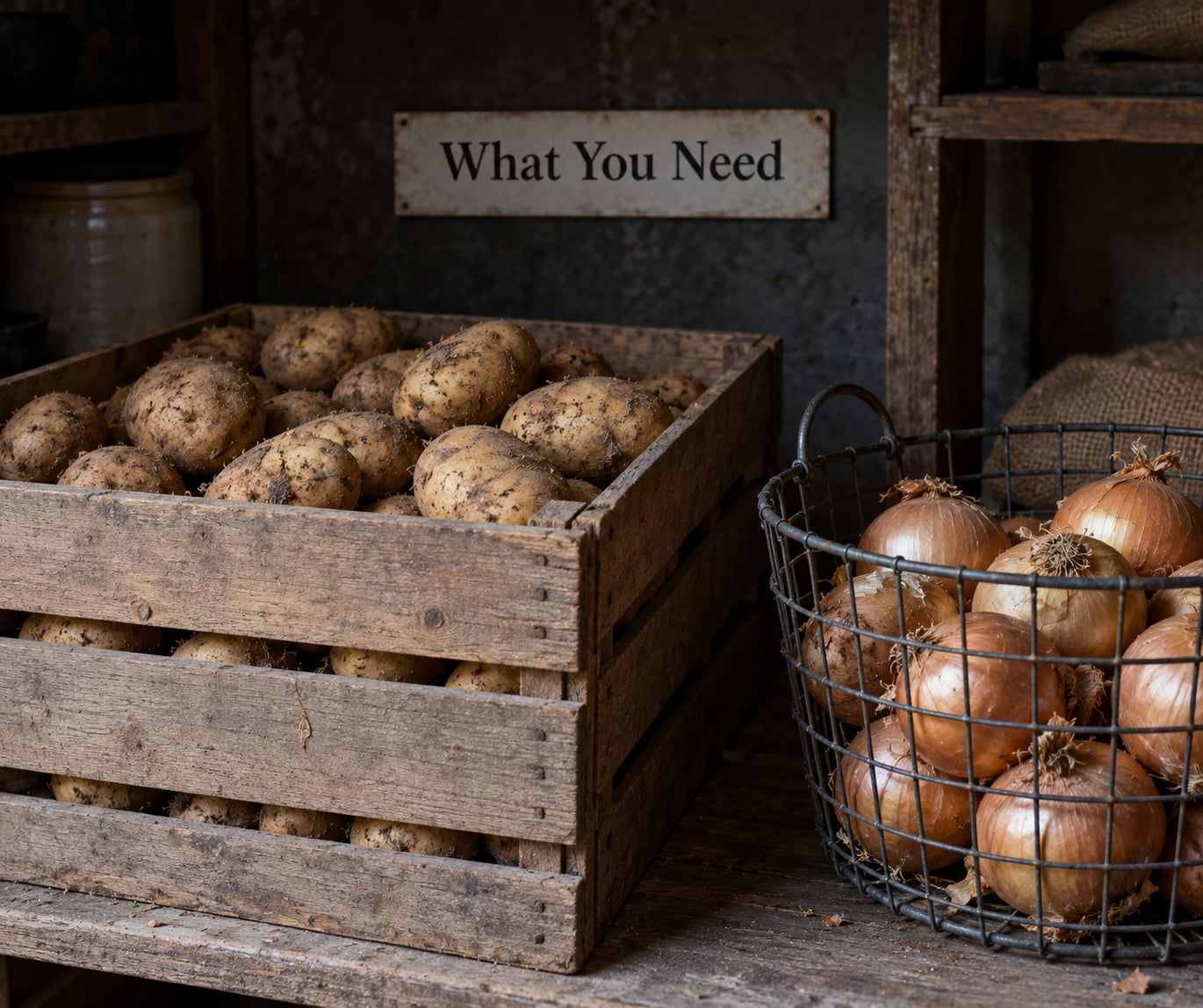
None of this costs much and most of it you probably own already. The list is short because good storage is mostly about location and airflow, not equipment.
For the potatoes
- A cool, dark, dry spot. A basement, garage, root cellar or the back of a lower pantry closet. If you have a thermometer, aim for 45-50°F, and stay under about 60°F.
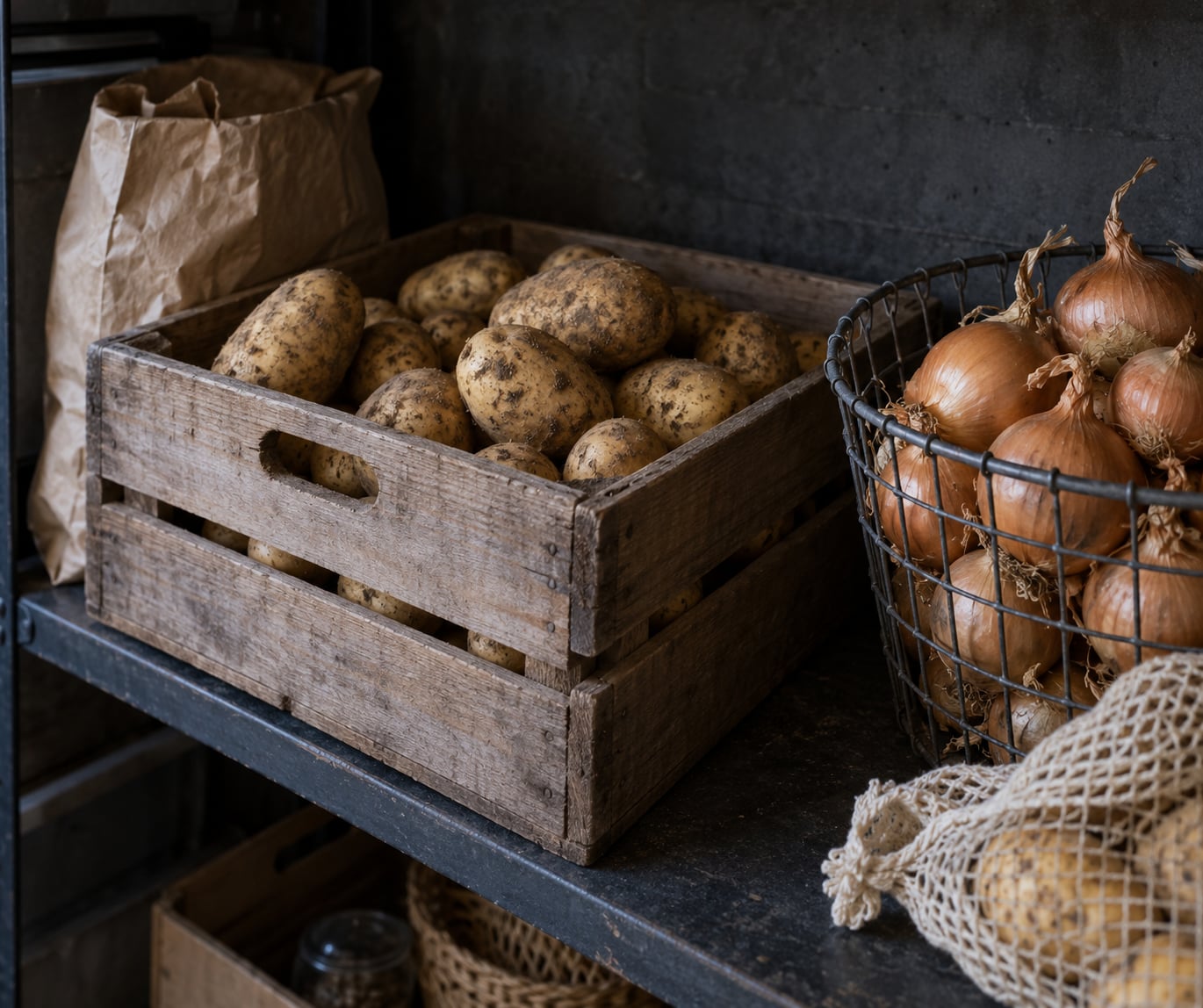
- A breathable container. A ventilated wooden crate, cardboard box with holes, wire basket, or a wicker basket. A cardboard box that held a delivery works well if you poke a few holes in the sides.
- A paper bag or mesh produce bag if you only have a few potatoes. Paper breathes, plastic does not.
- A dim bulb or flashlight for the weekly check, so you can look without letting light sit on the pile.
For the onions
- A dry, ventilated shelf. Out of direct sun, not above the stove, not next to the dishwasher.
- A wire basket, mesh bag, wooden crate or open bowl. Anything with holes. Ventilated terracotta canisters and wicker baskets get plenty of praise from home cooks and gardeners because the clay or weave pulls moisture out instead of trapping it.
- A mesh produce bag for a few onions. Paper bags work too, as long as they are open at the top.
- A hook or beam if you want the old method. An onion braid or a suspended mesh bag keeps airflow all the way around.
For the prep, if you harvested or bought them dirty
- A wire cooling rack or screen for curing, plus a shaded, airy spot.
- A soft brush or dry cloth to knock soil off.
- A cool, dark room or shed where you can leave a layer of onions for about a week without thinking about it.
Step-by-Step: How to Store Potatoes and Onions Correctly
1. Choose separate storage locations
Give each vegetable its own spot before you move anything. Potatoes belong in the coolest, darkest, most humid corner you have, ideally 45-50°F. Onions belong somewhere dry and ventilated at 45-55°F, which is the range the National Onion Association gives for dry storage.
The two crops want opposite things. Potatoes keep better with a little surrounding moisture so they do not shrivel, and onions rot quickly in humid air. That single difference explains most of the rest.
What happens if you put them in the same container? Both are living. They keep respirating long after harvest, and respiration releases water vapour. Stacked together, that moisture has nowhere to go. Potatoes sitting in damp air pick up skin blight and soft rot, and onions in the same space lose their dryness and go soft or mouldy from the neck inward. You get two half-spoiled piles instead of two good ones.
You will see the same claim repeated online, that onions give off ethylene gas that spoils potatoes. Onions do release small amounts of plant gases, but ethylene is not the culprit people think it is, and plenty of home cooks who ignore the rule report fine results. The real driver is moisture and trapped humidity. You can test this in your own kitchen: put one onion next to a potato in a sealed container and a potato alone in a similar container, and watch which one softens first.
If you grow onions and like to keep them and potatoes in one pantry, you will see advice online suggesting you stack the onion basket on top of the potato basket. That works better than a shared shelf because air still moves, but it is a compromise. If you have the space, one shelf apart is the clean answer.
2. Prepare the potatoes before storage
Sort the pile first. Pull out anything cut, bruised, soft, or already showing white or green patches. Those pieces rot and take healthy neighbours with them, so do not store them alongside the keepers.
Do not wash the potatoes. You might want to rinse soil off for cooking, but that is a rinse under the tap and then dry thoroughly, not a soak. Any water left on the skin sits in the creases and turns into rot. Brush off dry soil and call it clean.
If you grew them or bought them with dirt and thick skins, curing helps. Spread them in a single layer on a wire rack in a shaded, dry, breezy spot for about a week to ten days. The skins toughen and small cuts seal. Skip this for thin-skinned supermarket potatoes that already look dry; they do not need it.
3. Store potatoes away from light and moisture
Now set up the storage spot. Keep it between 45 and 50°F if you can measure, and below about 60°F in any case. Warm storage is what turns starch back into sugar and speeds rot. Household humidity around 85-90% is the range commercial potato storage aims for, which in a home kitchen means the coolest cupboard rather than the dry one next to the oven.
Arrange the potatoes loosely, in a single layer where you can, or no more than two deep. Contact bruising is another way soft spots start, and a deep pile crushes the ones at the bottom. Cardboard boxes are good for this reason as well as for breathability.
Keep them away from the light. Any light source, including a bare bulb left on, pushes chlorophyll into the skin and makes the potato bitter. Green patches mean solanine, and that is covered in step 5.
Keep them away from ethylene-producing fruit as well. Apples, bananas, pears and avocados release enough ethylene to speed up sprouting in a closed cupboard. Out in the open on a pantry shelf the effect is small, but there is no reason to park a bowl of apples next to the potato box.
You will know the storage is working when the potatoes stay firm and their skins stay dry and papery after a few weeks, and nothing in the box smells sour or sweet.
4. Prepare and store onions properly
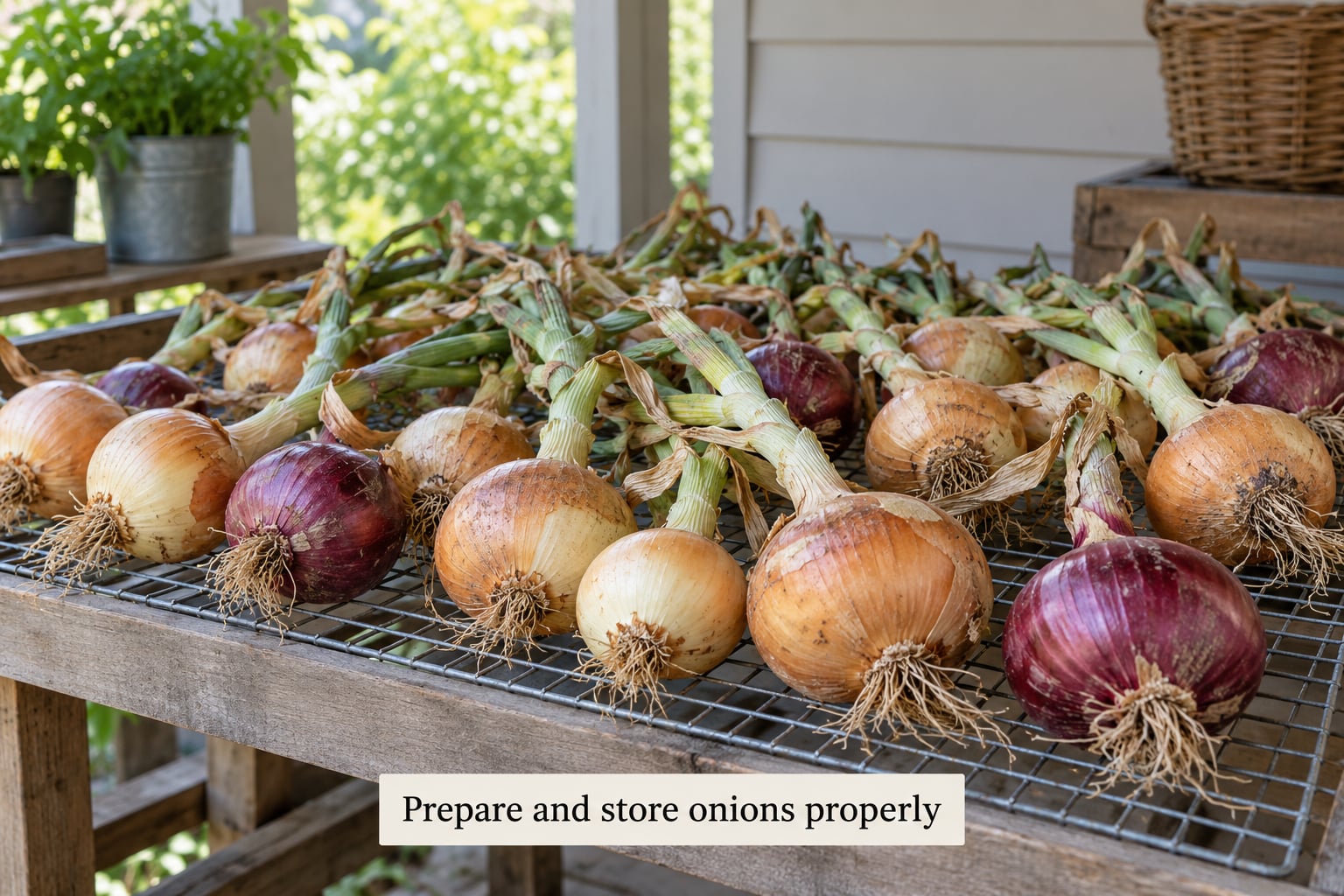
Onions are stored in one of two states: cured or not. If yours have dried, papery necks and no loose skin flaking, they are already cured and you can move straight to storage. If the necks are still green and thick, or you lifted them from soil this week, cure them first.
Spread the onions in a single layer on a wire rack or screen, or tie them in small bunches and hang them. Choose somewhere shaded, dry and breezy, not a humid shed. Two weeks is a typical window, and the neck should feel completely dry and papery with no green left. Roots should be dry and brittle too. Be patient here; onions stored before the neck closes are the ones that rot in January.
Store cured onions loose in a mesh bag, a wire basket, a wooden crate or an open basket on a dry shelf. Not in plastic, and not in a sealed container. Air has to move around each bulb so moisture can leave. The National Onion Association is blunt about this in their storage guidance: no wrapping onions in plastic and no plastic bags.
Sunlight is the enemy here too. Direct light turns onions soft and sometimes triggers sprouting, which is why a closed pantry beats a windowsill.
Good onion storage is working when the outer skins feel papery, the bulbs still have weight, and a cut bulb shows firm white or yellow flesh with no browning at the centre.
5. Check both vegetables regularly
Do a weekly walk-by with a dim light. Once a month, actually move things around and feel each one.
For potatoes, throw out anything soft, leaking, badly sprouted, or green. Firm potatoes with short white sprouts are fine to eat; trim the sprouts and use them quickly. Green skin is different, and that is a safety question rather than a quality one. Green means solanine, and the concentration rises sharply as more of the potato turns green, especially near the sprouts and the eyes. Small green patches on a large potato can be cut away generously; a potato that is green and bitter-tasting throughout, or one that shrivelled into a leathery lump, is not worth the gamble. When in doubt, discard it.
For onions, remove anything soft, mushy or showing grey or black mould at the neck. An onion that has lost weight and gone papery thin all over is still usable if it smells clean and the inside is firm; peel two layers back to check. Any sour or musty smell means mould has moved inside, and that one goes out.
Move survivors away from the suspect pieces rather than back into the same spot, and if you lost half a box, check whether the temperature or the container is the cause. That is usually the real diagnosis.
How far apart do they need to be?
This is the question nobody answers well, and it is the one people actually have. For a small kitchen, here is how I would rank it.
- Different shelf in the same closet. Best compromise. Full separation of conditions, minimal space used.
- Different cupboards in one room. Better still, if the onion cupboard has any airflow at all.
- Different rooms. Ideal, and easy in most flats: onions in a bedroom wardrobe or hallway cupboard, potatoes in the kitchen.
- One above the other, not touching. Acceptable. Several people do this with stacked baskets and get months out of both, because air still moves around each basket.
- The same closed container. No. This is where moisture accumulates and both crops lose.
If you truly have one shelf, put the onions in an open basket and the potatoes in a vented crate with an inch or two of space between them, and skip the plastic entirely. That is a workable small-kitchen answer, not the ideal one.
Common Mistakes
Storing both in the same plastic bag. This is the single most common failure and the fastest route to mush. Plastic does not breathe, so every bit of water vapour the vegetables release collects in the bag. In warm kitchens the bag goes foggy within days. Move everything to paper, mesh, wicker or cardboard, and wash the plastic bag out before you use it for something else.
Rinsing potatoes before they go in the cupboard. Washing is fine if you dry them properly. Soaking, or storing them wet, is not. Residual moisture trapped against the skin starts soft rot in about a week. Dry them fully on a towel before they go anywhere.
Using the refrigerator for whole onions. Whole onions keep well in the fridge, which sounds like a good thing, but chilling breaks down the sugars that give onions their flavour and brings on moisture damage faster. Store whole onions cool and dry, not cold. Cut onions are the opposite case and belong in the fridge, sealed airtight.
Leaving the cupboard light. A bare bulb, a glass pantry door, a gap under a window. Potatoes will green and onions will soften. If you check the potatoes with the light on, turn it off and close the door again.
Piling everything deep into one big bin. A five-kilo box at the bottom of the pile gets crushed and bruised, and bruises turn into soft spots that spread. Fill shallow boxes, keep layers to one or two deep, and check the ones at the bottom first.
Storing onions and potatoes next to the stove or the dishwasher. Both spots run warm and humid at some point. A cupboard across the room beats the most convenient shelf in the kitchen.
Storing home-harvested onions without curing. Thick green necks and damp roots are how rot starts. Two weeks on a rack in the breeze prevents most of it.
Ignoring soft spots instead of removing them. One leaking potato will wet its neighbours and the whole box can follow within a week. Take two minutes a week to feel for softness. A weekly check is the whole maintenance routine for this task.
Throwing away soft potatoes too early. Wrinkled but firm potatoes are dehydrated, not rotten. Spread them in a single layer somewhere dry for a day or two and they firm up again. Sprouted onions with firm flesh underneath peel fine and cook as normal. Rescue before you discard.
Frequently Asked Questions
Should potatoes and onions be stored together?
No. Potatoes and onions should be stored separately, in their own containers, at their own temperatures. Potatoes need cool, dark, slightly humid air and onions need cool, dry, ventilated air. Stacked together they release moisture that has nowhere to go, which causes skin blight and soft rot on potatoes and mould at the neck of onions. Different shelves in the same cupboard works fine for most kitchens.
How long can potatoes and onions be stored at room temperature?
In good conditions, around 45-50F for potatoes and 45-55F for onions, potatoes keep for several months and onions for roughly six months. Warm kitchens cut both short, sometimes to a few weeks. Only cured bulbs kept fully dry and ventilated last that long, so buy in smaller quantities more often than you plan to store large bulk amounts in a warm flat.
Can potatoes be stored in the refrigerator?
You can, and it will not make them toxic, but cold makes them sweeter and turns the starch into sugar faster, so the texture suffers after a week or two. It is better for a few leftover potatoes than for your main supply. Keep the storage supply in a cool dark place at 45-50F instead, and refrigerate only what you plan to eat soon. Do not store cut potatoes in the fridge, refrigerate them in water and use them within a day.
Why are my stored potatoes turning green or sprouting?
Green skin means the potato was exposed to light, and chlorophyll plus rising solanine develop at the same time. Sprouting means it is too warm, too old, or both, since light also encourages it. Move the potatoes to a darker, cooler spot around 45-50F and take the green ones out. Small green patches on an otherwise firm potato can be cut away generously, but discard anything green and bitter throughout.
Should onions be kept in a plastic bag?
No, not for whole storage onions. Plastic does not breathe, so the water vapour the onions release condenses inside the bag, softens the skins and starts rot at the neck. Use a mesh produce bag, a wire basket, a cardboard box with holes, or an open basket on a dry shelf. Cut onions are the exception: seal them airtight and refrigerate them, and use them within a week.
How should cut potatoes and onions be stored?
Cut onions must go in the refrigerator in an airtight container or sealed bag, and they keep about a week. Cut potatoes go in the fridge covered in water, changed daily, and should be used within a day. Cutting breaks the skin that protects both vegetables, so the rules that keep whole produce safe in a pantry no longer apply once you have made a cut.
Start with the split. Find the coolest dark spot in your home for the potatoes, find a separate dry shelf for the onions, and pull anything out of plastic before it goes back in. Ten minutes of rearranging buys you months of shelf life, and a weekly two-minute check keeps it that way.